United Arab Emirates (UAE) Bathroom Linen Market Size, Share & Growth Rate
The United Arab Emirates (UAE) Bathroom Linen Market was estimated at USD 308 Million in 2025 and is projected to reach USD 431 Million by 2032, growing at a CAGR of 4.9% from 2026 to 2032. This positive trajectory is primarily fueled by the continuous expansion of the hospitality and tourism sector, which significantly elevates demand for premium bathroom linens. Additionally, an upsurge in residential construction and rising disposable incomes are propelling consumer preference towards luxury bathroom textiles, enhancing the market landscape.
United Arab Emirates (UAE) Bathroom Linen Market Year-wise Growth Rate and Key Drivers
This graph highlights how the United Arab Emirates (UAE) Bathroom Linen Market has steadily grown over the years, supported by major growth factors.
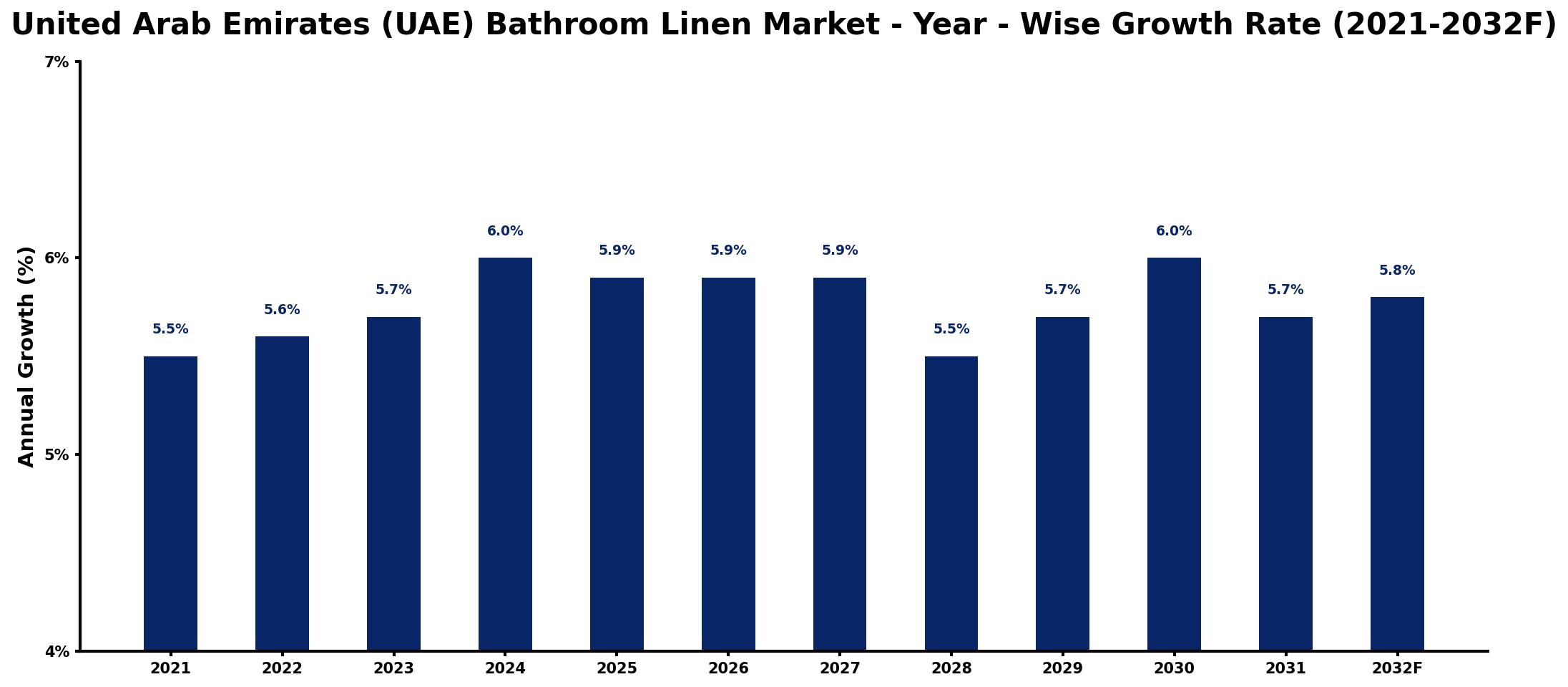
The table below presents the year‑wise growth rates along with the key drivers influencing the market
| Year | Growth Rate | Major Drivers |
| 2021 | 5.5% | Rising consumer spending trends |
| 2022 | 5.6% | Increased focus on home aesthetics |
| 2023 | 5.7% | Growing influence of hospitality sector |
| 2024 | 6.0% | Expansion of luxury retail spaces |
| 2025 | 5.9% | Surge in online shopping popularity |
| 2026 | 5.9% | Growing interest in sustainability practices |
| 2027 | 5.9% | Increased tourism boosting demand |
| 2028 | 5.5% | Emerging health wellness trends |
| 2029 | 5.7% | Rising number of residential projects |
| 2030 | 6.0% | Increased disposable income levels |
| 2031 | 5.7% | Growing preference for premium products |
| 2032 | 5.8% | Development of innovative designs |
Note: Market size estimations and growth projections presented in this report are based on 6Wresearch's proprietary forecasting methodology, utilizing the latest available industry data, government publications, and primary research inputs.
United Arab Emirates (UAE) Bathroom Linen Market Synopsis
The most influential force currently shaping the UAE bathroom linen market is the booming hospitality sector, characterized by a high influx of international tourists and the proliferation of luxury accommodations. This sector's focus on providing an exquisite guest experience inherently drives demand for high-quality towels, bathrobes, and other bathroom textiles.
As the region embraces a lifestyle centered around luxury living, there is a notable surge in the demand for upscale bathroom linens in residential properties. This trend is complemented by the discerning consumer base, which increasingly prioritizes both functionality and aesthetics, thus elevating the market's competitive dynamics.
United Arab Emirates (UAE) Bathroom Linen Market Key Takeaways
- The UAE bathroom linen market is set for robust growth driven by the hospitality industry's expansion.
- Increasing disposable income levels are leading to higher consumer spending on premium bathroom textiles.
- The surge in high-end residential construction is further stimulating demand for luxury bathroom linen products.
- Consumer preferences are shifting toward sustainable and eco-friendly bathroom textiles.
- The market is characterized by fierce competition among local and international players, enhancing product innovation.
Evaluation of Restraints in United Arab Emirates (UAE) Bathroom Linen Market
The UAE bathroom linen market is not without its challenges, primarily stemming from fluctuating consumer demand influenced by seasonal travel patterns and economic shifts. Additionally, the intense competition landscape often leads to price wars, which can restrict profit margins for manufacturers. The necessity for constant innovation to stand out in this crowded market remains a critical area of focus for businesses looking to sustain their market share.
United Arab Emirates (UAE) Bathroom Linen Market Trends
Current trends within the UAE bathroom linen market highlight a growing consumer shift towards sustainable materials. This trend is being driven by heightened awareness of environmental issues, prompting brands to explore eco-friendly fabric options. Furthermore, smart textiles, which integrate technology into bathroom linens for enhanced user experience, are emerging as a prominent trend, blending comfort with innovation.
United Arab Emirates (UAE) Bathroom Linen Market Opportunities
There lies a significant growth opportunity in the development of niche markets, such as luxury eco-friendly bathroom linens and customized products for high-end clients. As sustainability becomes a paramount consumer concern, investing in organic and recycled materials can position brands favorably. Additionally, tapping into the burgeoning e-commerce segment presents avenues for reaching broader audiences and enhancing sales channels.
Government Initiatives in the United Arab Emirates (UAE) Bathroom Linen Market
The UAE government has been actively promoting the hospitality and tourism sectors through various initiatives, including public spending on infrastructure development and incentives aimed at attracting foreign investments. These efforts aim to position the UAE as a global tourism hub, indirectly benefiting the bathroom linen market as demand grows for high-quality linens in hospitality venues. Furthermore, regulations promoting sustainable practices are likely to foster innovation in eco-friendly bathroom textiles.
Future Insights of the United Arab Emirates (UAE) Bathroom Linen Market
Looking ahead to 2026-2032, the UAE bathroom linen market is expected to continue its upward trajectory. The continued investment in luxury tourism and hospitality infrastructure will drive sustained demand for high-quality bathroom linens. Additionally, as the local consumer base becomes increasingly discerning, brands that prioritize quality, sustainability, and innovative designs are likely to thrive, solidifying their foothold in this competitive landscape.
United Arab Emirates (UAE) Bathroom Linen Market Latest Developments (2025 - 2026)
In recent months, the UAE bathroom linen market has witnessed a surge in collaborations between manufacturers and technology firms aimed at developing smart textiles for the hospitality sector. Innovations have focused on enhancing user comfort through temperature regulation and moisture-wicking properties. Furthermore, several companies are launching new eco-friendly product lines to cater to the increasing demand for sustainable options among environmentally conscious consumers.
United Arab Emirates (UAE) Bathroom Linen Market - Key Attractiveness of the Report
- 10 Years of Market Numbers
- Historical Data Starting from 2022 to 2025
- Base Year: 2025
- Forecast Data until 2032
- Key Performance Indicators Impacting the Market
- Major Upcoming Developments and Projects
Key Highlights of the Report:
- United Arab Emirates (UAE) Bathroom Linen Market Outlook
- Market Size of United Arab Emirates (UAE) Bathroom Linen Market, 2025
- Forecast of United Arab Emirates (UAE) Bathroom Linen Market, 2032
- Historical Data and Forecast of United Arab Emirates (UAE) Bathroom Linen Revenues & Volume for the Period 2022-2032F
- United Arab Emirates (UAE) Bathroom Linen Market Trend Evolution
- United Arab Emirates (UAE) Bathroom Linen Market Drivers and Challenges
- United Arab Emirates (UAE) Bathroom Linen Price Trends
- United Arab Emirates (UAE) Bathroom Linen Porter's Five Forces
- United Arab Emirates (UAE) Bathroom Linen Industry Life Cycle
- Historical Data and Forecast of United Arab Emirates (UAE) Bathroom Linen Market Revenues & Volume By Product for the Period 2022-2032F
- Historical Data and Forecast of United Arab Emirates (UAE) Bathroom Linen Market Revenues & Volume By Bath Towels for the Period 2022-2032F
- Historical Data and Forecast of United Arab Emirates (UAE) Bathroom Linen Market Revenues & Volume By Bathrobes for the Period 2022-2032F
- Historical Data and Forecast of United Arab Emirates (UAE) Bathroom Linen Market Revenues & Volume By Others for the Period 2022-2032F
- United Arab Emirates (UAE) Bathroom Linen Import Export Trade Statistics
- Market Opportunity Assessment By Product
- United Arab Emirates (UAE) Bathroom Linen Top Companies Market Share
- United Arab Emirates (UAE) Bathroom Linen Competitive Benchmarking By Technical and Operational Parameters
- United Arab Emirates (UAE) Bathroom Linen Company Profiles
- United Arab Emirates (UAE) Bathroom Linen Key Strategic Recommendations






































