United Arab Emirates (UAE) Chain Drivers Market Size, Share & Growth Rate
The United Arab Emirates (UAE) Chain Drivers Market was estimated at USD 823 Million in 2025 and is projected to reach USD 1442 Million by 2032, growing at a CAGR of 8.3% from 2026 to 2032. This growth trajectory is primarily fueled by the booming industrial and manufacturing sectors, which are increasingly adopting chain drivers for enhanced efficiency in power transmission. Furthermore, the ongoing construction projects across the UAE create a robust demand for these critical components in machinery and heavy equipment.
United Arab Emirates (UAE) Chain Drivers Market Year-wise Growth Rate and Key Drivers
This graph highlights how the United Arab Emirates (UAE) Chain Drivers Market has steadily grown over the years, supported by major growth factors.
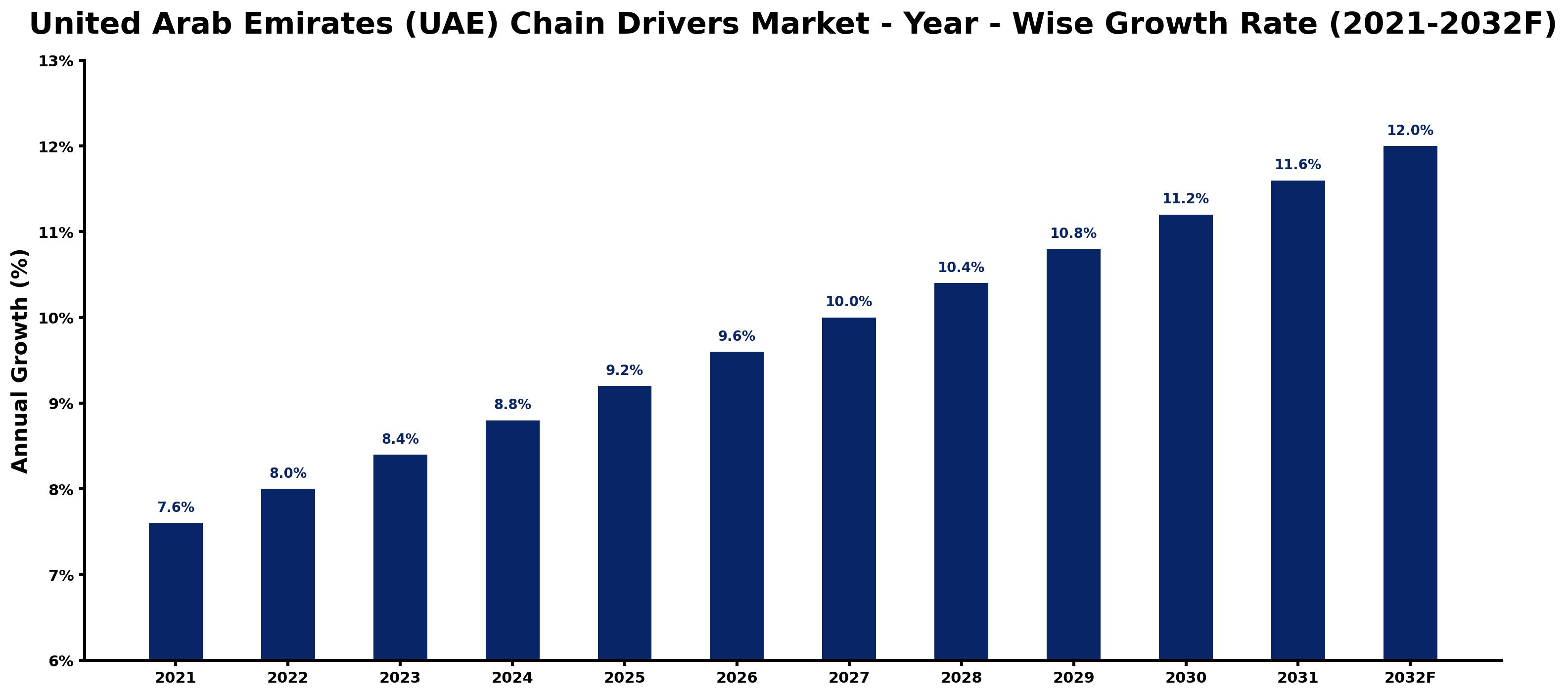
The table below presents the year‑wise growth rates along with the key drivers influencing the market
| Year | Growth Rate | Major Drivers |
| 2021 | 7.6% | Rising electricity demand across industries |
| 2022 | 8.0% | Increasing smart city development projects |
| 2023 | 8.4% | Rapid growth in telecom and data center sectors |
| 2024 | 8.8% | Government infrastructure modernization initiatives |
| 2025 | 9.2% | Rising electricity demand across industries |
| 2026 | 9.6% | Increasing adoption of advanced technologies |
| 2027 | 10.0% | Government infrastructure modernization initiatives |
| 2028 | 10.4% | Growing renewable energy integration projects |
| 2029 | 10.8% | Rapid growth in telecom and data center sectors |
| 2030 | 11.2% | Expansion of manufacturing activities |
| 2031 | 11.6% | Growing renewable energy integration projects |
| 2032 | 12.0% | Growing renewable energy integration projects |
Note - Market size estimations and growth projections presented in this report are based on 6Wresearch's advanced forecasting approach, validated with industry datasets as of June 2026.
United Arab Emirates (UAE) Chain Drivers Market Synopsis
The UAE chain drivers market is characterized by its dynamic growth, underpinned by the nation's strategic investments in infrastructure and industrial advancements. With manufacturing and construction at the forefront, chain drivers have become essential in facilitating seamless operations across various sectors.
Recent trends indicate a shift towards higher quality standards, as industries increasingly prioritize durability and reliability in their power transmission solutions. This emphasis not only enhances operational efficiency but also ensures a longer lifespan for critical machinery, further propelling the market's expansion.
United Arab Emirates (UAE) Chain Drivers Market Key Takeaways
- The UAE chain drivers market is experiencing robust growth driven by the industrial and construction sectors.
- There is a strong demand for high-quality and durable chain drivers, particularly in machinery applications.
- The market is influenced by both local manufacturing and competitive imports from established international players.
- The Covid-19 pandemic initially disrupted the market but has led to renewed focus on reliable supply chains.
- Leading companies are actively innovating to meet the diverse needs of various industries.
Evaluation of Restraints in United Arab Emirates (UAE) Chain Drivers Market
While the UAE chain drivers market is poised for growth, it faces some key restraints that could hinder its momentum. The competition from imported chain drivers remains a significant challenge, especially from countries with well-established manufacturing capabilities. Domestic manufacturers must focus on enhancing the quality and reliability of their offerings to effectively compete in this landscape. Additionally, fluctuations in the prices of essential raw materials, such as steel, can create cost pressures that impact production profitability, necessitating strategic management in sourcing and manufacturing.
United Arab Emirates (UAE) Chain Drivers Market Trends
The current trends in the UAE chain drivers market reflect a growing preference for advanced engineering solutions that enhance performance and longevity. Automation and smart technologies are increasingly integrated into machinery, which is influencing the design and functionality of chain drivers. Additionally, a shift towards sustainable practices is prompting manufacturers to consider eco-friendly materials and production processes, aligning with global trends towards sustainability in manufacturing.
United Arab Emirates (UAE) Chain Drivers Market Opportunities
The UAE chain drivers market offers significant growth and investment opportunities, particularly in emerging industries such as renewable energy and high-tech manufacturing. As the nation diversifies its economy, there is potential for innovative applications of chain drivers in new sectors. Moreover, increased public and private sector collaboration on infrastructure projects can further expand the market, providing local manufacturers with ample opportunities to showcase their products in high-visibility projects.
Government Initiatives in the United Arab Emirates (UAE) Chain Drivers Market
The UAE government has implemented several initiatives aimed at boosting the industrial sector, including the chain drivers market. Public spending on infrastructure projects is a significant driver, fostering an environment conducive to business growth. Additionally, policies aimed at enhancing local manufacturing capabilities and incentivizing research and development are positively influencing the market. These government programs provide a framework for industry stakeholders to collaborate and innovate, ultimately benefiting the market.
Future Insights of the United Arab Emirates (UAE) Chain Drivers Market
Looking ahead to the period from 2026 to 2032, the UAE chain drivers market is expected to continue its upward trajectory, driven by persistent industrial growth and an expanding construction sector. The integration of cutting-edge technologies and a focus on high-quality, durable products will become increasingly important as industries evolve. Local manufacturers that can adapt to these trends while maintaining competitive pricing will likely find themselves in advantageous positions as the market matures.
United Arab Emirates (UAE) Chain Drivers Market Latest Developments (May 2025 - June 2026)
Recent developments in the UAE chain drivers market indicate a concerted effort towards enhancing product offerings and technology integration. Companies are increasingly collaborating with technology partners to innovate and improve the efficiency of chain drivers. Moreover, as infrastructure projects ramp up following the pandemic, there has been a surge in demand for robust power transmission solutions across various applications, ensuring a positive outlook for the market.
United Arab Emirates (UAE) Chain Drivers Market - Key Attractiveness of the Report
- 10 Years of Market Numbers
- Historical Data Starting from 2022 to 2025
- Base Year: 2025
- Forecast Data until 2032
- Key Performance Indicators Impacting the Market
- Major Upcoming Developments and Projects
Key Highlights of the Report:
- United Arab Emirates (UAE) Chain Drivers Market Outlook
- Market Size of United Arab Emirates (UAE) Chain Drivers Market, 2025
- Forecast of United Arab Emirates (UAE) Chain Drivers Market, 2032
- Historical Data and Forecast of United Arab Emirates (UAE) Chain Drivers Revenues & Volume for the Period 2022-2032F
- United Arab Emirates (UAE) Chain Drivers Market Trend Evolution
- United Arab Emirates (UAE) Chain Drivers Market Drivers and Challenges
- United Arab Emirates (UAE) Chain Drivers Price Trends
- United Arab Emirates (UAE) Chain Drivers Porter's Five Forces
- United Arab Emirates (UAE) Chain Drivers Industry Life Cycle
- Historical Data and Forecast of United Arab Emirates (UAE) Chain Drivers Market Revenues & Volume By Product Type for the Period 2022-2032F
- Historical Data and Forecast of United Arab Emirates (UAE) Chain Drivers Market Revenues & Volume By Roller Chains for the Period 2022-2032F
- Historical Data and Forecast of United Arab Emirates (UAE) Chain Drivers Market Revenues & Volume By Silent Chains for the Period 2022-2032F
- Historical Data and Forecast of United Arab Emirates (UAE) Chain Drivers Market Revenues & Volume By Leaf Chains for the Period 2022-2032F
- Historical Data and Forecast of United Arab Emirates (UAE) Chain Drivers Market Revenues & Volume By Others for the Period 2022-2032F
- Historical Data and Forecast of United Arab Emirates (UAE) Chain Drivers Market Revenues & Volume By Applications for the Period 2022-2032F
- Historical Data and Forecast of United Arab Emirates (UAE) Chain Drivers Market Revenues & Volume By Industrial Sector for the Period 2022-2032F
- Historical Data and Forecast of United Arab Emirates (UAE) Chain Drivers Market Revenues & Volume By Heavy Equipment Industry for the Period 2022-2032F
- Historical Data and Forecast of United Arab Emirates (UAE) Chain Drivers Market Revenues & Volume By Agricultural Equipment Industry for the Period 2022-2032F
- Historical Data and Forecast of United Arab Emirates (UAE) Chain Drivers Market Revenues & Volume By Others for the Period 2022-2032F
- United Arab Emirates (UAE) Chain Drivers Import Export Trade Statistics
- Market Opportunity Assessment By Product Type
- Market Opportunity Assessment By Applications
- United Arab Emirates (UAE) Chain Drivers Top Companies Market Share
- United Arab Emirates (UAE) Chain Drivers Competitive Benchmarking By Technical and Operational Parameters
- United Arab Emirates (UAE) Chain Drivers Company Profiles
- United Arab Emirates (UAE) Chain Drivers Key Strategic Recommendations






































