United Arab Emirates (UAE) Digital Market Size & Growth Rate (2026-2032)
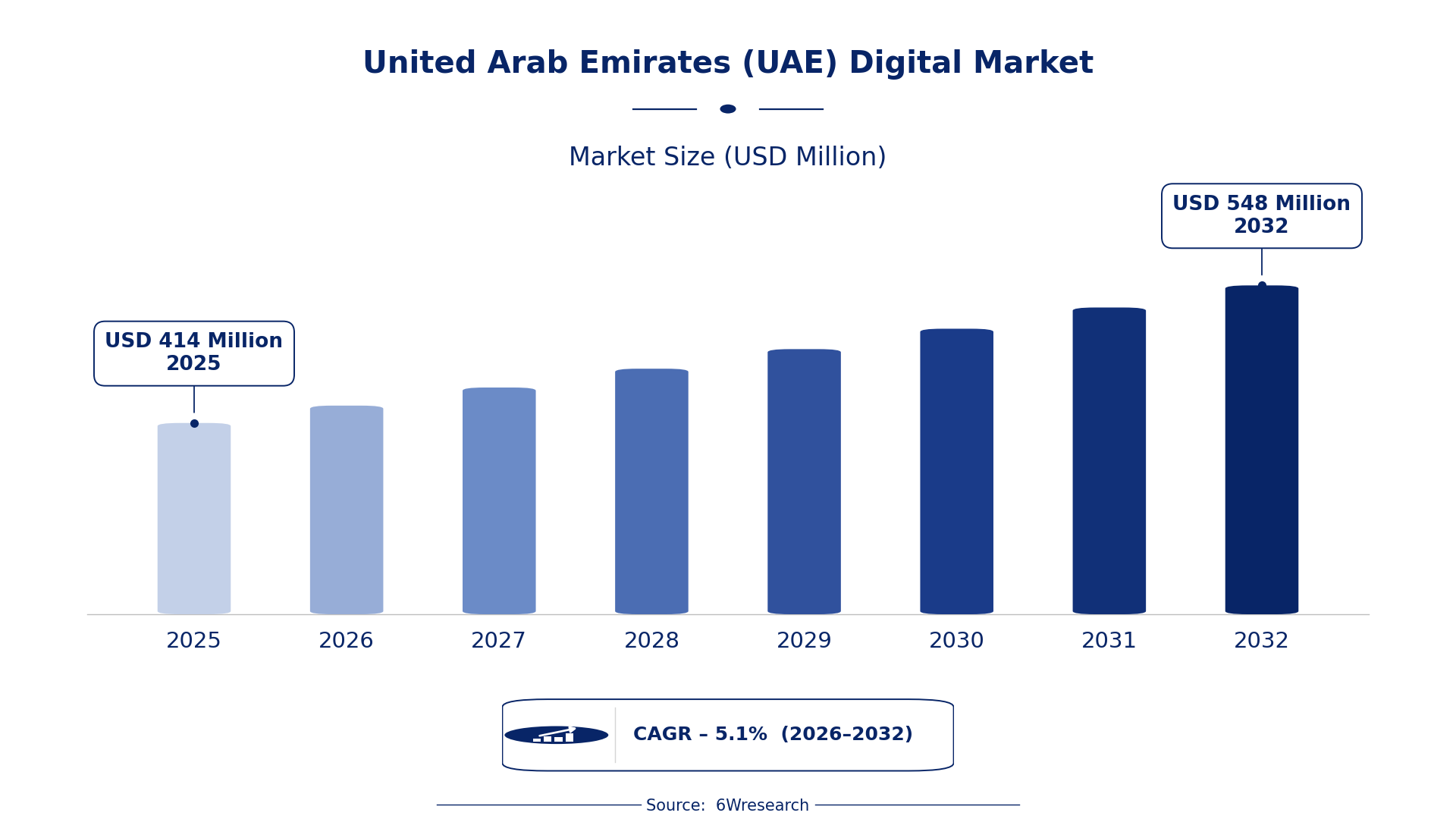
The United Arab Emirates (UAE) Digital Market was estimated at USD 414 Million in 2025 and is projected to reach USD 548 Million by 2032, growing at a CAGR of 5.1% from 2026 to 2032.
United Arab Emirates (UAE) Digital Market Synopsis
The UAE Digital Market has experienced significant momentum in recent years, fueled by government-led initiatives and a growing consumer base that embraces digital solutions. This momentum reflects a broader commitment to technological advancement, yet the market is set for further evolution as businesses adapt to new consumer expectations and technological innovations.
With the rise of e-commerce, digital marketing, and enhanced online services, the UAE is carving out a space as a regional digital hub. The ongoing investment in infrastructure and innovation is not just about catching up; it’s about leading the charge toward a fully integrated digital economy.
United Arab Emirates (UAE) Digital Market Year-wise Growth Rate and Key Drivers
This graph illustrates the annual growth rates of the United Arab Emirates (UAE) Digital Market from 2021 to 2032, highlighting a steady upward trajectory and projected expansion over the forecast period.
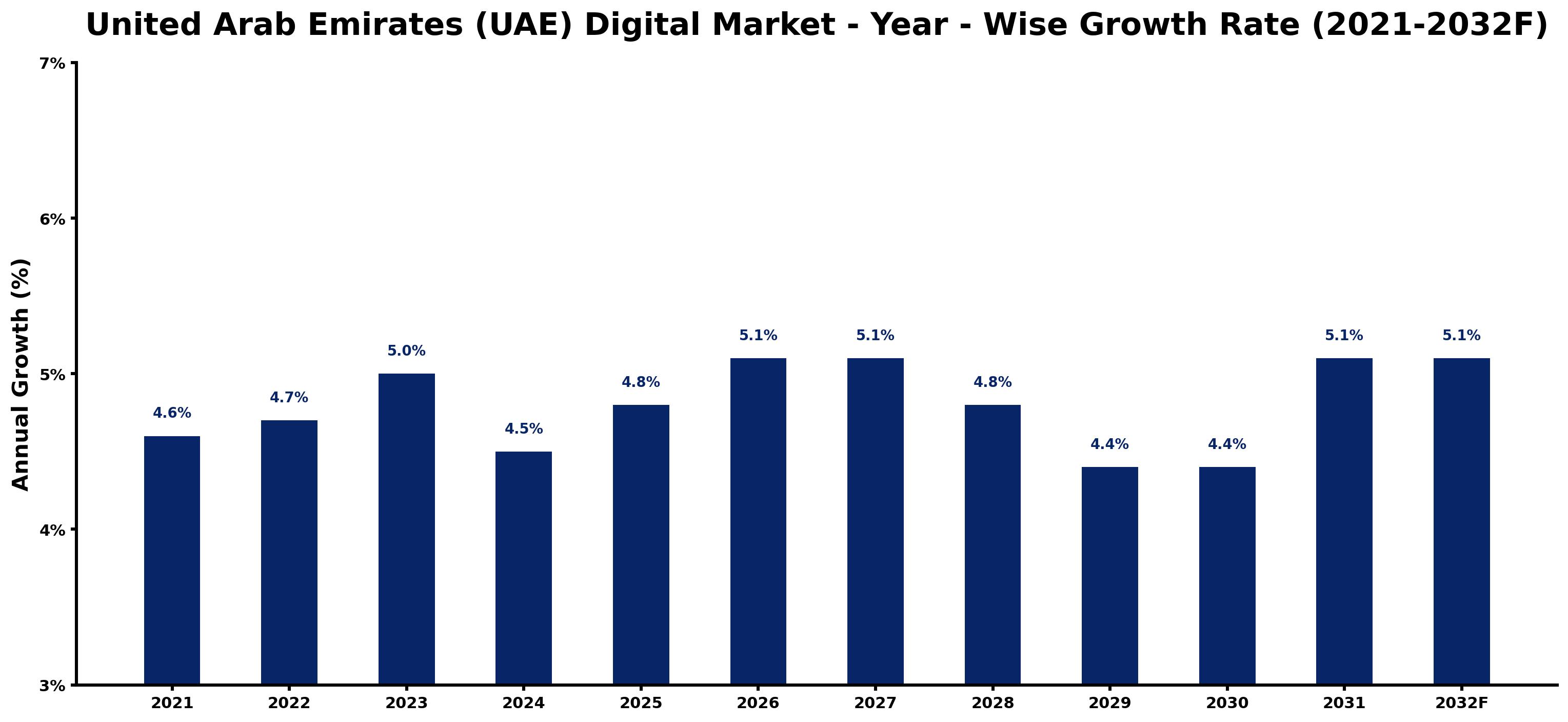
The table below presents the year‑wise growth rates along with the key drivers influencing the market
| Year | Growth Rate | Major Drivers |
| 2021 | 4.6% | UAE Vision 2021 enhancing digital transformation strategies |
| 2022 | 4.7% | Increased smartphone penetration driving online services uptake |
| 2023 | 5.0% | Launch of Emirates Digital Wallet boosting fintech engagement |
| 2024 | 4.5% | 5G rollout accelerating digital service adoption nationwide |
| 2025 | 4.8% | Growing youth demographic embracing e-commerce platforms |
| 2026 | 5.1% | Smart Dubai initiative promoting digital innovation and services |
| 2027 | 5.1% | Government incentives for startups enhancing digital entrepreneurship |
| 2028 | 4.8% | Rise in digital content consumption among expatriate communities |
| 2029 | 4.4% | Increased investment in cybersecurity enhancing digital trust |
| 2030 | 4.4% | Digital payment regulations simplifying transaction processes |
| 2031 | 5.1% | UAE’s focus on AI integration transforming digital solutions |
| 2032 | 5.1% | Sustainable Development Goals fostering eco-friendly digital practices |
Note: Market size estimations and growth projections presented in this report are based on 6Wresearch's proprietary forecasting methodology, utilizing the latest available industry data, government publications, and primary research inputs.
United Arab Emirates (UAE) Digital Market Key Takeaways
Below are some of the specific key takeaways from the market, including:
- The market is set for steady growth, driven by increasing consumer demand for digital services.
- Government initiatives are central to the market's evolution, fostering a conducive environment for digital innovation.
- Emerging technologies like AI and blockchain are gaining traction, reshaping traditional business models.
- Digital literacy remains a priority, essential for maximizing the potential of the digital market.
- Investments in digital infrastructure are expected to accelerate, supporting future growth avenues.
Evaluation of Restraints in United Arab Emirates (UAE) Digital Market
While the UAE Digital Market is thriving, it is not without its hurdles. The rapid pace of technological change often outstrips the ability of businesses to adapt, leading to integration challenges. Many companies struggle with aligning new digital technologies with existing processes, which can hinder operational efficiency and customer satisfaction. on top of that, there are persistent gaps in digital literacy that need to be addressed to ensure that the workforce can fully engage with and capitalize on emerging digital opportunities.
United Arab Emirates (UAE) Digital Market Trends
Several key trends are shaping the UAE Digital Market. A significant shift towards mobile commerce is evident, as consumers increasingly favor shopping via smartphones. Personalization through advanced data analytics is becoming crucial for businesses striving to enhance customer experiences. The integration of AI in customer service is also on the rise, streamlining interactions and boosting engagement. Additionally, sustainability in digital practices is gaining traction, reflecting a broader global consciousness about environmental impact.
United Arab Emirates (UAE) Digital Market Opportunities
The UAE Digital Market presents various growth and investment opportunities, particularly in sectors like e-commerce and online services. As more consumers shift to digital platforms, businesses that provide innovative solutions tailored to this demand stand to benefit significantly. on top of that, sectors like fintech and health tech are ripe for disruption, offering fertile ground for startups and established companies alike. The government's focus on digital transformation creates an encouraging landscape for investments in technology and infrastructure.
Government Initiatives in the United Arab Emirates (UAE) Digital Market
The UAE government has taken a proactive approach to shaping the digital market, prioritizing initiatives that promote digital literacy and infrastructure development. Public policy plays a crucial role in ensuring that the digital economy is not only competitive but also inclusive, aiming to equip citizens and businesses with the necessary tools to thrive in a digital-first world.
- A national digital infrastructure upgrade programme completed in late 2023 aimed at enhancing connectivity across urban and rural areas.
- Current initiatives include a nationwide campaign to improve digital literacy, focusing on equipping the workforce with essential skills for the future.
- A regulatory framework introduced in 2024 mandates transparency in e-commerce practices, benefiting consumers and businesses alike.
- Plans for a public-private partnership expected to launch by 2025 will focus on expanding access to broadband services in underserved regions.
Future Insights of the United Arab Emirates (UAE) Digital Market
Looking ahead to 2026-2032, the UAE Digital Market is set for transformative changes. The increasing integration of AI and machine learning into everyday business practices will revolutionize how companies interact with consumers. Enhanced regulatory frameworks will likely provide a more stable environment for both new and existing digital players. As consumer expectations evolve, businesses that prioritize agility and responsiveness will emerge as leaders in this dynamic landscape.
United Arab Emirates (UAE) Digital Market Latest Developments
In the past year, the UAE Digital Market has witnessed a flurry of activity as companies and government bodies align with the digital transformation vision. The emphasis on technology adoption and digital services has led to innovative projects and initiatives that aim to enhance the overall digital ecosystem.
- A major technology vendor launched an AI-driven customer service platform in Q1 2025, aimed at improving user engagement and support.
- An initiative that began in mid-2025 to integrate blockchain technology into supply chain processes is currently underway, enhancing transparency and efficiency.
- A collaboration between leading regional firms was announced in early 2025, focusing on developing a new e-commerce platform tailored for small and medium enterprises.
- Upcoming in late 2026, a comprehensive digital skills training program is set to be rolled out, targeting youth and job seekers.
United Arab Emirates (UAE) Digital Market - Key Attractiveness of the Report
- 10 Years of Market Numbers
- Historical Data Starting from 2022 to 2025
- Base Year: 2025
- Forecast Data until 2032
- Key Performance Indicators Impacting the Market
- Major Upcoming Developments and Projects
Key Highlights of the Report:
- United Arab Emirates (UAE) Digital Market Outlook
- Market Size of United Arab Emirates (UAE) Digital Market, 2025
- Forecast of United Arab Emirates (UAE) Digital Market, 2032
- Historical Data and Forecast of United Arab Emirates (UAE) Digital Revenues & Volume for the Period 2022-2032F
- United Arab Emirates (UAE) Digital Market Trend Evolution
- United Arab Emirates (UAE) Digital Market Drivers and Challenges
- United Arab Emirates (UAE) Digital Price Trends
- United Arab Emirates (UAE) Digital Porter's Five Forces
- United Arab Emirates (UAE) Digital Industry Life Cycle
- Historical Data and Forecast of United Arab Emirates (UAE) Digital Market Revenues & Volume By Software for the Period 2022-2032F
- Historical Data and Forecast of United Arab Emirates (UAE) Digital Market Revenues & Volume By CRM Software for the Period 2022-2032F
- Historical Data and Forecast of United Arab Emirates (UAE) Digital Market Revenues & Volume By Email Marketing Software for the Period 2022-2032F
- Historical Data and Forecast of United Arab Emirates (UAE) Digital Market Revenues & Volume By Social Media Advertising for the Period 2022-2032F
- United Arab Emirates (UAE) Digital Import Export Trade Statistics
- Market Opportunity Assessment By Software
- United Arab Emirates (UAE) Digital Top Companies Market Share
- United Arab Emirates (UAE) Digital Competitive Benchmarking By Technical and Operational Parameters
- United Arab Emirates (UAE) Digital Company Profiles
- United Arab Emirates (UAE) Digital Key Strategic Recommendations






































