United Arab Emirates (UAE) Electrical and electronics Market Summary
The united arab emirates (uae) electrical and electronics market was estimated at USD 406 Million in 2025 and is projected to reach USD 570 Million by 2032, growing at a CAGR of 6.0% from 2026 to 2032.
United Arab Emirates (UAE) Electrical and electronics Market Year-wise Growth Rate and Key Drivers
This graph highlights how the United Arab Emirates (UAE) Electrical and electronics Market has steadily grown over the past five years, supported by major growth factors.
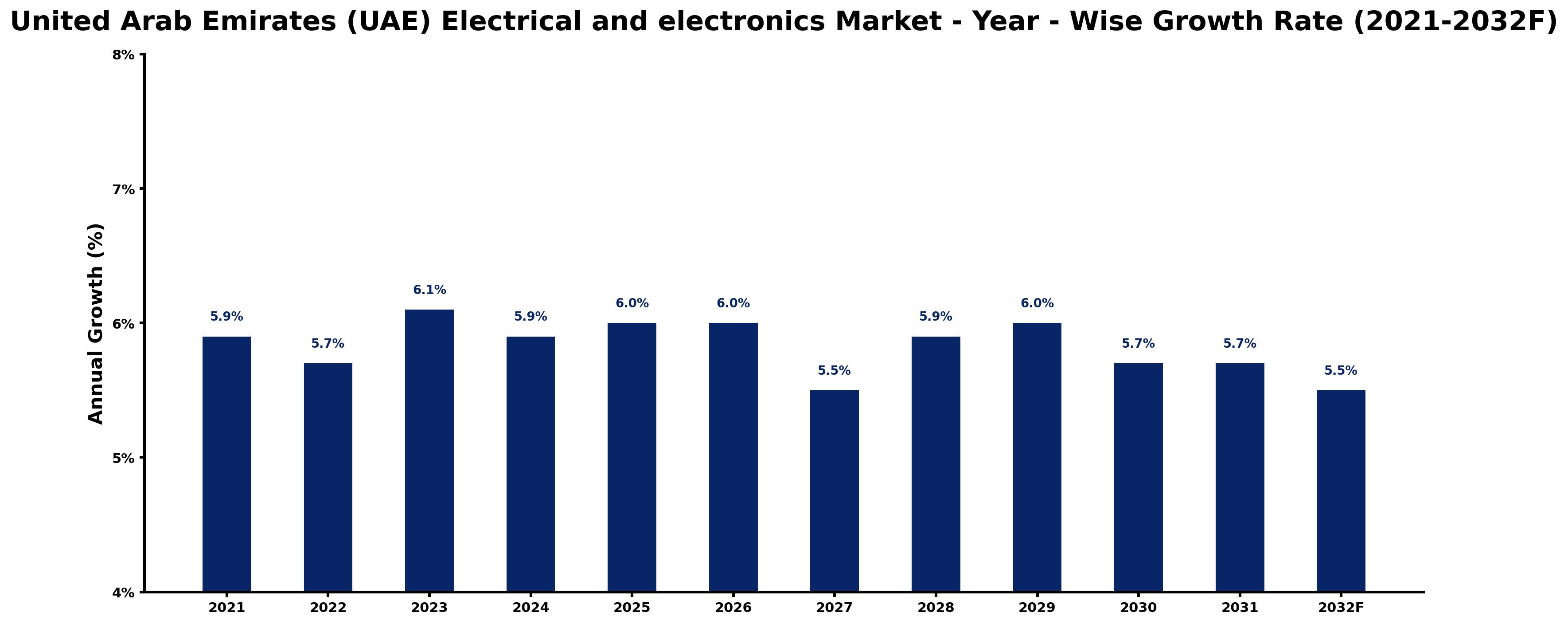
The table below presents the year wise growth rates along with the key drivers influencing the market
| Year | Growth Rate | Major Drivers |
| 2021 | 5.9% | Post-lockdown retail projects catalyze increased investments in smart home electronics. |
| 2022 | 5.7% | Local manufacturers pivot towards high-efficiency solar products amid energy diversification trends. |
| 2023 | 6.1% | Infrastructure developments in Neom create extensive opportunities for electronics supply chains. |
| 2024 | 5.9% | Rising consumer interest in lifestyle tech fuels demand for advanced wearable devices. |
| 2025 | 6.0% | Emerging e-commerce platforms enhance the accessibility of electronics across urban areas. |
| 2026 | 6.0% | Smart city initiatives necessitate robust electronic systems for enhanced urban management. |
| 2027 | 5.5% | Corporate budgets prioritize investments in automation and energy-efficient technologies. |
| 2028 | 5.9% | Regional collaborations aim to establish sustainable production models in electronics manufacturing. |
| 2029 | 6.0% | Hot climate requirements drive innovation in cooling systems for residential electronics. |
| 2030 | 5.7% | Increased expatriate population boosts demand for high-end consumer electronics products. |
| 2031 | 5.7% | Tech-savvy younger demographics influence trends towards personalized electronic solutions. |
| 2032 | 5.5% | Sustainability concerns push manufacturers towards eco-friendly materials and recycling initiatives. |
Note - Market size estimations and growth projections presented in this report are based on 6Wresearch's advanced forecasting approach, validated with industry datasets as of June 2026.
United Arab Emirates (UAE) Electrical and electronics Market Synopsis
The United Arab Emirates (UAE) Electrical and electronics Market is projected to reach 6.0% and witness significant growth during the forecast period (2026-2032). This market comprises a diverse array of products, including consumer electronics, home appliances, electrical components, and industrial equipment. The substantial growth of this market can be linked to various factors that reflect the socioeconomic landscape of the UAE, such as increased disposable income, rapid urbanization, and the government's emphasis on infrastructure development and the establishment of smart cities.
United Arab Emirates (UAE) Electrical and electronics Market Growth Drivers
A principal driver of the UAE electrical and electronics market is the country's robust per capita income, which stands among the highest globally. This affluence fosters demand for high-end consumer electronics, luxury home appliances, and a variety of smart gadgets. Additional drivers include:
- Rapid urbanization is fueling the construction of new residential and commercial properties, thereby increasing the need for electrical components and advanced systems for building automation.
- The UAE government's commitment to transforming urban areas into smart cities, which incorporates advanced technologies, stimulates growth opportunities in the electrical and electronics sector.
- Consumer preference is shifting towards energy-efficient and sustainable products, driving manufacturers to innovate and improve their offerings in response to market demand.
- The rise of e-commerce has also created new channels for consumers to access electrical and electronic products, consequently expanding the market scope.
United Arab Emirates (UAE) Electrical and electronics Market Challenges and Restraints
Despite the favorable growth factors, the UAE electrical and electronics market is not without its challenges. One of the most pressing concerns is competition from well-established international brands. While local manufacturers strive to gain a foothold, they often face hurdles such as:
- The necessity for local products to meet international quality standards, innovation, and after-sales services to compete effectively in a crowded market.
- Fluctuations in raw material prices and currency exchange rates that can directly affect manufacturing costs and pricing strategies.
- Economic uncertainties which can lead to reduced consumer spending and investment in non-essential electronics.
- The risk of market saturation in certain segments, leading to fierce price competition and reduced profit margins.
United Arab Emirates (UAE) Electrical and electronics Market Impact of Covid-19
The Covid-19 pandemic profoundly influenced the UAE electrical and electronics market, leading to shifts in consumer behavior and spending patterns. Initially, economic uncertainties resulted in a decline in demand for non-essential electronics and luxury appliances as consumers prioritized essential goods. However, the subsequent recovery in economic activities has spurred a resurgence in demand. Furthermore, the pandemic accelerated the adoption of digital technologies, remote work solutions, and e-commerce platforms, which have transformed the landscape of consumer electronics demand.
United Arab Emirates (UAE) Electrical and electronics Market Government Investment and Initiatives
The UAE government is actively investing in initiatives that bolster the electrical and electronics market. Strategic planning and investment in infrastructure development have been prioritized to enhance connectivity and efficiency across sectors. Notable initiatives include:
- Investment in smart city projects designed to integrate advanced technology in urban planning, ultimately enhancing the overall quality of life.
- Supportive policies intended to attract foreign direct investment and collaboration with international companies to elevate technological standards in the UAE.
- Grants and incentives focused on research and development in clean energy technologies, further stimulating growth in the electrical sector.
- Programs aimed at fostering local talent and upskilling the workforce in line with the latest technological advancements.
United Arab Emirates (UAE) Electrical and electronics Market Latest Developments (May 2025 - June 2026)
Recent trends in the UAE electrical and electronics market indicate a shift towards enhanced sustainability and smart technology integration. Key developments observed during this timeframe include increased focus on energy-efficient appliances amid rising environmental concerns. The market is also witnessing an uptick in the adoption of IoT (Internet of Things) devices, enabling interconnected systems that improve user experience and efficiency. Furthermore, collaborations between local manufacturers and global technology firms are becoming more prevalent, fostering innovation and competitiveness in product offerings.
United Arab Emirates (UAE) Electrical and electronics Market - Key Attractiveness of the Report
- 10 Years of Market Numbers
- Historical Data Starting from 2022 to 2025
- Base Year: 2025
- Forecast Data until 2032
- Key Performance Indicators Impacting the Market
- Major Upcoming Developments and Projects
Key Highlights of the Report:
- United Arab Emirates (UAE) Electrical and electronics Market Outlook
- Market Size of United Arab Emirates (UAE) Electrical and electronics Market, 2025
- Forecast of United Arab Emirates (UAE) Electrical and electronics Market, 2032
- Historical Data and Forecast of United Arab Emirates (UAE) Electrical and electronics Revenues & Volume for the Period 2022-2032F
- United Arab Emirates (UAE) Electrical and electronics Market Trend Evolution
- United Arab Emirates (UAE) Electrical and electronics Market Drivers and Challenges
- United Arab Emirates (UAE) Electrical and electronics Price Trends
- United Arab Emirates (UAE) Electrical and electronics Porter's Five Forces
- United Arab Emirates (UAE) Electrical and electronics Industry Life Cycle
- Historical Data and Forecast of United Arab Emirates (UAE) Electrical and electronics Market Revenues & Volume By Type for the Period 2022-2032F
- Historical Data and Forecast of United Arab Emirates (UAE) Electrical and electronics Market Revenues & Volume By Electric Motors for the Period 2022-2032F
- Historical Data and Forecast of United Arab Emirates (UAE) Electrical and electronics Market Revenues & Volume By Primary And Storage Batteries for the Period 2022-2032F
- Historical Data and Forecast of United Arab Emirates (UAE) Electrical and electronics Market Revenues & Volume By Generators for the Period 2022-2032F
- Historical Data and Forecast of United Arab Emirates (UAE) Electrical and electronics Market Revenues & Volume By Semiconductors for the Period 2022-2032F
- Historical Data and Forecast of United Arab Emirates (UAE) Electrical and electronics Market Revenues & Volume By Household Appliances for the Period 2022-2032F
- Historical Data and Forecast of United Arab Emirates (UAE) Electrical and electronics Market Revenues & Volume By Applications for the Period 2022-2032F
- Historical Data and Forecast of United Arab Emirates (UAE) Electrical and electronics Market Revenues & Volume By Online for the Period 2022-2032F
- Historical Data and Forecast of United Arab Emirates (UAE) Electrical and electronics Market Revenues & Volume By Offline for the Period 2022-2032F
- United Arab Emirates (UAE) Electrical and electronics Import Export Trade Statistics
- Market Opportunity Assessment By Type
- Market Opportunity Assessment By Applications
- United Arab Emirates (UAE) Electrical and electronics Top Companies Market Share
- United Arab Emirates (UAE) Electrical and electronics Competitive Benchmarking By Technical and Operational Parameters
- United Arab Emirates (UAE) Electrical and electronics Company Profiles
- United Arab Emirates (UAE) Electrical and electronics Key Strategic Recommendations






































