United Arab Emirates (UAE) Emergency Ambulance Vehicle Market Size, Share & Growth Rate
The United Arab Emirates (UAE) Emergency Ambulance Vehicle Market was estimated at USD 156 Million in 2025 and is projected to reach USD 212 Million by 2032, growing at a CAGR of 4.5% from 2026 to 2032. This growth trajectory is primarily fueled by the UAE's unwavering commitment to enhancing its healthcare infrastructure. With an expanding population and heightened expectations for rapid medical response times, the demand for advanced ambulance vehicles is increasingly evident.
United Arab Emirates (UAE) Emergency Ambulance Vehicle Market Year-wise Growth Rate and Key Drivers
This graph highlights how the United Arab Emirates (UAE) Emergency Ambulance Vehicle Market has steadily grown over the years, supported by major growth factors.
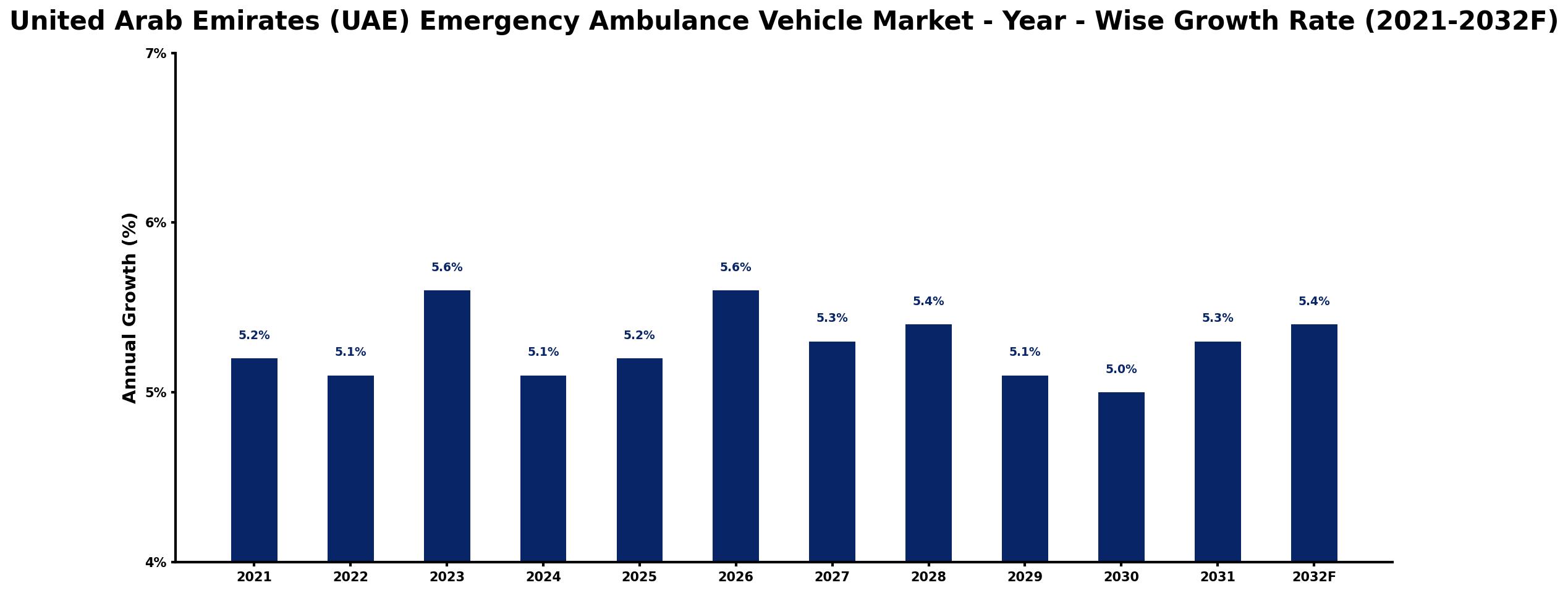
The table below presents the year‑wise growth rates along with the key drivers influencing the market
| Year | Growth Rate | Major Drivers |
| 2021 | 5.2% | increased healthcare infrastructure investments |
| 2022 | 5.1% | growing demand for rapid response |
| 2023 | 5.6% | expansion of telemedicine services |
| 2024 | 5.1% | enhanced training for medical personnel |
| 2025 | 5.2% | government initiatives for public health |
| 2026 | 5.6% | rising population health awareness |
| 2027 | 5.3% | expanding manufacturing base activity |
| 2028 | 5.4% | advancements in medical technology usage |
| 2029 | 5.1% | increased urbanization and population density |
| 2030 | 5.0% | increased capital investment inflows |
| 2031 | 5.3% | growing commercial sector adoption |
| 2032 | 5.4% | growing emphasis on patient care |
Note: Market size estimations and growth projections presented in this report are based on 6Wresearch's proprietary forecasting methodology, utilizing the latest available industry data, government publications, and primary research inputs.
United Arab Emirates (UAE) Emergency Ambulance Vehicle Market Synopsis
The UAE's emergency ambulance vehicle market is witnessing significant momentum, bolstered by ongoing investments in healthcare services. The focus on integrating advanced medical technologies within ambulance units is paving the way for a more responsive and efficient emergency medical system.
As this market progresses, key players are tasked with adapting to evolving regulatory standards and ensuring that their offerings meet the stringent requirements set by local authorities. The future promises innovative vehicle designs that are not only equipped for emergency medical responses but also tailored for the unique geographical challenges faced across the UAE.
United Arab Emirates (UAE) Emergency Ambulance Vehicle Market Key Takeaways
- The market is driven by substantial investments in healthcare infrastructure and emergency response services.
- Increasing population and healthcare standards demand more advanced ambulance vehicles.
- Government initiatives play a crucial role in shaping market growth and improving response times.
- Continuous innovation in medical equipment is vital for meeting market demands.
- Recruitment and retention of skilled paramedical staff remain significant industry challenges.
Evaluation of Restraints in United Arab Emirates (UAE) Emergency Ambulance Vehicle Market
Despite the promising growth, the UAE emergency ambulance vehicle market faces notable constraints. The need for ongoing investment in high-quality medical equipment can impose financial pressures on operators, potentially limiting service expansion. The geographical diversity across the UAE presents logistical challenges in ensuring timely emergency responses. Moreover, adherence to stringent regulatory standards for vehicle safety and medical equipment requires meticulous attention and resources, which can hinder operational agility. Additionally, the competitive nature of the labor market complicates efforts to recruit and retain trained paramedics, further complicating service delivery.
United Arab Emirates (UAE) Emergency Ambulance Vehicle Market Trends
Current trends in the UAE emergency ambulance vehicle market are heavily influenced by technological advancements. Manufacturers are increasingly focusing on equipping ambulances with telemedicine capabilities, allowing for real-time consultation between paramedics and hospital staff. Additionally, the integration of electric and hybrid vehicles into ambulance fleets is gaining traction, reflecting the UAEs broader sustainability goals. Smart technologies, such as GPS tracking and mobile health applications, are enhancing operational efficiency, ensuring that medical teams can respond faster to emergencies.
United Arab Emirates (UAE) Emergency Ambulance Vehicle Market Opportunities
The UAE emergency ambulance vehicle market presents numerous opportunities for growth and investment. As the healthcare landscape continues to evolve, the demand for specialized vehicles designed for various medical emergencies is on the rise. Public-private partnerships can also play a vital role in enhancing emergency medical services, offering avenues for innovation. Additionally, as the region increasingly embraces smart city initiatives, the integration of advanced technologies into ambulance services opens doors for new operational efficiencies and enhanced patient care.
Government Initiatives in the United Arab Emirates (UAE) Emergency Ambulance Vehicle Market
The UAE government has prioritized investments in healthcare services, particularly in emergency medical response systems. Initiatives aimed at increasing the number of ambulances and improving response times are under continual development. Public spending on healthcare infrastructure is complemented by programs designed to enhance the training of medical staff and paramedics. Additionally, regulatory bodies are consistently reviewing and updating guidelines to ensure that ambulance services meet international safety and operational standards.
Future Insights of the United Arab Emirates (UAE) Emergency Ambulance Vehicle Market
Looking ahead to the period from 2026 to 2032, the UAE emergency ambulance vehicle market is poised for robust growth. Continued investments in healthcare infrastructure, coupled with the UAE's strategic initiatives to enhance emergency services, will likely stimulate market expansion. The integration of next-generation technologies, such as artificial intelligence and data analytics, is expected to revolutionize emergency response capabilities, improving patient outcomes. Overall, the market's trajectory remains positive, driven by a commitment to innovation and quality in healthcare delivery.
United Arab Emirates (UAE) Emergency Ambulance Vehicle Market Latest Developments (2025 - 2026)
In the past year, the UAE emergency ambulance vehicle market has seen several noteworthy developments. Advancements in ambulance design and technology have been implemented, focusing on improving the efficiency of emergency responses. Collaborations between public health authorities and private sector firms are increasingly common, reflecting a holistic approach to enhancing emergency medical services. Additionally, training programs for paramedics have been expanded, emphasizing the importance of continual professional development in the sector.
United Arab Emirates (UAE) Emergency Ambulance Vehicle Market - Key Attractiveness of the Report
- 10 Years of Market Numbers
- Historical Data Starting from 2022 to 2025
- Base Year: 2025
- Forecast Data until 2032
- Key Performance Indicators Impacting the Market
- Major Upcoming Developments and Projects
Key Highlights of the Report:
- United Arab Emirates (UAE) Emergency Ambulance Vehicle Market Outlook
- Market Size of United Arab Emirates (UAE) Emergency Ambulance Vehicle Market, 2025
- Forecast of United Arab Emirates (UAE) Emergency Ambulance Vehicle Market, 2032
- Historical Data and Forecast of United Arab Emirates (UAE) Emergency Ambulance Vehicle Revenues & Volume for the Period 2022-2032F
- United Arab Emirates (UAE) Emergency Ambulance Vehicle Market Trend Evolution
- United Arab Emirates (UAE) Emergency Ambulance Vehicle Market Drivers and Challenges
- United Arab Emirates (UAE) Emergency Ambulance Vehicle Price Trends
- United Arab Emirates (UAE) Emergency Ambulance Vehicle Porter's Five Forces
- United Arab Emirates (UAE) Emergency Ambulance Vehicle Industry Life Cycle
- Historical Data and Forecast of United Arab Emirates (UAE) Emergency Ambulance Vehicle Market Revenues & Volume By Vehicle Type for the Period 2022-2032F
- Historical Data and Forecast of United Arab Emirates (UAE) Emergency Ambulance Vehicle Market Revenues & Volume By Vans for the Period 2022-2032F
- Historical Data and Forecast of United Arab Emirates (UAE) Emergency Ambulance Vehicle Market Revenues & Volume By Cars for the Period 2022-2032F
- Historical Data and Forecast of United Arab Emirates (UAE) Emergency Ambulance Vehicle Market Revenues & Volume By Motorcycles for the Period 2022-2032F
- Historical Data and Forecast of United Arab Emirates (UAE) Emergency Ambulance Vehicle Market Revenues & Volume By Others for the Period 2022-2032F
- Historical Data and Forecast of United Arab Emirates (UAE) Emergency Ambulance Vehicle Market Revenues & Volume By Application for the Period 2022-2032F
- Historical Data and Forecast of United Arab Emirates (UAE) Emergency Ambulance Vehicle Market Revenues & Volume By Hospitals for the Period 2022-2032F
- Historical Data and Forecast of United Arab Emirates (UAE) Emergency Ambulance Vehicle Market Revenues & Volume By Emergency Center for the Period 2022-2032F
- Historical Data and Forecast of United Arab Emirates (UAE) Emergency Ambulance Vehicle Market Revenues & Volume By Others for the Period 2022-2032F
- United Arab Emirates (UAE) Emergency Ambulance Vehicle Import Export Trade Statistics
- Market Opportunity Assessment By Vehicle Type
- Market Opportunity Assessment By Application
- United Arab Emirates (UAE) Emergency Ambulance Vehicle Top Companies Market Share
- United Arab Emirates (UAE) Emergency Ambulance Vehicle Competitive Benchmarking By Technical and Operational Parameters
- United Arab Emirates (UAE) Emergency Ambulance Vehicle Company Profiles
- United Arab Emirates (UAE) Emergency Ambulance Vehicle Key Strategic Recommendations






































