United Arab Emirates (UAE) Fuel Station Market Size, Share & Growth Rate
The United Arab Emirates (UAE) Fuel Station Market was estimated at USD 304 Million in 2025 and is projected to reach USD 421 Million by 2032, growing at a CAGR of 4.8% from 2026 to 2032. This growth trajectory is primarily driven by the booming population and an increase in vehicle registrations, both of which are fueled by the country's robust economic expansion and thriving tourism sector. Additionally, the ongoing shift towards private transportation and a strengthening logistics sector further underpin this positive outlook.
United Arab Emirates (UAE) Fuel Station Market Year-wise Growth Rate and Key Drivers
This graph highlights how the United Arab Emirates (UAE) Fuel Station Market has steadily grown over the years, supported by major growth factors.
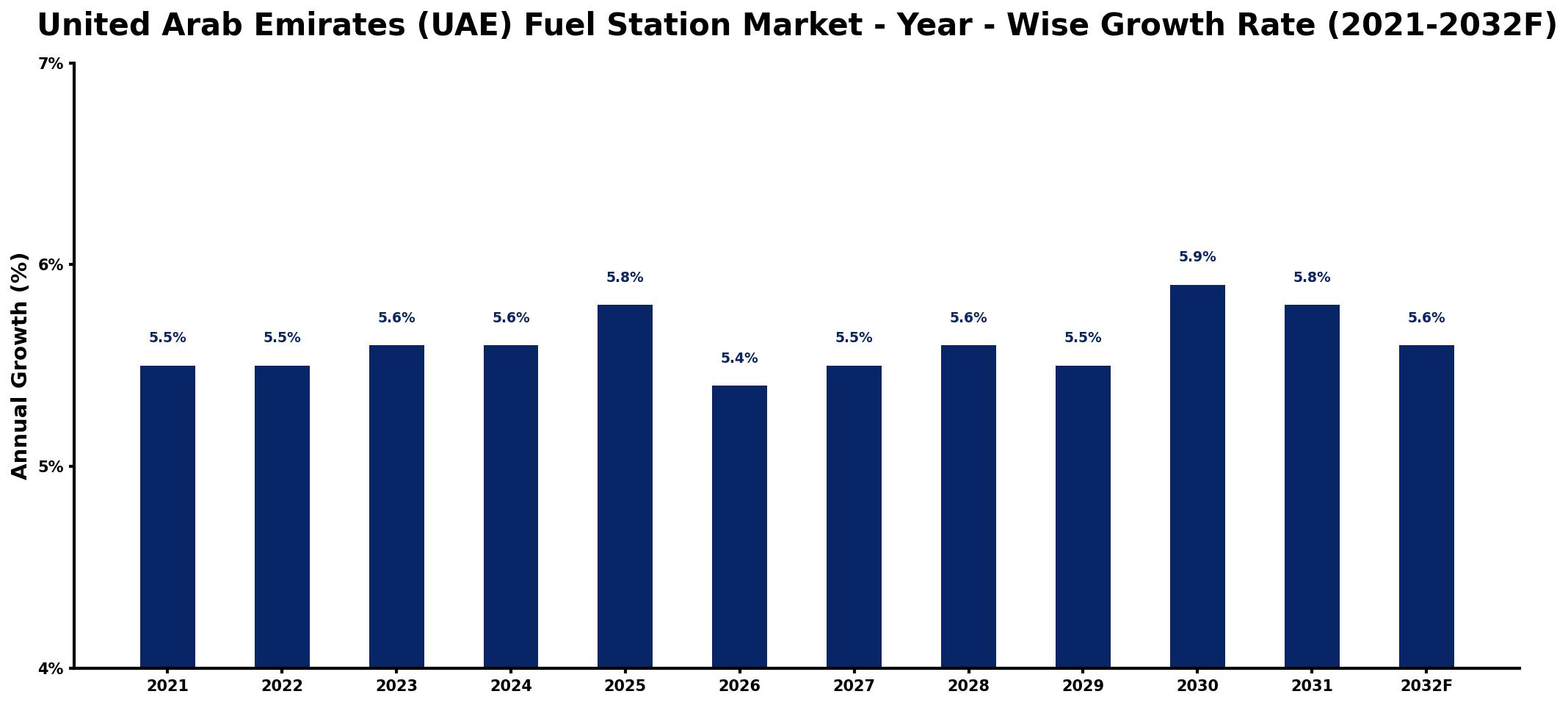
The table below presents the year‑wise growth rates along with the key drivers influencing the market
| Year | Growth Rate | Major Drivers |
| 2021 | 5.5% | Rising consumer demand for mobility |
| 2022 | 5.5% | Increased infrastructure development projects |
| 2023 | 5.6% | Expansion of electric vehicle networks |
| 2024 | 5.6% | Growing tourism and travel activities |
| 2025 | 5.8% | Investment in renewable energy initiatives |
| 2026 | 5.4% | Strengthened logistics and transportation sectors |
| 2027 | 5.5% | Adoption of cleaner energy solutions |
| 2028 | 5.6% | Enhanced urbanization and population growth |
| 2029 | 5.5% | Development of smart city projects |
| 2030 | 5.9% | Boost in domestic tourism initiatives |
| 2031 | 5.8% | Innovations in energy efficiency technologies |
| 2032 | 5.6% | Rising awareness of sustainability practices |
Note: Market size estimations and growth projections presented in this report are based on 6Wresearch's proprietary forecasting methodology, utilizing the latest available industry data, government publications, and primary research inputs.
United Arab Emirates (UAE) Fuel Station Market Synopsis
The UAE Fuel Station market is an essential pillar of the nations transport infrastructure, playing a significant role in meeting the diverse fuel needs of both individuals and businesses. As the economy grows and urban centers expand, the demand for fuel stations has become increasingly crucial, with many locations diversifying their services to enhance customer experience.
Innovative technologies are rapidly transforming the market landscape, introducing features such as automated dispensers and digital payment options. Moreover, the gradual integration of electric vehicle charging stations reflects a shift towards sustainability, ensuring the fuel station sector remains resilient in an evolving energy environment.
United Arab Emirates (UAE) Fuel Station Market Key Takeaways
- The market is on a growth trajectory driven by increasing vehicle ownership and economic diversification.
- Innovative technologies are improving customer service and operational efficiency within fuel stations.
- The sector is adapting to the rise of electric vehicles, incorporating charging stations into existing infrastructures.
- Ongoing regulatory requirements necessitate significant investment for compliance and modernization.
- Diversification of service offerings, including convenience stores, is emerging as a strategy for resilience.
Evaluation of Restraints in United Arab Emirates (UAE) Fuel Station Market
While the UAE Fuel Station market presents promising growth opportunities, it faces significant restraints. The proliferation of electric vehicles challenges traditional fuel business models, pushing existing fuel stations to rethink their operational strategies and invest heavily in alternative fueling infrastructure. Additionally, the stringent environmental regulations add a layer of complexity, requiring extensive upgrades to existing facilities to meet compliance and sustainability targets, further straining financial resources.
United Arab Emirates (UAE) Fuel Station Market Trends
Emerging trends within the UAE Fuel Station market reveal a strong inclination toward sustainability and technology integration. The adoption of smart technologies, such as mobile apps for fuel payments and loyalty programs, is enhancing the consumer experience. Furthermore, as public awareness around environmental issues rises, more stations are expected to adopt eco-friendly practices, including using renewable energy sources. The gradual shift towards electric vehicles is also prompting stations to invest in EV charging infrastructure, marking a notable trend in the market.
United Arab Emirates (UAE) Fuel Station Market Opportunities
The UAE Fuel Station market offers various growth opportunities, particularly in the realm of service diversification. Stations are increasingly transitioning to offer complementary services, such as convenience stores and fast-food outlets, which cater to the evolving consumer needs and preferences. Additionally, the development of electric vehicle charging stations represents a vital investment opportunity, positioning fuel stations as essential hubs in a multi-fuel future. Collaborations with tech firms to enhance digital offerings can also unlock significant potential in engaging tech-savvy customers.
Government Initiatives in the United Arab Emirates (UAE) Fuel Station Market
The UAE government is actively promoting sustainable energy solutions, which includes substantial investments in alternative fuel infrastructures, such as electric vehicle charging stations. Programs aimed at reducing carbon emissions are also being implemented, encouraging fuel stations to adopt cleaner technologies and practices. Furthermore, public spending on transportation infrastructure supports the expansion of fuel stations, making them a vital component of the nations vision for a sustainable future.
Future Insights of the United Arab Emirates (UAE) Fuel Station Market
Looking ahead to 2026-2032, the UAE Fuel Station market is poised for transformative changes. The combination of economic growth, increased vehicular demand, and the integration of renewable energy sources is likely to redefine the operational landscape. By continuing to adapt to consumer preferences and technological advancements, fuel stations can ensure their relevance in a competitive marketplace. Strategic investments in diversified services and infrastructure will be critical in capturing the evolving market dynamics.
United Arab Emirates (UAE) Fuel Station Market Latest Developments (2025 - 2026)
Recent developments in the UAE Fuel Station market reflect a trend towards modernization and diversification. Many stations are enhancing their facilities by integrating electric vehicle charging capabilities alongside traditional fuel services. Additionally, there is a noticeable shift towards contactless payment systems and improved customer loyalty programs, driven by the need for enhanced convenience and safety. This evolution positions fuel stations not merely as service points, but as comprehensive retail destinations.
United Arab Emirates (UAE) Fuel Station Market - Key Attractiveness of the Report
- 10 Years of Market Numbers
- Historical Data Starting from 2022 to 2025
- Base Year: 2025
- Forecast Data until 2032
- Key Performance Indicators Impacting the Market
- Major Upcoming Developments and Projects
Key Highlights of the Report:
- United Arab Emirates (UAE) Fuel Station Market Outlook
- Market Size of United Arab Emirates (UAE) Fuel Station Market, 2025
- Forecast of United Arab Emirates (UAE) Fuel Station Market, 2032
- Historical Data and Forecast of United Arab Emirates (UAE) Fuel Station Revenues & Volume for the Period 2022-2032F
- United Arab Emirates (UAE) Fuel Station Market Trend Evolution
- United Arab Emirates (UAE) Fuel Station Market Drivers and Challenges
- United Arab Emirates (UAE) Fuel Station Price Trends
- United Arab Emirates (UAE) Fuel Station Porter's Five Forces
- United Arab Emirates (UAE) Fuel Station Industry Life Cycle
- Historical Data and Forecast of United Arab Emirates (UAE) Fuel Station Market Revenues & Volume By Fuel for the Period 2022-2032F
- Historical Data and Forecast of United Arab Emirates (UAE) Fuel Station Market Revenues & Volume By Gasoline for the Period 2022-2032F
- Historical Data and Forecast of United Arab Emirates (UAE) Fuel Station Market Revenues & Volume By Diesel for the Period 2022-2032F
- Historical Data and Forecast of United Arab Emirates (UAE) Fuel Station Market Revenues & Volume By Gas for the Period 2022-2032F
- Historical Data and Forecast of United Arab Emirates (UAE) Fuel Station Market Revenues & Volume By others for the Period 2022-2032F
- Historical Data and Forecast of United Arab Emirates (UAE) Fuel Station Market Revenues & Volume By End-User for the Period 2022-2032F
- Historical Data and Forecast of United Arab Emirates (UAE) Fuel Station Market Revenues & Volume By Road Transport Vehicles for the Period 2022-2032F
- Historical Data and Forecast of United Arab Emirates (UAE) Fuel Station Market Revenues & Volume By Air Transport Vehicles for the Period 2022-2032F
- Historical Data and Forecast of United Arab Emirates (UAE) Fuel Station Market Revenues & Volume By Water Transport Vehicles for the Period 2022-2032F
- United Arab Emirates (UAE) Fuel Station Import Export Trade Statistics
- Market Opportunity Assessment By Fuel
- Market Opportunity Assessment By End-User
- United Arab Emirates (UAE) Fuel Station Top Companies Market Share
- United Arab Emirates (UAE) Fuel Station Competitive Benchmarking By Technical and Operational Parameters
- United Arab Emirates (UAE) Fuel Station Company Profiles
- United Arab Emirates (UAE) Fuel Station Key Strategic Recommendations






































