United Arab Emirates (UAE) Industrial Gases Market Summary
The united arab emirates (uae) industrial gases market was estimated at USD 211 Million in 2025 and is projected to reach USD 279 Million by 2032, growing at a CAGR of 4.6% from 2026 to 2032.
United Arab Emirates (UAE) Industrial Gases Market Year-wise Growth Rate and Key Drivers
This graph highlights how the United Arab Emirates (UAE) Industrial Gases Market has steadily grown over the past five years, supported by major growth factors.
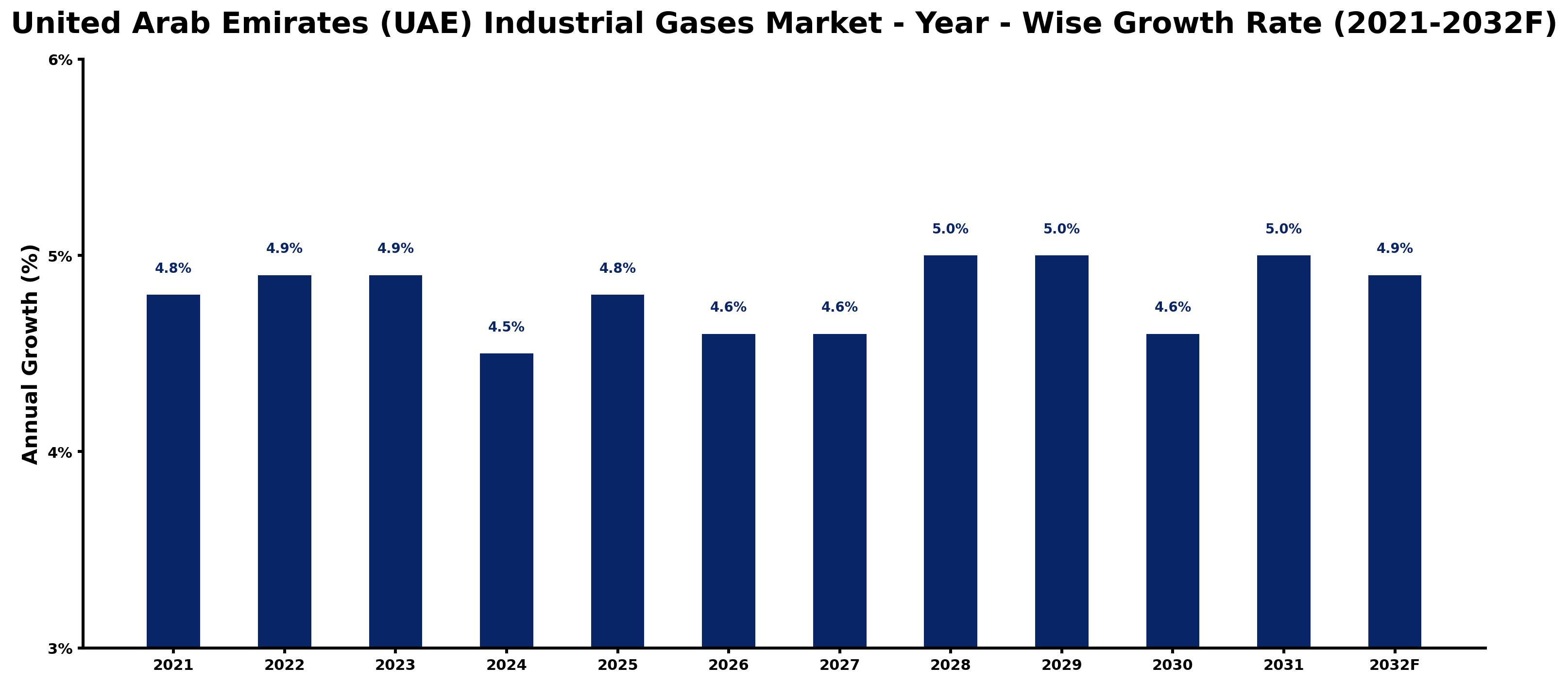
The table below presents the year wise growth rates along with the key drivers influencing the market
| Year | Growth Rate | Major Drivers |
| 2021 | 4.8% | Post-lockdown industrial activities accelerated demand for essential gases across sectors. |
| 2022 | 4.9% | Expansion of construction projects in the UAE increased nitrogen and oxygen requirements. |
| 2023 | 4.9% | Localization initiatives prompted growth in on-site gas production and management solutions. |
| 2024 | 4.5% | Investment in renewable energy projects attracted interest in hydrogen gas for various applications. |
| 2025 | 4.8% | Technological advancements in gas purification and storage improved operational efficiencies significantly. |
| 2026 | 4.6% | Rising petrochemical production fostered a robust market for various industrial gas applications. |
| 2027 | 4.6% | Corporate investments in smart manufacturing technologies created new opportunities for gas utilization. |
| 2028 | 5.0% | The need for enhanced safety standards led to increased demand for specialty gases. |
| 2029 | 5.0% | Growing automotive and aerospace sectors expanded requirements for high-purity gases. |
| 2030 | 4.6% | Economic diversification efforts in the UAE further stimulated gas sector competitiveness. |
| 2031 | 5.0% | Regional supply chain developments enabled better logistics for industrial gas distribution. |
| 2032 | 4.9% | Increased focus on sustainability prompted demand for environmentally-friendly gas solutions. |
Note - Market size estimations and growth projections presented in this report are based on 6Wresearch's advanced forecasting approach, validated with industry datasets as of June 2026.
United Arab Emirates (UAE) Industrial Gases Market Synopsis
The United Arab Emirates (UAE) Industrial Gases Market is projected to reach 4.6% and witness significant growth during the forecast period (2026-2032). This market encompasses the production, distribution, and supply of a wide array of industrial gases that are essential in sectors such as oil and gas, manufacturing, healthcare, and chemicals. Industrial gases serve pivotal roles in various applications, including welding, cutting, refrigeration, and medical treatments. The growing industrial and economic landscape of the UAE contributes to this market's expansion, alongside the rising demand for specialized gases across different sectors and a keen focus on sustainable and environmentally friendly solutions.
United Arab Emirates (UAE) Industrial Gases Market Growth Drivers
Several factors are driving the growth of the UAE industrial gases market. One significant contributor is the country's robust industrial and economic development. As the UAE continues to diversify its economy, investments in various sectors have increased the demand for industrial gases, which are crucial for manufacturing processes, oil and gas operations, and other industrial applications. Additionally, the growing emphasis on energy efficiency drives the adoption of gases that contribute to cleaner industrial practices. The need for regulatory compliance in environmental standards further enhances market demand, as industries seek to minimize their carbon footprint through cleaner technologies. Furthermore, the evolution of the healthcare sector, particularly post-pandemic, has increased the necessity for medical gases, thus providing an additional growth avenue. Lastly, innovations in gas production technologies are leading to more efficient processes, contributing to overall market expansion.
United Arab Emirates (UAE) Industrial Gases Market Challenges and Restraints
Despite the positive growth prospects, the UAE industrial gases market faces notable challenges. High production and distribution costs remain a prominent concern, as industrial gases necessitate specialized facilities for their manufacture, storage, and transport, leading to substantial capital investments. Moreover, with the increasing focus on environmental sustainability, alternative technologies that reduce reliance on certain industrial gases pose competitive challenges within the market. Fluctuations in global supply chains could also impact availability and pricing, adding another layer of complexity for operators in the region. Additionally, evolving regulatory frameworks may require ongoing adjustments in operational protocols, demanding continuous investment and adaptation by market participants.
United Arab Emirates (UAE) Industrial Gases Market Government Investment and Initiatives
The UAE government plays a pivotal role in fostering the industrial gases market through various investments and initiatives. Public spending on infrastructure development, particularly in the energy and manufacturing sectors, aims to enhance the efficiency and sustainability of industrial processes. The government's commitment to economic diversification encourages investments in advanced technologies and renewable energy sources, which often utilize industrial gases. Additionally, various economic development plans outline incentives for businesses to adopt cleaner technologies and adhere to stringent environmental regulations. These initiatives not only bolster the demand for industrial gases but also position the UAE as a hub for innovation in the region. Furthermore, the government supports research and development activities that focus on enhancing the efficiency of industrial gas applications, aligning with the global sustainability agenda.
United Arab Emirates (UAE) Industrial Gases Market Latest Developments (May 2025 - June 2026)
The period from May 2025 to June 2026 has seen significant developments in the UAE industrial gases market. The industry has witnessed an increase in investment towards the enhancement of production facilities, aligning with rising demand across multiple sectors. There is a palpable shift in focus towards the integration of digital technologies in gas production and distribution processes, aimed at improving operational efficiencies. Moreover, environmental regulations are prompting companies within the market to develop and promote more sustainable gas solutions, reflecting a broader commitment to sustainability. The healthcare sector has also reported a surge in the demand for medical gases, particularly as hospitals continue to adapt to new healthcare challenges post-pandemic. Overall, these developments mark a pivotal shift in the UAE industrial gases landscape, steering it towards more innovative and environmentally-conscious practices.
United Arab Emirates (UAE) Industrial Gases Market - Key Attractiveness of the Report
- 10 Years of Market Numbers
- Historical Data Starting from 2022 to 2025
- Base Year: 2025
- Forecast Data until 2032
- Key Performance Indicators Impacting the Market
- Major Upcoming Developments and Projects
Key Highlights of the Report:
- United Arab Emirates (UAE) Industrial Gases Market Outlook
- Market Size of United Arab Emirates (UAE) Industrial Gases Market, 2025
- Forecast of United Arab Emirates (UAE) Industrial Gases Market, 2032
- Historical Data and Forecast of United Arab Emirates (UAE) Industrial Gases Revenues & Volume for the Period 2022-2032F
- United Arab Emirates (UAE) Industrial Gases Market Trend Evolution
- United Arab Emirates (UAE) Industrial Gases Market Drivers and Challenges
- United Arab Emirates (UAE) Industrial Gases Price Trends
- United Arab Emirates (UAE) Industrial Gases Porter's Five Forces
- United Arab Emirates (UAE) Industrial Gases Industry Life Cycle
- Historical Data and Forecast of United Arab Emirates (UAE) Industrial Gases Market Revenues & Volume By Product Type for the Period 2022-2032F
- Historical Data and Forecast of United Arab Emirates (UAE) Industrial Gases Market Revenues & Volume By Oxygen for the Period 2022-2032F
- Historical Data and Forecast of United Arab Emirates (UAE) Industrial Gases Market Revenues & Volume By Nitrogen for the Period 2022-2032F
- Historical Data and Forecast of United Arab Emirates (UAE) Industrial Gases Market Revenues & Volume By Hydrogen for the Period 2022-2032F
- Historical Data and Forecast of United Arab Emirates (UAE) Industrial Gases Market Revenues & Volume By Carbon Dioxide for the Period 2022-2032F
- Historical Data and Forecast of United Arab Emirates (UAE) Industrial Gases Market Revenues & Volume By Acetylene for the Period 2022-2032F
- Historical Data and Forecast of United Arab Emirates (UAE) Industrial Gases Market Revenues & Volume By Argon for the Period 2022-2032F
- Historical Data and Forecast of United Arab Emirates (UAE) Industrial Gases Market Revenues & Volume By Others for the Period 2022-2032F
- Historical Data and Forecast of United Arab Emirates (UAE) Industrial Gases Market Revenues & Volume By Application for the Period 2022-2032F
- Historical Data and Forecast of United Arab Emirates (UAE) Industrial Gases Market Revenues & Volume By Healthcare for the Period 2022-2032F
- Historical Data and Forecast of United Arab Emirates (UAE) Industrial Gases Market Revenues & Volume By Manufacturing for the Period 2022-2032F
- Historical Data and Forecast of United Arab Emirates (UAE) Industrial Gases Market Revenues & Volume By Metallurgy & Glasses for the Period 2022-2032F
- Historical Data and Forecast of United Arab Emirates (UAE) Industrial Gases Market Revenues & Volume By Food & Beverage for the Period 2022-2032F
- Historical Data and Forecast of United Arab Emirates (UAE) Industrial Gases Market Revenues & Volume By Retail for the Period 2022-2032F
- Historical Data and Forecast of United Arab Emirates (UAE) Industrial Gases Market Revenues & Volume By Chemicals & Energy for the Period 2022-2032F
- Historical Data and Forecast of United Arab Emirates (UAE) Industrial Gases Market Revenues & Volume By Others for the Period 2022-2032F
- Historical Data and Forecast of United Arab Emirates (UAE) Industrial Gases Market Revenues & Volume By Distribution for the Period 2022-2032F
- Historical Data and Forecast of United Arab Emirates (UAE) Industrial Gases Market Revenues & Volume By On-site for the Period 2022-2032F
- Historical Data and Forecast of United Arab Emirates (UAE) Industrial Gases Market Revenues & Volume By Bulk (Liquid Gas Transport) for the Period 2022-2032F
- Historical Data and Forecast of United Arab Emirates (UAE) Industrial Gases Market Revenues & Volume By Cylinder (Merchant) for the Period 2022-2032F
- United Arab Emirates (UAE) Industrial Gases Import Export Trade Statistics
- Market Opportunity Assessment By Product Type
- Market Opportunity Assessment By Application
- Market Opportunity Assessment By Distribution
- United Arab Emirates (UAE) Industrial Gases Top Companies Market Share
- United Arab Emirates (UAE) Industrial Gases Competitive Benchmarking By Technical and Operational Parameters
- United Arab Emirates (UAE) Industrial Gases Company Profiles
- United Arab Emirates (UAE) Industrial Gases Key Strategic Recommendations






































