United Arab Emirates (UAE) Livestock Market Size, Share & Growth Rate
The United Arab Emirates (UAE) Livestock Market was estimated at USD 414 Million in 2025 and is projected to reach USD 601 Million by 2032, growing at a CAGR of 5.5% from 2026 to 2032. This growth trajectory is significantly influenced by shifting consumer preferences towards high-quality, leaner meat options and increased demand for sustainable livestock practices. As the country continues to enhance its agricultural infrastructure and address food security concerns, the livestock market is poised for robust development in the coming years.
United Arab Emirates (UAE) Livestock Market Year-wise Growth Rate and Key Drivers
This graph highlights how the United Arab Emirates (UAE) Livestock Market has steadily grown over the years, supported by major growth factors.
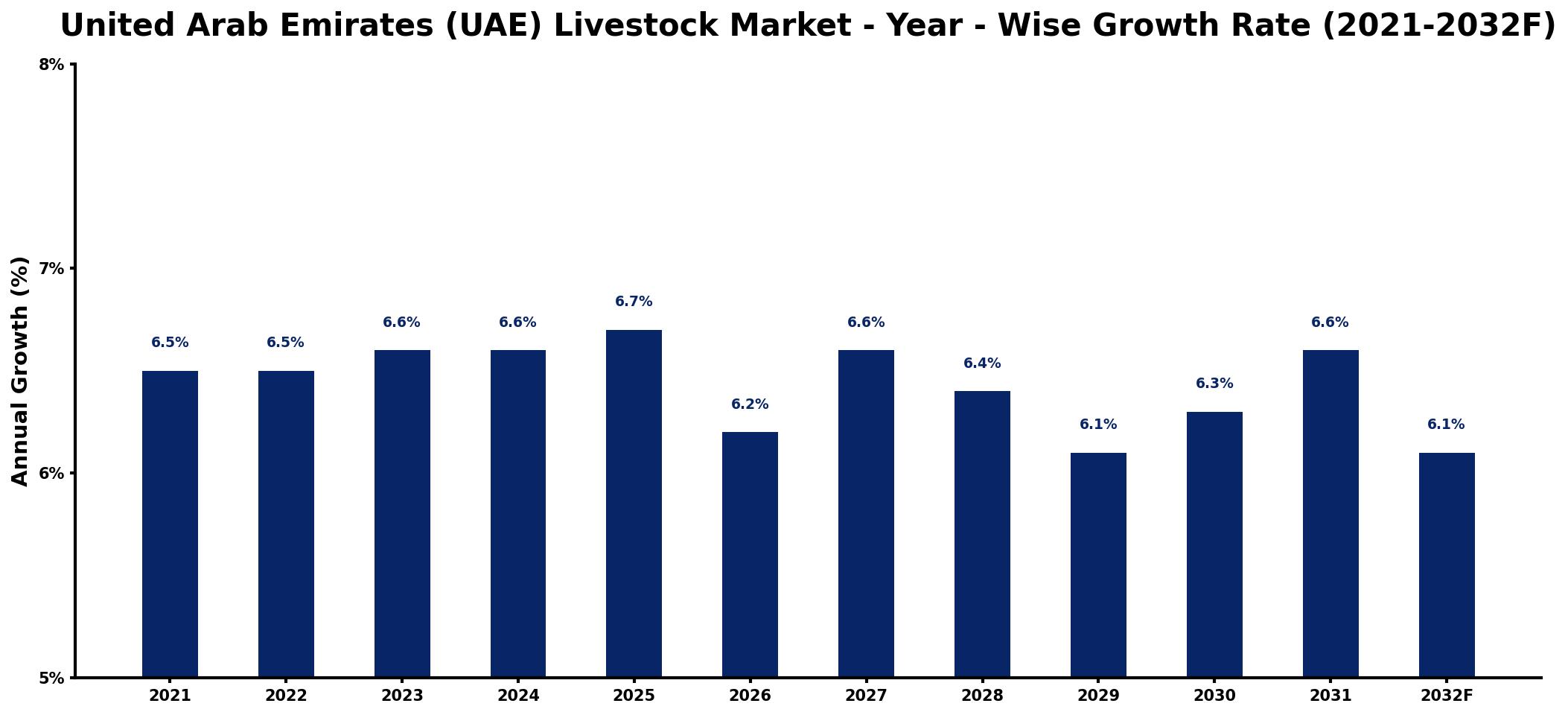
The table below presents the year‑wise growth rates along with the key drivers influencing the market
| Year | Growth Rate | Major Drivers |
| 2021 | 6.5% | Rising consumer demand for protein |
| 2022 | 6.5% | Increased investment in agriculture technology |
| 2023 | 6.6% | Expansion of local farming initiatives |
| 2024 | 6.6% | Growing popularity of organic products |
| 2025 | 6.7% | Enhanced distribution network efficiency |
| 2026 | 6.2% | Diversification of feed sources available |
| 2027 | 6.6% | Strengthened export market opportunities |
| 2028 | 6.4% | Government incentives for agricultural growth |
| 2029 | 6.1% | Emergence of sustainable farming practices |
| 2030 | 6.3% | Increase in health-conscious consumers |
| 2031 | 6.6% | Advancements in breeding technologies |
| 2032 | 6.1% | Improved supply chain management systems |
Note: Market size estimations and growth projections presented in this report are based on 6Wresearch's proprietary forecasting methodology, utilizing the latest available industry data, government publications, and primary research inputs.
United Arab Emirates (UAE) Livestock Market Synopsis
The livestock market in the UAE has recently exhibited substantial momentum, driven by an increasing emphasis on premium meat quality and welfare standards. However, as the sector evolves, it is also adapting to meet the growing demands for sustainability and ethical sourcing among consumers.
Looking ahead, the market is expected to navigate challenges posed by stringent import regulations and food safety standards. Yet, with a focus on local production and strategic partnerships, the UAE livestock market is well-positioned for future growth as it aligns with global trends in animal welfare and healthy eating.
United Arab Emirates (UAE) Livestock Market Key Takeaways
- The market is shifting towards premium-quality, sustainable livestock to meet evolving consumer demands.
- Increased imports are driving supply to satisfy the appetite for leaner meat options.
- Local production initiatives are gaining traction to enhance food security and reduce reliance on imports.
- Regulatory challenges related to animal health and import restrictions remain a critical concern.
- Market growth is supported by government initiatives aimed at boosting the agricultural sector.
Evaluation of Restraints in United Arab Emirates (UAE) Livestock Market
The UAE livestock market encounters several restraints that limit its potential. Strict import regulations can hamper the timely entry of livestock and genetic materials necessary for enhancing local breeds. Moreover, the focus on animal welfare standards often results in higher operational costs for local producers, which can limit competitive pricing. The sector is also susceptible to fluctuations in consumer demand, which can be volatile due to changing dietary trends and health perceptions.
United Arab Emirates (UAE) Livestock Market Trends
Several key trends are currently shaping the UAE livestock market. First, a marked increase in demand for organic and free-range products reflects the population's growing interest in health and nutrition. Additionally, technological advancements in breeding and farming practices are enhancing productivity and animal welfare. The growing popularity of e-commerce platforms is also transforming how livestock products are marketed and distributed, allowing consumers easier access to high-quality meat.
United Arab Emirates (UAE) Livestock Market Opportunities
Significant growth opportunities lie in the expansion of local farms and facilities that prioritize animal welfare and sustainable practices. Additionally, the rise of agritech solutions presents avenues for improving efficiencies in livestock management. With government support, there is potential for increased investment in research and development focused on breeding programs, disease management, and environmental sustainability, further positioning the UAE as a leader in the livestock sector.
Government Initiatives in the United Arab Emirates (UAE) Livestock Market
The UAE government has introduced several initiatives aimed at bolstering the livestock sector as part of its broader agricultural strategy. This includes investments in research programs that enhance animal health and productivity while ensuring compliance with international standards. Incentives for local producers to adopt sustainable farming practices are also being promoted, reflecting a commitment to food security and environmental stewardship.
Future Insights of the United Arab Emirates (UAE) Livestock Market
From 2026 to 2032, the UAE livestock market is expected to experience steady growth driven by consumer trends toward premium-quality products. The increasing focus on sustainability will likely lead to further investments in local production capabilities. As infrastructure improves and regulatory frameworks adapt to support emerging technologies, the market is well-poised to capitalize on both local and export opportunities.
United Arab Emirates (UAE) Livestock Market Latest Developments (2025 - 2026)
Recently, the livestock market has been witnessing a shift towards enhancing local production capacities, particularly in response to heightened consumer interest in locally sourced products. Collaborations between agricultural institutions and private sectors are emerging to advance animal husbandry techniques. Moreover, increased attention to animal welfare is prompting stakeholders to adopt more stringent practices, setting new benchmarks in quality and ethical sourcing.
United Arab Emirates (UAE) Livestock Market - Key Attractiveness of the Report
- 10 Years of Market Numbers
- Historical Data Starting from 2022 to 2025
- Base Year: 2025
- Forecast Data until 2032
- Key Performance Indicators Impacting the Market
- Major Upcoming Developments and Projects
Key Highlights of the Report:
- United Arab Emirates (UAE) Livestock Market Outlook
- Market Size of United Arab Emirates (UAE) Livestock Market, 2025
- Forecast of United Arab Emirates (UAE) Livestock Market, 2032
- Historical Data and Forecast of United Arab Emirates (UAE) Livestock Revenues & Volume for the Period 2022-2032F
- United Arab Emirates (UAE) Livestock Market Trend Evolution
- United Arab Emirates (UAE) Livestock Market Drivers and Challenges
- United Arab Emirates (UAE) Livestock Price Trends
- United Arab Emirates (UAE) Livestock Porter's Five Forces
- United Arab Emirates (UAE) Livestock Industry Life Cycle
- Historical Data and Forecast of United Arab Emirates (UAE) Livestock Market Revenues & Volume By Animal Type for the Period 2022-2032F
- Historical Data and Forecast of United Arab Emirates (UAE) Livestock Market Revenues & Volume By Ruminants for the Period 2022-2032F
- Historical Data and Forecast of United Arab Emirates (UAE) Livestock Market Revenues & Volume By Poultry for the Period 2022-2032F
- Historical Data and Forecast of United Arab Emirates (UAE) Livestock Market Revenues & Volume By Swine for the Period 2022-2032F
- Historical Data and Forecast of United Arab Emirates (UAE) Livestock Market Revenues & Volume By Aquaculture for the Period 2022-2032F
- United Arab Emirates (UAE) Livestock Import Export Trade Statistics
- Market Opportunity Assessment By Animal Type
- United Arab Emirates (UAE) Livestock Top Companies Market Share
- United Arab Emirates (UAE) Livestock Competitive Benchmarking By Technical and Operational Parameters
- United Arab Emirates (UAE) Livestock Company Profiles
- United Arab Emirates (UAE) Livestock Key Strategic Recommendations






































