United Arab Emirates (UAE) Non-grape Wine Market Summary
The united arab emirates (uae) non-grape wine market was estimated at USD 1046 Million in 2025 and is projected to reach USD 1521 Million by 2032, growing at a CAGR of 6.2% from 2026 to 2032.
United Arab Emirates (UAE) Non-grape Wine Market Year-wise Growth Rate and Key Drivers
This graph highlights how the United Arab Emirates (UAE) Non-grape Wine Market has steadily grown over the past five years, supported by major growth factors.
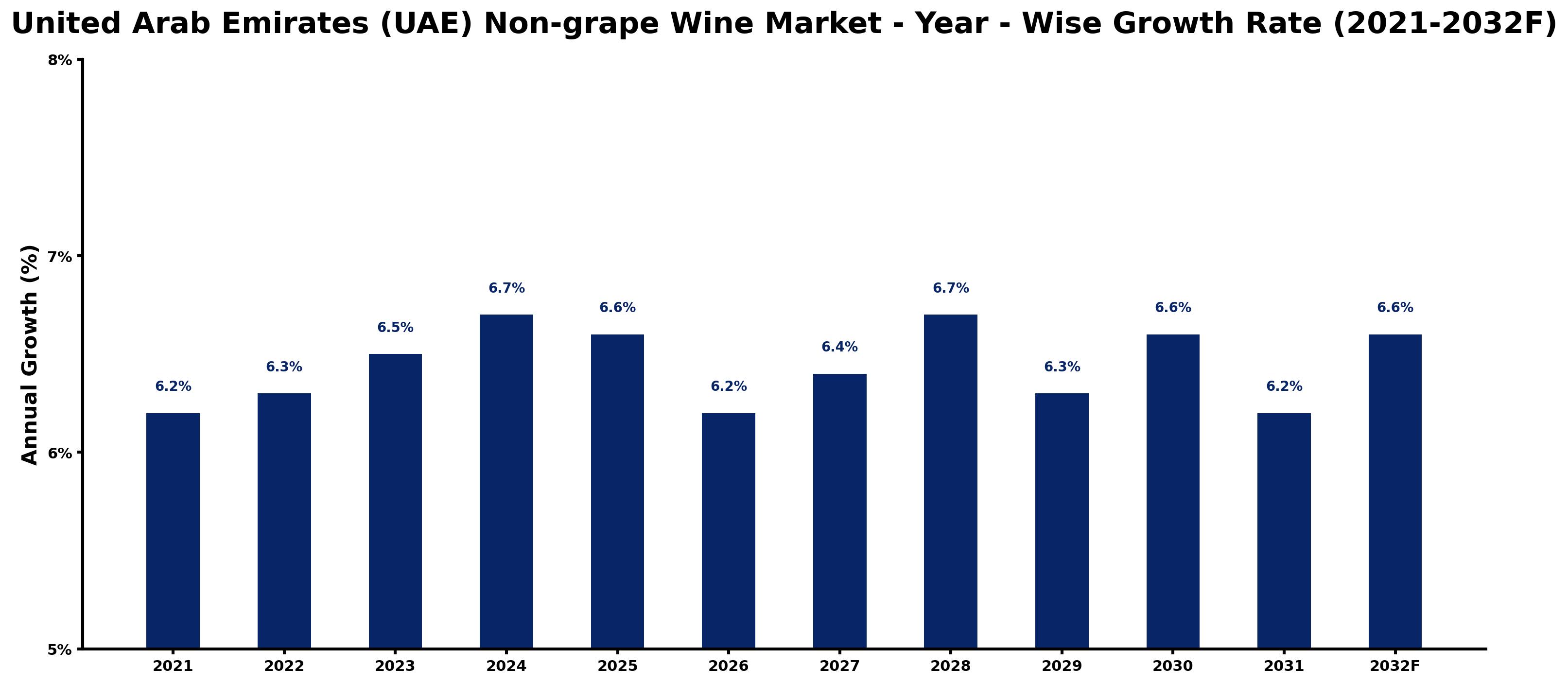
The table below presents the year wise growth rates along with the key drivers influencing the market
| Year | Growth Rate | Major Drivers |
| 2021 | 6.2% | Post-lockdown retail projects opened opportunities for boutique non-grape wine brands. |
| 2022 | 6.3% | Local producers focused on innovative blends appealing to diverse consumer tastes. |
| 2023 | 6.5% | Increased foreign investments supported the establishment of local vineyards and wineries. |
| 2024 | 6.7% | Changing consumer preferences shifted attention towards organic and health-conscious beverages. |
| 2025 | 6.6% | Cultural acceptance of non-grape wines expanded through marketing and social media engagement. |
| 2026 | 6.2% | Collaborations with restaurants showcased non-grape wine pairings, enhancing dining experiences. |
| 2027 | 6.4% | New production technologies improved quality and consistency of non-grape wine offerings. |
| 2028 | 6.7% | Emerging beverage trends highlighted sustainable practices in wine production and packaging. |
| 2029 | 6.3% | E-commerce platforms strengthened distribution channels for niche non-grape wine products. |
| 2030 | 6.6% | Culinary tourism initiatives promoted local non-grape wines to international visitors. |
| 2031 | 6.2% | Consumer education campaigns increased awareness of non-grape wine varieties and styles. |
| 2032 | 6.6% | Cross-border collaborations emerged, expanding the market for regional non-grape wine exports. |
Note - Market size estimations and growth projections presented in this report are based on 6Wresearch's advanced forecasting approach, validated with industry datasets as of June 2026.
United Arab Emirates (UAE) Non-grape Wine Market Synopsis
The United Arab Emirates (UAE) Non-grape Wine Market is projected to reach 6.2% and witness significant growth during the forecast period (2026-2032). This segment of the beverage market focuses on wines crafted from various fruits, including apples, berries, and peaches, distinguishing itself from traditional grape-based offerings. As the UAE continues to diversify its beverage landscape, the non-grape wine sector is gaining traction, driven by evolving consumer preferences and growing demand for unique, flavorful alternatives.
United Arab Emirates (UAE) Non-grape Wine Market Growth Drivers
Several factors are propelling the growth of the UAE non-grape wine market. First and foremost, the increasing health consciousness among consumers plays a pivotal role. Non-grape wines are often perceived as healthier options due to their fruit-based composition, which is rich in antioxidants and nutrients. This perception appeals particularly to the health-savvy demographic, sparking interest in exploring these beverages.
Furthermore, the UAE's multicultural population drives the demand for diverse wine offerings. Residents hailing from various countries bring their unique cultural preferences, which encompasses a variety of traditional fruit-based alcoholic beverages. This cultural melting pot fosters an environment ripe for experimentation with non-grape wine varieties.
Tourism significantly influences the UAE non-grape wine market as well. The region's status as a prime tourist destination attracts visitors who are eager to experience local and international beverage offerings. This dynamic creates a notable demand for innovative non-grape wines, catering to the adventurous palates of tourists.
Additionally, the rising popularity of non-alcoholic beverages boosts interest in non-grape wines, especially those with lower alcohol content. As consumers seek alternatives to traditional wines, non-grape options provide a compelling choice that aligns with their preferences.
Finally, the shift towards e-commerce and online platforms for alcoholic beverages can be seen as a growth facilitator. The transition to digital retail channels has allowed producers to reach a wider consumer base without the limitations imposed by traditional retail structures.
United Arab Emirates (UAE) Non-grape Wine Market Challenges and Restraints
Despite the optimistic growth projections, the UAE non-grape wine market is not without its challenges. A significant hurdle lies in the regulatory environment governing the sale and consumption of alcoholic beverages. The strict laws require non-grape wines—despite their lower alcohol content—to comply with stringent regulations, which can complicate market access for producers and restrict the availability of these products to consumers.
Moreover, non-grape wines face competition from established grape wines, which have long been entrenched in the UAE market. The robust marketing and consumer familiarity with grape wines can overshadow the emerging non-grape wine segment, making it essential for newer options to carve out a distinct identity in the marketplace.
Additionally, consumer education poses a challenge as many potential buyers may be unfamiliar with non-grape wines, their offerings, and their unique flavor profiles. Building awareness and understanding among the consumer base will be crucial for market growth.
Global economic fluctuations can also pose risks to the UAE non-grape wine market. Changes in disposable incomes and shifts in consumer spending habits can directly impact the consumption of premium beverages, including non-grape wines.
Lastly, COVID-19 had significant repercussions for the hospitality sector, reducing demand for non-grape wines in hotels and restaurants. While the pandemic spurred a rise in e-commerce, the decline in traditional consumption channels remains a challenge.
United Arab Emirates (UAE) Non-grape Wine Market Government Investment and Initiatives
The UAE government has implemented various initiatives aimed at fostering growth within the non-grape wine market. By promoting tourism and hospitality, local authorities encourage the diversification of beverage offerings, including non-grape wines. This strategic approach aligns with the country's vision to enhance its status as a global tourism hub.
Furthermore, the government has introduced policies to encourage local production of beverages, which include various non-grape wine offerings. These initiatives often feature financial incentives and support for producers, thereby stimulating domestic industry growth.
Investment in public awareness campaigns highlights the cultural significance of traditional fruit-based beverages, paving the way for an increased appreciation of non-grape wines among consumers.
Regulatory bodies are also actively involved in creating a balanced framework that allows for the responsible production and distribution of alcoholic beverages, including non-grape wines. These regulations aim to ensure consumer safety while promoting market access for various wine types.
Overall, government initiatives demonstrate a commitment to nurturing a vibrant non-grape wine sector within the UAE, supporting both consumer choice and economic growth.
United Arab Emirates (UAE) Non-grape Wine Market Latest Developments (May 2025 - June 2026)
Recent developments in the UAE non-grape wine market have showcased an evolving landscape. Producers have increasingly focused on innovative product development, aiming to capture the attention of health-conscious consumers and align with trends emphasizing natural ingredients and lower alcohol content. The introduction of new flavors and blends has also expanded consumer options.
There has been a notable rise in online retailing, with producers leveraging e-commerce platforms to reach a broader audience, driving sales and enhancing direct-to-consumer engagement. This shift has facilitated greater accessibility for consumers seeking non-grape wines.
Collaboration among producers has emerged as a key strategy to enhance brand visibility and create unique offerings, often blending local fruits with established production processes. Such partnerships are essential for expanding market awareness and driving consumer interest.
Additionally, public events and tasting sessions have been organized to promote the unique qualities of non-grape wines, allowing consumers to sample and engage with these products in a community setting.
Lastly, awareness campaigns have been gaining momentum, emphasizing the health benefits associated with fruit-based beverages and encouraging a broader acceptance of non-grape wines within the beverage sector.
United Arab Emirates (UAE) Non-grape Wine Market - Key Attractiveness of the Report
- 10 Years of Market Numbers
- Historical Data Starting from 2022 to 2025
- Base Year: 2025
- Forecast Data until 2032
- Key Performance Indicators Impacting the Market
- Major Upcoming Developments and Projects
Key Highlights of the Report:
- United Arab Emirates (UAE) Non-grape Wine Market Outlook
- Market Size of United Arab Emirates (UAE) Non-grape Wine Market, 2025
- Forecast of United Arab Emirates (UAE) Non-grape Wine Market, 2032
- Historical Data and Forecast of United Arab Emirates (UAE) Non-grape Wine Revenues & Volume for the Period 2022-2032F
- United Arab Emirates (UAE) Non-grape Wine Market Trend Evolution
- United Arab Emirates (UAE) Non-grape Wine Market Drivers and Challenges
- United Arab Emirates (UAE) Non-grape Wine Price Trends
- United Arab Emirates (UAE) Non-grape Wine Porter's Five Forces
- United Arab Emirates (UAE) Non-grape Wine Industry Life Cycle
- Historical Data and Forecast of United Arab Emirates (UAE) Non-grape Wine Market Revenues & Volume By Product Type for the Period 2022-2032F
- Historical Data and Forecast of United Arab Emirates (UAE) Non-grape Wine Market Revenues & Volume By Fermented Fruit Wine for the Period 2022-2032F
- Historical Data and Forecast of United Arab Emirates (UAE) Non-grape Wine Market Revenues & Volume By Distilled Fruit Wine for the Period 2022-2032F
- Historical Data and Forecast of United Arab Emirates (UAE) Non-grape Wine Market Revenues & Volume By Preparation Fruit Wine for the Period 2022-2032F
- Historical Data and Forecast of United Arab Emirates (UAE) Non-grape Wine Market Revenues & Volume By Sparkling Fruit Wine for the Period 2022-2032F
- Historical Data and Forecast of United Arab Emirates (UAE) Non-grape Wine Market Revenues & Volume By Application for the Period 2022-2032F
- Historical Data and Forecast of United Arab Emirates (UAE) Non-grape Wine Market Revenues & Volume By Household for the Period 2022-2032F
- Historical Data and Forecast of United Arab Emirates (UAE) Non-grape Wine Market Revenues & Volume By Commercial for the Period 2022-2032F
- United Arab Emirates (UAE) Non-grape Wine Import Export Trade Statistics
- Market Opportunity Assessment By Product Type
- Market Opportunity Assessment By Application
- United Arab Emirates (UAE) Non-grape Wine Top Companies Market Share
- United Arab Emirates (UAE) Non-grape Wine Competitive Benchmarking By Technical and Operational Parameters
- United Arab Emirates (UAE) Non-grape Wine Company Profiles
- United Arab Emirates (UAE) Non-grape Wine Key Strategic Recommendations






































