United Arab Emirates (UAE) Pearl Jewelry Market Size, Share & Growth Rate
The United Arab Emirates (UAE) Pearl Jewelry Market was estimated at USD 246 Million in 2025 and is projected to reach USD 348 Million by 2032, growing at a CAGR of 5.1% from 2026 to 2032. This growth trajectory is primarily driven by an increasing appreciation for traditional craftsmanship, as well as a rising global demand for authentic and high-quality pearls. As the UAE continues to enhance its status as a luxury goods destination, both local artisans and international jewelers contribute to the rich diversity of the market.
United Arab Emirates (UAE) Pearl Jewelry Market Year-wise Growth Rate and Key Drivers
This graph highlights how the United Arab Emirates (UAE) Pearl Jewelry Market has steadily grown over the years, supported by major growth factors.
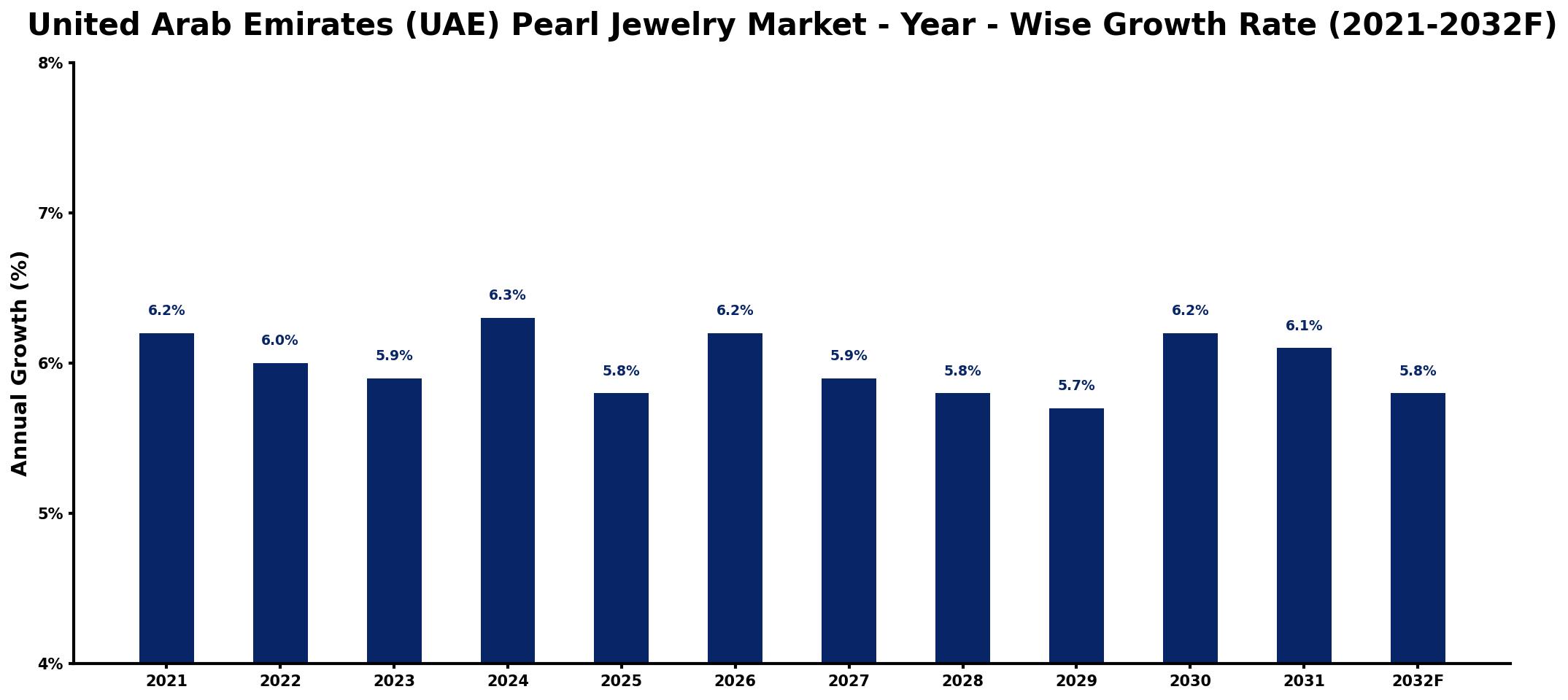
The table below presents the year‑wise growth rates along with the key drivers influencing the market
| Year | Growth Rate | Major Drivers |
| 2021 | 6.2% | Rising consumer spending habits |
| 2022 | 6.0% | Increased tourism and hospitality |
| 2023 | 5.9% | Growing online retail platforms |
| 2024 | 6.3% | Expansion of luxury markets |
| 2025 | 5.8% | Cultural events boosting interest |
| 2026 | 6.2% | Rising disposable income levels |
| 2027 | 5.9% | Enhanced marketing strategies employed |
| 2028 | 5.8% | Collaborations with fashion designers |
| 2029 | 5.7% | Innovations in sustainable sourcing |
| 2030 | 6.2% | Strengthened global trade networks |
| 2031 | 6.1% | Popularity of local artisans |
| 2032 | 5.8% | Increased investment in craftsmanship |
Note: Market size estimations and growth projections presented in this report are based on 6Wresearch's proprietary forecasting methodology, utilizing the latest available industry data, government publications, and primary research inputs.
United Arab Emirates (UAE) Pearl Jewelry Market Synopsis
The UAE pearl jewelry market has seen a notable resurgence in recent years, characterized by a renewed interest in traditional designs and local artistry. This momentum is juxtaposed with the necessity for the market to adapt to contemporary styles, catering to evolving consumer preferences. As the market progresses, it continues to reflect the unique cultural heritage of the UAE, attracting both collectors and casual buyers alike.
Local artisans are pivotal in this transformative journey, merging time-honored techniques with innovative designs that resonate with today's luxury consumers. However, the industry's health is also dependent on broader economic trends and consumer sentiment, especially given the fluctuations experienced during the pandemic.
United Arab Emirates (UAE) Pearl Jewelry Market Key Takeaways
- The UAE pearl jewelry market is significantly influenced by its rich cultural history and traditional craftsmanship.
- Consumer demand is shifting towards unique, culturally significant jewelry pieces that reflect Emirati heritage.
- Online retail channels are increasingly vital as consumer behaviors change in the wake of the pandemic.
- The presence of high-net-worth individuals and luxury tourists continues to bolster market growth.
- Strategic government initiatives aim to preserve traditional pearl diving and jewelry-making techniques.
Evaluation of Restraints in United Arab Emirates (UAE) Pearl Jewelry Market
The UAE pearl jewelry market faces several restraints that could hinder its growth potential. One significant challenge lies in the preservation of traditional craftsmanship amidst modern influences and consumer demands. As new trends emerge, balancing authenticity with contemporary appeal becomes increasingly complex. Furthermore, ensuring artisans receive fair compensation for their skills while nurturing the cultural significance of pearls presents ongoing hurdles. Additionally, the market remains sensitive to economic fluctuations and tourism dynamics, which can heavily impact consumer spending patterns.
United Arab Emirates (UAE) Pearl Jewelry Market Trends
Several trends are currently shaping the UAE pearl jewelry market. One notable trend is the increasing emphasis on sustainable and ethically sourced pearls, as consumers become more conscious of the environmental impact of luxury goods. Additionally, there is a growing appetite for personalized jewelry that tells a story, further intertwining consumer identity with cultural heritage. Digital innovation is also on the rise, with online sales channels gaining prominence, catering to a tech-savvy clientele eager for convenience and curated shopping experiences.
United Arab Emirates (UAE) Pearl Jewelry Market Opportunities
The market presents numerous growth and investment opportunities, particularly in the realms of e-commerce and sustainable practices. Enhancing online platforms can significantly widen reach, especially among younger consumers looking for unique, authentic pieces. Moreover, investment in marketing strategies that highlight the cultural significance and craftsmanship of pearls could capture a larger share of the luxury goods market. Collaborations between local artisans and international designers may also create distinctive product lines that appeal to diverse consumer bases.
Government Initiatives in the United Arab Emirates (UAE) Pearl Jewelry Market
The UAE government actively supports initiatives aimed at preserving the nation's pearl diving heritage and promoting local craftsmanship. Various programs focus on providing training for artisans, fostering skills that are critical for sustaining traditional techniques. Public spending on cultural preservation and tourism enhancements further strengthens the market, ensuring that the rich history of pearl jewelry remains an integral part of the UAE's identity.
Future Insights of the United Arab Emirates (UAE) Pearl Jewelry Market
Looking ahead, the UAE pearl jewelry market is poised for a robust recovery and growth phase from 2026 to 2032. The convergence of renewed tourism, evolving consumer preferences, and enhanced online retail experiences will likely drive demand. Additionally, as global interest in cultural and sustainable luxury products increases, the UAE's rich history in pearl production positions it advantageously for both local and international markets. The continued innovation by artisans, combined with strategic government support, will undoubtedly shape a vibrant future for the industry.
United Arab Emirates (UAE) Pearl Jewelry Market Latest Developments (2025 - 2026)
Recent industry developments indicate a strong trend towards enhancing online sales platforms, with many businesses investing in digital marketing strategies to reach broader audiences. Local artisans are increasingly collaborating with designers to create bespoke pieces that combine traditional and contemporary aesthetics. The focus on sustainability and ethical sourcing is growing, leading to initiatives aimed at promoting environmentally friendly practices within the pearl jewelry sector.
United Arab Emirates (UAE) Pearl Jewelry Market - Key Attractiveness of the Report
- 10 Years of Market Numbers
- Historical Data Starting from 2022 to 2025
- Base Year: 2025
- Forecast Data until 2032
- Key Performance Indicators Impacting the Market
- Major Upcoming Developments and Projects
Key Highlights of the Report:
- United Arab Emirates (UAE) Pearl Jewelry Market Outlook
- Market Size of United Arab Emirates (UAE) Pearl Jewelry Market, 2025
- Forecast of United Arab Emirates (UAE) Pearl Jewelry Market, 2032
- Historical Data and Forecast of United Arab Emirates (UAE) Pearl Jewelry Revenues & Volume for the Period 2022-2032F
- United Arab Emirates (UAE) Pearl Jewelry Market Trend Evolution
- United Arab Emirates (UAE) Pearl Jewelry Market Drivers and Challenges
- United Arab Emirates (UAE) Pearl Jewelry Price Trends
- United Arab Emirates (UAE) Pearl Jewelry Porter's Five Forces
- United Arab Emirates (UAE) Pearl Jewelry Industry Life Cycle
- Historical Data and Forecast of United Arab Emirates (UAE) Pearl Jewelry Market Revenues & Volume By Pearl Type for the Period 2022-2032F
- Historical Data and Forecast of United Arab Emirates (UAE) Pearl Jewelry Market Revenues & Volume By Freshwater for the Period 2022-2032F
- Historical Data and Forecast of United Arab Emirates (UAE) Pearl Jewelry Market Revenues & Volume By Saltwater for the Period 2022-2032F
- Historical Data and Forecast of United Arab Emirates (UAE) Pearl Jewelry Market Revenues & Volume By Material Type for the Period 2022-2032F
- Historical Data and Forecast of United Arab Emirates (UAE) Pearl Jewelry Market Revenues & Volume By Gold for the Period 2022-2032F
- Historical Data and Forecast of United Arab Emirates (UAE) Pearl Jewelry Market Revenues & Volume By Silver for the Period 2022-2032F
- Historical Data and Forecast of United Arab Emirates (UAE) Pearl Jewelry Market Revenues & Volume By Others for the Period 2022-2032F
- Historical Data and Forecast of United Arab Emirates (UAE) Pearl Jewelry Market Revenues & Volume By Jewelry Type for the Period 2022-2032F
- Historical Data and Forecast of United Arab Emirates (UAE) Pearl Jewelry Market Revenues & Volume By Necklace for the Period 2022-2032F
- Historical Data and Forecast of United Arab Emirates (UAE) Pearl Jewelry Market Revenues & Volume By Earrings for the Period 2022-2032F
- Historical Data and Forecast of United Arab Emirates (UAE) Pearl Jewelry Market Revenues & Volume By Rings for the Period 2022-2032F
- Historical Data and Forecast of United Arab Emirates (UAE) Pearl Jewelry Market Revenues & Volume By Others for the Period 2022-2032F
- United Arab Emirates (UAE) Pearl Jewelry Import Export Trade Statistics
- Market Opportunity Assessment By Pearl Type
- Market Opportunity Assessment By Material Type
- Market Opportunity Assessment By Jewelry Type
- United Arab Emirates (UAE) Pearl Jewelry Top Companies Market Share
- United Arab Emirates (UAE) Pearl Jewelry Competitive Benchmarking By Technical and Operational Parameters
- United Arab Emirates (UAE) Pearl Jewelry Company Profiles
- United Arab Emirates (UAE) Pearl Jewelry Key Strategic Recommendations






































