United Arab Emirates (UAE) Perchloroethylene Market Size, Share & Growth Rate
The United Arab Emirates (UAE) Perchloroethylene Market was estimated at USD 423 Million in 2025 and is projected to reach USD 583 Million by 2032, growing at a CAGR of 4.7% from 2026 to 2032. This growth trajectory is largely driven by the sustained demand from the textile and dry cleaning sectors, which continue to thrive in the region. Additionally, a robust industrial framework in the UAE ensures a stable requirement for perchloroethylene in various applications, maintaining market vitality.
United Arab Emirates (UAE) Perchloroethylene Market Year-wise Growth Rate and Key Drivers
This graph highlights how the United Arab Emirates (UAE) Perchloroethylene Market has steadily grown over the years, supported by major growth factors.
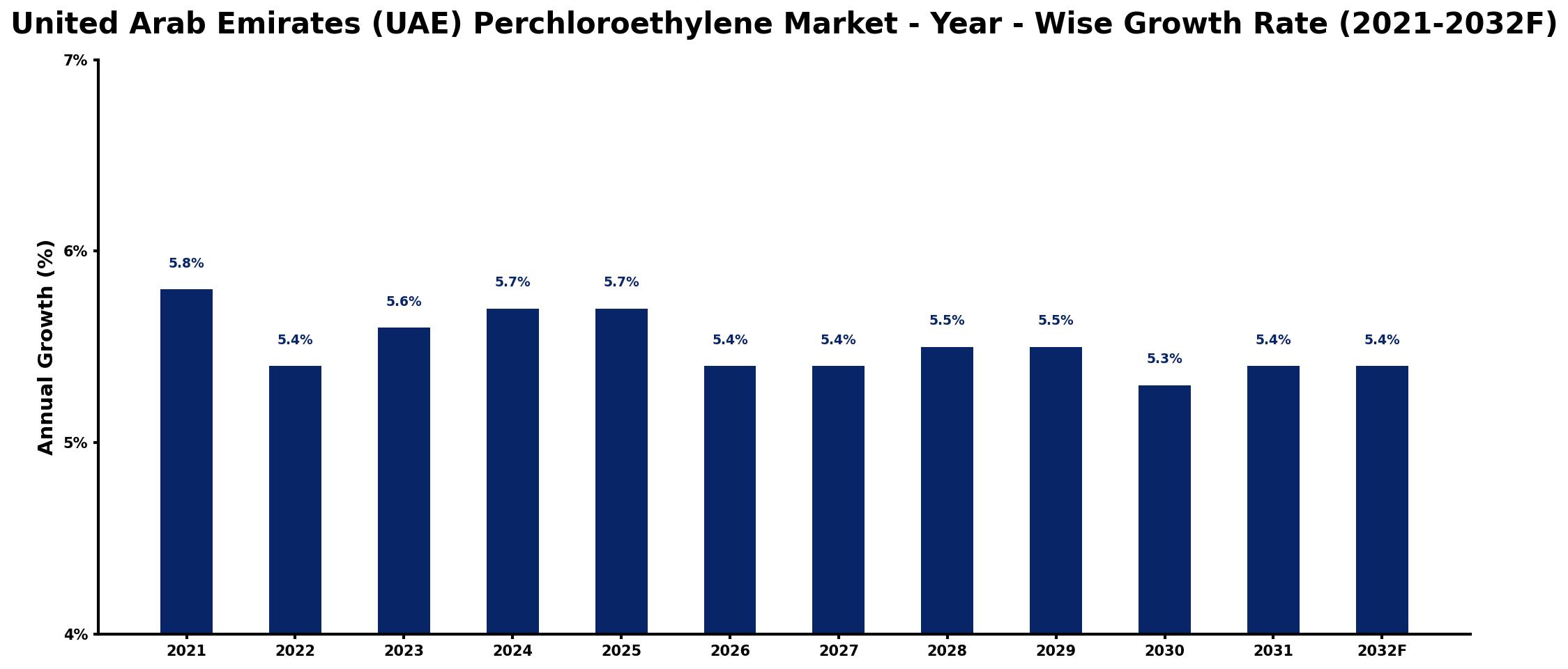
The table below presents the year‑wise growth rates along with the key drivers influencing the market
| Year | Growth Rate | Major Drivers |
| 2021 | 5.8% | Rising demand in dry cleaning |
| 2022 | 5.4% | Expansion of industrial cleaning sector |
| 2023 | 5.6% | Increased focus on environmental regulations |
| 2024 | 5.7% | Growth in automotive maintenance services |
| 2025 | 5.7% | Surge in textile manufacturing activities |
| 2026 | 5.4% | Investments in chemical processing facilities |
| 2027 | 5.4% | Growing demand from electronics industry |
| 2028 | 5.5% | Rise in construction activities nationwide |
| 2029 | 5.5% | Emergence of new cleaning technologies |
| 2030 | 5.3% | Increased usage in degreasing applications |
| 2031 | 5.4% | Focus on sustainable cleaning solutions |
| 2032 | 5.4% | growing downstream application demand |
Note: Market size estimations and growth projections presented in this report are based on 6Wresearch's proprietary forecasting methodology, utilizing the latest available industry data, government publications, and primary research inputs.
United Arab Emirates (UAE) Perchloroethylene Market Synopsis
The perchloroethylene market in the UAE has displayed notable resilience, even amidst environmental and regulatory pressures. As industries increasingly navigate the complexities of compliance and sustainability, there is a dynamic shift towards the exploration of greener alternatives while still relying on conventional uses of perchloroethylene.
Looking forward, while the market maintains steady growth, the escalating scrutiny over VOC emissions and health risks associated with perchloroethylene use poses significant challenges. This juxtaposition of demand stability against emerging regulatory frameworks shapes the market's future landscape.
United Arab Emirates (UAE) Perchloroethylene Market Key Takeaways
- The market is expected to see substantial growth from 2025 to 2032, driven by the textile and dry cleaning industries.
- Heightened environmental regulations are pushing industries towards alternative solvents.
- Worker safety concerns are leading to stricter handling and disposal regulations, affecting operational costs.
- The economic recovery post-COVID-19 is anticipated to stabilize demand in the industrial sector.
- Environmental awareness is catalyzing a transition towards more sustainable practices in chemical usage.
Evaluation of Restraints in United Arab Emirates (UAE) Perchloroethylene Market
A multitude of restraints impacts the UAE perchloroethylene market, primarily centered around environmental concerns. The volatile organic compound classification of perchloroethylene raises alarms regarding its implications for air quality and groundwater contamination. As awareness of climate and health issues mounts globally, industries are faced with increasing pressure to limit their reliance on this chemical. Furthermore, health risks associated with perchloroethylene exposure complicate its adoption, as businesses confront potential liability and regulatory penalties. These factors necessitate a delicate balancing act between maintaining current production levels and transitioning to sustainable alternatives.
United Arab Emirates (UAE) Perchloroethylene Market Trends
The market is witnessing several emerging trends that are reshaping demand dynamics. Notably, the adoption of advanced technology in dry cleaning processes is allowing for more efficient use of perchloroethylene while minimizing exposure risks. Additionally, as sustainability becomes a focal point for businesses, there is an increasing trend towards the research and development of bio-based and less hazardous solvents. This shift not only reflects changing consumer preferences but also aligns with broader regulatory expectations aimed at reducing environmental impacts.
United Arab Emirates (UAE) Perchloroethylene Market Opportunities
Despite the challenges, several avenues for growth and investment exist within the UAE perchloroethylene market. One of the most promising opportunities lies in the development of innovative cleaning technologies that utilize perchloroethylene more efficiently or in combination with safer alternatives. Furthermore, the governments focus on sustainable industrial practices provides a fertile ground for companies willing to invest in eco-friendly processes. Exploring markets beyond dry cleaning—such as metal degreasing and chemical manufacturing—could also open new revenue streams, especially as industrial output in the UAE continues to expand.
Government Initiatives in the United Arab Emirates (UAE) Perchloroethylene Market
The UAE government has been proactive in establishing policies aimed at enhancing environmental protection and promoting sustainability in various sectors, including chemical manufacturing. Through initiatives that emphasize waste reduction and the adoption of cleaner technologies, the government is fostering a regulatory environment that encourages industries to transition away from hazardous chemicals. Public spending on research and development for alternative solvents and sustainable practices further reflects the commitment to a greener economy.
Future Insights of the United Arab Emirates (UAE) Perchloroethylene Market
Looking ahead to the period from 2026 to 2032, the UAE perchloroethylene market is poised for an evolution characterized by a dual approach of growth and transition. As demand from traditional sectors stabilizes, businesses will likely ramp up efforts to innovate and comply with stricter environmental regulations. This dual focus on maintaining production levels while adapting to changing norms will be crucial for industry players aiming to remain competitive in a landscape increasingly defined by sustainability and safety.
United Arab Emirates (UAE) Perchloroethylene Market Latest Developments (2025 - 2026)
Recent developments in the UAE perchloroethylene market indicate a significant shift towards compliance with new environmental regulations. Companies are actively seeking innovative solutions that align with sustainability goals while maintaining operational efficiency. There has been a noticeable increase in partnerships aimed at developing and testing alternative solvents, signaling an industry-wide commitment to improving the safety and environmental profile of cleaning processes.
United Arab Emirates (UAE) Perchloroethylene Market - Key Attractiveness of the Report
- 10 Years of Market Numbers
- Historical Data Starting from 2022 to 2025
- Base Year: 2025
- Forecast Data until 2032
- Key Performance Indicators Impacting the Market
- Major Upcoming Developments and Projects
Key Highlights of the Report:
- United Arab Emirates (UAE) Perchloroethylene Market Outlook
- Market Size of United Arab Emirates (UAE) Perchloroethylene Market, 2025
- Forecast of United Arab Emirates (UAE) Perchloroethylene Market, 2032
- Historical Data and Forecast of United Arab Emirates (UAE) Perchloroethylene Revenues & Volume for the Period 2022-2032F
- United Arab Emirates (UAE) Perchloroethylene Market Trend Evolution
- United Arab Emirates (UAE) Perchloroethylene Market Drivers and Challenges
- United Arab Emirates (UAE) Perchloroethylene Price Trends
- United Arab Emirates (UAE) Perchloroethylene Porter's Five Forces
- United Arab Emirates (UAE) Perchloroethylene Industry Life Cycle
- Historical Data and Forecast of United Arab Emirates (UAE) Perchloroethylene Market Revenues & Volume By Type for the Period 2022-2032F
- Historical Data and Forecast of United Arab Emirates (UAE) Perchloroethylene Market Revenues & Volume By Ethylene Oxychlorination for the Period 2022-2032F
- Historical Data and Forecast of United Arab Emirates (UAE) Perchloroethylene Market Revenues & Volume By Acetylene Method for the Period 2022-2032F
- Historical Data and Forecast of United Arab Emirates (UAE) Perchloroethylene Market Revenues & Volume By Ethylene Direct Chlorination for the Period 2022-2032F
- Historical Data and Forecast of United Arab Emirates (UAE) Perchloroethylene Market Revenues & Volume By End-use for the Period 2022-2032F
- Historical Data and Forecast of United Arab Emirates (UAE) Perchloroethylene Market Revenues & Volume By Dry Cleaning Agent for the Period 2022-2032F
- Historical Data and Forecast of United Arab Emirates (UAE) Perchloroethylene Market Revenues & Volume By Solvent for the Period 2022-2032F
- Historical Data and Forecast of United Arab Emirates (UAE) Perchloroethylene Market Revenues & Volume By Others for the Period 2022-2032F
- United Arab Emirates (UAE) Perchloroethylene Import Export Trade Statistics
- Market Opportunity Assessment By Type
- Market Opportunity Assessment By End-use
- United Arab Emirates (UAE) Perchloroethylene Top Companies Market Share
- United Arab Emirates (UAE) Perchloroethylene Competitive Benchmarking By Technical and Operational Parameters
- United Arab Emirates (UAE) Perchloroethylene Company Profiles
- United Arab Emirates (UAE) Perchloroethylene Key Strategic Recommendations






































