United Arab Emirates (UAE) Perfume Ingredients Chemicals Market Size, Share & Growth Rate
The United Arab Emirates (UAE) Perfume Ingredients Chemicals Market was estimated at USD 925 Million in 2025 and is projected to reach USD 1338 Million by 2032, growing at a CAGR of 5.4% from 2026 to 2032. This growth is fueled by a booming cosmetics sector and the UAE's vibrant cultural affinity for fragrances, creating a continuous demand for high-quality perfume ingredients. Additionally, innovation in fragrance formulations and a shift towards natural and sustainable ingredients are transforming the market landscape.
United Arab Emirates (UAE) Perfume Ingredients Chemicals Market Year-wise Growth Rate and Key Drivers
This graph highlights how the United Arab Emirates (UAE) Perfume Ingredients Chemicals Market has steadily grown over the years, supported by major growth factors.
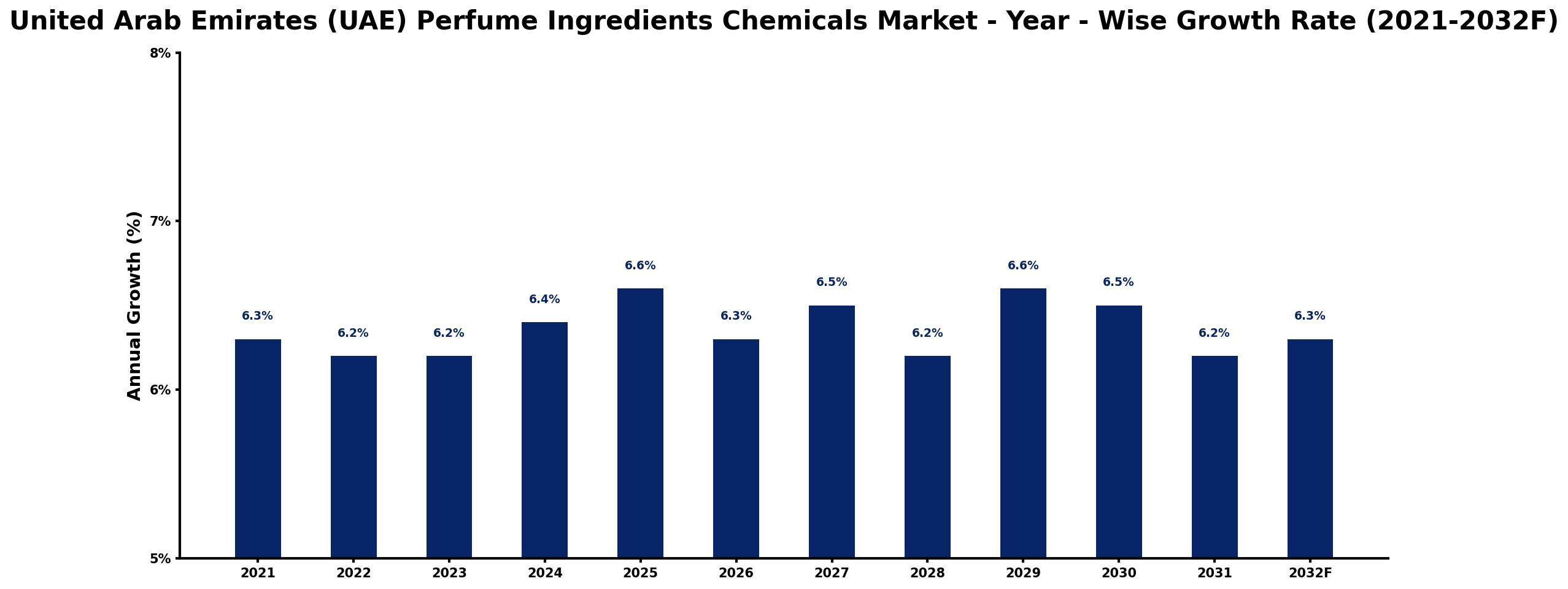
The table below presents the year‑wise growth rates along with the key drivers influencing the market
| Year | Growth Rate | Major Drivers |
| 2021 | 6.3% | Rising consumer spending on luxury |
| 2022 | 6.2% | Increased focus on sustainability practices |
| 2023 | 6.2% | Expansion of online retail platforms |
| 2024 | 6.4% | Growing popularity of niche brands |
| 2025 | 6.6% | Investment in research and development |
| 2026 | 6.3% | Adoption of innovative marketing strategies |
| 2027 | 6.5% | Enhanced distribution network efficiency |
| 2028 | 6.2% | Surge in demand for personalization |
| 2029 | 6.6% | Collaborations with fashion industries |
| 2030 | 6.5% | Emergence of eco-friendly packaging solutions |
| 2031 | 6.2% | Strengthened regulatory compliance initiatives |
| 2032 | 6.3% | Growing interest in artisanal products |
Note: Market size estimations and growth projections presented in this report are based on 6Wresearch's proprietary forecasting methodology, utilizing the latest available industry data, government publications, and primary research inputs.
United Arab Emirates (UAE) Perfume Ingredients Chemicals Market Synopsis
The UAE's perfume ingredients chemicals market stands out due to its unique blend of traditional values and modern trends in fragrance. This dynamic environment is characterized by a strong demand for both synthetic and natural ingredients, reflecting consumers' evolving preferences.
As the region continues to embrace luxury and bespoke perfumes, the market is witnessing a rise in innovative fragrance compositions that cater to diverse tastes. The strategic positioning of the UAE as a trade hub further enhances its potential, facilitating access to premium fragrance compounds from around the world.
United Arab Emirates (UAE) Perfume Ingredients Chemicals Market Key Takeaways
- The UAE fragrance industry shows robust growth, driven by cultural affinity for perfumes.
- There is a notable shift towards sustainable and eco-friendly fragrance ingredients among consumers.
- The market is adapting to rapidly changing consumer preferences and trends, posing both opportunities and challenges.
- Innovation in fragrance formulation technology is leading to new product development in the market.
- Regulatory compliance concerning safety and ingredient labeling remains a critical factor for manufacturers.
Evaluation of Restraints in United Arab Emirates (UAE) Perfume Ingredients Chemicals Market
Despite its growth, the UAE perfume ingredients chemicals market faces significant constraints that can hinder progress. The volatility of consumer preferences in the fragrance industry poses a challenge to manufacturers, complicating accurate demand forecasting. Frequent shifts in trends may lead to excess inventory or product wastage if brands cannot keep up with consumer desires. Furthermore, the increasing preference for sustainable and natural ingredients creates pressure on traditional synthetic ingredient suppliers to adapt their offerings. Compliance with complex regulations surrounding ingredient safety and labeling also adds to the operational burden for companies within this sector.
United Arab Emirates (UAE) Perfume Ingredients Chemicals Market Trends
Key trends in the UAE perfume ingredients chemicals market include a rising consumer shift towards organic and sustainable fragrances, aligning with global environmental concerns. Innovations in technology have led to the introduction of more complex scent profiles, often incorporating rare and exotic ingredients. Additionally, the influence of social media in promoting niche and artisanal perfumes has become significant, driving demand for unique and bespoke fragrance formulations.
United Arab Emirates (UAE) Perfume Ingredients Chemicals Market Opportunities
The market presents several growth opportunities, particularly for companies willing to invest in research and development focused on sustainable practices. Developing eco-friendly fragrance lines can cater to the increasing demand for natural products. Moreover, there is potential for market expansion through partnerships with local artisans and niche brands, harnessing the UAE's rich cultural tapestry to create unique fragrances that appeal to both local and international markets.
Government Initiatives in the United Arab Emirates (UAE) Perfume Ingredients Chemicals Market
The UAE government has been proactive in fostering the growth of the fragrance industry through supportive policies and initiatives aimed at enhancing local manufacturing capabilities. Incentives for businesses to adopt sustainable practices are increasingly prominent, reflecting a broader commitment to environmental stewardship. Programs that encourage innovation and research in the cosmetics and fragrance sectors are also in place, enabling companies to enhance their competitive edge.
Future Insights of the United Arab Emirates (UAE) Perfume Ingredients Chemicals Market
Looking ahead to 2026-2032, the UAE perfume ingredients chemicals market is poised for continued growth driven by evolving consumer demands and technological advancements. As consumers become more discerning regarding fragrance authenticity and sustainability, brands that can effectively respond to these preferences are likely to thrive. The rise of e-commerce and digital platforms also presents new avenues for distribution and consumer engagement, further propelling market expansion.
United Arab Emirates (UAE) Perfume Ingredients Chemicals Market Latest Developments (2025 - 2026)
Recent developments in the UAE perfume ingredients chemicals market indicate a surge in innovation with an emphasis on sustainability. Many companies are actively reformulating their products to incorporate natural ingredients, responding to consumer preferences for cleaner labels. Additionally, collaborations between local and international fragrance houses have emerged, focusing on unique, culturally inspired scents that reflect the UAEs rich heritage. Trends also show increasing digitalization within retail, enhancing consumer access to diverse fragrance offerings.
United Arab Emirates (UAE) Perfume Ingredients Chemicals Market - Key Attractiveness of the Report
- 10 Years of Market Numbers
- Historical Data Starting from 2022 to 2025
- Base Year: 2025
- Forecast Data until 2032
- Key Performance Indicators Impacting the Market
- Major Upcoming Developments and Projects
Key Highlights of the Report:
- United Arab Emirates (UAE) Perfume Ingredients Chemicals Market Outlook
- Market Size of United Arab Emirates (UAE) Perfume Ingredients Chemicals Market, 2025
- Forecast of United Arab Emirates (UAE) Perfume Ingredients Chemicals Market, 2032
- Historical Data and Forecast of United Arab Emirates (UAE) Perfume Ingredients Chemicals Revenues & Volume for the Period 2022-2032F
- United Arab Emirates (UAE) Perfume Ingredients Chemicals Market Trend Evolution
- United Arab Emirates (UAE) Perfume Ingredients Chemicals Market Drivers and Challenges
- United Arab Emirates (UAE) Perfume Ingredients Chemicals Price Trends
- United Arab Emirates (UAE) Perfume Ingredients Chemicals Porter's Five Forces
- United Arab Emirates (UAE) Perfume Ingredients Chemicals Industry Life Cycle
- Historical Data and Forecast of United Arab Emirates (UAE) Perfume Ingredients Chemicals Market Revenues & Volume By Type for the Period 2022-2032F
- Historical Data and Forecast of United Arab Emirates (UAE) Perfume Ingredients Chemicals Market Revenues & Volume By Aromatic chemicals for the Period 2022-2032F
- Historical Data and Forecast of United Arab Emirates (UAE) Perfume Ingredients Chemicals Market Revenues & Volume By Essential oils for the Period 2022-2032F
- Historical Data and Forecast of United Arab Emirates (UAE) Perfume Ingredients Chemicals Market Revenues & Volume By Application for the Period 2022-2032F
- Historical Data and Forecast of United Arab Emirates (UAE) Perfume Ingredients Chemicals Market Revenues & Volume By Soaps and detergents for the Period 2022-2032F
- Historical Data and Forecast of United Arab Emirates (UAE) Perfume Ingredients Chemicals Market Revenues & Volume By Cosmetics and toiletries for the Period 2022-2032F
- Historical Data and Forecast of United Arab Emirates (UAE) Perfume Ingredients Chemicals Market Revenues & Volume By Fine fragrances for the Period 2022-2032F
- Historical Data and Forecast of United Arab Emirates (UAE) Perfume Ingredients Chemicals Market Revenues & Volume By Others for the Period 2022-2032F
- United Arab Emirates (UAE) Perfume Ingredients Chemicals Import Export Trade Statistics
- Market Opportunity Assessment By Type
- Market Opportunity Assessment By Application
- United Arab Emirates (UAE) Perfume Ingredients Chemicals Top Companies Market Share
- United Arab Emirates (UAE) Perfume Ingredients Chemicals Competitive Benchmarking By Technical and Operational Parameters
- United Arab Emirates (UAE) Perfume Ingredients Chemicals Company Profiles
- United Arab Emirates (UAE) Perfume Ingredients Chemicals Key Strategic Recommendations






































