United Arab Emirates (UAE) Piano Market Size, Share & Growth Rate
The United Arab Emirates (UAE) Piano Market was estimated at USD 1338 Million in 2025 and is projected to reach USD 1933 Million by 2032, growing at a CAGR of 5.4% from 2026 to 2032. This growth trajectory is significantly influenced by the increasing interest in music education and the expanding presence of music schools, which encourage both individual and collective musical pursuits. The demand for quality instruments, particularly among affluent households, further complements this trend, illustrating the UAE's commitment to nurturing artistic talent.
United Arab Emirates (UAE) Piano Market Year-wise Growth Rate and Key Drivers
This graph highlights how the United Arab Emirates (UAE) Piano Market has steadily grown over the years, supported by major growth factors.
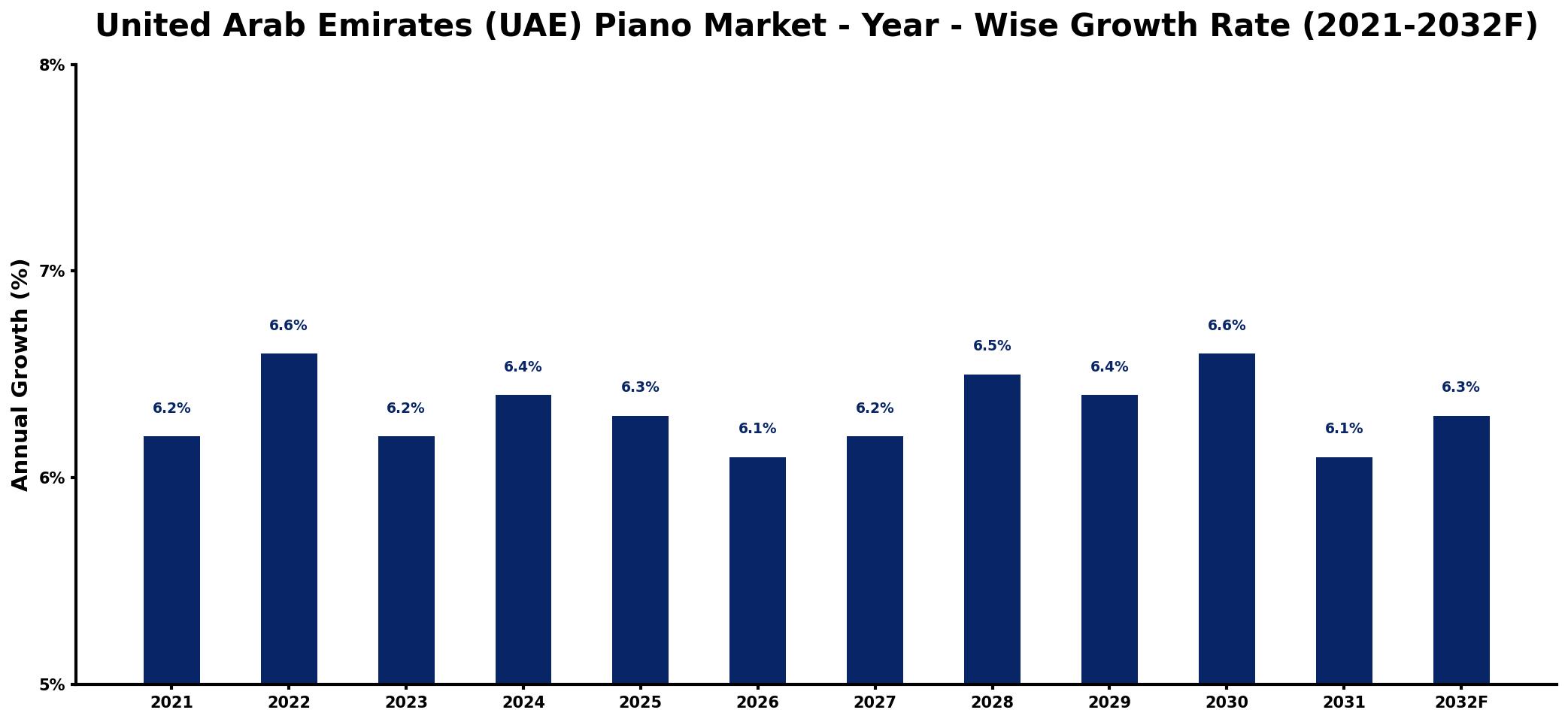
The table below presents the year‑wise growth rates along with the key drivers influencing the market
| Year | Growth Rate | Major Drivers |
| 2021 | 6.2% | Rising interest in music education |
| 2022 | 6.6% | Increase in disposable income levels |
| 2023 | 6.2% | Growing popularity of music events |
| 2024 | 6.4% | Expansion of music retail outlets |
| 2025 | 6.3% | Increased investment in cultural initiatives |
| 2026 | 6.1% | Heightened demand for online lessons |
| 2027 | 6.2% | Emergence of new music genres |
| 2028 | 6.5% | Boost in home entertainment spending |
| 2029 | 6.4% | Growth in family-oriented activities |
| 2030 | 6.6% | Surge in digital music platforms |
| 2031 | 6.1% | improved raw material availability |
| 2032 | 6.3% | Rising awareness of music therapy |
Note: Market size estimations and growth projections presented in this report are based on 6Wresearch's proprietary forecasting methodology, utilizing the latest available industry data, government publications, and primary research inputs.
United Arab Emirates (UAE) Piano Market Synopsis
The strongest force shaping the United Arab Emirates (UAE) Piano Market today is the burgeoning interest in music education among the population. Parents are increasingly recognizing the value of music in a child's development, leading to a rise in piano enrollments at local academies and institutions. This growing appreciation not only stimulates demand for pianos but also enriches the cultural landscape of the UAE.
Alongside the educational drive, the market caters to an array of consumers, from passionate musicians to hotels seeking to enhance ambiance. The availability of both traditional and modern piano options allows for a diverse customer base, ensuring that everyone—from beginners to seasoned players—can find an instrument that fits their aspirations and surroundings.
United Arab Emirates (UAE) Piano Market Key Takeaways
- The UAE Piano Market is projected to reach USD 1933 Million by 2032, reflecting a robust growth rate.
- Increased focus on music education among the youth is a primary driver of market demand.
- Affluent households significantly contribute to the market, fueling demand for high-quality pianos.
- Competition from digital instruments influences product offerings and market dynamics.
- Cultural appreciation for music, especially Western classical, enhances consumer engagement with pianos.
Evaluation of Restraints in United Arab Emirates (UAE) Piano Market
The UAE Piano Market grapples with several restraints that could hinder its growth. Economic fluctuations often render pianos luxury items, and during downturns, consumer spending tends to tighten, significantly affecting sales. Additionally, regulatory import barriers and high transportation costs contribute to increased pricing, making pianos less accessible to a broader audience. Cultural factors also play a role, as shifting musical preferences can lead to fluctuations in demand for traditional pianos versus digital alternatives.
United Arab Emirates (UAE) Piano Market Trends
Several trends are currently shaping the United Arab Emirates (UAE) Piano Market, notably the rise of online learning platforms that are making piano education more accessible than ever. This trend gained momentum during the COVID-19 pandemic, encouraging a shift towards digital instruction and remote learning. Furthermore, the growing integration of technology into pianos, such as smart features and app connectivity, is attracting a younger audience eager to blend traditional music with modern capabilities. This innovative approach not only enhances the user experience but also adapts to the evolving musical landscape.
United Arab Emirates (UAE) Piano Market Opportunities
The United Arab Emirates (UAE) Piano Market presents multiple opportunities for growth and investment. As the nation continues to invest in arts and culture, new initiatives supporting music education can pave the way for expanded market access. This includes potential collaborations with educational institutions to provide tailored programs that highlight the significance of piano education. Additionally, the increasing trend towards experiential marketing—such as piano events, competitions, and workshops—offers avenues for engagement and brand promotion, further driving market interest.
Government Initiatives in the United Arab Emirates (UAE) Piano Market
The UAE government has shown a commitment to fostering arts and culture, evident through various initiatives aimed at enhancing music education and promoting artistic talent. Investments in cultural programs, public art projects, and partnerships with educational institutions are pivotal in encouraging a musical renaissance across the country. These efforts not only provide resources for aspiring musicians but also help embed music into the cultural fabric of society, further nurturing the piano market.
Future Insights of the United Arab Emirates (UAE) Piano Market
Looking ahead to 2026-2032, the United Arab Emirates (UAE) Piano Market is poised for considerable expansion. As the educational landscape evolves with an ongoing focus on music, coupled with a stable affluent consumer base, the demand for quality instruments is expected to rise. The integration of innovative technologies into pianos and the expansion of digital learning platforms will likely attract new enthusiasts, ensuring sustained growth and diversification in the offerings available to consumers.
United Arab Emirates (UAE) Piano Market Latest Developments (2025 - 2026)
Recent developments in the United Arab Emirates Piano Market highlight a shift towards more interactive and engaging learning experiences. Music schools are increasingly adopting blended learning approaches that combine traditional instruction with digital platforms, enhancing accessibility for students. Additionally, there has been a notable increase in community-oriented piano events and festivals that aim to foster a greater appreciation for music among the public.
United Arab Emirates (UAE) Piano Market - Key Attractiveness of the Report
- 10 Years of Market Numbers
- Historical Data Starting from 2022 to 2025
- Base Year: 2025
- Forecast Data until 2032
- Key Performance Indicators Impacting the Market
- Major Upcoming Developments and Projects
Key Highlights of the Report:
- United Arab Emirates (UAE) Piano Market Outlook
- Market Size of United Arab Emirates (UAE) Piano Market, 2025
- Forecast of United Arab Emirates (UAE) Piano Market, 2032
- Historical Data and Forecast of United Arab Emirates (UAE) Piano Revenues & Volume for the Period 2022-2032F
- United Arab Emirates (UAE) Piano Market Trend Evolution
- United Arab Emirates (UAE) Piano Market Drivers and Challenges
- United Arab Emirates (UAE) Piano Price Trends
- United Arab Emirates (UAE) Piano Porter's Five Forces
- United Arab Emirates (UAE) Piano Industry Life Cycle
- Historical Data and Forecast of United Arab Emirates (UAE) Piano Market Revenues & Volume By Type for the Period 2022-2032F
- Historical Data and Forecast of United Arab Emirates (UAE) Piano Market Revenues & Volume By Grand Piano for the Period 2022-2032F
- Historical Data and Forecast of United Arab Emirates (UAE) Piano Market Revenues & Volume By Upright Piano for the Period 2022-2032F
- Historical Data and Forecast of United Arab Emirates (UAE) Piano Market Revenues & Volume By Application for the Period 2022-2032F
- Historical Data and Forecast of United Arab Emirates (UAE) Piano Market Revenues & Volume By Learning and Teaching for the Period 2022-2032F
- Historical Data and Forecast of United Arab Emirates (UAE) Piano Market Revenues & Volume By Entertainment for the Period 2022-2032F
- Historical Data and Forecast of United Arab Emirates (UAE) Piano Market Revenues & Volume By Other for the Period 2022-2032F
- United Arab Emirates (UAE) Piano Import Export Trade Statistics
- Market Opportunity Assessment By Type
- Market Opportunity Assessment By Application
- United Arab Emirates (UAE) Piano Top Companies Market Share
- United Arab Emirates (UAE) Piano Competitive Benchmarking By Technical and Operational Parameters
- United Arab Emirates (UAE) Piano Company Profiles
- United Arab Emirates (UAE) Piano Key Strategic Recommendations






































