United Arab Emirates (UAE) Planes, Helicopters, and Spacecraft Market Size, Share & Growth Rate
The United Arab Emirates (UAE) Planes, Helicopters, and Spacecraft Market was estimated at USD 151 Million in 2025 and is projected to reach USD 213 Million by 2032, growing at a CAGR of 5.0% from 2026 to 2032. This growth trajectory is fueled by the UAE's strategic investments in aerospace technologies and its robust space initiatives, including the ambitious goals set by the UAE Space Agency. Furthermore, the country's strategic location as a transit hub for global air travel bolsters demand across various segments of the market.
United Arab Emirates (UAE) Planes, Helicopters, and Spacecraft Market Year-wise Growth Rate and Key Drivers
This graph highlights how the United Arab Emirates (UAE) Planes, Helicopters, and Spacecraft Market has steadily grown over the years, supported by major growth factors.
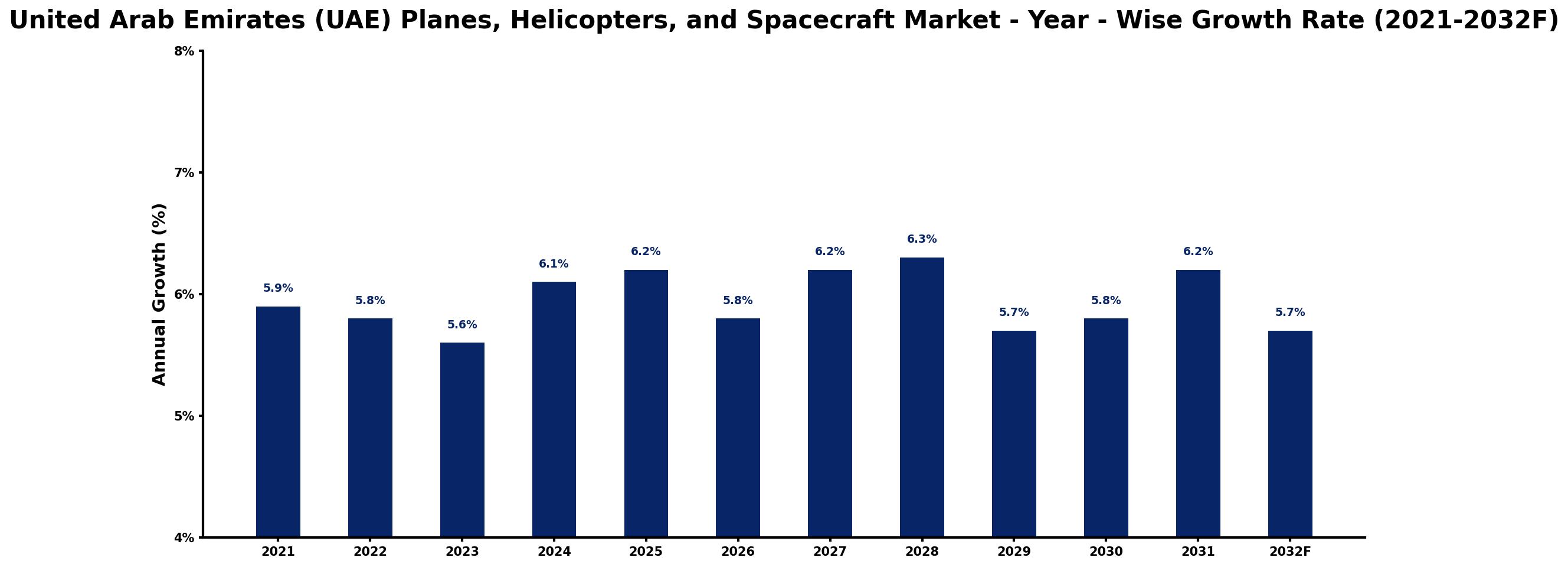
The table below presents the year‑wise growth rates along with the key drivers influencing the market
| Year | Growth Rate | Major Drivers |
| 2021 | 5.9% | Increased defense spending initiatives |
| 2022 | 5.8% | Rising demand for commercial travel |
| 2023 | 5.6% | Expansion of aerospace manufacturing sector |
| 2024 | 6.1% | Growing tourism boosting travel needs |
| 2025 | 6.2% | Investments in advanced technologies |
| 2026 | 5.8% | Emerging markets requiring transportation solutions |
| 2027 | 6.2% | Strengthened international trade agreements |
| 2028 | 6.3% | Innovations in sustainable aviation practices |
| 2029 | 5.7% | Increased focus on regional security |
| 2030 | 5.8% | Development of urban mobility projects |
| 2031 | 6.2% | Enhanced research and development funding |
| 2032 | 5.7% | Collaborations between industry stakeholders |
Note: Market size estimations and growth projections presented in this report are based on 6Wresearch's proprietary forecasting methodology, utilizing the latest available industry data, government publications, and primary research inputs.
United Arab Emirates (UAE) Planes, Helicopters, and Spacecraft Market Synopsis
The UAE's aerospace sector has recently gained significant momentum, marked by increased government support and investment in innovation. As this momentum builds, the market is positioned to capitalize on expanding demand for advanced aerospace technologies and services, especially in the realms of space exploration and air transportation.
Looking ahead, the UAE Plans, Helicopters, and Spacecraft Market is poised for substantial growth as it embraces cutting-edge technologies and navigates emerging challenges. With ongoing developments in the region and a focus on enhancing capabilities, the market is likely to attract further investments and partnerships in the coming years.
United Arab Emirates (UAE) Planes, Helicopters, and Spacecraft Market Key Takeaways
- The market is on a growth trajectory, with a projected value of USD 213 Million by 2032.
- Government initiatives, particularly through the UAE Space Agency, are driving demand for advanced technologies.
- The strategic geographical location of the UAE enhances its position as a global transit hub for air travel.
- Resilience in the market was demonstrated during the COVID-19 pandemic through sustained investments in defense and space technologies.
- The competitive landscape is challenging, with international players vying for a share of the lucrative contracts.
Evaluation of Restraints in United Arab Emirates (UAE) Planes, Helicopters, and Spacecraft Market
Despite robust growth prospects, the UAE Planes, Helicopters, and Spacecraft Market faces significant restraints that could hinder its progress. One primary concern is the intense competition from established global players, which necessitates continuous innovation and technological advancement to secure contracts. Moreover, fluctuations in the global economy and geopolitical tensions can introduce uncertainty, affecting investment decisions and overall market stability. Addressing these challenges will be vital for maintaining a competitive edge and ensuring long-term growth.
United Arab Emirates (UAE) Planes, Helicopters, and Spacecraft Market Trends
Several key trends are currently shaping the UAE's aerospace sector. The increasing focus on sustainable aviation technologies is driving interest in fuel-efficient aircraft and eco-friendly practices. Moreover, the proliferation of digital technologies, such as data analytics and AI, is enhancing operational efficiencies within the sector. As the UAE continues to prioritize its space exploration agenda, advancements in spacecraft design and satellite technologies are expected to gain traction, supporting the nation's vision for technological leadership.
United Arab Emirates (UAE) Planes, Helicopters, and Spacecraft Market Opportunities
The UAE presents lucrative opportunities in the aerospace market, particularly in sectors related to military and defense technologies. With the government's emphasis on enhancing national security, investments in advanced aircraft and drones are likely to rise. Additionally, the growing private sector's interest in aviation services and charter flights opens avenues for new business models and partnerships. The ongoing expansion of infrastructure at airports and space facilities further bolsters investment prospects, creating a favorable environment for innovative aerospace ventures.
Government Initiatives in the United Arab Emirates (UAE) Planes, Helicopters, and Spacecraft Market
The UAE government is actively promoting its aerospace and aviation industries through various initiatives and policies aimed at fostering growth. The establishment of the UAE Space Agency exemplifies this commitment, supporting research and development in space exploration and technology. Public spending is focused on upgrading airport infrastructure and enhancing air traffic management systems, which collectively contribute to bolstering the nation's capabilities in both commercial aviation and space missions. Furthermore, incentives for private investments in aerospace manufacturing are being developed to attract global players to establish operations within the UAE.
Future Insights of the United Arab Emirates (UAE) Planes, Helicopters, and Spacecraft Market
Looking forward to 2026-2032, the UAE Planes, Helicopters, and Spacecraft Market is anticipated to experience sustained growth, driven by continuous government backing and innovation in technology. As the UAE cements its role as a global aerospace hub, investments in both commercial and defense sectors are expected to flourish. The strategic focus on enhancing satellite capabilities and exploring partnerships for space missions will further solidify the UAE's position in the global aerospace arena. Overall, the market is on track for a promising future, guided by ambitious national goals and a commitment to advanced technology.
United Arab Emirates (UAE) Planes, Helicopters, and Spacecraft Market Latest Developments (2025 - 2026)
Recent developments in the UAE's aerospace sector indicate a strong focus on innovation and collaboration. Government-backed projects aimed at enhancing satellite capabilities are advancing, signaling a commitment to expanding the nation's space program. Concurrently, efforts to modernize commercial aircraft and helicopter fleets are underway, reflecting a drive towards operational efficiency and sustainability. As investments continue to flow into the sector, the UAE is positioning itself to achieve its ambitious aerospace objectives.
United Arab Emirates (UAE) Planes, Helicopters, and Spacecraft Market - Key Attractiveness of the Report
- 10 Years of Market Numbers
- Historical Data Starting from 2022 to 2025
- Base Year: 2025
- Forecast Data until 2032
- Key Performance Indicators Impacting the Market
- Major Upcoming Developments and Projects
Key Highlights of the Report:
- United Arab Emirates (UAE) Planes, Helicopters, and Spacecraft Market Outlook
- Market Size of United Arab Emirates (UAE) Planes, Helicopters, and Spacecraft Market, 2025
- Forecast of United Arab Emirates (UAE) Planes, Helicopters, and Spacecraft Market, 2032
- Historical Data and Forecast of United Arab Emirates (UAE) Planes, Helicopters, and Spacecraft Revenues & Volume for the Period 2022-2032F
- United Arab Emirates (UAE) Planes, Helicopters, and Spacecraft Market Trend Evolution
- United Arab Emirates (UAE) Planes, Helicopters, and Spacecraft Market Drivers and Challenges
- United Arab Emirates (UAE) Planes, Helicopters, and Spacecraft Price Trends
- United Arab Emirates (UAE) Planes, Helicopters, and Spacecraft Porter's Five Forces
- United Arab Emirates (UAE) Planes, Helicopters, and Spacecraft Industry Life Cycle
- Historical Data and Forecast of United Arab Emirates (UAE) Planes, Helicopters, and Spacecraft Market Revenues & Volume By End User for the Period 2022-2032F
- Historical Data and Forecast of United Arab Emirates (UAE) Planes, Helicopters, and Spacecraft Market Revenues & Volume By Aviation for the Period 2022-2032F
- Historical Data and Forecast of United Arab Emirates (UAE) Planes, Helicopters, and Spacecraft Market Revenues & Volume By Military for the Period 2022-2032F
- Historical Data and Forecast of United Arab Emirates (UAE) Planes, Helicopters, and Spacecraft Market Revenues & Volume By Private for the Period 2022-2032F
- Historical Data and Forecast of United Arab Emirates (UAE) Planes, Helicopters, and Spacecraft Market Revenues & Volume By Others for the Period 2022-2032F
- United Arab Emirates (UAE) Planes, Helicopters, and Spacecraft Import Export Trade Statistics
- Market Opportunity Assessment By End User
- United Arab Emirates (UAE) Planes, Helicopters, and Spacecraft Top Companies Market Share
- United Arab Emirates (UAE) Planes, Helicopters, and Spacecraft Competitive Benchmarking By Technical and Operational Parameters
- United Arab Emirates (UAE) Planes, Helicopters, and Spacecraft Company Profiles
- United Arab Emirates (UAE) Planes, Helicopters, and Spacecraft Key Strategic Recommendations






































