United Arab Emirates (UAE) Recycled Textiles Market Size, Share & Growth Rate
The United Arab Emirates (UAE) Recycled Textiles Market was estimated at USD 424 Million in 2025 and is projected to reach USD 588 Million by 2032, growing at a CAGR of 4.8% from 2026 to 2032. This anticipated growth is propelled by increasing consumer awareness surrounding sustainability and a national shift toward eco-friendly practices. As the UAE continues to embrace circular economy principles, the recycled textiles sector is positioned to play a crucial role in reducing environmental impact while providing innovative fashion solutions.
United Arab Emirates (UAE) Recycled Textiles Market Year-wise Growth Rate and Key Drivers
This graph highlights how the United Arab Emirates (UAE) Recycled Textiles Market has steadily grown over the years, supported by major growth factors.
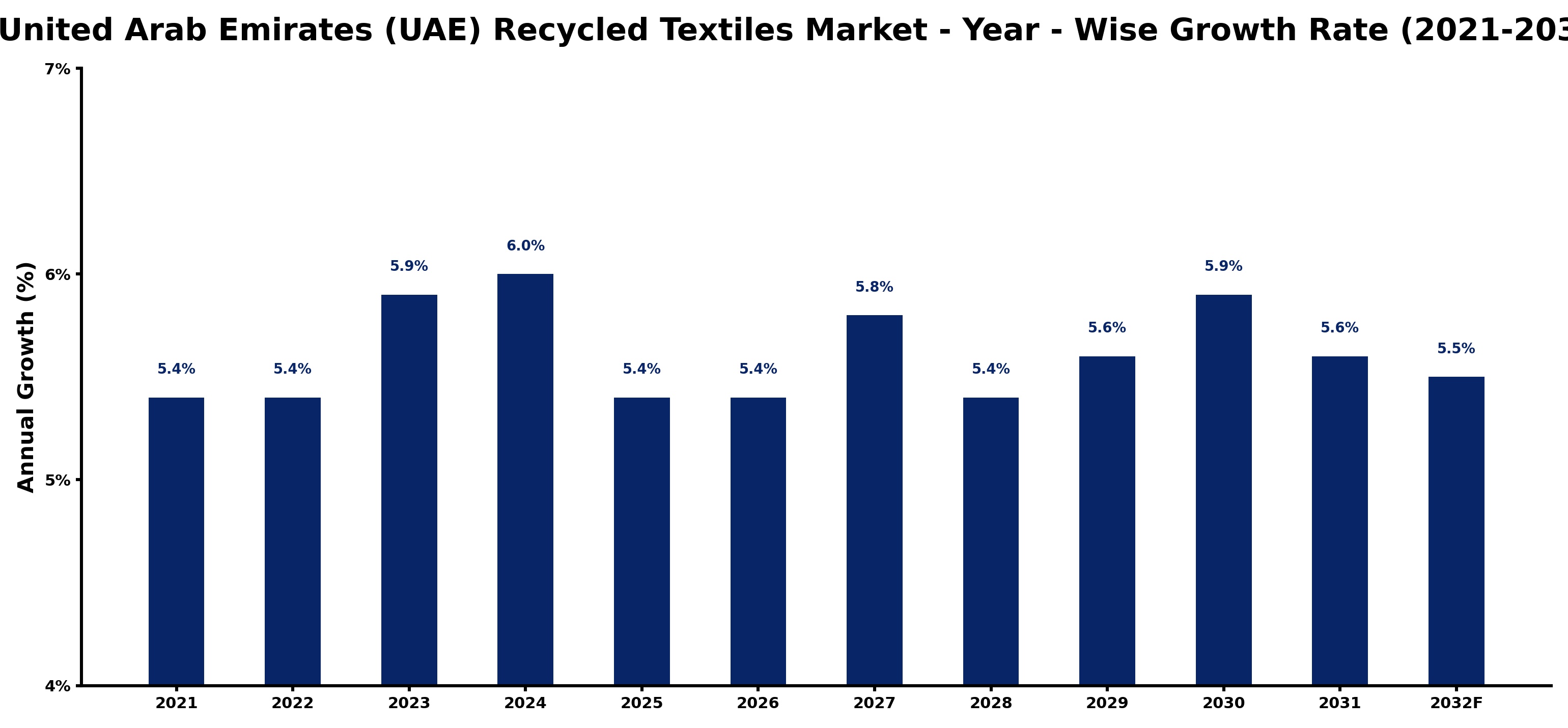
The table below presents the year‑wise growth rates along with the key drivers influencing the market
| Year | Growth Rate | Major Drivers |
| 2021 | 5.4% | Sustainability initiatives gained momentum |
| 2022 | 5.4% | Consumer awareness heightened recycling importance |
| 2023 | 5.9% | Government policies encouraged textile recycling |
| 2024 | 6.0% | Investment in recycling technologies increased |
| 2025 | 5.4% | Collaboration with fashion brands expanded |
| 2026 | 5.4% | Circular economy practices gained traction |
| 2027 | 5.8% | E-commerce platforms promoted recycled textiles |
| 2028 | 5.4% | Educational campaigns raised recycling awareness |
| 2029 | 5.6% | Partnerships with NGOs enhanced outreach |
| 2030 | 5.9% | Innovative recycling methods emerged rapidly |
| 2031 | 5.6% | Industrial activity supported growth |
| 2032 | 5.5% | Market expansion drove consumption |
Note - Market size estimations and growth projections presented in this report are based on 6Wresearch’s advanced forecasting approach, validated with industry datasets as of June 2026.
United Arab Emirates (UAE) Recycled Textiles Market Synopsis
A major force currently shaping the UAE recycled textiles market is the heightened environmental consciousness among consumers. This shift has prompted a growing demand for sustainable alternatives, influencing the fashion industry to adopt more eco-friendly practices, including the use of recycled materials. As a result, recycled textiles are becoming an increasingly viable option for the discerning consumer.
Moreover, the UAE's strategic initiatives to establish itself as a hub of sustainability are fostering innovation and investment within this market. The government's commitment to reducing waste and encouraging recycling is setting a clear agenda for growth, paving the way for businesses to thrive in this evolving landscape.
United Arab Emirates (UAE) Recycled Textiles Market Key Takeaways
- The market is witnessing a significant shift toward sustainable fashion, driven by consumer demand for eco-friendly options.
- Government policies promoting recycling and waste reduction are bolstering market growth.
- Consumer education regarding the benefits of recycled textiles remains essential for broader acceptance.
- Investment in collection and sorting infrastructure is critical for optimizing supply chains in this sector.
- Market players are increasingly focusing on quality and aesthetics to align recycled textiles with consumer expectations.
Evaluation of Restraints in United Arab Emirates (UAE) Recycled Textiles Market
Despite its growth potential, the UAE recycled textiles market faces several restraints. A key challenge lies in the current lack of a robust infrastructure for the collection and sorting of discarded textiles. This inefficiency can lead to lost opportunities in recycling and upcycling. Furthermore, there exists a gap in consumer understanding regarding the benefits of recycled materials, which impacts the mainstream acceptance of these products. Ensuring that recycled textiles meet the quality and aesthetic standards of consumers is also crucial for fostering trust and long-term market growth.
United Arab Emirates (UAE) Recycled Textiles Market Trends
Current trends in the UAE recycled textiles market include a surge in the popularity of upcycled fashion and a focus on innovative designs that incorporate sustainable materials. This movement is encouraging local designers to explore creative possibilities with recycled fabrics. Social media platforms are playing a vital role in spreading awareness, showcasing sustainable brands, and connecting consumers with eco-conscious fashion choices. In addition, collaborations between businesses and environmental organizations are facilitating knowledge sharing and enhancing community engagement in sustainability initiatives.
United Arab Emirates (UAE) Recycled Textiles Market Opportunities
There are significant growth opportunities within the UAE recycled textiles market, particularly for brands that prioritize eco-friendly materials and production methods. Businesses that invest in technological advancements for better sorting and processing of textiles can gain a competitive edge. Additionally, tapping into the burgeoning online retail space with platforms dedicated to sustainable fashion can attract a wider audience. Partnerships with government agencies and NGOs can also facilitate broader outreach and consumer education, further driving demand.
Government Initiatives in the United Arab Emirates (UAE) Recycled Textiles Market
The UAE government is actively promoting sustainability through various initiatives and programs aimed at waste reduction and recycling. Policies encouraging the use of recycled materials are being integrated into national strategies. Public awareness campaigns are also being launched to educate consumers about the importance of sustainable practices. These governmental efforts not only reflect a commitment to environmental stewardship but also encourage businesses to adopt circular economy principles, enhancing the overall growth potential of the recycled textiles market.
Future Insights of the United Arab Emirates (UAE) Recycled Textiles Market
Looking ahead to the period between 2026 and 2032, the UAE recycled textiles market is expected to evolve significantly. As consumer awareness continues to grow, demand for recycled textiles will likely expand, driven by innovative designs and higher quality offerings. Businesses that adapt to emerging trends and prioritize sustainability will be well-positioned for success. Furthermore, the ongoing commitment from the UAE government to environmental initiatives will catalyze investment and development within this market, creating a more sustainable future for fashion.
United Arab Emirates (UAE) Recycled Textiles Market Latest Developments (May 2025 - June 2026)
In recent months, the UAE recycled textiles market has seen a notable increase in collaborations between fashion brands and sustainability-focused organizations. Initiatives aimed at enhancing consumer education on the benefits of recycled textiles are gaining traction. Furthermore, various platforms are emerging, focusing on eco-conscious consumerism, showcasing sustainable fashion options. The overall direction is clear: the industry is increasingly aligning with global sustainability goals while navigating the challenges posed by traditional fashion practices.
United Arab Emirates (UAE) Recycled Textiles Market - Key Attractiveness of the Report
- 10 Years of Market Numbers
- Historical Data Starting from 2022 to 2025
- Base Year: 2025
- Forecast Data until 2032
- Key Performance Indicators Impacting the Market
- Major Upcoming Developments and Projects
Key Highlights of the Report:
- United Arab Emirates (UAE) Recycled Textiles Market Outlook
- Market Size of United Arab Emirates (UAE) Recycled Textiles Market, 2025
- Forecast of United Arab Emirates (UAE) Recycled Textiles Market, 2032
- Historical Data and Forecast of United Arab Emirates (UAE) Recycled Textiles Revenues & Volume for the Period 2022-2032F
- United Arab Emirates (UAE) Recycled Textiles Market Trend Evolution
- United Arab Emirates (UAE) Recycled Textiles Market Drivers and Challenges
- United Arab Emirates (UAE) Recycled Textiles Price Trends
- United Arab Emirates (UAE) Recycled Textiles Porter's Five Forces
- United Arab Emirates (UAE) Recycled Textiles Industry Life Cycle
- Historical Data and Forecast of United Arab Emirates (UAE) Recycled Textiles Market Revenues & Volume By Type for the Period 2022-2032F
- Historical Data and Forecast of United Arab Emirates (UAE) Recycled Textiles Market Revenues & Volume By Recycled Cotton for the Period 2022-2032F
- Historical Data and Forecast of United Arab Emirates (UAE) Recycled Textiles Market Revenues & Volume By Recycled Wool for the Period 2022-2032F
- Historical Data and Forecast of United Arab Emirates (UAE) Recycled Textiles Market Revenues & Volume By Recycled Polyester for the Period 2022-2032F
- Historical Data and Forecast of United Arab Emirates (UAE) Recycled Textiles Market Revenues & Volume By Recycled Nylon for the Period 2022-2032F
- Historical Data and Forecast of United Arab Emirates (UAE) Recycled Textiles Market Revenues & Volume By Others for the Period 2022-2032F
- Historical Data and Forecast of United Arab Emirates (UAE) Recycled Textiles Market Revenues & Volume By End-use Industry for the Period 2022-2032F
- Historical Data and Forecast of United Arab Emirates (UAE) Recycled Textiles Market Revenues & Volume By Automotive for the Period 2022-2032F
- Historical Data and Forecast of United Arab Emirates (UAE) Recycled Textiles Market Revenues & Volume By Retail for the Period 2022-2032F
- Historical Data and Forecast of United Arab Emirates (UAE) Recycled Textiles Market Revenues & Volume By Mining for the Period 2022-2032F
- Historical Data and Forecast of United Arab Emirates (UAE) Recycled Textiles Market Revenues & Volume By Building & Construction for the Period 2022-2032F
- Historical Data and Forecast of United Arab Emirates (UAE) Recycled Textiles Market Revenues & Volume By Others for the Period 2022-2032F
- United Arab Emirates (UAE) Recycled Textiles Import Export Trade Statistics
- Market Opportunity Assessment By Type
- Market Opportunity Assessment By End-use Industry
- United Arab Emirates (UAE) Recycled Textiles Top Companies Market Share
- United Arab Emirates (UAE) Recycled Textiles Competitive Benchmarking By Technical and Operational Parameters
- United Arab Emirates (UAE) Recycled Textiles Company Profiles
- United Arab Emirates (UAE) Recycled Textiles Key Strategic Recommendations






































