United Arab Emirates (UAE) Refined Petroleum Products Market Size, Share & Growth Rate
The United Arab Emirates (UAE) Refined Petroleum Products Market was estimated at USD 484 Million in 2025 and is projected to reach USD 682 Million by 2032, growing at a CAGR of 5.0% from 2026 to 2032. This growth trajectory is primarily driven by the country's strategic investments in refining capacity and an increasing demand for high-quality petroleum products, both locally and in international markets. The ongoing efforts to enhance production capabilities and meet shifting consumer needs position the UAE as a formidable force in the global petroleum landscape.
United Arab Emirates (UAE) Refined Petroleum Products Market Year-wise Growth Rate and Key Drivers
This graph highlights how the United Arab Emirates (UAE) Refined Petroleum Products Market has steadily grown over the years, supported by major growth factors.
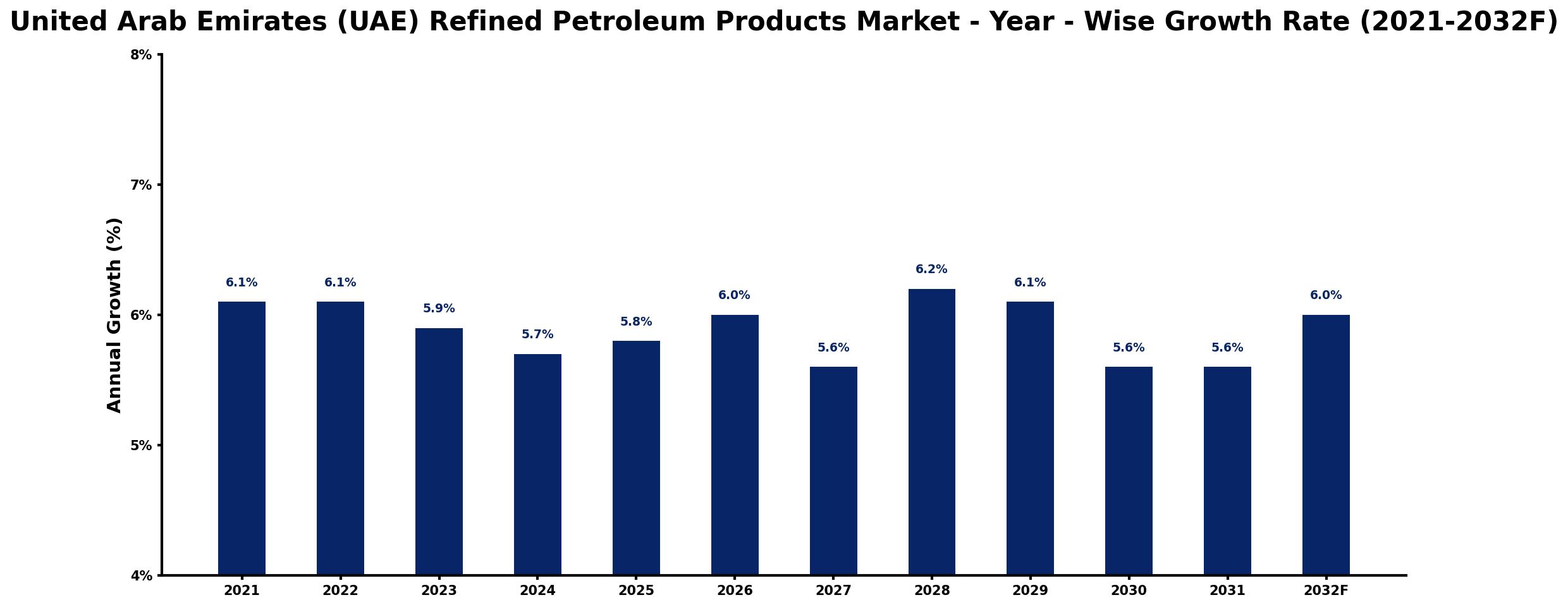
The table below presents the year‑wise growth rates along with the key drivers influencing the market
| Year | Growth Rate | Major Drivers |
| 2021 | 6.1% | increased transportation sector activity |
| 2022 | 6.1% | growing industrial energy requirements |
| 2023 | 5.9% | expansion of construction projects |
| 2024 | 5.7% | rise in tourism activities |
| 2025 | 5.8% | higher global energy demand |
| 2026 | 6.0% | investment in infrastructure development |
| 2027 | 5.6% | increased urbanization trends observed |
| 2028 | 6.2% | growing logistics and supply chains |
| 2029 | 6.1% | enhanced refinery capacity utilization |
| 2030 | 5.6% | development of renewable energy initiatives |
| 2031 | 5.6% | expansion in retail fuel distribution |
| 2032 | 6.0% | increased demand for transportation fuel |
Note: Market size estimations and growth projections presented in this report are based on 6Wresearch's proprietary forecasting methodology, utilizing the latest available industry data, government publications, and primary research inputs.
United Arab Emirates (UAE) Refined Petroleum Products Market Synopsis
A significant force shaping the UAE refined petroleum products market is the nation's strategic position as a major global energy player. The UAE's advanced infrastructure and state-of-the-art refineries allow it to produce a wide array of refined products that not only meet domestic demands but also cater to international export opportunities. This dual focus has solidified its reputation in the global arena.
Moreover, the market is currently experiencing a revival as global economic activities resume post-COVID-19. The increase in transportation activity, coupled with the rising demand for petrochemicals, is contributing to a positive outlook. The countrys commitment to diversifying its energy portfolio is also set to influence market dynamics significantly.
United Arab Emirates (UAE) Refined Petroleum Products Market Key Takeaways
- The UAE's refined petroleum products market is on a robust growth path driven by strategic investments in refining capacity.
- Domestic consumption is complemented by exports, highlighting the UAE's role in the global petroleum landscape.
- The market is recovering from COVID-19 impacts, particularly in sectors like jet fuel and gasoline.
- Increasing demand for petrochemicals presents new growth avenues within the market.
- The governments policies aimed at energy diversification will shape future developments in this sector.
Evaluation of Restraints in United Arab Emirates (UAE) Refined Petroleum Products Market
Despite its many strengths, the UAE refined petroleum products market faces certain restraints. One notable limitation is the increasing competition within the global oil industry, as emerging markets ramp up their own refining capabilities. Moreover, the volatile nature of oil prices poses a constant threat to revenue stability. Additionally, the pressing need for the UAE to transition towards renewable energy sources complicates reliance on fossil fuels, creating a challenging landscape for stakeholders focused on traditional petroleum products.
United Arab Emirates (UAE) Refined Petroleum Products Market Trends
A key trend in the UAE refined petroleum products market is the growing emphasis on sustainability and environmental responsibility. Companies are increasingly investing in cleaner refining technologies and processes to align with global initiatives aimed at reducing carbon emissions. Moreover, the demand for biofuels and alternative energy sources is slowly rising, driven by both consumer preferences and governmental policies that encourage green energy solutions. This shift represents a crucial intersection between traditional petroleum products and emerging sustainable practices.
United Arab Emirates (UAE) Refined Petroleum Products Market Opportunities
Opportunities for growth in the UAE refined petroleum products market are abundant, particularly in the petrochemical sector. The rising demand for materials used in packaging, construction, and automotive applications presents a significant avenue for expansion. Additionally, as global demand for energy continues to climb, the UAE's strategic investments in refining technology could further elevate its market position. Collaborations with international partners to innovate new products and technologies also represent potential growth strategies.
Government Initiatives in the United Arab Emirates (UAE) Refined Petroleum Products Market
The UAE government is actively promoting initiatives aimed at enhancing the refined petroleum products market. This includes substantial public investments in infrastructure, research and development, and incentives for adopting cleaner technologies. Moreover, strategic policies are being implemented to encourage diversification within the energy sector, thereby mitigating the risks associated with dependency on fossil fuels. These initiatives not only bolster market stability but also prepare the UAE for a future increasingly focused on sustainability.
Future Insights of the United Arab Emirates (UAE) Refined Petroleum Products Market
Looking ahead to 2026-2032, the UAE refined petroleum products market is poised for continued growth, underpinned by advancements in refining technology and increased international demand. The ongoing recovery from the impacts of COVID-19 will likely bolster consumption patterns, particularly as global mobility increases. Furthermore, the UAEs commitment to diversifying its energy portfolio will shape the market's future landscape, influencing product development and strategic partnerships.
United Arab Emirates (UAE) Refined Petroleum Products Market Latest Developments (2025 - 2026)
Recent developments in the UAE refined petroleum products market indicate a strong push towards innovation and sustainability. Companies are exploring new refining methods that minimize environmental impact, with several projects aimed at integrating renewable energy sources into traditional refining operations. Additionally, there is a noticeable trend towards expanding the export capabilities of refined products, driven by increasing international demand.
United Arab Emirates (UAE) Refined Petroleum Products Market - Key Attractiveness of the Report
- 10 Years of Market Numbers
- Historical Data Starting from 2022 to 2025
- Base Year: 2025
- Forecast Data until 2032
- Key Performance Indicators Impacting the Market
- Major Upcoming Developments and Projects
Key Highlights of the Report:
- United Arab Emirates (UAE) Refined Petroleum Products Market Outlook
- Market Size of United Arab Emirates (UAE) Refined Petroleum Products Market, 2025
- Forecast of United Arab Emirates (UAE) Refined Petroleum Products Market, 2032
- Historical Data and Forecast of United Arab Emirates (UAE) Refined Petroleum Products Revenues & Volume for the Period 2022-2032F
- United Arab Emirates (UAE) Refined Petroleum Products Market Trend Evolution
- United Arab Emirates (UAE) Refined Petroleum Products Market Drivers and Challenges
- United Arab Emirates (UAE) Refined Petroleum Products Price Trends
- United Arab Emirates (UAE) Refined Petroleum Products Porter's Five Forces
- United Arab Emirates (UAE) Refined Petroleum Products Industry Life Cycle
- Historical Data and Forecast of United Arab Emirates (UAE) Refined Petroleum Products Market Revenues & Volume By Product Type for the Period 2022-2032F
- Historical Data and Forecast of United Arab Emirates (UAE) Refined Petroleum Products Market Revenues & Volume By Diesel for the Period 2022-2032F
- Historical Data and Forecast of United Arab Emirates (UAE) Refined Petroleum Products Market Revenues & Volume By Gasoline for the Period 2022-2032F
- Historical Data and Forecast of United Arab Emirates (UAE) Refined Petroleum Products Market Revenues & Volume By Fuel Oils for the Period 2022-2032F
- Historical Data and Forecast of United Arab Emirates (UAE) Refined Petroleum Products Market Revenues & Volume By Kerosene for the Period 2022-2032F
- Historical Data and Forecast of United Arab Emirates (UAE) Refined Petroleum Products Market Revenues & Volume By Others for the Period 2022-2032F
- Historical Data and Forecast of United Arab Emirates (UAE) Refined Petroleum Products Market Revenues & Volume By Application for the Period 2022-2032F
- Historical Data and Forecast of United Arab Emirates (UAE) Refined Petroleum Products Market Revenues & Volume By Fuel for the Period 2022-2032F
- Historical Data and Forecast of United Arab Emirates (UAE) Refined Petroleum Products Market Revenues & Volume By Chemical for the Period 2022-2032F
- Historical Data and Forecast of United Arab Emirates (UAE) Refined Petroleum Products Market Revenues & Volume By Others for the Period 2022-2032F
- Historical Data and Forecast of United Arab Emirates (UAE) Refined Petroleum Products Market Revenues & Volume By Fraction for the Period 2022-2032F
- Historical Data and Forecast of United Arab Emirates (UAE) Refined Petroleum Products Market Revenues & Volume By Light Distillates for the Period 2022-2032F
- Historical Data and Forecast of United Arab Emirates (UAE) Refined Petroleum Products Market Revenues & Volume By Middle Distillates for the Period 2022-2032F
- Historical Data and Forecast of United Arab Emirates (UAE) Refined Petroleum Products Market Revenues & Volume By Heavy Oils for the Period 2022-2032F
- United Arab Emirates (UAE) Refined Petroleum Products Import Export Trade Statistics
- Market Opportunity Assessment By Product Type
- Market Opportunity Assessment By Application
- Market Opportunity Assessment By Fraction
- United Arab Emirates (UAE) Refined Petroleum Products Top Companies Market Share
- United Arab Emirates (UAE) Refined Petroleum Products Competitive Benchmarking By Technical and Operational Parameters
- United Arab Emirates (UAE) Refined Petroleum Products Company Profiles
- United Arab Emirates (UAE) Refined Petroleum Products Key Strategic Recommendations






































