United Arab Emirates (UAE) Renewable Chemicals Market Size, Share & Growth Rate
The United Arab Emirates (UAE) Renewable Chemicals Market was estimated at USD 517 Million in 2025 and is projected to reach USD 750 Million by 2032, growing at a CAGR of 5.5% from 2026 to 2032. This upward trajectory is being driven by the UAE's commitment to sustainability, which has led to heightened investments in renewable feedstock development and innovative technologies. The growing preference for bio-based and eco-friendly products among consumers and businesses is further propelling market demand.
United Arab Emirates (UAE) Renewable Chemicals Market Year-wise Growth Rate and Key Drivers
This graph highlights how the United Arab Emirates (UAE) Renewable Chemicals Market has steadily grown over the years, supported by major growth factors.
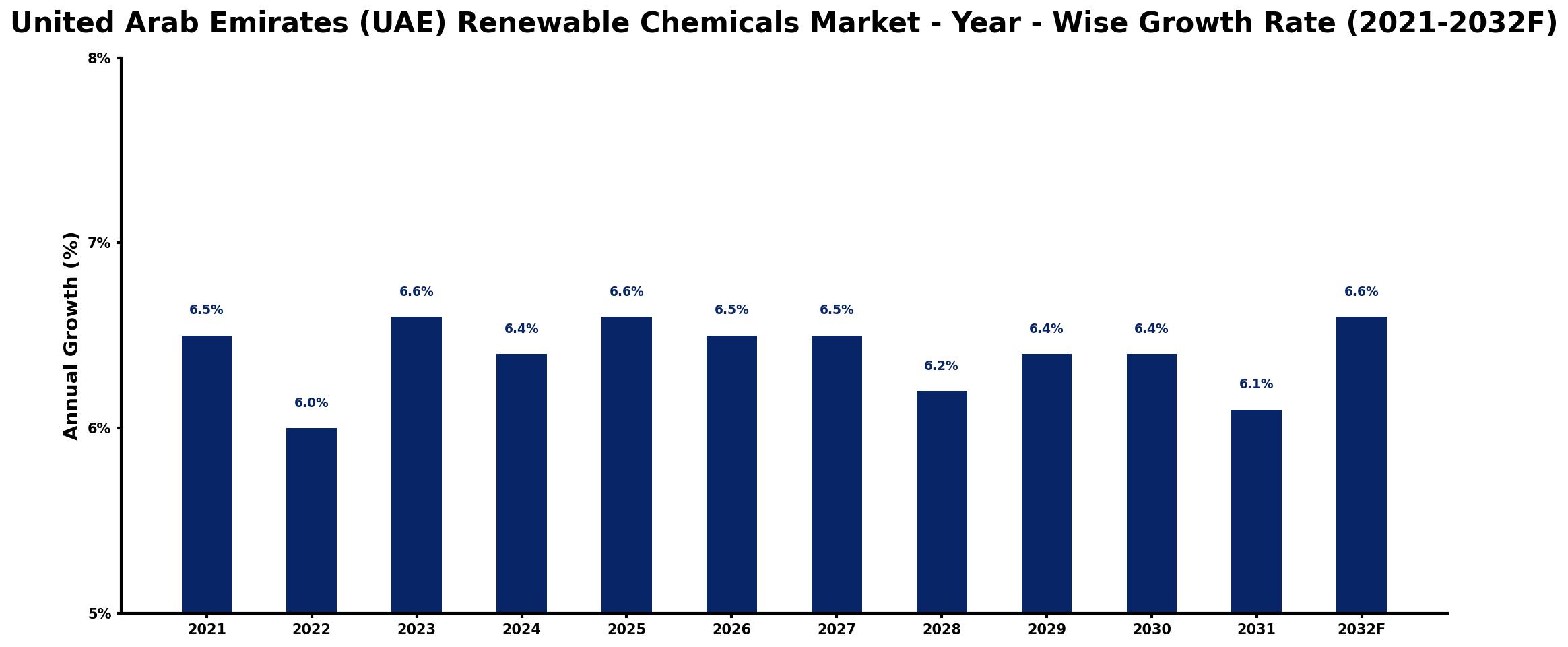
The table below presents the year‑wise growth rates along with the key drivers influencing the market
| Year | Growth Rate | Major Drivers |
| 2021 | 6.5% | Rising demand for sustainable solutions |
| 2022 | 6.0% | Increased investments in green technologies |
| 2023 | 6.6% | growing commercial sector adoption |
| 2024 | 6.4% | Expansion of regulatory support initiatives |
| 2025 | 6.6% | Development of innovative production methods |
| 2026 | 6.5% | Surge in corporate sustainability commitments |
| 2027 | 6.5% | Increase in public awareness campaigns |
| 2028 | 6.2% | growing automotive sector requirements |
| 2029 | 6.4% | Strengthened international collaboration efforts |
| 2030 | 6.4% | rising infrastructure development spending |
| 2031 | 6.1% | Diversification of supply chain sources |
| 2032 | 6.6% | Advancements in biobased material technologies |
Note: Market size estimations and growth projections presented in this report are based on 6Wresearch's proprietary forecasting methodology, utilizing the latest available industry data, government publications, and primary research inputs.
United Arab Emirates (UAE) Renewable Chemicals Market Synopsis
As a result of its strategic position in the Middle East, the UAE is cultivating a robust ecosystem for the renewable chemicals sector. This includes a burgeoning demand for green chemicals in industries like packaging, textiles, and automotive, underscoring a shift away from fossil-fuel-derived chemicals. Additionally, investments in R&D are enhancing the production capabilities, ensuring a steady supply of innovative products.
The UAE's diversification strategy aims to reduce reliance on oil and gas, making renewable chemicals a crucial component of its industrial landscape. Notably, the national vision supports initiatives that promote sustainability, which aligns perfectly with the growing global momentum for green chemistry. This synergy sets the stage for significant market evolution.
United Arab Emirates (UAE) Renewable Chemicals Market Key Takeaways
- The market is driven by the UAE's strategic push for sustainability and reduced fossil fuel dependence.
- Consumer and industry demand for eco-friendly solutions is rapidly increasing.
- Innovations in production technologies are enhancing the economic viability of renewable chemicals.
- Research investments are crucial for establishing a steady supply of bio-based feedstock.
- The COVID-19 pandemic highlighted the need for sustainable alternatives, accelerating market interest.
Evaluation of Restraints in United Arab Emirates (UAE) Renewable Chemicals Market
Despite the positive outlook, the UAE renewable chemicals market faces several key restraints. One prominent limitation is the development of cost-effective production processes that can compete with traditional petrochemicals. Additionally, securing sufficient feedstock for renewable chemical production remains a challenge, as the availability of bio-based materials fluctuates. Furthermore, gaining market acceptance for these eco-friendly alternatives is essential, as customers transition from established products.
United Arab Emirates (UAE) Renewable Chemicals Market Trends
Current trends in the UAE renewable chemicals market include a noticeable shift towards bioplastics and biodegradable materials, which are rapidly gaining traction in consumer goods and packaging applications. Moreover, emerging technologies such as bioconversion and fermentation processes are revolutionizing production methods, offering more efficient routes to market. Another trend is the increased collaboration between academia and industry to foster innovation and address challenges in renewable feedstock utilization.
United Arab Emirates (UAE) Renewable Chemicals Market Opportunities
There exists a wealth of opportunities in the UAE renewable chemicals market, particularly in the area of bioplastics, which are increasingly sought after in various sectors. Investment in R&D can unlock novel applications and expand the product range available, catering to emerging consumer demands. Furthermore, as global companies look to source sustainable materials, the UAE has the potential to position itself as a leading supplier of renewable chemicals in the region.
Government Initiatives in the United Arab Emirates (UAE) Renewable Chemicals Market
The UAE government is actively promoting sustainability through various initiatives and policies aimed at fostering the renewable chemicals sector. These include investments in green technology, tax incentives for companies producing eco-friendly products, and strategic partnerships that encourage innovation. The UAEs Vision 2021 and the subsequent 2050 Energy Strategy underline the commitment to diversifying the economy and ensuring environmental protection, which positively impacts the renewable chemicals landscape.
Future Insights of the United Arab Emirates (UAE) Renewable Chemicals Market
Looking towards the future, the UAE renewable chemicals market is expected to continue its upward trajectory through 2032. With increasing global pressure for sustainable practices, coupled with robust government support, the market is likely to experience heightened innovation and investment. As consumer awareness grows, the demand for renewable chemicals will expand, leading to more diversified applications and potentially new markets.
United Arab Emirates (UAE) Renewable Chemicals Market Latest Developments (2025 - 2026)
Recent developments in the UAE renewable chemicals market indicate a positive shift towards more sustainable practices. Companies are increasingly implementing innovative technologies to enhance production efficiencies and reduce costs. Moreover, there is a surge in partnerships between private enterprises and governmental bodies, aimed at accelerating the commercialization of renewable chemical products. These collaborations are crucial as they pave the way for comprehensive solutions that meet both regulatory and consumer demands.
United Arab Emirates (UAE) Renewable Chemicals Market - Key Attractiveness of the Report
- 10 Years of Market Numbers
- Historical Data Starting from 2022 to 2025
- Base Year: 2025
- Forecast Data until 2032
- Key Performance Indicators Impacting the Market
- Major Upcoming Developments and Projects
Key Highlights of the Report:
- United Arab Emirates (UAE) Renewable Chemicals Market Outlook
- Market Size of United Arab Emirates (UAE) Renewable Chemicals Market, 2025
- Forecast of United Arab Emirates (UAE) Renewable Chemicals Market, 2032
- Historical Data and Forecast of United Arab Emirates (UAE) Renewable Chemicals Revenues & Volume for the Period 2022-2032F
- United Arab Emirates (UAE) Renewable Chemicals Market Trend Evolution
- United Arab Emirates (UAE) Renewable Chemicals Market Drivers and Challenges
- United Arab Emirates (UAE) Renewable Chemicals Price Trends
- United Arab Emirates (UAE) Renewable Chemicals Porter's Five Forces
- United Arab Emirates (UAE) Renewable Chemicals Industry Life Cycle
- Historical Data and Forecast of United Arab Emirates (UAE) Renewable Chemicals Market Revenues & Volume By Product Type for the Period 2022-2032F
- Historical Data and Forecast of United Arab Emirates (UAE) Renewable Chemicals Market Revenues & Volume By Alcohols for the Period 2022-2032F
- Historical Data and Forecast of United Arab Emirates (UAE) Renewable Chemicals Market Revenues & Volume By Organic Acids for the Period 2022-2032F
- Historical Data and Forecast of United Arab Emirates (UAE) Renewable Chemicals Market Revenues & Volume By Ketones for the Period 2022-2032F
- Historical Data and Forecast of United Arab Emirates (UAE) Renewable Chemicals Market Revenues & Volume By Platform Chemicals for the Period 2022-2032F
- Historical Data and Forecast of United Arab Emirates (UAE) Renewable Chemicals Market Revenues & Volume By Biopolymers for the Period 2022-2032F
- Historical Data and Forecast of United Arab Emirates (UAE) Renewable Chemicals Market Revenues & Volume By Others for the Period 2022-2032F
- Historical Data and Forecast of United Arab Emirates (UAE) Renewable Chemicals Market Revenues & Volume By Applications for the Period 2022-2032F
- Historical Data and Forecast of United Arab Emirates (UAE) Renewable Chemicals Market Revenues & Volume By Transportation for the Period 2022-2032F
- Historical Data and Forecast of United Arab Emirates (UAE) Renewable Chemicals Market Revenues & Volume By Textiles for the Period 2022-2032F
- Historical Data and Forecast of United Arab Emirates (UAE) Renewable Chemicals Market Revenues & Volume By Food safety for the Period 2022-2032F
- Historical Data and Forecast of United Arab Emirates (UAE) Renewable Chemicals Market Revenues & Volume By Environment for the Period 2022-2032F
- Historical Data and Forecast of United Arab Emirates (UAE) Renewable Chemicals Market Revenues & Volume By Communication for the Period 2022-2032F
- Historical Data and Forecast of United Arab Emirates (UAE) Renewable Chemicals Market Revenues & Volume By Housing for the Period 2022-2032F
- Historical Data and Forecast of United Arab Emirates (UAE) Renewable Chemicals Market Revenues & Volume By Recreation for the Period 2022-2032F
- Historical Data and Forecast of United Arab Emirates (UAE) Renewable Chemicals Market Revenues & Volume By Other Applications for the Period 2022-2032F
- United Arab Emirates (UAE) Renewable Chemicals Import Export Trade Statistics
- Market Opportunity Assessment By Product Type
- Market Opportunity Assessment By Applications
- United Arab Emirates (UAE) Renewable Chemicals Top Companies Market Share
- United Arab Emirates (UAE) Renewable Chemicals Competitive Benchmarking By Technical and Operational Parameters
- United Arab Emirates (UAE) Renewable Chemicals Company Profiles
- United Arab Emirates (UAE) Renewable Chemicals Key Strategic Recommendations






































