United Arab Emirates (UAE) Retail And Wholesale Market Size, Share & Growth Rate
The United Arab Emirates (UAE) Retail And Wholesale Market was estimated at USD 656 Million in 2025 and is projected to reach USD 1143 Million by 2032, growing at a CAGR of 8.3% from 2026 to 2032. This robust growth trajectory is underpinned by the UAE's pivotal role as a shopping destination, attracting millions of international tourists each year. Additionally, rising disposable incomes among the diverse local population continue to fuel consumer spending across a wide range of retail categories, creating ample opportunities for businesses.
United Arab Emirates (UAE) Retail And Wholesale Market Year-wise Growth Rate and Key Drivers
This graph highlights how the United Arab Emirates (UAE) Retail And Wholesale Market has steadily grown over the years, supported by major growth factors.
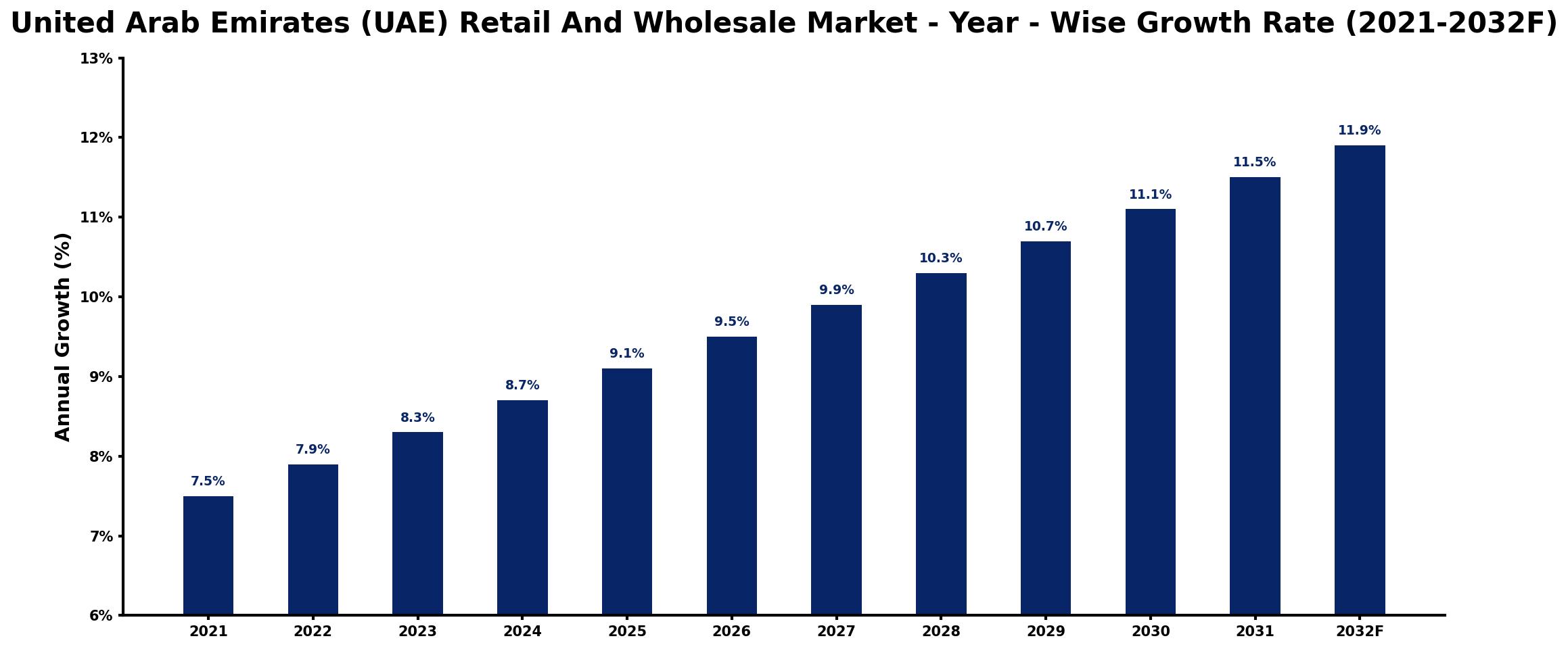
The table below presents the year‑wise growth rates along with the key drivers influencing the market
| Year | Growth Rate | Major Drivers |
| 2021 | 7.5% | Increased e-commerce adoption rates |
| 2022 | 7.9% | Expansion of local manufacturing capabilities |
| 2023 | 8.3% | Rising consumer disposable incomes |
| 2024 | 8.7% | Growth in tourism and hospitality |
| 2025 | 9.1% | Emergence of new shopping formats |
| 2026 | 9.5% | Increased foreign direct investment |
| 2027 | 9.9% | Technological advancements in logistics |
| 2028 | 10.3% | Strengthening of supply chain networks |
| 2029 | 10.7% | Higher demand for sustainable products |
| 2030 | 11.1% | enhanced product quality standards |
| 2031 | 11.5% | increased domestic production output |
| 2032 | 11.9% | Increased focus on experiential shopping |
Note: Market size estimations and growth projections presented in this report are based on 6Wresearch's proprietary forecasting methodology, utilizing the latest available industry data, government publications, and primary research inputs.
United Arab Emirates (UAE) Retail And Wholesale Market Synopsis
The UAE retail and wholesale market has witnessed a dynamic transformation in recent years, shifting from traditional shopping paradigms to more modern, digital-centric retail experiences. While the market thrived on in-store shopping and bustling souks, the pandemic has catalyzed a significant pivot toward e-commerce, reshaping the consumer landscape.
Looking ahead, the market is expected to stabilize as it integrates lessons learned during recent disruptions. The blend of traditional and digital shopping experiences, fueled by innovative technologies and changing consumer preferences, is set to redefine the retail and wholesale ecosystem in the UAE.
United Arab Emirates (UAE) Retail And Wholesale Market Key Takeaways
- The market is projected to grow from USD 656 Million in 2025 to USD 1143 Million by 2032.
- A vibrant tourism sector and a wealthy local population are driving retail demand.
- Retailers are increasingly adopting omnichannel strategies to meet changing consumer behaviors.
- Investment in e-commerce and digital payment solutions is vital for competitive advantage.
- The government's supportive trade policies continue to attract foreign investment in the sector.
Evaluation of Restraints in United Arab Emirates (UAE) Retail And Wholesale Market
While the UAE retail and wholesale market is positioned for growth, it faces several constraints that may impact its trajectory. The rapid evolution of consumer preferences demands agility and innovation from retailers, compelling them to invest in technology and digital platforms. Additionally, rising operational costs, especially in terms of rent and labor, pose challenges to profitability, particularly for smaller businesses. There remains an ongoing struggle to maintain compliance with stringent regulations regarding product quality and safety, which adds complexity to market entry and operations.
United Arab Emirates (UAE) Retail And Wholesale Market Trends
Current trends in the UAE retail and wholesale market reflect a significant shift towards digitalization and experiential retailing. E-commerce has exploded in popularity, with more consumers opting for online shopping options that offer convenience and safety. Additionally, sustainability trends are influencing purchasing decisions, as consumers increasingly seek eco-friendly products. Social media and influencer marketing are also becoming integral to retail strategies, shaping brand perception and driving engagement among younger consumers.
United Arab Emirates (UAE) Retail And Wholesale Market Opportunities
The UAE retail and wholesale market presents numerous opportunities for growth and investment. E-commerce, in particular, offers vast potential as consumers continue to embrace online shopping experiences. The rise of digital payment platforms enhances the convenience of transactions, further driving sales. Retailers can explore niche markets catering to diverse consumer preferences, including luxury goods, health and wellness products, and artisanal offerings. Collaborations with international brands and participation in government-led initiatives can also unlock new growth avenues.
Government Initiatives in the United Arab Emirates (UAE) Retail And Wholesale Market
The UAE government actively promotes the retail and wholesale sector through various initiatives and policies aimed at enhancing the business environment. Efforts to streamline regulations and enhance ease of doing business are pivotal in attracting foreign investment. Additionally, public spending on infrastructure projects and tourism development bolsters retail activities. Programs focused on digital transformation and entrepreneurship further support the growth of startups and established businesses alike, ensuring the sector remains competitive on a global scale.
Future Insights of the United Arab Emirates (UAE) Retail And Wholesale Market
As we look towards 2026-2032, the UAE retail and wholesale market is poised for significant evolution. Continued advancements in technology will shape customer experiences, enabling personalized shopping through AI and data analytics. The integration of online and offline platforms will become increasingly seamless, catering to evolving consumer expectations. Sustainability will play a central role in brand strategies as consumers demand responsible practices. Moreover, the sustained influx of international visitors will keep the retail landscape vibrant, solidifying the UAE's status as a leading global shopping destination.
United Arab Emirates (UAE) Retail And Wholesale Market Latest Developments (2025 - 2026)
Recent developments within the UAE retail and wholesale market indicate a strong focus on technological integration and enhanced customer engagement strategies. Retailers are ramping up investments in e-commerce platforms and mobile apps to facilitate seamless shopping experiences. Additionally, there is a noticeable shift towards incorporating sustainability practices, with various brands launching eco-friendly product lines. These movements reflect the industry's responsiveness to consumer trends and the ongoing transformation of the market landscape.
United Arab Emirates (UAE) Retail And Wholesale Market - Key Attractiveness of the Report
- 10 Years of Market Numbers
- Historical Data Starting from 2022 to 2025
- Base Year: 2025
- Forecast Data until 2032
- Key Performance Indicators Impacting the Market
- Major Upcoming Developments and Projects
Key Highlights of the Report:
- United Arab Emirates (UAE) Retail And Wholesale Market Outlook
- Market Size of United Arab Emirates (UAE) Retail And Wholesale Market, 2025
- Forecast of United Arab Emirates (UAE) Retail And Wholesale Market, 2032
- Historical Data and Forecast of United Arab Emirates (UAE) Retail And Wholesale Revenues & Volume for the Period 2022-2032F
- United Arab Emirates (UAE) Retail And Wholesale Market Trend Evolution
- United Arab Emirates (UAE) Retail And Wholesale Market Drivers and Challenges
- United Arab Emirates (UAE) Retail And Wholesale Price Trends
- United Arab Emirates (UAE) Retail And Wholesale Porter's Five Forces
- United Arab Emirates (UAE) Retail And Wholesale Industry Life Cycle
- Historical Data and Forecast of United Arab Emirates (UAE) Retail And Wholesale Market Revenues & Volume By Type for the Period 2022-2032F
- Historical Data and Forecast of United Arab Emirates (UAE) Retail And Wholesale Market Revenues & Volume By Retail for the Period 2022-2032F
- Historical Data and Forecast of United Arab Emirates (UAE) Retail And Wholesale Market Revenues & Volume By Wholesale for the Period 2022-2032F
- Historical Data and Forecast of United Arab Emirates (UAE) Retail And Wholesale Market Revenues & Volume By Ownership for the Period 2022-2032F
- Historical Data and Forecast of United Arab Emirates (UAE) Retail And Wholesale Market Revenues & Volume By Retail Chain/Wholesale Chain for the Period 2022-2032F
- Historical Data and Forecast of United Arab Emirates (UAE) Retail And Wholesale Market Revenues & Volume By Independent Retailer/Independent Wholesalers for the Period 2022-2032F
- Historical Data and Forecast of United Arab Emirates (UAE) Retail And Wholesale Market Revenues & Volume By Price Range for the Period 2022-2032F
- Historical Data and Forecast of United Arab Emirates (UAE) Retail And Wholesale Market Revenues & Volume By Premium for the Period 2022-2032F
- Historical Data and Forecast of United Arab Emirates (UAE) Retail And Wholesale Market Revenues & Volume By Mid-Range for the Period 2022-2032F
- Historical Data and Forecast of United Arab Emirates (UAE) Retail And Wholesale Market Revenues & Volume By Economy for the Period 2022-2032F
- Historical Data and Forecast of United Arab Emirates (UAE) Retail And Wholesale Market Revenues & Volume By Distribution Channel for the Period 2022-2032F
- Historical Data and Forecast of United Arab Emirates (UAE) Retail And Wholesale Market Revenues & Volume By Supermarkets/Hypermarkets for the Period 2022-2032F
- Historical Data and Forecast of United Arab Emirates (UAE) Retail And Wholesale Market Revenues & Volume By Convenience Stores for the Period 2022-2032F
- Historical Data and Forecast of United Arab Emirates (UAE) Retail And Wholesale Market Revenues & Volume By Department Stores for the Period 2022-2032F
- Historical Data and Forecast of United Arab Emirates (UAE) Retail And Wholesale Market Revenues & Volume By Specialty Stores for the Period 2022-2032F
- United Arab Emirates (UAE) Retail And Wholesale Import Export Trade Statistics
- Market Opportunity Assessment By Type
- Market Opportunity Assessment By Ownership
- Market Opportunity Assessment By Price Range
- Market Opportunity Assessment By Distribution Channel
- United Arab Emirates (UAE) Retail And Wholesale Top Companies Market Share
- United Arab Emirates (UAE) Retail And Wholesale Competitive Benchmarking By Technical and Operational Parameters
- United Arab Emirates (UAE) Retail And Wholesale Company Profiles
- United Arab Emirates (UAE) Retail And Wholesale Key Strategic Recommendations






































