United Arab Emirates (UAE) Rolling Mill Market Size, Share & Growth Rate
The United Arab Emirates (UAE) Rolling Mill Market was estimated at USD 400 Million in 2025 and is projected to reach USD 535 Million by 2032, growing at a CAGR of 4.2% from 2026 to 2032. This robust growth is predominantly driven by the flourishing construction sector, which necessitates a constant supply of rolled metal products. Furthermore, advancements in metalworking technology and an increasing demand for high-quality steel and aluminum within the automotive industry are also significant factors contributing to this positive trajectory.
United Arab Emirates (UAE) Rolling Mill Market Year-wise Growth Rate and Key Drivers
This graph highlights how the United Arab Emirates (UAE) Rolling Mill Market has steadily grown over the years, supported by major growth factors.
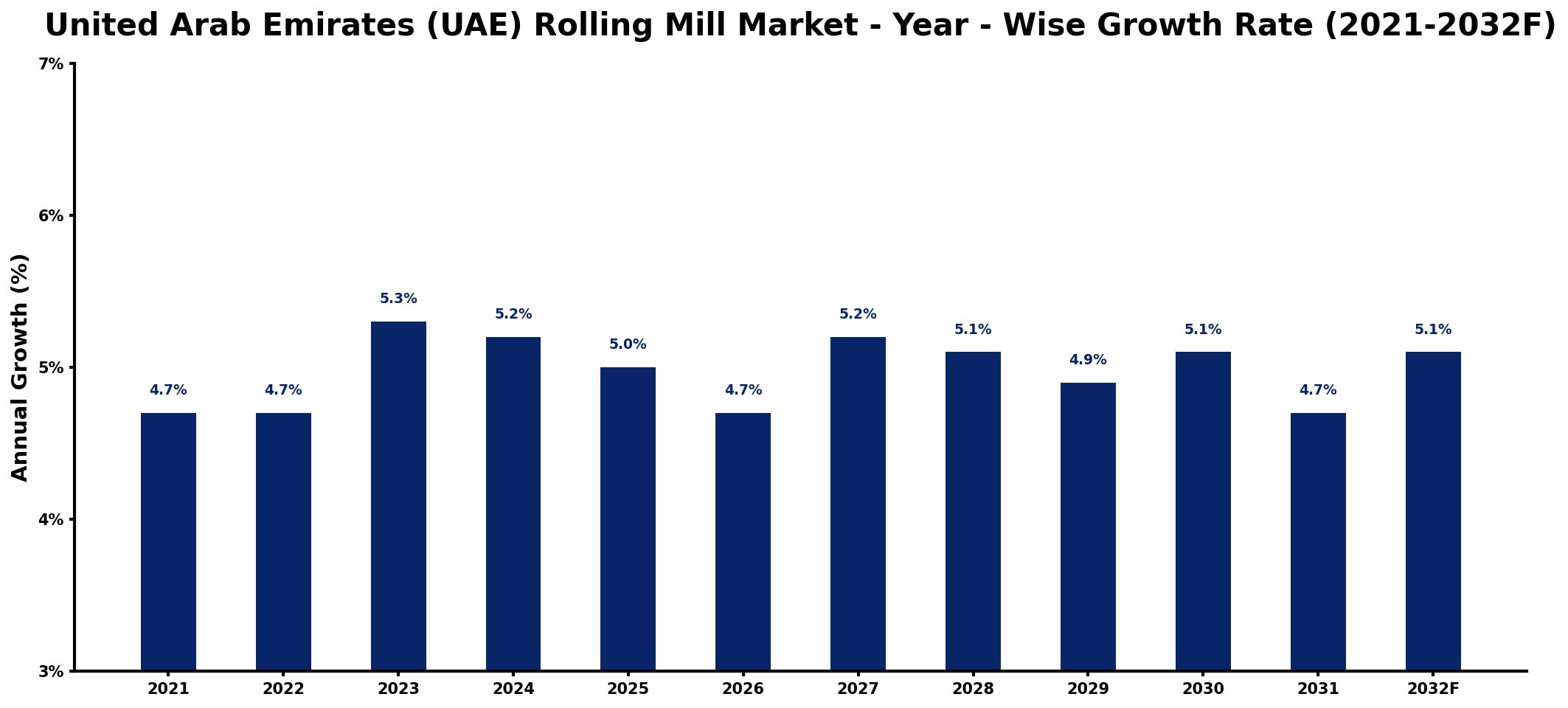
The table below presents the year‑wise growth rates along with the key drivers influencing the market
| Year | Growth Rate | Major Drivers |
| 2021 | 4.7% | Infrastructure investments boosting demand |
| 2022 | 4.7% | Increased construction activity nationwide |
| 2023 | 5.3% | Government initiatives fostering growth |
| 2024 | 5.2% | Rising energy sector requirements |
| 2025 | 5.0% | Demand from automotive manufacturing |
| 2026 | 4.7% | Expanding renewable energy projects |
| 2027 | 5.2% | Technological advancements enhancing efficiency |
| 2028 | 5.1% | Strong real estate market recovery |
| 2029 | 4.9% | Growing consumer electronics sector |
| 2030 | 5.1% | Increased exports to neighboring regions |
| 2031 | 4.7% | Emerging markets driving consumption |
| 2032 | 5.1% | Sustainability initiatives promoting investments |
Note: Market size estimations and growth projections presented in this report are based on 6Wresearch's proprietary forecasting methodology, utilizing the latest available industry data, government publications, and primary research inputs.
United Arab Emirates (UAE) Rolling Mill Market Synopsis
The UAE Rolling Mill Market is instrumental in the production of various rolled metal products, particularly due to the expansive infrastructure projects undertaken across the nation. This demand is amplified by the rapid urbanization and real estate boom, which have heightened the need for high-quality metals in construction and manufacturing processes.
In recent years, the integration of advanced metalworking technologies has further transformed the operational landscape of rolling mills in the UAE. This includes the implementation of automated solutions, enhancing efficiency and product quality while meeting the increasing needs of various industries, including automotive and construction.
United Arab Emirates (UAE) Rolling Mill Market Key Takeaways
- The market is experiencing strong growth, driven primarily by the construction and manufacturing sectors.
- There is a rising demand for rolled metal products, particularly steel and aluminum.
- Technological advancements in metalworking are improving operational efficiencies within the sector.
- Infrastructure projects and a booming real estate market are essential factors influencing market dynamics.
- Market resilience was demonstrated during the COVID-19 pandemic, aided by government stimulus measures.
Evaluation of Restraints in United Arab Emirates (UAE) Rolling Mill Market
Despite its upward trajectory, the UAE Rolling Mill Market is challenged by the inherent volatility of raw material prices and energy costs, particularly concerning steel and aluminum. These materials are heavily influenced by global market trends, leading to fluctuating operational costs. Additionally, the energy-intensive nature of rolling operations adds another layer of complexity, with energy prices impacting profitability and operational sustainability.
United Arab Emirates (UAE) Rolling Mill Market Trends
Current trends within the UAE Rolling Mill Market include a marked shift towards sustainability and eco-friendly practices. Many manufacturers are focusing on the recycling of materials and adopting greener technologies to minimize their carbon footprints. Additionally, the rise of Industry 4.0, with its emphasis on automation and data-driven decision-making, is reshaping the way rolling mills operate, leading to smarter and more efficient processes.
United Arab Emirates (UAE) Rolling Mill Market Opportunities
There exists considerable potential for growth and investment within the UAE Rolling Mill Market, particularly in the realms of technology integration and product diversification. Opportunities abound in developing new alloys and specialized rolled products tailored to specific industries. Furthermore, as the UAE continues to position itself as a global trading hub, there are ample prospects for expanding export capabilities, enabling local manufacturers to tap into international markets.
Government Initiatives in the United Arab Emirates (UAE) Rolling Mill Market
The government of the UAE has been proactive in bolstering the manufacturing sector, implementing policies and public spending initiatives aimed at infrastructure development. Programs aimed at promoting sustainability and innovation within the metalworking industry reflect the national vision for economic diversification. Incentives for adopting advanced technologies and improving energy efficiency are also in place, fostering a more competitive environment for rolling mills.
Future Insights of the United Arab Emirates (UAE) Rolling Mill Market
Looking forward to the period from 2026 to 2032, the UAE Rolling Mill Market is anticipated to continue its growth trajectory. As infrastructure projects are expected to expand in scale and scope, the demand for rolled products will likely increase correspondingly. Additionally, innovations in metalworking processes, coupled with a focus on sustainability, will drive market evolution. These factors will collectively enhance the markets resilience against external challenges while presenting new avenues for investment and growth.
United Arab Emirates (UAE) Rolling Mill Market Latest Developments (2025 - 2026)
Recent developments in the UAE Rolling Mill Market indicate a strong push towards modernization, with several players adopting advanced manufacturing techniques to improve efficiency and product quality. Additionally, partnerships between local firms and international technology providers are fostering innovation, enabling the introduction of smarter rolling solutions. The recovery from COVID-19 has also seen a revitalization of the sector, with increased investments in infrastructure and construction projects driving demand for rolled products.
United Arab Emirates (UAE) Rolling Mill Market - Key Attractiveness of the Report
- 10 Years of Market Numbers
- Historical Data Starting from 2022 to 2025
- Base Year: 2025
- Forecast Data until 2032
- Key Performance Indicators Impacting the Market
- Major Upcoming Developments and Projects
Key Highlights of the Report:
- United Arab Emirates (UAE) Rolling Mill Market Outlook
- Market Size of United Arab Emirates (UAE) Rolling Mill Market, 2025
- Forecast of United Arab Emirates (UAE) Rolling Mill Market, 2032
- Historical Data and Forecast of United Arab Emirates (UAE) Rolling Mill Revenues & Volume for the Period 2022-2032F
- United Arab Emirates (UAE) Rolling Mill Market Trend Evolution
- United Arab Emirates (UAE) Rolling Mill Market Drivers and Challenges
- United Arab Emirates (UAE) Rolling Mill Price Trends
- United Arab Emirates (UAE) Rolling Mill Porter's Five Forces
- United Arab Emirates (UAE) Rolling Mill Industry Life Cycle
- Historical Data and Forecast of United Arab Emirates (UAE) Rolling Mill Market Revenues & Volume By Machine Type for the Period 2022-2032F
- Historical Data and Forecast of United Arab Emirates (UAE) Rolling Mill Market Revenues & Volume By Two high rolling mill for the Period 2022-2032F
- Historical Data and Forecast of United Arab Emirates (UAE) Rolling Mill Market Revenues & Volume By Three high rolling mill for the Period 2022-2032F
- Historical Data and Forecast of United Arab Emirates (UAE) Rolling Mill Market Revenues & Volume By Four high rolling mill for the Period 2022-2032F
- Historical Data and Forecast of United Arab Emirates (UAE) Rolling Mill Market Revenues & Volume By Tandem rolling mill for the Period 2022-2032F
- Historical Data and Forecast of United Arab Emirates (UAE) Rolling Mill Market Revenues & Volume By Cluster rolling mill for the Period 2022-2032F
- Historical Data and Forecast of United Arab Emirates (UAE) Rolling Mill Market Revenues & Volume By Planetary rolling mill for the Period 2022-2032F
- Historical Data and Forecast of United Arab Emirates (UAE) Rolling Mill Market Revenues & Volume By Process for the Period 2022-2032F
- Historical Data and Forecast of United Arab Emirates (UAE) Rolling Mill Market Revenues & Volume By Controlled rolling for the Period 2022-2032F
- Historical Data and Forecast of United Arab Emirates (UAE) Rolling Mill Market Revenues & Volume By Forge rolling for the Period 2022-2032F
- Historical Data and Forecast of United Arab Emirates (UAE) Rolling Mill Market Revenues & Volume By Profile rolling for the Period 2022-2032F
- Historical Data and Forecast of United Arab Emirates (UAE) Rolling Mill Market Revenues & Volume By Ring rolling for the Period 2022-2032F
- Historical Data and Forecast of United Arab Emirates (UAE) Rolling Mill Market Revenues & Volume By Hot rolling for the Period 2022-2032F
- Historical Data and Forecast of United Arab Emirates (UAE) Rolling Mill Market Revenues & Volume By Cold rolling for the Period 2022-2032F
- Historical Data and Forecast of United Arab Emirates (UAE) Rolling Mill Market Revenues & Volume By Application for the Period 2022-2032F
- Historical Data and Forecast of United Arab Emirates (UAE) Rolling Mill Market Revenues & Volume By Metal fabrication for the Period 2022-2032F
- Historical Data and Forecast of United Arab Emirates (UAE) Rolling Mill Market Revenues & Volume By Household appliances for the Period 2022-2032F
- Historical Data and Forecast of United Arab Emirates (UAE) Rolling Mill Market Revenues & Volume By Construction materials for the Period 2022-2032F
- Historical Data and Forecast of United Arab Emirates (UAE) Rolling Mill Market Revenues & Volume By Railway tracks for the Period 2022-2032F
- Historical Data and Forecast of United Arab Emirates (UAE) Rolling Mill Market Revenues & Volume By End Use for the Period 2022-2032F
- Historical Data and Forecast of United Arab Emirates (UAE) Rolling Mill Market Revenues & Volume By Automotive and Transportation for the Period 2022-2032F
- Historical Data and Forecast of United Arab Emirates (UAE) Rolling Mill Market Revenues & Volume By General Manufacturing for the Period 2022-2032F
- Historical Data and Forecast of United Arab Emirates (UAE) Rolling Mill Market Revenues & Volume By Construction for the Period 2022-2032F
- Historical Data and Forecast of United Arab Emirates (UAE) Rolling Mill Market Revenues & Volume By Residential and Commercial for the Period 2022-2032F
- Historical Data and Forecast of United Arab Emirates (UAE) Rolling Mill Market Revenues & Volume By Defense for the Period 2022-2032F
- Historical Data and Forecast of United Arab Emirates (UAE) Rolling Mill Market Revenues & Volume By Energy for the Period 2022-2032F
- United Arab Emirates (UAE) Rolling Mill Import Export Trade Statistics
- Market Opportunity Assessment By Machine Type
- Market Opportunity Assessment By Process
- Market Opportunity Assessment By Application
- Market Opportunity Assessment By End Use
- United Arab Emirates (UAE) Rolling Mill Top Companies Market Share
- United Arab Emirates (UAE) Rolling Mill Competitive Benchmarking By Technical and Operational Parameters
- United Arab Emirates (UAE) Rolling Mill Company Profiles
- United Arab Emirates (UAE) Rolling Mill Key Strategic Recommendations






































