United Arab Emirates (UAE) Silk Yarn Market Size, Share & Growth Rate
The United Arab Emirates (UAE) Silk Yarn Market was estimated at USD 456 Million in 2025 and is projected to reach USD 596 Million by 2032, growing at a CAGR of 3.9% from 2026 to 2032. This growth trajectory is primarily driven by a burgeoning demand for luxurious and sustainable fabrics among consumers, particularly within the fashion and interior design sectors. The UAE's pivotal trade position further enhances accessibility and stimulates market expansion.
United Arab Emirates (UAE) Silk Yarn Market Year-wise Growth Rate and Key Drivers
This graph highlights how the United Arab Emirates (UAE) Silk Yarn Market has steadily grown over the years, supported by major growth factors.
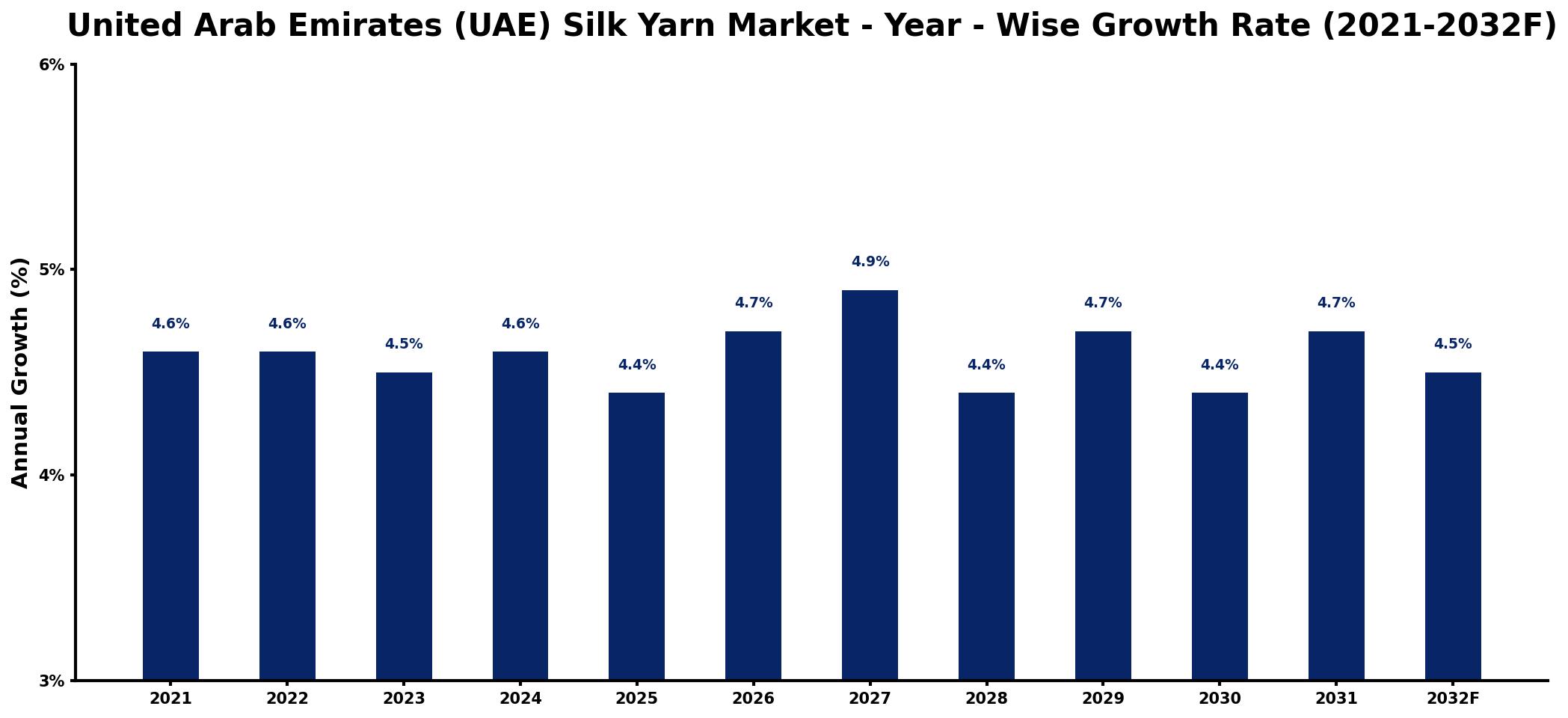
The table below presents the year‑wise growth rates along with the key drivers influencing the market
| Year | Growth Rate | Major Drivers |
| 2021 | 4.6% | Growing luxury fashion market demand |
| 2022 | 4.6% | Rising interest in sustainable textiles |
| 2023 | 4.5% | Increased investment in textile technology |
| 2024 | 4.6% | Expansion of online retail platforms |
| 2025 | 4.4% | Emergence of eco-friendly production methods |
| 2026 | 4.7% | Boost in artisanal craft industries |
| 2027 | 4.9% | Surge in high-end home decor |
| 2028 | 4.4% | Growing demand for premium apparel |
| 2029 | 4.7% | Increased collaborations with designers |
| 2030 | 4.4% | Rising popularity of bespoke tailoring |
| 2031 | 4.7% | growing downstream application demand |
| 2032 | 4.5% | Increase in textile innovation initiatives |
Note: Market size estimations and growth projections presented in this report are based on 6Wresearch's proprietary forecasting methodology, utilizing the latest available industry data, government publications, and primary research inputs.
United Arab Emirates (UAE) Silk Yarn Market Synopsis
The most significant force shaping the UAE Silk Yarn Market today is the increasing consumer preference for premium and sustainable materials. As awareness grows regarding ethical sourcing, consumers are gravitating towards silk yarn, known for its durability and luxurious feel, making it a favored choice for upscale textiles.
Moreover, the market is witnessing an influx of innovative production techniques that emphasize eco-friendly practices. The integration of sustainability with traditional craftsmanship not only caters to modern consumer demands but also positions local manufacturers competitively in the broader Middle Eastern market.
United Arab Emirates (UAE) Silk Yarn Market Key Takeaways
- Growing consumer interest in luxury and sustainable textiles is driving the silk yarn market.
- The UAE's strategic trade location enhances accessibility to both local and international markets.
- Production techniques are evolving to embrace sustainability, aligning with global trends.
- Rising demand for silk in fashion and interior design propels market growth.
- Key players are adapting to market fluctuations through innovative sourcing and production strategies.
Evaluation of Restraints in United Arab Emirates (UAE) Silk Yarn Market
Despite its positive outlook, the UAE Silk Yarn Market faces significant constraints. One of the foremost challenges is securing high-quality raw silk, which is essential for maintaining the luxury status associated with silk products. Additionally, balancing the rich tradition of silk craftsmanship with modern manufacturing technologies presents a complex task for producers. The emphasis on ethical and sustainable practices in silk production, while welcomed by consumers, introduces layers of complexity that require substantial investment and education. These factors, alongside the need to counter competition from synthetic alternatives, create a landscape that demands agility and foresight from market participants.
United Arab Emirates (UAE) Silk Yarn Market Trends
A significant trend in the UAE Silk Yarn Market is the growing integration of sustainable practices in production. As both consumers and retailers prioritize eco-friendly sourcing, manufacturers are beginning to adopt processes that minimize environmental impact. Moreover, the rise of personalized and bespoke textile applications in fashion is steering demand toward high-quality silk yarn. Advanced technology is also playing a pivotal role, with innovations in dyeing and weaving enhancing the aesthetic appeal and functionality of silk products.
United Arab Emirates (UAE) Silk Yarn Market Opportunities
There are lucrative growth opportunities within the UAE Silk Yarn Market, particularly for businesses that focus on sustainable sourcing. The burgeoning demand for silk in high-end fashion and luxury home textiles provides avenues for investment. Furthermore, tapping into the growing e-commerce landscape can offer local manufacturers a platform to reach broader markets, both regionally and internationally. Collaborations with designers and brands emphasizing ethical production can further enhance visibility and market share.
Government Initiatives in the United Arab Emirates (UAE) Silk Yarn Market
The UAE government has implemented several initiatives aimed at bolstering the textile industry, including the silk yarn market. Public spending on infrastructure improvements enhances trade capabilities, facilitating smoother import and export processes. Additionally, various programs aimed at promoting sustainable business practices are being introduced, encouraging manufacturers to adopt eco-friendly techniques. These initiatives not only support local businesses but also align with the country's broader commitment to sustainability and innovation.
Future Insights of the United Arab Emirates (UAE) Silk Yarn Market
Looking ahead to 2026-2032, the UAE Silk Yarn Market is poised for continued growth, spurred by evolving consumer preferences and technological advancements. As the market increasingly embraces sustainable practices, it is likely that local manufacturers will invest in green technologies and processes. Moreover, the growing global market for luxury textiles will encourage regional players to refine their offerings, ensuring they remain competitive. Overall, the outlook remains optimistic, with significant potential for innovation and expansion within the sector.
United Arab Emirates (UAE) Silk Yarn Market Latest Developments (2025 - 2026)
Recent industry developments highlight a shift towards greater sustainability in silk production. Increased collaboration between manufacturers and designers has resulted in innovative textile applications that leverage the unique properties of silk. Additionally, investment in technology to streamline production processes and enhance quality has become a focal point for firms aiming to differentiate themselves in a competitive landscape. These trends suggest a proactive approach to market challenges and consumer demands.
United Arab Emirates (UAE) Silk Yarn Market - Key Attractiveness of the Report
- 10 Years of Market Numbers
- Historical Data Starting from 2022 to 2025
- Base Year: 2025
- Forecast Data until 2032
- Key Performance Indicators Impacting the Market
- Major Upcoming Developments and Projects
Key Highlights of the Report:
- United Arab Emirates (UAE) Silk Yarn Market Outlook
- Market Size of United Arab Emirates (UAE) Silk Yarn Market, 2025
- Forecast of United Arab Emirates (UAE) Silk Yarn Market, 2032
- Historical Data and Forecast of United Arab Emirates (UAE) Silk Yarn Revenues & Volume for the Period 2022-2032F
- United Arab Emirates (UAE) Silk Yarn Market Trend Evolution
- United Arab Emirates (UAE) Silk Yarn Market Drivers and Challenges
- United Arab Emirates (UAE) Silk Yarn Price Trends
- United Arab Emirates (UAE) Silk Yarn Porter's Five Forces
- United Arab Emirates (UAE) Silk Yarn Industry Life Cycle
- Historical Data and Forecast of United Arab Emirates (UAE) Silk Yarn Market Revenues & Volume By Production Analysis for the Period 2022-2032F
- Historical Data and Forecast of United Arab Emirates (UAE) Silk Yarn Market Revenues & Volume By Volume for the Period 2022-2032F
- Historical Data and Forecast of United Arab Emirates (UAE) Silk Yarn Market Revenues & Volume By Consumption Analysis for the Period 2022-2032F
- Historical Data and Forecast of United Arab Emirates (UAE) Silk Yarn Market Revenues & Volume By Value for the Period 2022-2032F
- Historical Data and Forecast of United Arab Emirates (UAE) Silk Yarn Market Revenues & Volume By Volume for the Period 2022-2032F
- Historical Data and Forecast of United Arab Emirates (UAE) Silk Yarn Market Revenues & Volume By Export Analysis for the Period 2022-2032F
- Historical Data and Forecast of United Arab Emirates (UAE) Silk Yarn Market Revenues & Volume By Value for the Period 2022-2032F
- Historical Data and Forecast of United Arab Emirates (UAE) Silk Yarn Market Revenues & Volume By Volume for the Period 2022-2032F
- Historical Data and Forecast of United Arab Emirates (UAE) Silk Yarn Market Revenues & Volume By Import Analysis for the Period 2022-2032F
- Historical Data and Forecast of United Arab Emirates (UAE) Silk Yarn Market Revenues & Volume By Value for the Period 2022-2032F
- Historical Data and Forecast of United Arab Emirates (UAE) Silk Yarn Market Revenues & Volume By Volume for the Period 2022-2032F
- United Arab Emirates (UAE) Silk Yarn Import Export Trade Statistics
- Market Opportunity Assessment By Production Analysis
- Market Opportunity Assessment By Consumption Analysis
- Market Opportunity Assessment By Export Analysis
- Market Opportunity Assessment By Import Analysis
- United Arab Emirates (UAE) Silk Yarn Top Companies Market Share
- United Arab Emirates (UAE) Silk Yarn Competitive Benchmarking By Technical and Operational Parameters
- United Arab Emirates (UAE) Silk Yarn Company Profiles
- United Arab Emirates (UAE) Silk Yarn Key Strategic Recommendations






































