United Arab Emirates (UAE) Talc and Steatite Market Size, Share & Growth Rate
The United Arab Emirates (UAE) Talc and Steatite Market was estimated at USD 282 Million in 2025 and is projected to reach USD 397 Million by 2032, growing at a CAGR of 5.0% from 2026 to 2032. This growth trajectory is primarily propelled by the rapid expansion of the construction sector, which increasingly utilizes talc and steatite as reinforcing fillers in various building materials. Additionally, the flourishing beauty and personal care market is contributing significantly to the rising demand for these minerals, owing to their unique properties that enhance product performance.
United Arab Emirates (UAE) Talc and Steatite Market Year-wise Growth Rate and Key Drivers
This graph highlights how the United Arab Emirates (UAE) Talc and Steatite Market has steadily grown over the years, supported by major growth factors.
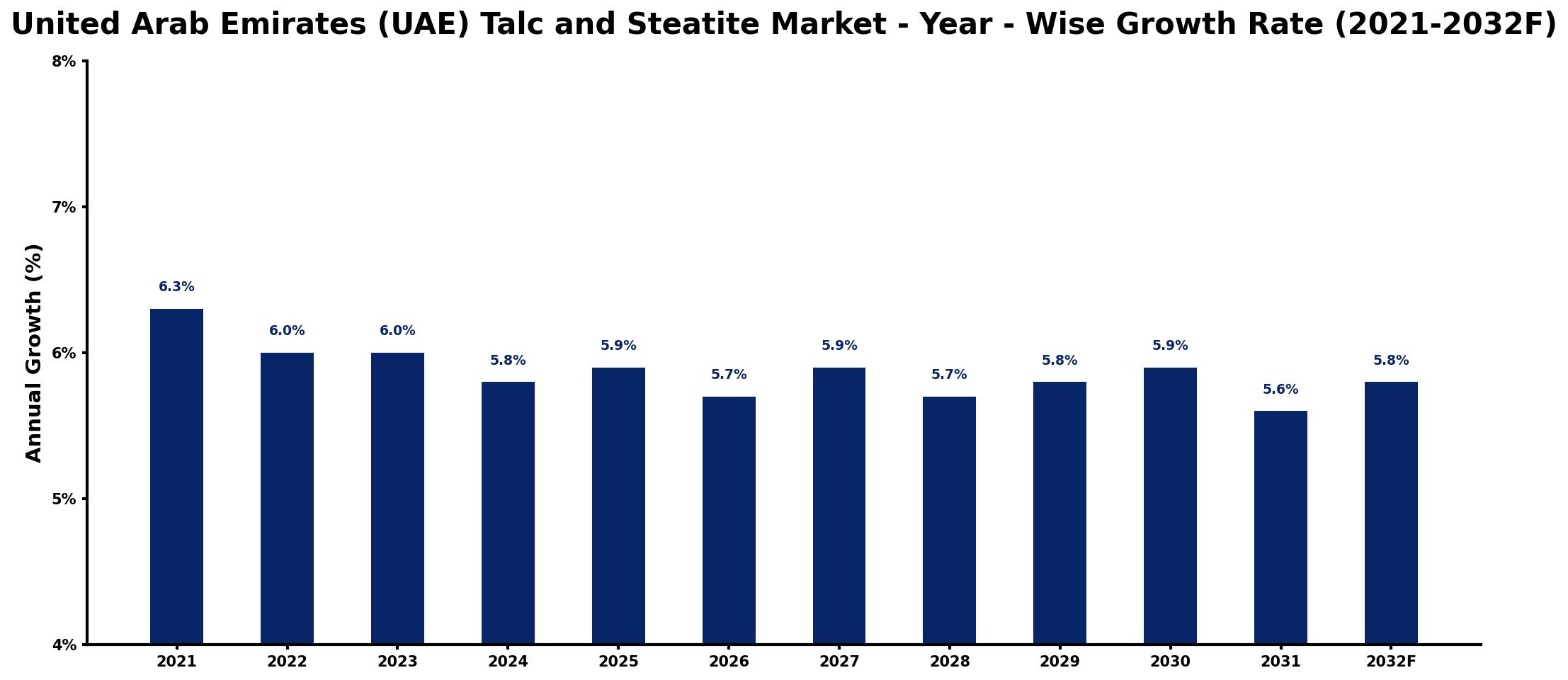
The table below presents the year‑wise growth rates along with the key drivers influencing the market
| Year | Growth Rate | Major Drivers |
| 2021 | 6.3% | increased demand from cosmetics industry |
| 2022 | 6.0% | growing applications in plastics sector |
| 2023 | 6.0% | rising interest in personal care |
| 2024 | 5.8% | expansion of construction materials market |
| 2025 | 5.9% | increased usage in paints coatings |
| 2026 | 5.7% | growing investments in manufacturing technologies |
| 2027 | 5.9% | development of new industrial applications |
| 2028 | 5.7% | rising demand from food sector |
| 2029 | 5.8% | increased focus on sustainable products |
| 2030 | 5.9% | growing popularity in pharmaceuticals market |
| 2031 | 5.6% | enhanced product quality standards |
| 2032 | 5.8% | growing emerging market penetration |
Note: Market size estimations and growth projections presented in this report are based on 6Wresearch's proprietary forecasting methodology, utilizing the latest available industry data, government publications, and primary research inputs.
United Arab Emirates (UAE) Talc and Steatite Market Synopsis
Currently, the most influential factor shaping the UAE talc and steatite market is the robust growth of the construction industry. This sector's expansion is fueled by ongoing infrastructure projects and a surge in real estate development, driving the demand for high-quality building materials containing talc and steatite. As a result, these minerals have become essential ingredients in paints, ceramics, and various composites.
In addition to construction, the cosmetics and personal care industries are increasingly leveraging the natural properties of talc and steatite. The rising awareness and preference for premium skincare products have led to an increase in demand for these minerals, recognized for their texture enhancement and absorbent qualities. This dual demand from both construction and cosmetics sectors is propelling market growth.
United Arab Emirates (UAE) Talc and Steatite Market Key Takeaways
- The UAE talc and steatite market is heavily influenced by the booming construction sector.
- Increasing demand for natural raw materials in cosmetics and personal care products is notable.
- Market growth is challenged by reliance on imports and fluctuations in global prices.
- Environmental regulations are impacting mining and processing operations for talc and steatite.
- Research and development are essential for exploring innovative applications and maintaining product quality.
Evaluation of Restraints in United Arab Emirates (UAE) Talc and Steatite Market
Despite its promising growth, the UAE talc and steatite market faces significant restraints. A major limitation is the heavy reliance on imported raw materials, which exposes the market to global price volatility and supply chain disruptions. Such fluctuations can impact production costs and overall market stability. Furthermore, increasing environmental concerns and regulatory pressures regarding mining practices pose additional challenges, compelling companies to adopt more sustainable practices, often at increased costs. This landscape necessitates a careful balance between growth ambitions and compliance with evolving regulations.
United Arab Emirates (UAE) Talc and Steatite Market Trends
Currently, one of the key trends shaping the UAE talc and steatite market is the increasing integration of sustainable practices in the production and application of these minerals. Companies are investing in eco-friendly mining and processing technologies, which not only meet regulatory standards but also appeal to environmentally conscious consumers. Additionally, the rise of multifunctional talc products that cater to niche markets in cosmetics is gaining traction, as manufacturers look for innovative ways to differentiate their offerings. The focus on quality control and compliance with international standards is also a growing trend, ensuring that products meet the high expectations of end-users.
United Arab Emirates (UAE) Talc and Steatite Market Opportunities
The UAE talc and steatite market presents several opportunities for growth and investment. The ongoing construction boom is an obvious area, as new infrastructure projects will require significant amounts of these minerals. Moreover, there is a clear opportunity within the expanding beauty and personal care sector, where innovative applications of talc and steatite can enhance product formulations. Companies that focus on research and development to create new applications for these materials are likely to gain a competitive edge. Additionally, tapping into regional markets can further broaden the potential customer base and foster industry growth.
Government Initiatives in the United Arab Emirates (UAE) Talc and Steatite Market
The UAE government has been proactive in promoting industrial development, which includes the talc and steatite sector. Initiatives aimed at enhancing local production capabilities and reducing reliance on imports are gaining traction. Public investments in infrastructure and construction have created a conducive environment for the talc and steatite market to flourish. Furthermore, regulations encouraging sustainable mining and processing practices are also shaping the landscape, pushing companies to adapt to greener methodologies while ensuring compliance with national objectives for sustainability and environmental protection.
Future Insights of the United Arab Emirates (UAE) Talc and Steatite Market
Looking ahead from 2026 to 2032, the UAE talc and steatite market is anticipated to continue its upward trajectory. The combined effects of a booming construction sector and a growing cosmetics industry will drive sustained demand. As businesses seek to innovate and respond to consumer preferences, investments in technology and product development will likely play a pivotal role. Additionally, the market's focus on sustainability will shape future operations, encouraging companies to explore alternative sourcing and processing methods while capitalizing on new market opportunities that arise in both local and regional contexts.
United Arab Emirates (UAE) Talc and Steatite Market Latest Developments (2025 - 2026)
Recent developments in the UAE talc and steatite market have highlighted a strong focus on sustainability and innovation. Companies are increasingly adopting eco-friendly practices in their extraction and processing operations to meet regulatory requirements and consumer expectations. Simultaneously, there has been a noticeable uptick in partnerships between manufacturers and technology firms to enhance product applications, particularly within the cosmetics industry. These collaborative efforts are expected to lead to the introduction of new products that cater to evolving consumer demands, reflecting the market's dynamic nature.
United Arab Emirates (UAE) Talc and Steatite Market - Key Attractiveness of the Report
- 10 Years of Market Numbers
- Historical Data Starting from 2022 to 2025
- Base Year: 2025
- Forecast Data until 2032
- Key Performance Indicators Impacting the Market
- Major Upcoming Developments and Projects
Key Highlights of the Report:
- United Arab Emirates (UAE) Talc and Steatite Market Outlook
- Market Size of United Arab Emirates (UAE) Talc and Steatite Market, 2025
- Forecast of United Arab Emirates (UAE) Talc and Steatite Market, 2032
- Historical Data and Forecast of United Arab Emirates (UAE) Talc and Steatite Revenues & Volume for the Period 2022-2032F
- United Arab Emirates (UAE) Talc and Steatite Market Trend Evolution
- United Arab Emirates (UAE) Talc and Steatite Market Drivers and Challenges
- United Arab Emirates (UAE) Talc and Steatite Price Trends
- United Arab Emirates (UAE) Talc and Steatite Porter's Five Forces
- United Arab Emirates (UAE) Talc and Steatite Industry Life Cycle
- Historical Data and Forecast of United Arab Emirates (UAE) Talc and Steatite Market Revenues & Volume By Product Type for the Period 2022-2032F
- Historical Data and Forecast of United Arab Emirates (UAE) Talc and Steatite Market Revenues & Volume By Crushed for the Period 2022-2032F
- Historical Data and Forecast of United Arab Emirates (UAE) Talc and Steatite Market Revenues & Volume By Powdered for the Period 2022-2032F
- United Arab Emirates (UAE) Talc and Steatite Import Export Trade Statistics
- Market Opportunity Assessment By Product Type
- United Arab Emirates (UAE) Talc and Steatite Top Companies Market Share
- United Arab Emirates (UAE) Talc and Steatite Competitive Benchmarking By Technical and Operational Parameters
- United Arab Emirates (UAE) Talc and Steatite Company Profiles
- United Arab Emirates (UAE) Talc and Steatite Key Strategic Recommendations






































