United Arab Emirates (UAE) Textile Fabric Market Size, Share & Growth Rate
The United Arab Emirates (UAE) Textile Fabric Market was estimated at USD 1010 Million in 2025 and is projected to reach USD 1469 Million by 2032, growing at a CAGR of 5.5% from 2026 to 2032. This robust growth trajectory can be attributed to the rising demand for premium textiles within the fashion and home decor sectors, coupled with increasing investments in innovative manufacturing technologies. Moreover, as the automotive industry continues to expand, its appetite for specialized textile solutions further propels market dynamics.
United Arab Emirates (UAE) Textile Fabric Market Year-wise Growth Rate and Key Drivers
This graph highlights how the United Arab Emirates (UAE) Textile Fabric Market has steadily grown over the years, supported by major growth factors.
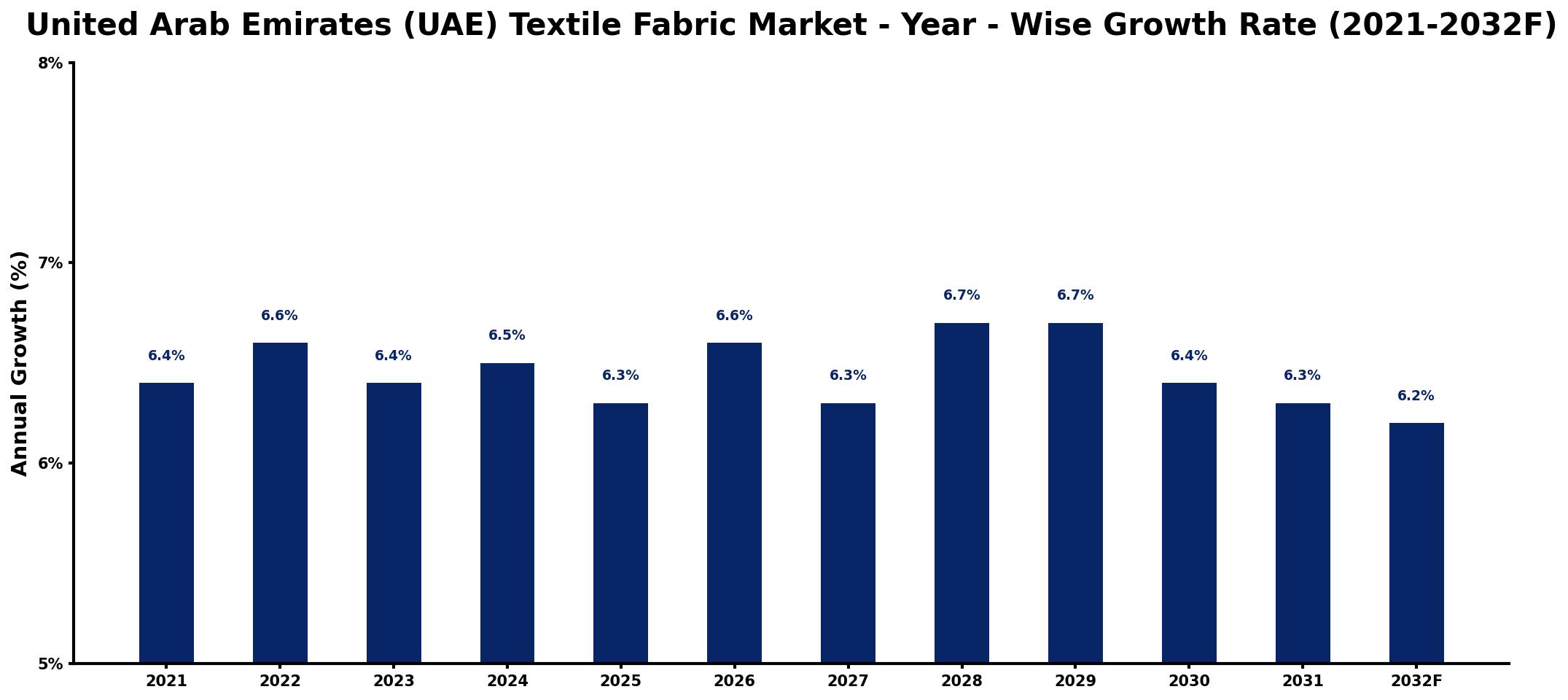
The table below presents the year‑wise growth rates along with the key drivers influencing the market
| Year | Growth Rate | Major Drivers |
| 2021 | 6.4% | Rising consumer demand for clothing |
| 2022 | 6.6% | Increased investment in manufacturing technology |
| 2023 | 6.4% | Expansion of e-commerce platforms |
| 2024 | 6.5% | Growth in fashion industry collaborations |
| 2025 | 6.3% | increased capital investment inflows |
| 2026 | 6.6% | Diversification of sustainable product lines |
| 2027 | 6.3% | Emergence of new retail channels |
| 2028 | 6.7% | Boost in export opportunities globally |
| 2029 | 6.7% | Increased focus on customization services |
| 2030 | 6.4% | strengthening international trade flows |
| 2031 | 6.3% | strengthening underlying market demand |
| 2032 | 6.2% | Rise in eco-friendly consumer preferences |
Note: Market size estimations and growth projections presented in this report are based on 6Wresearch's proprietary forecasting methodology, utilizing the latest available industry data, government publications, and primary research inputs.
United Arab Emirates (UAE) Textile Fabric Market Synopsis
The UAE textile fabric market has demonstrated significant momentum in recent years, driven by the dual forces of innovation and consumer demand. With a diverse array of fabrics designed for various applications—from clothing to home textiles—the market is evolving rapidly, adapting to the latest fashion trends and consumer preferences.
As the market progresses, stakeholders face the challenge of aligning product offerings with the rising expectations for quality and sustainability. The thriving interior design and fashion industries in the UAE are essential to this narrative, representing both a challenge and an opportunity for manufacturers as they seek to leverage these trends to foster growth.
United Arab Emirates (UAE) Textile Fabric Market Key Takeaways
- Significant growth driven by the flourishing fashion and interior design sectors.
- Technological advancements in textile manufacturing enhance product quality and innovation.
- The automotive sector's demand for specialized textiles contributes to market expansion.
- Industry players are adapting to evolving consumer preferences for sustainable fabrics.
- The market is increasingly responsive to health-related textile needs post-COVID-19.
Evaluation of Restraints in United Arab Emirates (UAE) Textile Fabric Market
Despite the robust growth outlook, the UAE textile fabric market grapples with several key restraints. The rapid evolution of fashion trends requires constant adaptation from manufacturers, making it challenging to maintain relevance in a fast-paced environment. Cost-effectiveness remains a significant concern as businesses aim to balance quality and affordability without sacrificing standards. Moreover, the rising emphasis on sustainable materials complicates decision-making processes in material selection and production. Compliance with international quality and safety benchmarks is essential yet burdensome, creating additional pressure on production efficiencies. Ultimately, companies must foster agility in their supply chains to navigate these challenges effectively.
United Arab Emirates (UAE) Textile Fabric Market Trends
Several trends are currently shaping the UAE textile fabric market landscape. Notably, the push for sustainable textiles has gained traction, as consumers become increasingly aware of environmental impacts. Innovations in fabric technology, including smart textiles and performance fabrics, are also on the rise, providing unique opportunities for differentiation. Furthermore, online retail platforms are reshaping the distribution landscape, enhancing access to a wider array of products. As market players navigate these dynamics, the emphasis on personalization and customization continues to grow, reflecting changing consumer behaviors and preferences.
United Arab Emirates (UAE) Textile Fabric Market Opportunities
The UAE textile fabric market is ripe with growth and investment opportunities. With a burgeoning demand for eco-friendly fabrics, companies that innovate in this area stand to gain significantly. Moreover, collaboration with local designers can open doors to unique fabric lines tailored to specific consumer segments, particularly within the luxury sector. The increase in public and private investments in infrastructure projects also presents opportunities for industrial textiles, particularly in sectors like automotive and construction. By leveraging these opportunities, market players can position themselves favorably for long-term growth.
Government Initiatives in the United Arab Emirates (UAE) Textile Fabric Market
The UAE government has implemented various initiatives to support the textile industry, recognizing its importance in diversifying the economy. Policies aimed at enhancing manufacturing capabilities, promoting local production, and attracting foreign investment are central to these efforts. Additionally, government programs focused on innovation and sustainability encourage companies to adopt eco-friendly practices. Such initiatives not only bolster the textile sector but also align with the broader goals of economic diversification and sustainable development.
Future Insights of the United Arab Emirates (UAE) Textile Fabric Market
Looking ahead to 2026-2032, the UAE textile fabric market is anticipated to evolve in response to both challenges and opportunities. The ongoing demand for high-quality, sustainable textiles will drive innovation and collaboration among industry players. As consumer preferences continue to shift, adaptability will be crucial for maintaining competitive advantage. Additionally, advancements in technology will enable enhanced manufacturing processes and improved product offerings. Ultimately, companies that can navigate these changing dynamics while prioritizing quality and sustainability will emerge as leaders in this vibrant market.
United Arab Emirates (UAE) Textile Fabric Market Latest Developments (2025 - 2026)
In recent months, the UAE textile fabric market has seen a notable shift towards the production of specialized textiles, particularly in response to the ongoing health and safety needs stemming from the pandemic. Companies are increasingly investing in research and development to create fabrics that meet both aesthetic and functional requirements. Simultaneously, collaborations among local designers and textile manufacturers are gaining prominence, leading to the launch of unique fabric collections tailored for specific market segments. This evolution reflects a market in transition, adapting to both consumer expectations and technological advancements.
United Arab Emirates (UAE) Textile Fabric Market - Key Attractiveness of the Report
- 10 Years of Market Numbers
- Historical Data Starting from 2022 to 2025
- Base Year: 2025
- Forecast Data until 2032
- Key Performance Indicators Impacting the Market
- Major Upcoming Developments and Projects
Key Highlights of the Report:
- United Arab Emirates (UAE) Textile Fabric Market Outlook
- Market Size of United Arab Emirates (UAE) Textile Fabric Market, 2025
- Forecast of United Arab Emirates (UAE) Textile Fabric Market, 2032
- Historical Data and Forecast of United Arab Emirates (UAE) Textile Fabric Revenues & Volume for the Period 2022-2032F
- United Arab Emirates (UAE) Textile Fabric Market Trend Evolution
- United Arab Emirates (UAE) Textile Fabric Market Drivers and Challenges
- United Arab Emirates (UAE) Textile Fabric Price Trends
- United Arab Emirates (UAE) Textile Fabric Porter's Five Forces
- United Arab Emirates (UAE) Textile Fabric Industry Life Cycle
- Historical Data and Forecast of United Arab Emirates (UAE) Textile Fabric Market Revenues & Volume By Fabric Type for the Period 2022-2032F
- Historical Data and Forecast of United Arab Emirates (UAE) Textile Fabric Market Revenues & Volume By Cotton for the Period 2022-2032F
- Historical Data and Forecast of United Arab Emirates (UAE) Textile Fabric Market Revenues & Volume By 65/35% for the Period 2022-2032F
- Historical Data and Forecast of United Arab Emirates (UAE) Textile Fabric Market Revenues & Volume By 50/50% for the Period 2022-2032F
- Historical Data and Forecast of United Arab Emirates (UAE) Textile Fabric Market Revenues & Volume By 35/65% for the Period 2022-2032F
- Historical Data and Forecast of United Arab Emirates (UAE) Textile Fabric Market Revenues & Volume By 40/60% for the Period 2022-2032F
- Historical Data and Forecast of United Arab Emirates (UAE) Textile Fabric Market Revenues & Volume By 10/90% for the Period 2022-2032F
- Historical Data and Forecast of United Arab Emirates (UAE) Textile Fabric Market Revenues & Volume By Polyester for the Period 2022-2032F
- Historical Data and Forecast of United Arab Emirates (UAE) Cotton Textile Fabric Market Revenues & Volume By Others for the Period 2022-2032F
- Historical Data and Forecast of United Arab Emirates (UAE) Textile Fabric Market Revenues & Volume By Application for the Period 2022-2032F
- Historical Data and Forecast of United Arab Emirates (UAE) Textile Fabric Market Revenues & Volume By T-Shirt for the Period 2022-2032F
- Historical Data and Forecast of United Arab Emirates (UAE) Textile Fabric Market Revenues & Volume By Sportswear for the Period 2022-2032F
- Historical Data and Forecast of United Arab Emirates (UAE) Textile Fabric Market Revenues & Volume By Outdoor Clothing for the Period 2022-2032F
- Historical Data and Forecast of United Arab Emirates (UAE) Textile Fabric Market Revenues & Volume By Performance Wear for the Period 2022-2032F
- United Arab Emirates (UAE) Textile Fabric Import Export Trade Statistics
- Market Opportunity Assessment By Fabric Type
- Market Opportunity Assessment By Application
- United Arab Emirates (UAE) Textile Fabric Top Companies Market Share
- United Arab Emirates (UAE) Textile Fabric Competitive Benchmarking By Technical and Operational Parameters
- United Arab Emirates (UAE) Textile Fabric Company Profiles
- United Arab Emirates (UAE) Textile Fabric Key Strategic Recommendations






































