United Arab Emirates (UAE) Warm Air Heating Equipment Market Size, Share & Growth Rate
The United Arab Emirates (UAE) Warm Air Heating Equipment Market was estimated at USD 1380 Million in 2025 and is projected to reach USD 2539 Million by 2032, growing at a CAGR of 9.1% from 2026 to 2032. This growth trajectory is spurred by the increasing need for reliable heating systems amid extreme temperature fluctuations and the rising emphasis on energy efficiency. As residential, commercial, and industrial spaces seek innovative climate control solutions, the market is set to expand significantly in the coming years.
United Arab Emirates (UAE) Warm Air Heating Equipment Market Year-wise Growth Rate and Key Drivers
This graph highlights how the United Arab Emirates (UAE) Warm Air Heating Equipment Market has steadily grown over the years, supported by major growth factors.
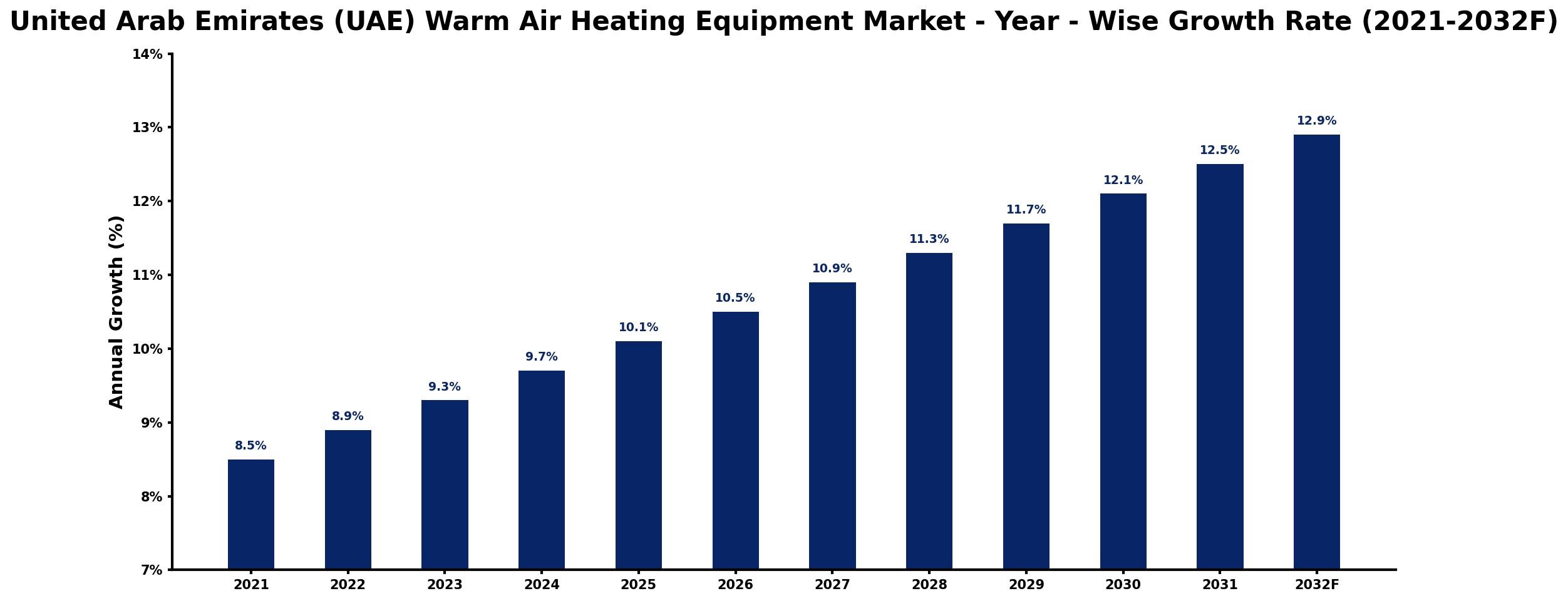
The table below presents the year‑wise growth rates along with the key drivers influencing the market
| Year | Growth Rate | Major Drivers |
| 2021 | 8.5% | Rising construction sector investments |
| 2022 | 8.9% | Increasing residential development projects |
| 2023 | 9.3% | Growing focus on energy efficiency |
| 2024 | 9.7% | Expansion of commercial spaces |
| 2025 | 10.1% | Surge in luxury property demand |
| 2026 | 10.5% | Enhanced government infrastructure spending |
| 2027 | 10.9% | Boom in hospitality industry growth |
| 2028 | 11.3% | Rising consumer awareness sustainability |
| 2029 | 11.7% | Technological advancements in automation |
| 2030 | 12.1% | Increased urban population density |
| 2031 | 12.5% | Growth in renewable energy initiatives |
| 2032 | 12.9% | growing emerging market penetration |
Note: Market size estimations and growth projections presented in this report are based on 6Wresearch's proprietary forecasting methodology, utilizing the latest available industry data, government publications, and primary research inputs.
United Arab Emirates (UAE) Warm Air Heating Equipment Market Synopsis
The warm air heating equipment market in the UAE is rapidly evolving, driven by the necessity for comfort and climate regulation. With a climate characterized by intense heat and cooler winter months, the demand for effective heating solutions is paramount for both residents and businesses.
Current trends indicate a shift toward energy-efficient heating systems, including furnaces and heat pumps that cater to the regions unique environmental challenges. This necessity for efficiency not only aligns with cost-saving measures but also addresses increasing environmental regulations.
United Arab Emirates (UAE) Warm Air Heating Equipment Market Key Takeaways
- Growing demand for reliable and energy-efficient heating solutions in residential and commercial sectors.
- Market recovery expected post-COVID-19 as construction projects resume and industrial activities increase.
- Technological advancements are driving innovations in heating equipment design and efficiency.
- Regulatory pressures are prompting a shift towards environmentally-friendly heating options.
- Strong focus on sustainability and energy savings is influencing purchasing decisions across sectors.
Evaluation of Restraints in United Arab Emirates (UAE) Warm Air Heating Equipment Market
Despite its growth potential, the UAE warm air heating equipment market faces notable restraints. One of the primary challenges is the need to balance heating and cooling demands within a short seasonal span, compelling manufacturers to develop versatile solutions. Additionally, evolving environmental regulations introduce complexity in compliance, requiring ongoing innovation in product design and function. Furthermore, consumer awareness and adaptation to these advanced technologies can lag, potentially hindering market penetration.
United Arab Emirates (UAE) Warm Air Heating Equipment Market Trends
Recent trends in the UAE's warm air heating equipment market indicate a growing preference for smart heating technologies and integration with home automation systems. The rise of the Internet of Things (IoT) is facilitating the development of more interactive and energy-efficient heating solutions. Furthermore, renewable energy sources, such as solar heating technologies, are gaining traction, reflecting the region's shift towards sustainability and reduced carbon footprints.
United Arab Emirates (UAE) Warm Air Heating Equipment Market Opportunities
There are significant opportunities for growth within the UAE warm air heating equipment market, particularly in energy-efficient and smart technologies. With the government encouraging investments in renewable energy solutions and green building practices, manufacturers have a chance to innovate and capture a substantial market share. Additionally, as the population continues to grow and urbanize, there will be an increased demand for advanced heating solutions in new developments.
Government Initiatives in the United Arab Emirates (UAE) Warm Air Heating Equipment Market
The UAE government is actively promoting initiatives aimed at enhancing energy efficiency and sustainability in building practices. Policies encouraging the adoption of energy-efficient technologies and renewable energy sources are paving the way for advancements in the warm air heating equipment market. Public spending on infrastructure development and eco-friendly projects is expected to bolster the demand for modern heating solutions, aligning with the UAE's Vision 2021 to create a sustainable environment.
Future Insights of the United Arab Emirates (UAE) Warm Air Heating Equipment Market
Looking ahead to 2026-2032, the UAE warm air heating equipment market is anticipated to experience robust growth. Increasing urbanization, heightened focus on energy efficiency, and evolving consumer preferences for advanced heating technologies will be central to this evolution. The market will likely see innovations that not only improve heating performance but also integrate seamlessly with smart home systems, making it a critical component of future residential and commercial designs.
United Arab Emirates (UAE) Warm Air Heating Equipment Market Latest Developments (2025 - 2026)
In the past year, the UAE warm air heating equipment market has witnessed several key developments aimed at enhancing energy efficiency and customer satisfaction. Manufacturers are increasingly investing in research and development to incorporate advanced technologies that improve heating performance while reducing energy consumption. Additionally, partnerships between key industry stakeholders are emerging to foster innovation and expand the reach of efficient heating solutions across the region.
United Arab Emirates (UAE) Warm Air Heating Equipment Market - Key Attractiveness of the Report
- 10 Years of Market Numbers
- Historical Data Starting from 2022 to 2025
- Base Year: 2025
- Forecast Data until 2032
- Key Performance Indicators Impacting the Market
- Major Upcoming Developments and Projects
Key Highlights of the Report:
- United Arab Emirates (UAE) Warm Air Heating Equipment Market Outlook
- Market Size of United Arab Emirates (UAE) Warm Air Heating Equipment Market, 2025
- Forecast of United Arab Emirates (UAE) Warm Air Heating Equipment Market, 2032
- Historical Data and Forecast of United Arab Emirates (UAE) Warm Air Heating Equipment Revenues & Volume for the Period 2022-2032F
- United Arab Emirates (UAE) Warm Air Heating Equipment Market Trend Evolution
- United Arab Emirates (UAE) Warm Air Heating Equipment Market Drivers and Challenges
- United Arab Emirates (UAE) Warm Air Heating Equipment Price Trends
- United Arab Emirates (UAE) Warm Air Heating Equipment Porter's Five Forces
- United Arab Emirates (UAE) Warm Air Heating Equipment Industry Life Cycle
- Historical Data and Forecast of United Arab Emirates (UAE) Warm Air Heating Equipment Market Revenues & Volume By Product Type for the Period 2022-2032F
- Historical Data and Forecast of United Arab Emirates (UAE) Warm Air Heating Equipment Market Revenues & Volume By Heat Pumps for the Period 2022-2032F
- Historical Data and Forecast of United Arab Emirates (UAE) Warm Air Heating Equipment Market Revenues & Volume By Humidifying Equipment for the Period 2022-2032F
- Historical Data and Forecast of United Arab Emirates (UAE) Warm Air Heating Equipment Market Revenues & Volume By Fuel Type for the Period 2022-2032F
- Historical Data and Forecast of United Arab Emirates (UAE) Warm Air Heating Equipment Market Revenues & Volume By Electric Powered for the Period 2022-2032F
- Historical Data and Forecast of United Arab Emirates (UAE) Warm Air Heating Equipment Market Revenues & Volume By Gas-Powered for the Period 2022-2032F
- Historical Data and Forecast of United Arab Emirates (UAE) Warm Air Heating Equipment Market Revenues & Volume By Hybrid for the Period 2022-2032F
- Historical Data and Forecast of United Arab Emirates (UAE) Warm Air Heating Equipment Market Revenues & Volume By Solar Powered for the Period 2022-2032F
- Historical Data and Forecast of United Arab Emirates (UAE) Warm Air Heating Equipment Market Revenues & Volume By Application for the Period 2022-2032F
- Historical Data and Forecast of United Arab Emirates (UAE) Warm Air Heating Equipment Market Revenues & Volume By Air to Air for the Period 2022-2032F
- Historical Data and Forecast of United Arab Emirates (UAE) Warm Air Heating Equipment Market Revenues & Volume By Air to Water for the Period 2022-2032F
- Historical Data and Forecast of United Arab Emirates (UAE) Warm Air Heating Equipment Market Revenues & Volume By Implementation for the Period 2022-2032F
- Historical Data and Forecast of United Arab Emirates (UAE) Warm Air Heating Equipment Market Revenues & Volume By New Construction for the Period 2022-2032F
- Historical Data and Forecast of United Arab Emirates (UAE) Warm Air Heating Equipment Market Revenues & Volume By Maintenance for the Period 2022-2032F
- Historical Data and Forecast of United Arab Emirates (UAE) Warm Air Heating Equipment Market Revenues & Volume By End User Industry for the Period 2022-2032F
- Historical Data and Forecast of United Arab Emirates (UAE) Warm Air Heating Equipment Market Revenues & Volume By Residential for the Period 2022-2032F
- Historical Data and Forecast of United Arab Emirates (UAE) Warm Air Heating Equipment Market Revenues & Volume By Commercial for the Period 2022-2032F
- Historical Data and Forecast of United Arab Emirates (UAE) Warm Air Heating Equipment Market Revenues & Volume By Industrial for the Period 2022-2032F
- Historical Data and Forecast of United Arab Emirates (UAE) Warm Air Heating Equipment Market Revenues & Volume By Business Type for the Period 2022-2032F
- Historical Data and Forecast of United Arab Emirates (UAE) Warm Air Heating Equipment Market Revenues & Volume By Original Equipment Manufacturer (OEM) for the Period 2022-2032F
- Historical Data and Forecast of United Arab Emirates (UAE) Warm Air Heating Equipment Market Revenues & Volume By Aftermarket for the Period 2022-2032F
- United Arab Emirates (UAE) Warm Air Heating Equipment Import Export Trade Statistics
- Market Opportunity Assessment By Product Type
- Market Opportunity Assessment By Fuel Type
- Market Opportunity Assessment By Application
- Market Opportunity Assessment By Implementation
- Market Opportunity Assessment By End User Industry
- Market Opportunity Assessment By Business Type
- United Arab Emirates (UAE) Warm Air Heating Equipment Top Companies Market Share
- United Arab Emirates (UAE) Warm Air Heating Equipment Competitive Benchmarking By Technical and Operational Parameters
- United Arab Emirates (UAE) Warm Air Heating Equipment Company Profiles
- United Arab Emirates (UAE) Warm Air Heating Equipment Key Strategic Recommendations






































