United Kingdom (UK) Advertising Market Size, Share & Growth Rate
The United Kingdom (UK) Advertising Market was estimated at USD 410 Million in 2025 and is projected to reach USD 507 Million by 2032, growing at a CAGR of 3.1% from 2026 to 2032. This growth trajectory is propelled primarily by the relentless rise of digital advertising, with brands increasingly pivoting towards mobile and social media platforms to engage with their audiences. Furthermore, the ongoing transformation within traditional media channels signals a gradual yet significant integration with digital strategies, enhancing overall market viability.
United Kingdom (UK) Advertising Market Year-wise Growth Rate and Key Drivers
This graph highlights how the United Kingdom (UK) Advertising Market has steadily grown over the years, supported by major growth factors.
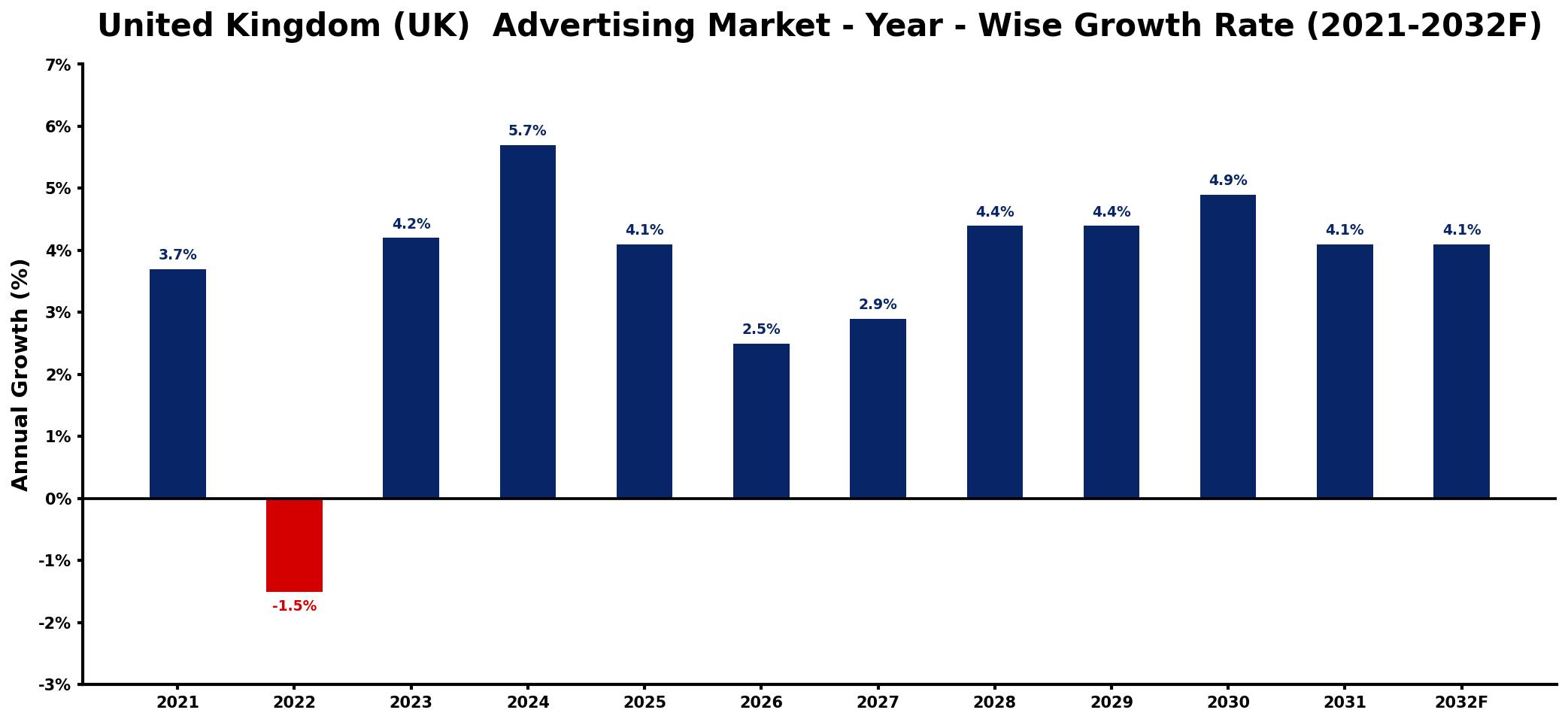
The table below presents the year‑wise growth rates along with the key drivers influencing the market
| Year | Growth Rate | Major Drivers |
| 2021 | 3.7% | Increased digital media spending |
| 2022 | -1.5% | Decline in traditional media usage |
| 2023 | 4.2% | Growth in influencer partnerships |
| 2024 | 5.7% | Expansion of programmatic buying |
| 2025 | 4.1% | Rise in mobile marketing strategies |
| 2026 | 2.5% | Investment in data analytics tools |
| 2027 | 2.9% | Growth of experiential marketing campaigns |
| 2028 | 4.4% | Increase in video content consumption |
| 2029 | 4.4% | growing downstream application demand |
| 2030 | 4.9% | increased production capacity utilization |
| 2031 | 4.1% | expanding healthcare application demand |
| 2032 | 4.1% | expanding manufacturing base activity |
Note: Market size estimations and growth projections presented in this report are based on 6Wresearch's proprietary forecasting methodology, utilizing the latest available industry data, government publications, and primary research inputs.
United Kingdom (UK) Advertising Market Synopsis
The UK advertising landscape is characterized by its rapid adaptability to consumer behavior shifts, with a marked preference for digital interactions. Advertisers are increasingly leveraging advanced data analytics to curate targeted campaigns, thus maximizing engagement and return on investment. This shift not only reflects the growing importance of online platforms but also signifies a broader cultural shift towards personalized marketing.
Traditional advertising mediums such as television and print continue to play an essential role, yet they are witnessing a transition towards digital integration. As brands endeavor to create impactful narratives, the interplay between creativity and technology becomes crucial for achieving effective communication in an ever-evolving market.
United Kingdom (UK) Advertising Market Key Takeaways
- Digital advertising dominates the UK market, significantly outpacing traditional mediums.
- Mobile and social media channels are increasingly vital for brand-consumer engagement.
- Transparency and ethical practices are becoming paramount in advertising strategies.
- The market is undergoing a fundamental shift towards data-driven targeting and personalized campaigns.
- Investment opportunities are expanding across digital platforms and influencer marketing.
Evaluation of Restraints in United Kingdom (UK) Advertising Market
Despite the robust growth forecast, the UK advertising market faces several restraints. Increasing regulations surrounding data privacy, particularly stemming from the implementation of GDPR, present significant hurdles for advertisers. Navigating complex legal frameworks requires investment in compliance measures, which can strain resources. Moreover, consumer preferences are evolving, with many individuals opting for ad-free experiences, prompting advertisers to rethink traditional outreach strategies. Consequently, brands must balance regulatory compliance with innovative marketing approaches to maintain consumer trust and engagement.
United Kingdom (UK) Advertising Market Trends
Current trends in the UK advertising market underscore the escalating significance of digital channels, particularly as online and mobile platforms flourish. Social media advertising has emerged as a cornerstone, fostering direct connections between brands and consumers. Additionally, brands are increasingly prioritizing sustainability and ethical marketing practices, reflecting a broader consumer demand for corporate responsibility. The emphasis on personalization and targeted messaging continues to reshape the advertising narrative, highlighting the role of data analytics and AI in driving innovation.
United Kingdom (UK) Advertising Market Opportunities
The UK advertising market offers a myriad of investment opportunities. With digital advertising expenditures projected to rise, there is substantial potential in digital platforms and programmatic advertising technologies. Furthermore, the out-of-home advertising sector is evolving with advanced technologies, including interactive displays, which can appeal to investors looking for dynamic advertising solutions. Influencer marketing is also on the rise, providing lucrative channels for brands to connect with their audiences authentically through strategic partnerships with digital influencers.
Government Initiatives in the United Kingdom (UK) Advertising Market
The UK government has established a framework of regulations to ensure fair competition and consumer protection in the advertising sector. The Advertising Standards Authority (ASA) plays a pivotal role in maintaining ethical advertising practices, while the Committee of Advertising Practice (CAP) offers guidance on advertising standards. These measures are designed to safeguard public interests, particularly in sensitive areas such as alcohol, tobacco, and gambling advertising, fostering an environment of accountability and integrity within the industry.
Future Insights of the United Kingdom (UK) Advertising Market
Looking ahead to 2026-2032, the United Kingdom advertising market is poised for continuous evolution. As digital advertising spending escalates, traditional channels may see tempered growth, prompting brands to enhance their digital engagement strategies. The focus on data-driven targeting and personalization is expected to amplify, driven by advancements in AI and machine learning technologies. However, looming regulatory changes and privacy concerns may challenge the industry, necessitating a balance between innovation and consumer protection. Overall, the market will remain dynamic, presenting vast opportunities for growth through innovative advertising solutions.
United Kingdom (UK) Advertising Market Latest Developments (2025 - 2026)
Recent developments within the UK advertising market reflect an ongoing commitment to innovation and ethical practices. Brands are actively exploring new digital platforms to enhance consumer engagement while navigating the challenges posed by changing regulations. Additionally, the emergence of interactive and experiential advertising strategies signals a shift towards more immersive consumer experiences. The advertising community is increasingly prioritizing transparency, fostering consumer trust amidst evolving market dynamics.
United Kingdom (UK) Advertising Market - Key Attractiveness of the Report
- 10 Years of Market Numbers
- Historical Data Starting from 2022 to 2025
- Base Year: 2025
- Forecast Data until 2032
- Key Performance Indicators Impacting the Market
- Major Upcoming Developments and Projects
Key Highlights of the Report:
- United Kingdom (UK) Advertising Market Outlook
- Market Size of United Kingdom (UK) Advertising Market, 2025
- Forecast of United Kingdom (UK) Advertising Market, 2032
- Historical Data and Forecast of United Kingdom (UK) Advertising Revenues & Volume for the Period 2022-2032F
- United Kingdom (UK) Advertising Market Trend Evolution
- United Kingdom (UK) Advertising Market Drivers and Challenges
- United Kingdom (UK) Advertising Price Trends
- United Kingdom (UK) Advertising Porter's Five Forces
- United Kingdom (UK) Advertising Industry Life Cycle
- Historical Data and Forecast of United Kingdom (UK) Advertising Market Revenues & Volume By Type for the Period 2022-2032F
- Historical Data and Forecast of United Kingdom (UK) Advertising Market Revenues & Volume By Television for the Period 2022-2032F
- Historical Data and Forecast of United Kingdom (UK) Advertising Market Revenues & Volume By Print (Newspaper and Magazine) for the Period 2022-2032F
- Historical Data and Forecast of United Kingdom (UK) Advertising Market Revenues & Volume By Radio for the Period 2022-2032F
- Historical Data and Forecast of United Kingdom (UK) Advertising Market Revenues & Volume By Outdoor for the Period 2022-2032F
- Historical Data and Forecast of United Kingdom (UK) Advertising Market Revenues & Volume By Internet (Search, Display, Classified, Video) for the Period 2022-2032F
- Historical Data and Forecast of United Kingdom (UK) Advertising Market Revenues & Volume By Mobile for the Period 2022-2032F
- Historical Data and Forecast of United Kingdom (UK) Advertising Market Revenues & Volume By Cinema for the Period 2022-2032F
- United Kingdom (UK) Advertising Import Export Trade Statistics
- Market Opportunity Assessment By Type
- United Kingdom (UK) Advertising Top Companies Market Share
- United Kingdom (UK) Advertising Competitive Benchmarking By Technical and Operational Parameters
- United Kingdom (UK) Advertising Company Profiles
- United Kingdom (UK) Advertising Key Strategic Recommendations






































