United Kingdom (UK) Aerosol Market: Import Trend Analysis
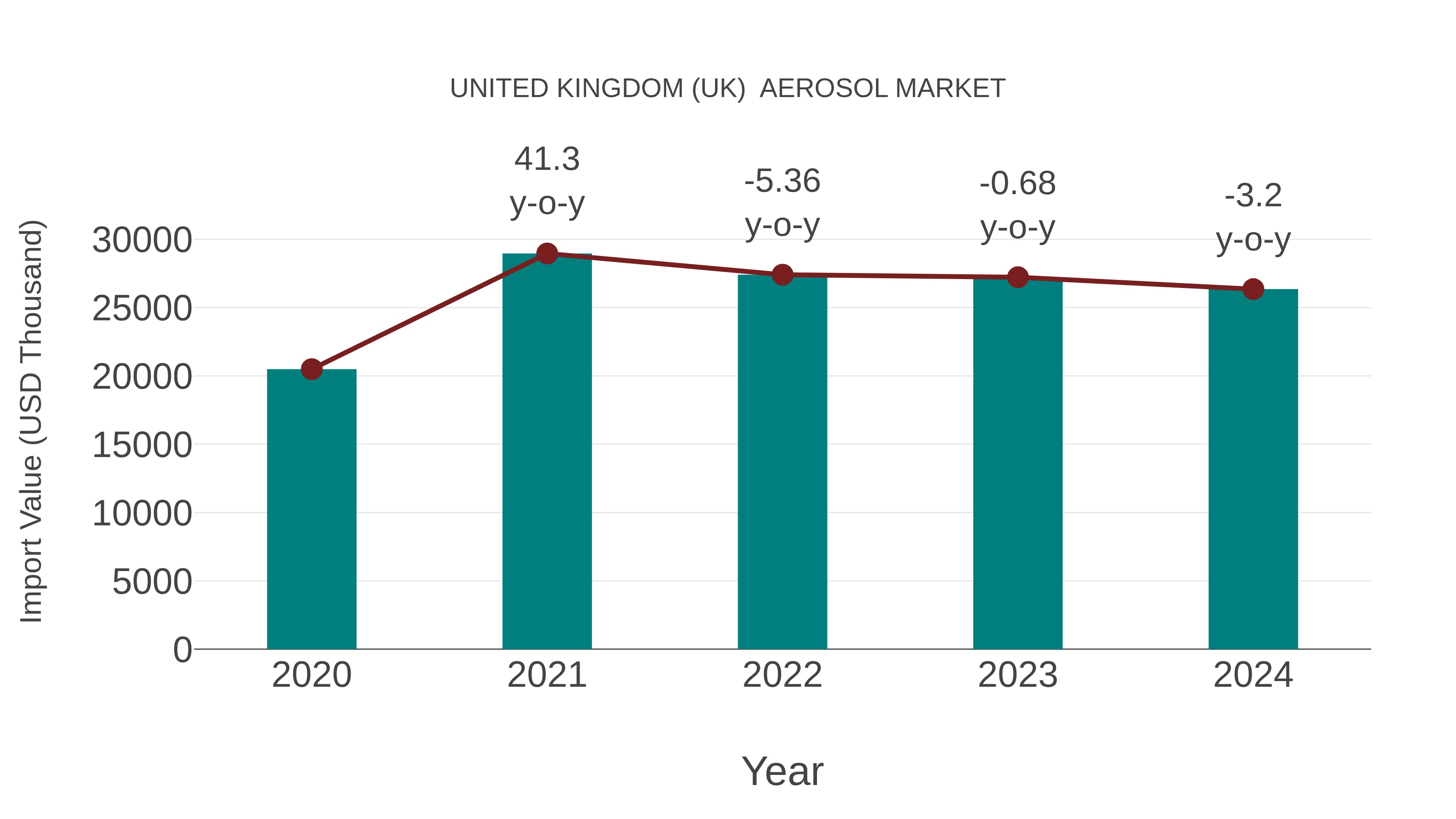
In 2024, the United Kingdom import trend for the aerosol market experienced a decline, with a growth rate of -3.2% compared to the previous year. However, the compound annual growth rate (CAGR) for 2020-2024 stood at a healthy 6.48%. This dip in import momentum could be attributed to shifting demand patterns or evolving trade policies impacting market stability.
United Kingdom (UK) Aerosol Market Synopsis
The United Kingdom aerosol market is a dynamic and growing sector within the consumer goods industry. The market is driven by the demand for convenient and efficient packaging solutions across various industries such as personal care, household products, and automotive. Key players in the UK aerosol market include multinational corporations as well as smaller, niche brands offering a wide range of products from deodorants and hairsprays to air fresheners and insecticides. With a focus on sustainability and environmental concerns, the market is witnessing a shift towards eco-friendly aerosol products that use compressed air or nitrogen as propellants. Regulatory compliance and innovation in packaging design are also shaping the market landscape, with an emphasis on safety, quality, and aesthetics to meet consumer preferences and expectations.
United Kingdom (UK) Aerosol Market Trends
The United Kingdom aerosol market is experiencing several key trends. Firstly, there is a growing demand for eco-friendly and sustainable aerosol products, driven by increasing environmental awareness among consumers. Brands are responding by introducing recyclable packaging and eco-friendly formulations. Secondly, there is a rising preference for aerosol products in the personal care and household cleaning segments due to their convenience, ease of use, and effective application. In addition, advancements in aerosol technology, such as improved valve systems and propellants, are enhancing product performance and safety. Lastly, the COVID-19 pandemic has led to a surge in demand for disinfectant aerosols and sanitizers, driving growth in the hygiene and disinfection segment of the UK aerosol market.
United Kingdom (UK) Aerosol Market Challenges
In the United Kingdom (UK) Aerosol Market, challenges primarily revolve around sustainability and environmental concerns. With growing awareness of the impact of aerosols on the environment, there is increasing pressure on companies to adopt more eco-friendly packaging solutions and propellants. This shift towards sustainability can be costly and time-consuming for manufacturers who may need to overhaul their production processes and invest in new technologies. Additionally, stringent regulations regarding the use of certain chemicals in aerosols pose a challenge for companies operating in the UK market. Adapting to these regulations while maintaining product performance and consumer satisfaction can be a delicate balance for businesses in the aerosol industry. Overall, navigating sustainability requirements and regulatory constraints are key challenges faced by players in the UK Aerosol Market.
United Kingdom (UK) Aerosol Market Investment Opportunities
The UK aerosol market presents promising investment opportunities across various sectors. With increasing consumer demand for convenient and sustainable packaging solutions, there is a growing trend towards eco-friendly aerosol products. This opens up opportunities for investment in companies focusing on innovation and development of sustainable aerosol technologies. Additionally, the beauty and personal care segment within the aerosol market is experiencing substantial growth, driven by changing consumer preferences and new product offerings. Investing in companies that specialize in beauty and personal care aerosol products could prove to be lucrative. Furthermore, the pharmaceutical and healthcare sectors are also key areas for investment, as there is a rising demand for aerosol-based medical products. Overall, the UK aerosol market offers diverse investment opportunities, particularly in the areas of sustainability, beauty, personal care, and healthcare.
Jordan Agar Market Government Policies
In the United Kingdom, the Aerosol Market is subject to various government policies and regulations aimed at ensuring product safety, environmental protection, and consumer welfare. The UK follows EU regulations regarding aerosol products, including restrictions on certain chemicals, labeling requirements for hazardous substances, and packaging guidelines to minimize environmental impact. Additionally, the UK government has implemented waste management policies to encourage recycling and proper disposal of aerosol containers. Companies operating in the UK Aerosol Market must comply with these regulations to ensure product quality, safety, and sustainability while meeting consumer expectations and contributing to a cleaner environment.
United Kingdom (UK) Aerosol Market Future Outlook
The future outlook for the United Kingdom Aerosol Market appears positive, with expected growth driven by factors such as increasing demand for convenient and sustainable packaging solutions across various industries including personal care, household products, and pharmaceuticals. The market is likely to benefit from innovation in aerosol technology, leading to the development of eco-friendly and recyclable packaging options. Additionally, the rising consumer preference for aerosol products due to their ease of use, efficiency, and hygiene benefits is expected to drive market expansion. Regulatory trends focusing on reducing environmental impact may also influence the market dynamics, prompting companies to invest in sustainable aerosol solutions. Overall, the UK Aerosol Market is anticipated to witness steady growth in the coming years, supported by evolving consumer preferences and industry advancements.
Key Highlights of the Report:
- United Kingdom (UK) Aerosol Market Outlook
- Market Size of United Kingdom (UK) Aerosol Market, 2025
- Forecast of United Kingdom (UK) Aerosol Market, 2032
- Historical Data and Forecast of United Kingdom (UK) Aerosol Revenues & Volume for the Period 2022 - 2032F
- United Kingdom (UK) Aerosol Market Trend Evolution
- United Kingdom (UK) Aerosol Market Drivers and Challenges
- United Kingdom (UK) Aerosol Price Trends
- United Kingdom (UK) Aerosol Porter's Five Forces
- United Kingdom (UK) Aerosol Industry Life Cycle
- Historical Data and Forecast of United Kingdom (UK) Aerosol Market Revenues & Volume By Material for the Period 2022 - 2032F
- Historical Data and Forecast of United Kingdom (UK) Aerosol Market Revenues & Volume By Steel for the Period 2022 - 2032F
- Historical Data and Forecast of United Kingdom (UK) Aerosol Market Revenues & Volume By Aluminum for the Period 2022 - 2032F
- Historical Data and Forecast of United Kingdom (UK) Aerosol Market Revenues & Volume By Others for the Period 2022 - 2032F
- Historical Data and Forecast of United Kingdom (UK) Aerosol Market Revenues & Volume By Type for the Period 2022 - 2032F
- Historical Data and Forecast of United Kingdom (UK) Aerosol Market Revenues & Volume By Bag-In-Valve for the Period 2022 - 2032F
- Historical Data and Forecast of United Kingdom (UK) Aerosol Market Revenues & Volume By Standard for the Period 2022 - 2032F
- Historical Data and Forecast of United Kingdom (UK) Aerosol Market Revenues & Volume By Application for the Period 2022 - 2032F
- Historical Data and Forecast of United Kingdom (UK) Aerosol Market Revenues & Volume By Personal Care for the Period 2022 - 2032F
- Historical Data and Forecast of United Kingdom (UK) Aerosol Market Revenues & Volume By Household for the Period 2022 - 2032F
- Historical Data and Forecast of United Kingdom (UK) Aerosol Market Revenues & Volume By Automotive & Industrial for the Period 2022 - 2032F
- Historical Data and Forecast of United Kingdom (UK) Aerosol Market Revenues & Volume By Food for the Period 2022 - 2032F
- Historical Data and Forecast of United Kingdom (UK) Aerosol Market Revenues & Volume By Paints for the Period 2022 - 2032F
- Historical Data and Forecast of United Kingdom (UK) Aerosol Market Revenues & Volume By Medical for the Period 2022 - 2032F
- Historical Data and Forecast of United Kingdom (UK) Aerosol Market Revenues & Volume By Others for the Period 2022 - 2032F
- United Kingdom (UK) Aerosol Import Export Trade Statistics
- Market Opportunity Assessment By Material
- Market Opportunity Assessment By Type
- Market Opportunity Assessment By Application
- United Kingdom (UK) Aerosol Top Companies Market Share
- United Kingdom (UK) Aerosol Competitive Benchmarking By Technical and Operational Parameters
- United Kingdom (UK) Aerosol Company Profiles
- United Kingdom (UK) Aerosol Key Strategic Recommendations






































