United Kingdom (UK) Bamboo Furniture Market Size, Share & Growth Rate
The United Kingdom (UK) Bamboo Furniture Market was estimated at USD 460 Million in 2025 and is projected to reach USD 571 Million by 2032, growing at a CAGR of 3.1% from 2026 to 2032. This growth trajectory is largely fueled by a significant shift in consumer preferences toward sustainable and eco-friendly living solutions. As awareness of bamboos environmental benefits spreads, demand for stylish and durable bamboo furniture is rising, particularly among environmentally conscious consumers.
United Kingdom (UK) Bamboo Furniture Market Year-wise Growth Rate and Key Drivers
This graph highlights how the United Kingdom (UK) Bamboo Furniture Market has steadily grown over the years, supported by major growth factors.
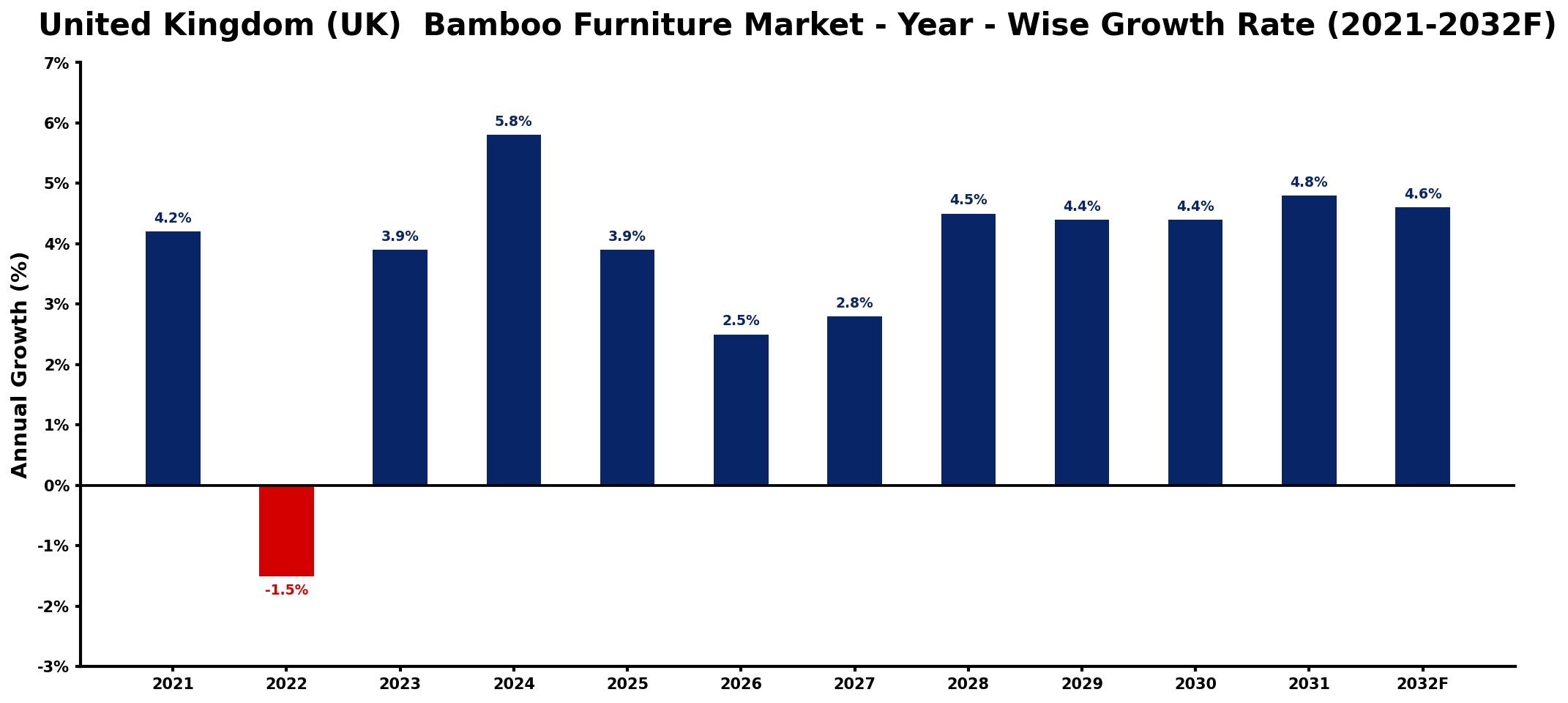
The table below presents the year‑wise growth rates along with the key drivers influencing the market
| Year | Growth Rate | Major Drivers |
| 2021 | 4.2% | Sustainable living trends rise |
| 2022 | -1.5% | Consumer interest in alternatives wanes |
| 2023 | 3.9% | Eco-friendly materials gain traction |
| 2024 | 5.8% | Home decor preferences shift positively |
| 2025 | 3.9% | Online retail channels expand rapidly |
| 2026 | 2.5% | Manufacturing innovations enhance efficiency |
| 2027 | 2.8% | Investment in green technologies increases |
| 2028 | 4.5% | Design collaborations attract new customers |
| 2029 | 4.4% | Health consciousness drives purchases |
| 2030 | 4.4% | Urbanization boosts space-saving solutions |
| 2031 | 4.8% | Customization trends appeal to buyers |
| 2032 | 4.6% | Circular economy initiatives gain momentum |
Note: Market size estimations and growth projections presented in this report are based on 6Wresearch's proprietary forecasting methodology, utilizing the latest available industry data, government publications, and primary research inputs.
United Kingdom (UK) Bamboo Furniture Market Synopsis
Recent momentum in the United Kingdom's bamboo furniture market is notable, showcasing a burgeoning interest in sustainable furnishings. As we look to the future, the market is set for continued expansion, driven by shifting consumer values that prioritize eco-friendliness without sacrificing design aesthetics.
This increasing demand is complemented by the growing trend of minimalist and contemporary design, which aligns seamlessly with the natural aesthetics of bamboo. Innovative product designs and versatile furniture options are enhancing the appeal, positioning bamboo furniture as a popular choice in modern homes.
United Kingdom (UK) Bamboo Furniture Market Key Takeaways
- Consumer awareness of sustainability drives the growing bamboo furniture market.
- The market is expected to experience a CAGR of 3.1% from 2026 to 2032.
- Minimalist design trends are increasing the demand for bamboo furniture.
- Innovative product offerings are catering to diverse consumer preferences.
- There is a rise in partnerships aimed at promoting bamboo as an eco-friendly choice.
Evaluation of Restraints in United Kingdom (UK) Bamboo Furniture Market
Despite the upward trend, the United Kingdom's bamboo furniture market faces notable challenges. A primary restraint lies in the limited consumer awareness regarding the advantages of bamboo over traditional materials like wood or metal. This lack of understanding can hinder consumer purchasing decisions, resulting in lower demand. Additionally, potential supply chain constraints involving sustainable bamboo sourcing and ensuring ethical production practices remain critical areas that require attention. The established dominance of traditional furniture brands further complicates market penetration for bamboo products, necessitating effective strategies to differentiate offerings and raise brand awareness.
United Kingdom (UK) Bamboo Furniture Market Trends
Key trends are shaping the United Kingdom's bamboo furniture market landscape, particularly the increasing emphasis on sustainability. As consumers become more discerning about the environmental impact of their purchases, bamboo furniture's unique qualities—renewability, durability, and aesthetic versatility—are rising to prominence. Additionally, innovative designs that blend functionality with natural beauty are capturing consumer interest. The shift towards hybrid materials, incorporating bamboo with other sustainable resources, is also emerging, creating new avenues for product development that aligns with modern consumer preferences.
United Kingdom (UK) Bamboo Furniture Market Opportunities
Investment opportunities within the United Kingdom's bamboo furniture market are promising. The growing consumer appetite for sustainable living solutions presents numerous avenues for manufacturers and retailers. Opportunities for innovation in design and product development can attract a more extensive customer base. Additionally, establishing retail outlets that focus on eco-friendly products can capitalize on the rising trend of sustainability in home décor. Collaborations with interior designers and influencers in the home furnishings space can further amplify the visibility of bamboo products, positioning them as stylish and responsible choices in the market.
Government Initiatives in the United Kingdom (UK) Bamboo Furniture Market
The UK government has introduced various initiatives aimed at fostering sustainability within the bamboo furniture market. Key policies promote the use of renewable materials and encourage waste reduction through recycling measures. Furthermore, public awareness campaigns are being launched to highlight the benefits of bamboo furniture, including its sustainability and durability. These efforts align with the countrys broader environmental goals and are likely to drive market growth while supporting sustainable practices across industries.
Future Insights of the United Kingdom (UK) Bamboo Furniture Market
Looking ahead, the United Kingdom bamboo furniture market is set to thrive between 2026 and 2032. With an increasing emphasis on environmental conservation and eco-friendly products, bamboos reputation as a sustainable material is expected to enhance its market presence. The anticipated rise in demand for a variety of bamboo furniture, including beds, tables, and storage units, will be supported by the growing trend of integrating natural elements into contemporary interior design. As manufacturers focus on innovation and sustainability, a robust market landscape will emerge, providing ample opportunities for both established and emerging players.
United Kingdom (UK) Bamboo Furniture Market Latest Developments (2025 - 2026)
The bamboo furniture industry in the United Kingdom is witnessing noteworthy developments as of mid-2026. Companies are increasingly adopting innovative practices that emphasize sustainability, such as utilizing advanced production technologies to enhance product quality while minimizing waste. Moreover, collaborations with eco-conscious influencers are gaining traction, effectively promoting bamboo as a desirable choice among consumers. These strategic movements reflect a dynamic shift in the market towards broader adoption of sustainable practices within the furniture sector.
United Kingdom (UK) Bamboo Furniture Market - Key Attractiveness of the Report
- 10 Years of Market Numbers
- Historical Data Starting from 2022 to 2025
- Base Year: 2025
- Forecast Data until 2032
- Key Performance Indicators Impacting the Market
- Major Upcoming Developments and Projects
Key Highlights of the Report:
- United Kingdom (UK) Bamboo Furniture Market Outlook
- Market Size of United Kingdom (UK) Bamboo Furniture Market, 2025
- Forecast of United Kingdom (UK) Bamboo Furniture Market, 2032
- Historical Data and Forecast of United Kingdom (UK) Bamboo Furniture Revenues & Volume for the Period 2022-2032F
- United Kingdom (UK) Bamboo Furniture Market Trend Evolution
- United Kingdom (UK) Bamboo Furniture Market Drivers and Challenges
- United Kingdom (UK) Bamboo Furniture Price Trends
- United Kingdom (UK) Bamboo Furniture Porter's Five Forces
- United Kingdom (UK) Bamboo Furniture Industry Life Cycle
- Historical Data and Forecast of United Kingdom (UK) Bamboo Furniture Market Revenues & Volume By Type for the Period 2022-2032F
- Historical Data and Forecast of United Kingdom (UK) Bamboo Furniture Market Revenues & Volume By Chairs & Tables for the Period 2022-2032F
- Historical Data and Forecast of United Kingdom (UK) Bamboo Furniture Market Revenues & Volume By Stools for the Period 2022-2032F
- Historical Data and Forecast of United Kingdom (UK) Bamboo Furniture Market Revenues & Volume By Beds for the Period 2022-2032F
- Historical Data and Forecast of United Kingdom (UK) Bamboo Furniture Market Revenues & Volume By Others for the Period 2022-2032F
- Historical Data and Forecast of United Kingdom (UK) Bamboo Furniture Market Revenues & Volume By End User for the Period 2022-2032F
- Historical Data and Forecast of United Kingdom (UK) Bamboo Furniture Market Revenues & Volume By Residential for the Period 2022-2032F
- Historical Data and Forecast of United Kingdom (UK) Bamboo Furniture Market Revenues & Volume By Commercial for the Period 2022-2032F
- United Kingdom (UK) Bamboo Furniture Import Export Trade Statistics
- Market Opportunity Assessment By Type
- Market Opportunity Assessment By End User
- United Kingdom (UK) Bamboo Furniture Top Companies Market Share
- United Kingdom (UK) Bamboo Furniture Competitive Benchmarking By Technical and Operational Parameters
- United Kingdom (UK) Bamboo Furniture Company Profiles
- United Kingdom (UK) Bamboo Furniture Key Strategic Recommendations






































