United Kingdom (UK) Building And Construction Plastic Market Size, Share & Growth Rate
The United Kingdom (UK) Building And Construction Plastic Market was estimated at USD 324 Million in 2025 and is projected to reach USD 410 Million by 2032, growing at a CAGR of 3.4% from 2026 to 2032. This growth trajectory is driven by a combination of factors, including the rapid urbanization of cities, a robust construction sector, and increasing government emphasis on sustainable practices. As the industry evolves, demand for innovative and eco-friendly plastic products continues to rise, solidifying the market's upward momentum.
United Kingdom (UK) Building And Construction Plastic Market Year-wise Growth Rate and Key Drivers
This graph highlights how the United Kingdom (UK) Building And Construction Plastic Market has steadily grown over the years, supported by major growth factors.
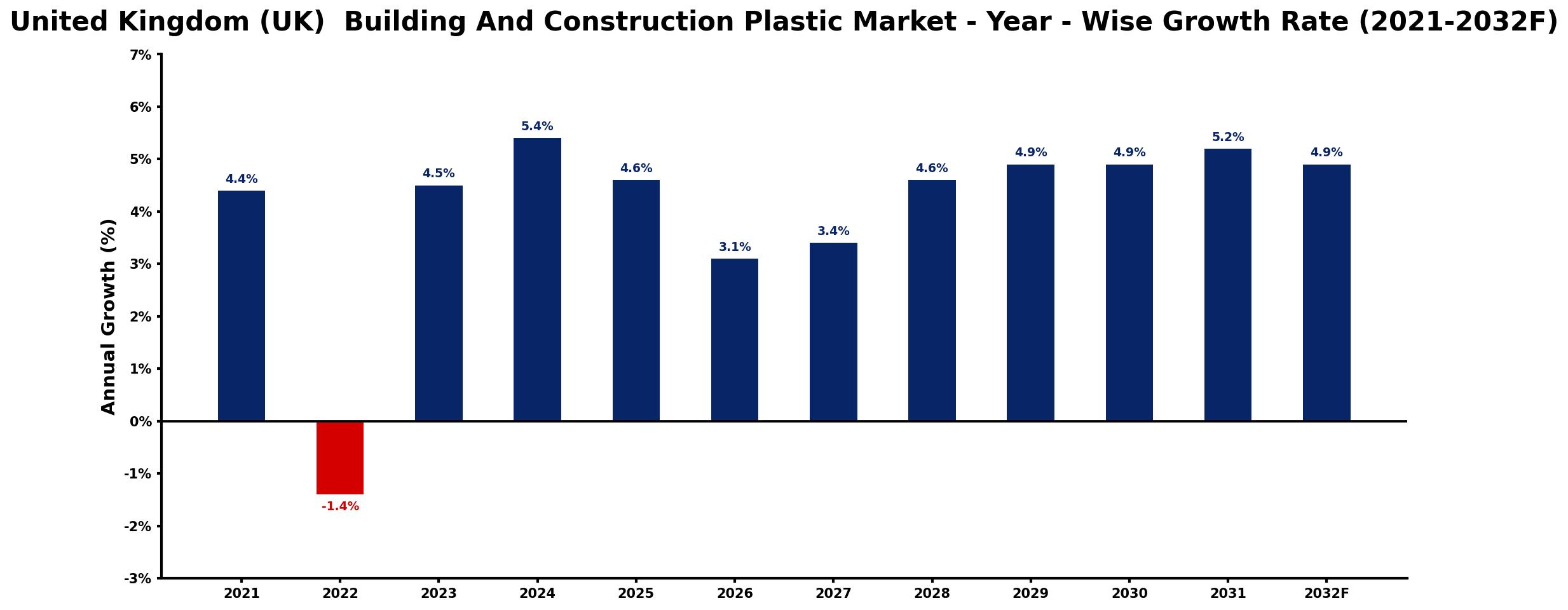
The table below presents the year‑wise growth rates along with the key drivers influencing the market
| Year | Growth Rate | Major Drivers |
| 2021 | 4.4% | Rising demand for sustainable materials |
| 2022 | -1.4% | Decrease in new project investments |
| 2023 | 4.5% | Increased infrastructure development projects |
| 2024 | 5.4% | Expansion of renewable energy initiatives |
| 2025 | 4.6% | Growing focus on energy efficiency |
| 2026 | 3.1% | Investment in advanced manufacturing technologies |
| 2027 | 3.4% | Surge in residential renovation activities |
| 2028 | 4.6% | Rise in government funding programs |
| 2029 | 4.9% | Boost in export opportunities abroad |
| 2030 | 4.9% | Increase in urbanization trends |
| 2031 | 5.2% | Growth in eco-friendly product offerings |
| 2032 | 4.9% | increased production capacity utilization |
Note: Market size estimations and growth projections presented in this report are based on 6Wresearch's proprietary forecasting methodology, utilizing the latest available industry data, government publications, and primary research inputs.
United Kingdom (UK) Building And Construction Plastic Market Synopsis
The UK Building and Construction Plastic Market has witnessed significant momentum in recent years, fueled by a growing appetite for modern construction solutions. As sustainability becomes increasingly essential, the market is shifting towards innovative plastic products that meet both performance and environmental standards.
Looking ahead, the landscape appears promising, with expectations of sustained growth driven by advancements in material technologies and regulatory support for greener alternatives. With a heightened focus on reducing carbon footprints, the transition to eco-friendly plastics is set to redefine industry standards.
United Kingdom (UK) Building And Construction Plastic Market Key Takeaways
- Robust growth projected due to urbanization and construction sector expansion.
- Sustainable practices and eco-friendly products are driving market innovation.
- Increased adoption of recycled plastics is reshaping traditional material use.
- Investment in R&D is critical for meeting emerging industry demands.
- Government policies are paving the way for greater environmental accountability.
Evaluation of Restraints in United Kingdom (UK) Building And Construction Plastic Market
Despite its promising outlook, the UK Building and Construction Plastic Market faces significant challenges. Fluctuating raw material costs can impact production expenses, while stringent regulations on plastic use compel businesses to adapt quickly. Additionally, economic uncertainties, including potential post-Brexit disruptions and labor shortages, pose further constraints. Navigating these hurdles requires a proactive approach, with firms prioritizing innovation and collaboration to ensure competitiveness.
United Kingdom (UK) Building And Construction Plastic Market Trends
Several key trends are shaping the UK Building and Construction Plastic Market. The move towards sustainable and environmentally friendly materials is gaining traction, propelled by regulatory frameworks and increasing consumer awareness. There is also a notable shift towards lightweight plastic composites and the integration of recycled materials in construction processes. This transition emphasizes the industry's commitment to reducing its environmental impact while enhancing the durability and efficiency of building components.
United Kingdom (UK) Building And Construction Plastic Market Opportunities
The UK market presents lucrative investment opportunities focused on sustainable practices and innovative technologies. Key areas include the development of eco-friendly plastics for insulation, piping, and roofing, catering to a growing demand for environmentally responsible construction solutions. Furthermore, enhancing plastic recycling and waste management technologies is vital, aligning with governmental goals of fostering a circular economy. Collaborations with construction firms to tailor plastic applications for energy-efficient projects also stand as a promising avenue for growth.
Government Initiatives in the United Kingdom (UK) Building And Construction Plastic Market
Government policies in the UK play a crucial role in shaping the Building and Construction Plastic Market. Key initiatives aim to promote sustainability, such as the Waste and Resources Strategy and the Construction 2025 Strategy, which encourages the use of recycled materials in construction. Additionally, the UK governments commitment to reducing plastic waste and enhancing recycling rates is evident through programs like the Plastics Pact and the Plastic Packaging Tax. Such measures facilitate a transition towards more sustainable practices within the construction sector.
Future Insights of the United Kingdom (UK) Building And Construction Plastic Market
The future of the UK Building and Construction Plastic Market looks promising from 2026 to 2032. Growth is anticipated to be driven by continuous advancements in construction practices and a persistent focus on sustainability. As the demand for durable, lightweight, and eco-friendly materials expands, the use of innovative plastic solutions will likely become the norm. Technological advancements, such as the development of high-performance plastics, will further support market expansion and diversification.
United Kingdom (UK) Building And Construction Plastic Market Latest Developments (2025 - 2026)
Recent developments in the UK Building and Construction Plastic Market reflect a trend towards greater sustainability and innovation. Companies are increasingly focusing on R&D initiatives aimed at enhancing the performance characteristics of plastic materials while minimizing environmental impact. Additionally, collaborative efforts among stakeholders are growing, with joint ventures and partnerships emerging to support the development of eco-friendly solutions in construction. These directions signal a robust response to the changing regulatory landscape and market expectations.
United Kingdom (UK) Building And Construction Plastic Market - Key Attractiveness of the Report
- 10 Years of Market Numbers
- Historical Data Starting from 2022 to 2025
- Base Year: 2025
- Forecast Data until 2032
- Key Performance Indicators Impacting the Market
- Major Upcoming Developments and Projects
Key Highlights of the Report:
- United Kingdom (UK) Building And Construction Plastic Market Outlook
- Market Size of United Kingdom (UK) Building And Construction Plastic Market, 2025
- Forecast of United Kingdom (UK) Building And Construction Plastic Market, 2032
- Historical Data and Forecast of United Kingdom (UK) Building And Construction Plastic Revenues & Volume for the Period 2022-2032F
- United Kingdom (UK) Building And Construction Plastic Market Trend Evolution
- United Kingdom (UK) Building And Construction Plastic Market Drivers and Challenges
- United Kingdom (UK) Building And Construction Plastic Price Trends
- United Kingdom (UK) Building And Construction Plastic Porter's Five Forces
- United Kingdom (UK) Building And Construction Plastic Industry Life Cycle
- Historical Data and Forecast of United Kingdom (UK) Building And Construction Plastic Market Revenues & Volume By Type for the Period 2022-2032F
- Historical Data and Forecast of United Kingdom (UK) Building And Construction Plastic Market Revenues & Volume By Thermoplastic for the Period 2022-2032F
- Historical Data and Forecast of United Kingdom (UK) Building And Construction Plastic Market Revenues & Volume By Thermosetting Plastic for the Period 2022-2032F
- Historical Data and Forecast of United Kingdom (UK) Building And Construction Plastic Market Revenues & Volume By Application for the Period 2022-2032F
- Historical Data and Forecast of United Kingdom (UK) Building And Construction Plastic Market Revenues & Volume By Flooring for the Period 2022-2032F
- Historical Data and Forecast of United Kingdom (UK) Building And Construction Plastic Market Revenues & Volume By Window and Door Panel for the Period 2022-2032F
- Historical Data and Forecast of United Kingdom (UK) Building And Construction Plastic Market Revenues & Volume By Siding for the Period 2022-2032F
- Historical Data and Forecast of United Kingdom (UK) Building And Construction Plastic Market Revenues & Volume By Piping for the Period 2022-2032F
- Historical Data and Forecast of United Kingdom (UK) Building And Construction Plastic Market Revenues & Volume By Roofing for the Period 2022-2032F
- Historical Data and Forecast of United Kingdom (UK) Building And Construction Plastic Market Revenues & Volume By Insulation for the Period 2022-2032F
- Historical Data and Forecast of United Kingdom (UK) Building And Construction Plastic Market Revenues & Volume By Others for the Period 2022-2032F
- United Kingdom (UK) Building And Construction Plastic Import Export Trade Statistics
- Market Opportunity Assessment By Type
- Market Opportunity Assessment By Application
- United Kingdom (UK) Building And Construction Plastic Top Companies Market Share
- United Kingdom (UK) Building And Construction Plastic Competitive Benchmarking By Technical and Operational Parameters
- United Kingdom (UK) Building And Construction Plastic Company Profiles
- United Kingdom (UK) Building And Construction Plastic Key Strategic Recommendations






































