United Kingdom (UK) Bulletproof Glass Market Size, Share & Growth Rate
The United Kingdom (UK) Bulletproof Glass Market was estimated at USD 311 Million in 2025 and is projected to reach USD 384 Million by 2032, growing at a CAGR of 3.1% from 2026 to 2032. This growth trajectory is predominantly influenced by escalating security concerns across various sectors, particularly in banking and public infrastructure. The increasing incidence of violent crimes and terrorist activities necessitates the integration of advanced protective solutions like bulletproof glass, further driving market demand.
United Kingdom (UK) Bulletproof Glass Market Year-wise Growth Rate and Key Drivers
This graph highlights how the United Kingdom (UK) Bulletproof Glass Market has steadily grown over the years, supported by major growth factors.
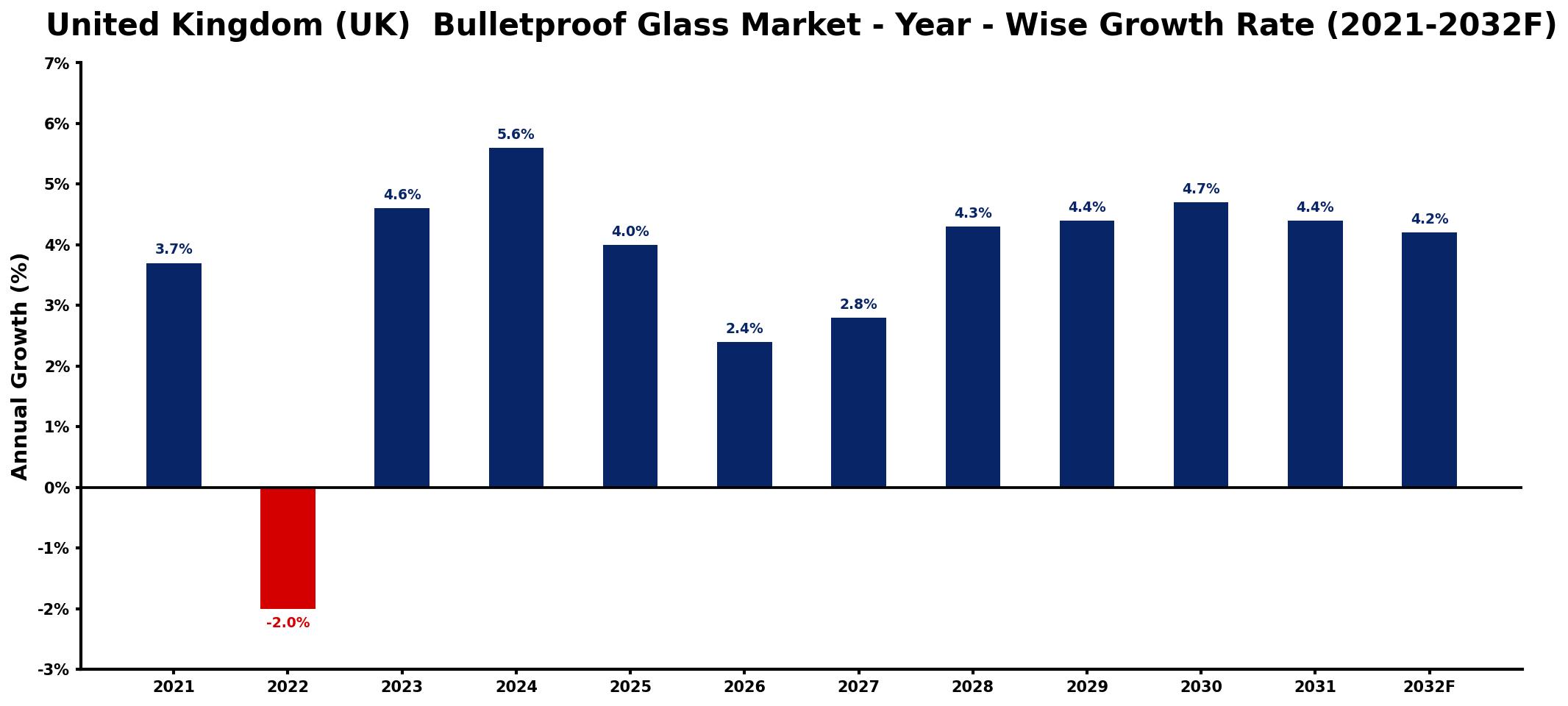
The table below presents the year‑wise growth rates along with the key drivers influencing the market
| Year | Growth Rate | Major Drivers |
| 2021 | 3.7% | Increased security investments across sectors |
| 2022 | -2.0% | Reduced construction activity and budgets |
| 2023 | 4.6% | Rising demand in security applications |
| 2024 | 5.6% | Expansion of transportation infrastructure projects |
| 2025 | 4.0% | Growing awareness of safety regulations |
| 2026 | 2.4% | Increased adoption in military sectors |
| 2027 | 2.8% | Higher urbanization driving demand growth |
| 2028 | 4.3% | Surge in commercial property investments |
| 2029 | 4.4% | Technological advancements enhancing offerings |
| 2030 | 4.7% | rising export shipment volumes |
| 2031 | 4.4% | Increased focus on disaster resilience |
| 2032 | 4.2% | Growing demand for luxury properties |
Note: Market size estimations and growth projections presented in this report are based on 6Wresearch's proprietary forecasting methodology, utilizing the latest available industry data, government publications, and primary research inputs.
United Kingdom (UK) Bulletproof Glass Market Synopsis
The UK bulletproof glass market is witnessing a notable surge in demand as organizations and government entities invest in securing their infrastructures. The heightened focus on safety protocols has made bulletproof glass a critical component for construction in high-risk areas, including government buildings and financial institutions.
Moreover, technological advancements have resulted in more effective production methods that enhance the performance of bulletproof glass. As manufacturers adopt innovative materials and techniques, the quality and affordability of bulletproof glass are improving, making it a viable option for a broader range of applications.
United Kingdom (UK) Bulletproof Glass Market Key Takeaways
- The market is driven by increasing security needs across various sectors, including banking, automotive, and defense.
- Technological advancements in materials and production processes are enhancing product performance and cost-efficiency.
- Government regulations are influencing market growth by setting stringent safety standards for ballistic resistance.
- High production costs and dependency on raw materials remain significant challenges for manufacturers.
- There is a growing adoption of bulletproof glass in public infrastructure projects and high-end vehicles.
Evaluation of Restraints in United Kingdom (UK) Bulletproof Glass Market
Despite the positive outlook for the UK bulletproof glass market, several restraints impede its full potential. The high cost of production is a primary concern; advanced manufacturing technologies and the reliance on expensive raw materials, such as polycarbonate and specialized interlayers, contribute to elevated expenses. These factors, coupled with stringent regulatory standards requiring extensive testing and certification, can deter new entrants from pursuing opportunities in this niche market. Furthermore, competition from alternative security solutions that offer cost-effective options poses an ongoing challenge, limiting market expansion.
United Kingdom (UK) Bulletproof Glass Market Trends
A significant trend in the UK bulletproof glass market is the increasing incorporation of advanced technologies, such as smart glass solutions that integrate security features with energy efficiency. Additionally, there is a noticeable shift towards customization, with clients seeking tailored solutions that fit specific security needs. This move towards personalized products is reshaping the landscape and enhancing customer satisfaction.
Moreover, the rise in urbanization is prompting higher investments in public transport infrastructure, which often necessitates the integration of bulletproof glass for safety against potential threats. As the urban landscape evolves, the demand for enhanced security measures will likely continue to rise, fueling growth in this market.
United Kingdom (UK) Bulletproof Glass Market Opportunities
The evolving threat landscape presents significant growth opportunities for the UK bulletproof glass market. Investment in high-security infrastructures, particularly within government and financial sectors, indicates a robust demand for enhanced protective solutions. Furthermore, increased public spending on urban development projects creates additional avenues for market expansion. Manufacturers focusing on R&D can leverage innovative technologies to differentiate their products, thus capitalizing on emerging market needs.
Government Initiatives in the United Kingdom (UK) Bulletproof Glass Market
The UK government has implemented a range of policies aimed at strengthening security across public and private sectors. These regulations set clear standards for ballistic resistance in buildings and vehicles, influencing the adoption of bulletproof glass. Compliance with these standards is vital for manufacturers and installers, ensuring that products meet rigorous safety requirements. Additionally, government spending on security initiatives encourages the use of advanced protective measures in critical infrastructure.
Future Insights of the United Kingdom (UK) Bulletproof Glass Market
Looking ahead to 2026-2032, the UK bulletproof glass market is poised for steady growth driven by the persistent demand for enhanced safety measures in various sectors. As the landscape of security threats continues to evolve, investment in protective solutions will likely increase. The integration of technological innovations will be crucial for manufacturers seeking to capture market share. Additionally, the emphasis on compliance with stringent regulatory standards will guide product development, ensuring that new offerings meet both safety and performance criteria.
United Kingdom (UK) Bulletproof Glass Market Latest Developments (2025 - 2026)
Recent developments in the UK bulletproof glass market highlight a focus on innovation and sustainability. Several manufacturers are exploring eco-friendly materials to meet the increasing demand for environmentally conscious solutions. Moreover, collaborations between technology firms and manufacturers are emerging, aiming to integrate smart technologies into bulletproof glass products, thereby enhancing their functionality and appeal to a broader customer base.
United Kingdom (UK) Bulletproof Glass Market - Key Attractiveness of the Report
- 10 Years of Market Numbers
- Historical Data Starting from 2022 to 2025
- Base Year: 2025
- Forecast Data until 2032
- Key Performance Indicators Impacting the Market
- Major Upcoming Developments and Projects
Key Highlights of the Report:
- United Kingdom (UK) Bulletproof Glass Market Outlook
- Market Size of United Kingdom (UK) Bulletproof Glass Market, 2025
- Forecast of United Kingdom (UK) Bulletproof Glass Market, 2032
- Historical Data and Forecast of United Kingdom (UK) Bulletproof Glass Revenues & Volume for the Period 2022-2032F
- United Kingdom (UK) Bulletproof Glass Market Trend Evolution
- United Kingdom (UK) Bulletproof Glass Market Drivers and Challenges
- United Kingdom (UK) Bulletproof Glass Price Trends
- United Kingdom (UK) Bulletproof Glass Porter's Five Forces
- United Kingdom (UK) Bulletproof Glass Industry Life Cycle
- Historical Data and Forecast of United Kingdom (UK) Bulletproof Glass Market Revenues & Volume By Type for the Period 2022-2032F
- Historical Data and Forecast of United Kingdom (UK) Bulletproof Glass Market Revenues & Volume By Solid Acrylic for the Period 2022-2032F
- Historical Data and Forecast of United Kingdom (UK) Bulletproof Glass Market Revenues & Volume By Traditional Laminated for the Period 2022-2032F
- Historical Data and Forecast of United Kingdom (UK) Bulletproof Glass Market Revenues & Volume By Polycarbonate for the Period 2022-2032F
- Historical Data and Forecast of United Kingdom (UK) Bulletproof Glass Market Revenues & Volume By Glass-clad Polycarbonate for the Period 2022-2032F
- Historical Data and Forecast of United Kingdom (UK) Bulletproof Glass Market Revenues & Volume By Other Types for the Period 2022-2032F
- Historical Data and Forecast of United Kingdom (UK) Bulletproof Glass Market Revenues & Volume By End-user Industry for the Period 2022-2032F
- Historical Data and Forecast of United Kingdom (UK) Bulletproof Glass Market Revenues & Volume By Automotive for the Period 2022-2032F
- Historical Data and Forecast of United Kingdom (UK) Bulletproof Glass Market Revenues & Volume By Buildings and Construction for the Period 2022-2032F
- Historical Data and Forecast of United Kingdom (UK) Bulletproof Glass Market Revenues & Volume By Defense for the Period 2022-2032F
- Historical Data and Forecast of United Kingdom (UK) Bulletproof Glass Market Revenues & Volume By Other End-user Industries for the Period 2022-2032F
- United Kingdom (UK) Bulletproof Glass Import Export Trade Statistics
- Market Opportunity Assessment By Type
- Market Opportunity Assessment By End-user Industry
- United Kingdom (UK) Bulletproof Glass Top Companies Market Share
- United Kingdom (UK) Bulletproof Glass Competitive Benchmarking By Technical and Operational Parameters
- United Kingdom (UK) Bulletproof Glass Company Profiles
- United Kingdom (UK) Bulletproof Glass Key Strategic Recommendations






































