United Kingdom (UK) Carbon Credit Market Size, Share & Growth Rate
The United Kingdom (UK) Carbon Credit Market was estimated at USD 342 Million in 2025 and is projected to reach USD 423 Million by 2032, growing at a CAGR of 3.1% from 2026 to 2032. This growth is significantly driven by the increasing demand for compliance mechanisms as businesses strive to meet stringent regulatory requirements aimed at achieving net-zero emissions by 2050. Coupled with rising corporate sustainability initiatives, the market is witnessing heightened participation from both domestic firms and international investors.
United Kingdom (UK) Carbon Credit Market Year-wise Growth Rate and Key Drivers
This graph highlights how the United Kingdom (UK) Carbon Credit Market has steadily grown over the years, supported by major growth factors.
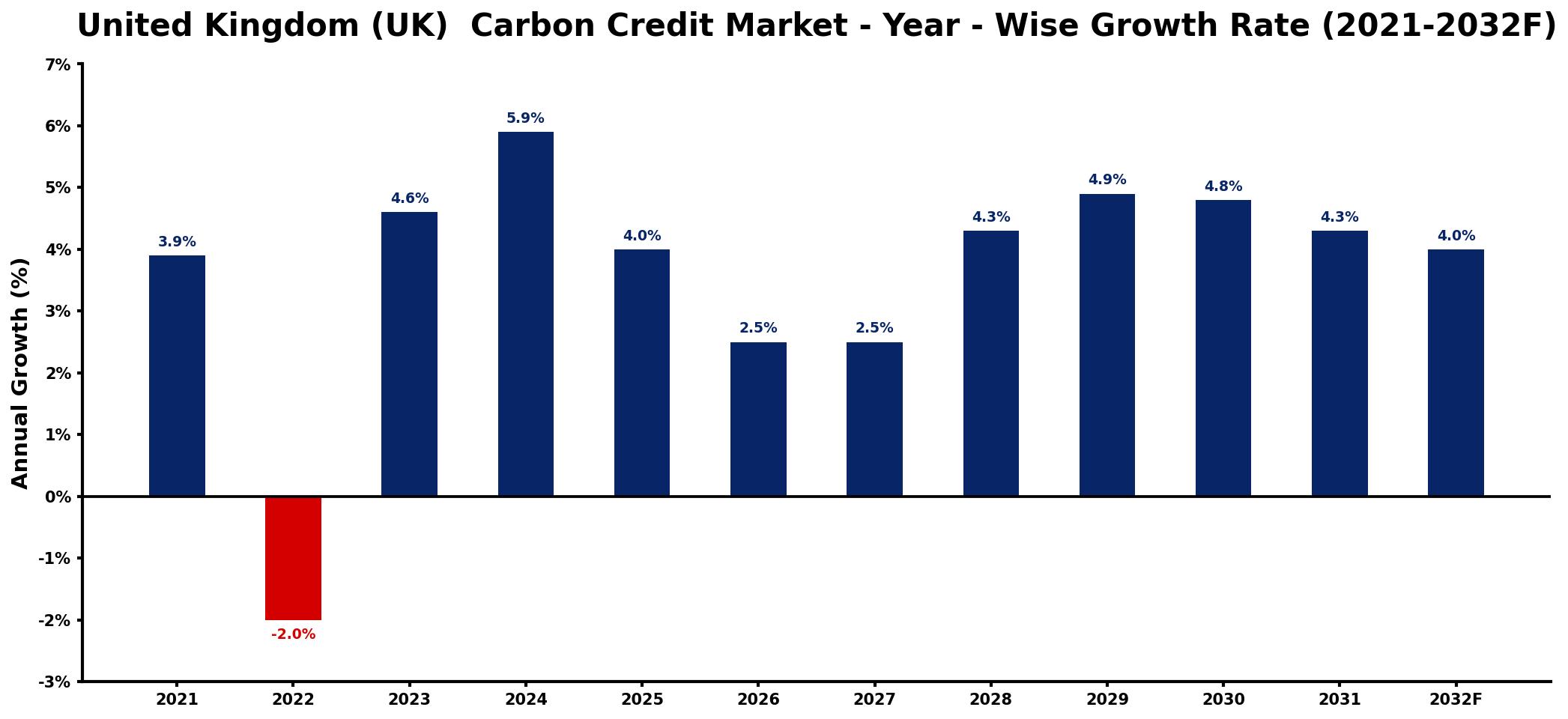
The table below presents the year‑wise growth rates along with the key drivers influencing the market
| Year | Growth Rate | Major Drivers |
| 2021 | 3.9% | Rising investment in renewable energy |
| 2022 | -2.0% | Decreased regulatory incentives for emissions |
| 2023 | 4.6% | Growing corporate sustainability commitments |
| 2024 | 5.9% | Increased focus on climate innovation |
| 2025 | 4.0% | Surge in green technology adoption |
| 2026 | 2.5% | Expansion of international cooperation agreements |
| 2027 | 2.5% | Heightened public awareness of sustainability |
| 2028 | 4.3% | Development of new market frameworks |
| 2029 | 4.9% | Strengthened governmental policy support |
| 2030 | 4.8% | Elevated corporate responsibility initiatives |
| 2031 | 4.3% | Broadening participation in environmental programs |
| 2032 | 4.0% | Continuous advancements in sustainable practices |
Note: Market size estimations and growth projections presented in this report are based on 6Wresearch's proprietary forecasting methodology, utilizing the latest available industry data, government publications, and primary research inputs.
United Kingdom (UK) Carbon Credit Market Synopsis
The UK Carbon Credit Market serves as a vital mechanism for corporate entities aiming to reduce their carbon emissions while complying with government regulations. As firms face pressure to demonstrate environmental responsibility, the market has seen a surge in voluntary carbon offsetting initiatives, signifying a shift towards sustainable practices.
Moreover, the UKs exit from the EU has led to the establishment of the UK Emissions Trading Scheme (UK ETS), which reinforces a domestic trading platform designed to drive efficiency in emissions reduction. This change is pivotal as it provides clarity and stability for market participants navigating the evolving landscape of carbon pricing.
United Kingdom (UK) Carbon Credit Market Key Takeaways
- The UK Carbon Credit Market is integral to the country's strategy for achieving net-zero emissions by 2050.
- Voluntary carbon offsetting by businesses is on the rise, highlighting a trend towards enhanced environmental responsibility.
- Uncertainties stemming from Brexit have reshaped the carbon credit landscape, necessitating adaptive strategies.
- Innovative carbon projects, including nature-based solutions, are gaining traction and reshaping the market's dynamics.
- Investment opportunities abound as businesses increasingly seek compliance through carbon credit purchases.
Evaluation of Restraints in United Kingdom (UK) Carbon Credit Market
Despite its potential, the UK Carbon Credit Market faces notable constraints. Regulatory uncertainties post-Brexit pose challenges regarding the future of carbon pricing and trading mechanisms. This ambiguity can hinder investment confidence and restrict market liquidity. Furthermore, fluctuating carbon prices driven by external economic factors could create volatility, impacting strategic planning for companies reliant on carbon credit transactions. Enhanced transparency and standardized processes will be critical to foster trust among market participants and facilitate smoother operations.
United Kingdom (UK) Carbon Credit Market Trends
The UK Carbon Credit Market is currently characterized by a strong emphasis on sustainability, resulting in innovative trends such as nature-based carbon offset projects and increased integration of renewable energy initiatives. These projects are gaining traction as they present viable alternatives to traditional carbon credits, appealing to a growing demographic of environmentally-conscious investors and companies. Additionally, the market is witnessing a notable increase in digital platforms for carbon trading, enhancing accessibility and efficiency for participants.
United Kingdom (UK) Carbon Credit Market Opportunities
The investment landscape within the UK Carbon Credit Market is ripe with opportunities for proactive investors. As companies face increasing pressures to meet emissions targets, the demand for carbon credits is likely to rise significantly. Furthermore, the trend towards corporate sustainability initiatives creates avenues for innovative projects that align with the market's evolving dynamics. Investors can also tap into emerging technologies facilitating the development of carbon credit trading platforms, contributing to a more streamlined market operation.
Government Initiatives in the United Kingdom (UK) Carbon Credit Market
The UK government has undertaken several initiatives to promote and regulate the Carbon Credit Market. Notably, the Carbon Price Support (CPS) aims to establish a minimum carbon price, fostering incentives for low-carbon investments. Additionally, the Carbon Reduction Commitment (CRC) mandates large organizations to monitor energy consumption and purchase allowances for carbon emissions. These policies collectively encourage emission reductions and support the transition towards a low-carbon economy, underpinning the market's operational framework.
Future Insights of the United Kingdom (UK) Carbon Credit Market
Looking ahead to 2026-2032, the UK Carbon Credit Market is anticipated to undergo significant transformation. The ongoing commitment to net-zero emissions will continue to drive demand for carbon credits, creating a burgeoning space for innovative carbon reduction projects. The implementation of the UK ETS post-Brexit will likely provide a robust platform for trading emissions allowances, enhancing market stability. Increased awareness of climate change issues and the urgency for mitigation measures will further accelerate investment and participation within the carbon credit framework.
United Kingdom (UK) Carbon Credit Market Latest Developments (2025 - 2026)
Recent developments in the UK Carbon Credit Market indicate a shift towards more standardized reporting practices and greater transparency in carbon credit transactions. This movement aims to enhance market trust among participants. There has also been a noticeable increase in collaboration between public and private sectors to develop innovative carbon offset projects. As businesses explore greener practices, the engagement in sustainable technology initiatives is expected to rise, further shaping the market's future trajectory.
United Kingdom (UK) Carbon Credit Market - Key Attractiveness of the Report
- 10 Years of Market Numbers
- Historical Data Starting from 2022 to 2025
- Base Year: 2025
- Forecast Data until 2032
- Key Performance Indicators Impacting the Market
- Major Upcoming Developments and Projects
Key Highlights of the Report:
- United Kingdom (UK) Carbon Credit Market Outlook
- Market Size of United Kingdom (UK) Carbon Credit Market, 2025
- Forecast of United Kingdom (UK) Carbon Credit Market, 2032
- Historical Data and Forecast of United Kingdom (UK) Carbon Credit Revenues & Volume for the Period 2022-2032F
- United Kingdom (UK) Carbon Credit Market Trend Evolution
- United Kingdom (UK) Carbon Credit Market Drivers and Challenges
- United Kingdom (UK) Carbon Credit Price Trends
- United Kingdom (UK) Carbon Credit Porter's Five Forces
- United Kingdom (UK) Carbon Credit Industry Life Cycle
- Historical Data and Forecast of United Kingdom (UK) Carbon Credit Market Revenues & Volume By Sector for the Period 2022-2032F
- Historical Data and Forecast of United Kingdom (UK) Carbon Credit Market Revenues & Volume By Energy for the Period 2022-2032F
- Historical Data and Forecast of United Kingdom (UK) Carbon Credit Market Revenues & Volume By Transportation for the Period 2022-2032F
- Historical Data and Forecast of United Kingdom (UK) Carbon Credit Market Revenues & Volume By Residential And Commercial Buildings for the Period 2022-2032F
- Historical Data and Forecast of United Kingdom (UK) Carbon Credit Market Revenues & Volume By Industry for the Period 2022-2032F
- Historical Data and Forecast of United Kingdom (UK) Carbon Credit Market Revenues & Volume By Agriculture for the Period 2022-2032F
- Historical Data and Forecast of United Kingdom (UK) Carbon Credit Market Revenues & Volume By Forestry for the Period 2022-2032F
- Historical Data and Forecast of United Kingdom (UK) Carbon Credit Market Revenues & Volume By Water And Wastewater for the Period 2022-2032F
- United Kingdom (UK) Carbon Credit Import Export Trade Statistics
- Market Opportunity Assessment By Sector
- United Kingdom (UK) Carbon Credit Top Companies Market Share
- United Kingdom (UK) Carbon Credit Competitive Benchmarking By Technical and Operational Parameters
- United Kingdom (UK) Carbon Credit Company Profiles
- United Kingdom (UK) Carbon Credit Key Strategic Recommendations






































