United Kingdom (UK) Cultured Meat Market Size, Share & Growth Rate
The United Kingdom (UK) Cultured Meat Market was estimated at USD 285 Million in 2025 and is projected to reach USD 354 Million by 2032, growing at a CAGR of 3.1% from 2026 to 2032. This anticipated growth is primarily fueled by increasing consumer awareness regarding sustainability and health, leading to a rising demand for innovative protein sources. Additionally, advancements in production technology and a shift in dietary preferences among the UK population further drive the market's upward trajectory.
United Kingdom (UK) Cultured Meat Market Year-wise Growth Rate and Key Drivers
This graph highlights how the United Kingdom (UK) Cultured Meat Market has steadily grown over the years, supported by major growth factors.
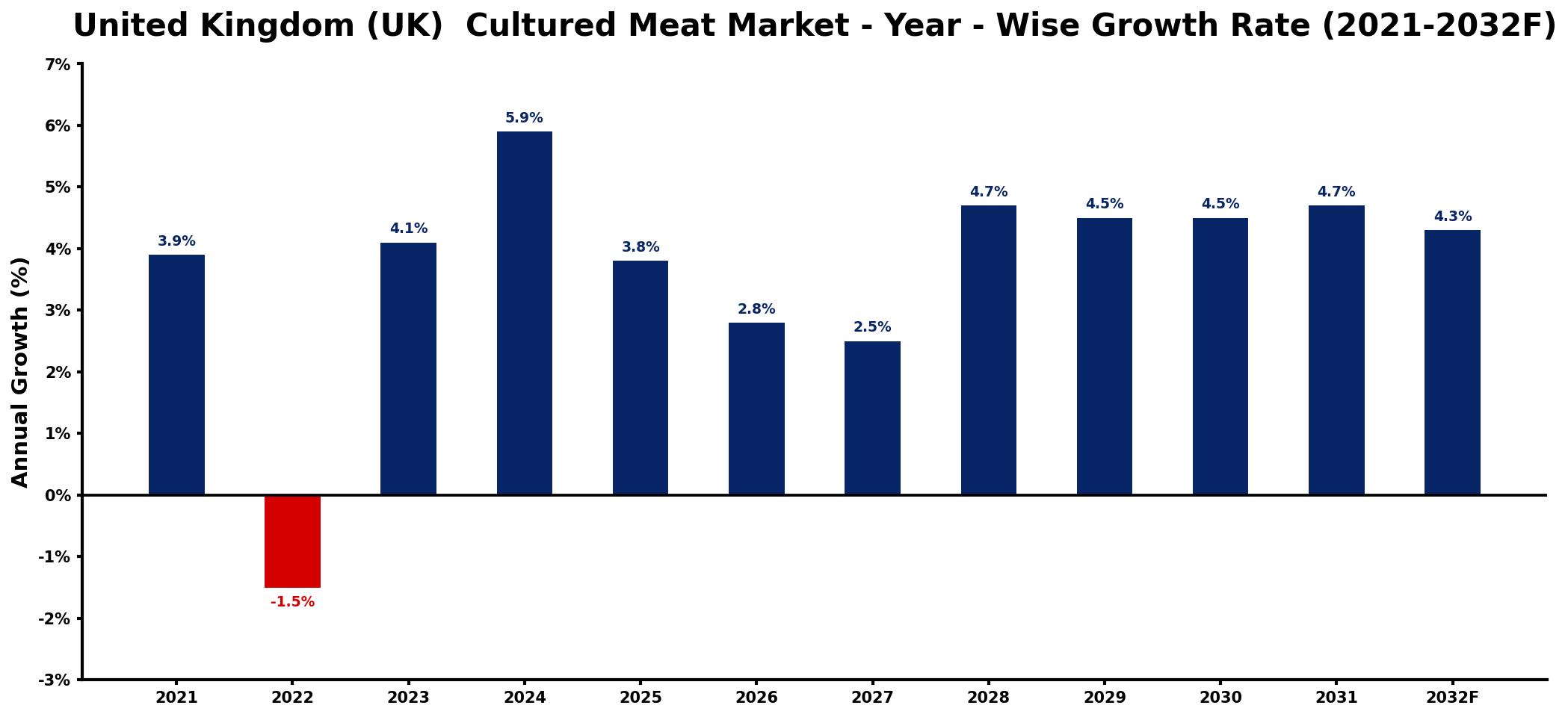
The table below presents the year‑wise growth rates along with the key drivers influencing the market
| Year | Growth Rate | Major Drivers |
| 2021 | 3.9% | Rising consumer health consciousness |
| 2022 | -1.5% | Market adaptation to consumer preferences |
| 2023 | 4.1% | Increased investment in innovation |
| 2024 | 5.9% | Expansion of sustainable production methods |
| 2025 | 3.8% | Growing demand for alternatives |
| 2026 | 2.8% | Technological advancements in production |
| 2027 | 2.5% | Emerging markets adopting alternatives |
| 2028 | 4.7% | Collaboration among industry stakeholders |
| 2029 | 4.5% | Enhanced regulatory support frameworks |
| 2030 | 4.5% | Consumer awareness and education campaigns |
| 2031 | 4.7% | Wider availability in retail channels |
| 2032 | 4.3% | Focus on environmental sustainability initiatives |
Note: Market size estimations and growth projections presented in this report are based on 6Wresearch's proprietary forecasting methodology, utilizing the latest available industry data, government publications, and primary research inputs.
United Kingdom (UK) Cultured Meat Market Synopsis
The UK cultured meat market has gained notable momentum in recent years, reflecting a paradigm shift toward sustainable protein alternatives. However, it faces critical challenges that could impact its growth trajectory as it moves toward commercialization and mainstream acceptance. Regulatory hurdles and consumer skepticism about lab-grown products remain significant obstacles.
Looking ahead, the market is set to evolve, supported by increasing investments in research, technological innovations, and favorable governmental policies. These factors not only promise to enhance production capabilities but also aim to improve consumer perceptions surrounding cultured meat, positioning the UK at the forefront of this food revolution.
United Kingdom (UK) Cultured Meat Market Key Takeaways
- The market is witnessing accelerated growth driven by sustainability and health consciousness.
- Technological advancements are enhancing production processes and taste profiles.
- Regulatory support is crucial for overcoming market entry challenges.
- Consumer education initiatives are key to addressing skepticism and ethical concerns.
- Research and development investments are critical for innovation and scalability.
Evaluation of Restraints in United Kingdom (UK) Cultured Meat Market
Despite its potential, the UK cultured meat market faces several formidable restraints. Regulatory challenges are particularly prominent, with stringent food safety standards and complex labeling requirements that can impede market entry. Furthermore, deep-seated consumer skepticism persists regarding the taste and ethics of lab-grown meat, making it difficult for these products to gain widespread acceptance. Alongside these issues, the industry struggles to scale production effectively, often encountering difficulties in maintaining high quality while striving for cost competitiveness. These barriers must be strategically navigated to realize the market's full potential.
United Kingdom (UK) Cultured Meat Market Trends
Several key trends are shaping the UK cultured meat market. A noticeable shift towards flexitarian and plant-based diets among consumers is influencing demand for alternative protein sources. Additionally, advancements in cellular agriculture are not only enhancing production efficiency but also improving product offerings in terms of taste and texture. Social media and influencers are increasingly playing a role in educating consumers about the benefits of cultured meat, contributing to a gradual shift in public perception. Finally, collaborations between tech companies and traditional food manufacturers are fostering innovation, leading to exciting new products entering the market.
United Kingdom (UK) Cultured Meat Market Opportunities
The cultured meat market in the UK presents numerous growth opportunities. With rising consumer demand for ethical and sustainable food choices, companies that can successfully position their products as environmentally friendly alternatives stand to gain a significant market share. Moreover, innovation in production techniques offers the potential for reduced costs, making cultured meat more accessible to a wider audience. Investment in public relations campaigns focused on educating consumers about the benefits of cultured meat can also enhance market penetration. Finally, partnerships with retailers and food service providers can help broaden distribution channels, facilitating market growth.
Government Initiatives in the United Kingdom (UK) Cultured Meat Market
The UK government has taken proactive steps to promote sustainable food production, including cultured meat technologies. Ongoing policies focus on supporting agriculture and food safety, with specific frameworks aimed at novel food innovations. By allocating research funding and establishing regulatory pathways for new food technologies, the government is creating an environment conducive to the growth of the cultured meat sector. Additionally, incentives for sustainable farming practices further reinforce this commitment, paving the way for advancements that benefit both producers and consumers.
Future Insights of the United Kingdom (UK) Cultured Meat Market
As we look toward 2026-2032, the UK cultured meat market is poised for transformative growth. Enhanced consumer education and awareness will play a pivotal role in driving acceptance and adoption of cultured meat products. Furthermore, breakthroughs in technology will likely continue to improve production efficiency, thereby reducing costs and enhancing quality. Regulatory frameworks will evolve, making it easier for innovative products to enter the market. Overall, the future holds a promising landscape for cultured meat, with the potential to become a staple in the UK's food ecosystem.
United Kingdom (UK) Cultured Meat Market Latest Developments (2025 - 2026)
Recent developments in the UK cultured meat market reflect a dynamic shift toward increased consumer engagement and technological innovation. Companies are actively pursuing collaborations with academic institutions and research bodies to enhance R&D efforts. Additionally, public demonstrations and tasting events are being organized to alleviate consumer concerns and promote acceptance. The regulatory landscape is also evolving, with discussions underway regarding more flexible guidelines for novel food products, which could facilitate market expansion in the near future.
United Kingdom (UK) Cultured Meat Market - Key Attractiveness of the Report
- 10 Years of Market Numbers
- Historical Data Starting from 2022 to 2025
- Base Year: 2025
- Forecast Data until 2032
- Key Performance Indicators Impacting the Market
- Major Upcoming Developments and Projects
Key Highlights of the Report:
- United Kingdom (UK) Cultured Meat Market Outlook
- Market Size of United Kingdom (UK) Cultured Meat Market, 2025
- Forecast of United Kingdom (UK) Cultured Meat Market, 2032
- Historical Data and Forecast of United Kingdom (UK) Cultured Meat Revenues & Volume for the Period 2022-2032F
- United Kingdom (UK) Cultured Meat Market Trend Evolution
- United Kingdom (UK) Cultured Meat Market Drivers and Challenges
- United Kingdom (UK) Cultured Meat Price Trends
- United Kingdom (UK) Cultured Meat Porter's Five Forces
- United Kingdom (UK) Cultured Meat Industry Life Cycle
- Historical Data and Forecast of United Kingdom (UK) Cultured Meat Market Revenues & Volume By Product Type for the Period 2022-2032F
- Historical Data and Forecast of United Kingdom (UK) Cultured Meat Market Revenues & Volume By Poultry for the Period 2022-2032F
- Historical Data and Forecast of United Kingdom (UK) Cultured Meat Market Revenues & Volume By Beef for the Period 2022-2032F
- Historical Data and Forecast of United Kingdom (UK) Cultured Meat Market Revenues & Volume By Seafood for the Period 2022-2032F
- Historical Data and Forecast of United Kingdom (UK) Cultured Meat Market Revenues & Volume By Pork for the Period 2022-2032F
- Historical Data and Forecast of United Kingdom (UK) Cultured Meat Market Revenues & Volume By Duck for the Period 2022-2032F
- Historical Data and Forecast of United Kingdom (UK) Cultured Meat Market Revenues & Volume By End-Use for the Period 2022-2032F
- Historical Data and Forecast of United Kingdom (UK) Cultured Meat Market Revenues & Volume By Nuggets for the Period 2022-2032F
- Historical Data and Forecast of United Kingdom (UK) Cultured Meat Market Revenues & Volume By Burgers for the Period 2022-2032F
- Historical Data and Forecast of United Kingdom (UK) Cultured Meat Market Revenues & Volume By Meatballs for the Period 2022-2032F
- Historical Data and Forecast of United Kingdom (UK) Cultured Meat Market Revenues & Volume By Sausage for the Period 2022-2032F
- Historical Data and Forecast of United Kingdom (UK) Cultured Meat Market Revenues & Volume By Hot dogs for the Period 2022-2032F
- Historical Data and Forecast of United Kingdom (UK) Cultured Meat Market Revenues & Volume By Others for the Period 2022-2032F
- United Kingdom (UK) Cultured Meat Import Export Trade Statistics
- Market Opportunity Assessment By Product Type
- Market Opportunity Assessment By End-Use
- United Kingdom (UK) Cultured Meat Top Companies Market Share
- United Kingdom (UK) Cultured Meat Competitive Benchmarking By Technical and Operational Parameters
- United Kingdom (UK) Cultured Meat Company Profiles
- United Kingdom (UK) Cultured Meat Key Strategic Recommendations






































