United Kingdom (UK) Curtains and Blinds Market Summary
The united kingdom (uk) curtains and blinds market was estimated at USD 422 Million in 2025 and is projected to reach USD 607 Million by 2032, growing at a CAGR of 5.1% from 2026 to 2032.
United Kingdom (UK) Curtains and Blinds Market Year-wise Growth Rate and Key Drivers
This graph highlights how the United Kingdom (UK) Curtains and Blinds Market has steadily grown over the past five years, supported by major growth factors.
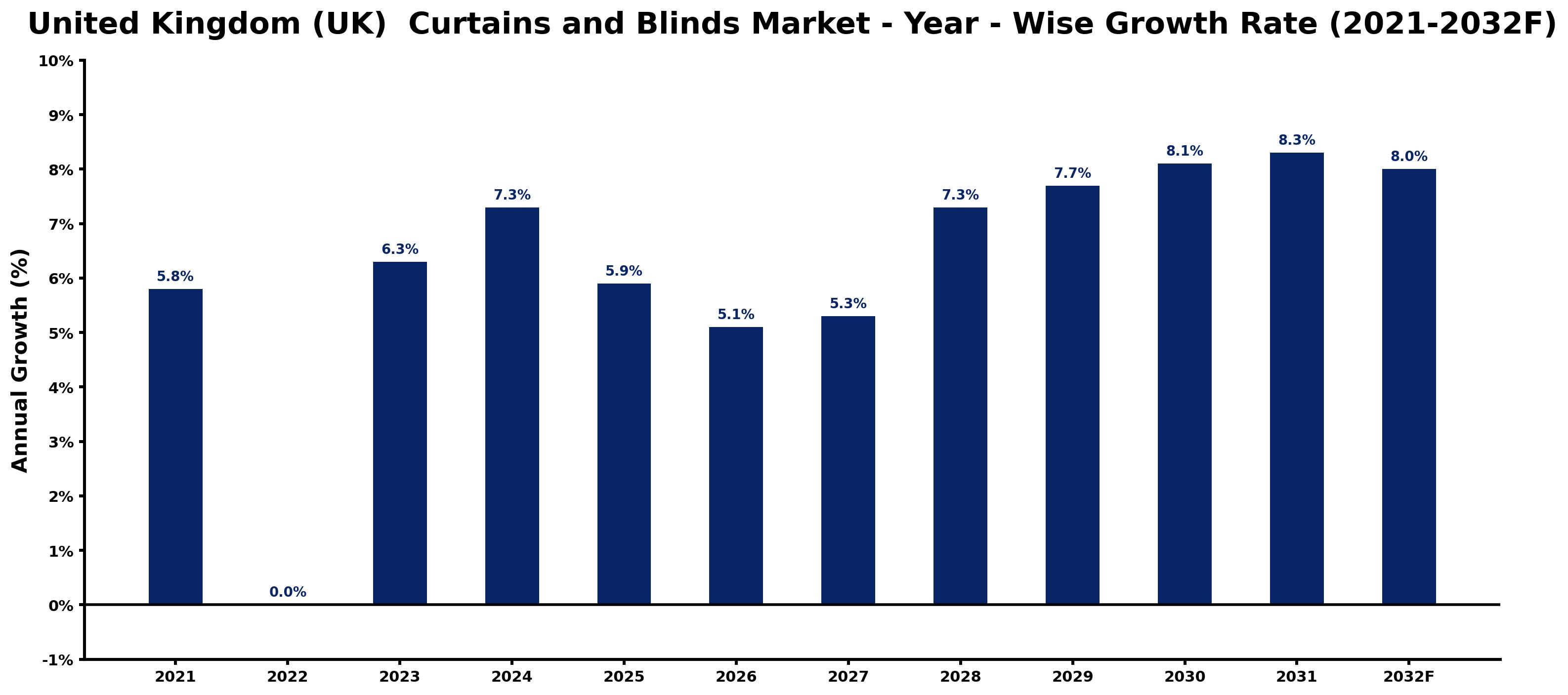
The table below presents the year wise growth rates along with the key drivers influencing the market
| Year | Growth Rate | Major Drivers |
| 2021 | 5.8% | Post-lockdown retail projects intensified focus on home improvement and interior aesthetics. |
| 2022 | 0.0% | E-commerce platforms expanded offerings, reaching a wider audience seeking tailored window solutions. |
| 2023 | 6.3% | Sustainability trends influenced consumer choices towards eco-friendly materials for window coverings. |
| 2024 | 7.3% | The increase in remote work shifted priorities toward enhancing home comfort and style. |
| 2025 | 5.9% | Smart home technologies integrated seamlessly, promoting automated curtains and blinds as desirable features. |
| 2026 | 5.1% | Urbanization fueled demand for space-saving solutions, increasing interest in vertical blinds and shades. |
| 2027 | 5.3% | Luxury market segments thrived, reflecting a preference for bespoke and premium window dressings. |
| 2028 | 7.3% | Economic recovery prompted home renovations, with curtains and blinds seen as essential upgrades. |
| 2029 | 7.7% | DIY culture gained momentum, leading to increased interest in custom installations and solutions. |
| 2030 | 8.1% | Global supply chain improvements allowed for more diverse fabric selections and design options. |
| 2031 | 8.3% | Home decor trends spotlighted seasonal updates, driving consumers to frequently refresh window treatments. |
| 2032 | 8.0% | Aging population necessitated adaptive living solutions, enhancing demand for user-friendly window coverings. |
Note - Market size estimations and growth projections presented in this report are based on 6Wresearch's advanced forecasting approach, validated with industry datasets as of June 2026.
United Kingdom (UK) Curtains and Blinds Market Synopsis
The United Kingdom (UK) Curtains and Blinds Market is projected to reach 5.1% and witness significant growth during the forecast period (2026-2032). The market has experienced notable expansion in recent years, largely attributed to several key factors. Increased disposable incomes among consumers have led to a greater demand for luxurious home furnishings, including curtains and blinds. Moreover, the heightened awareness regarding energy efficiency has fostered a trend towards products that offer thermal insulation and light control. Technological innovations in product design, specifically the rise of motorized and automated window treatments, have further enhanced market appeal, aligning with modern consumer preferences for convenience and efficiency. Additionally, the ongoing investments in residential construction projects across the UK, supported by stringent building regulations, are positively influencing market dynamics.
United Kingdom (UK) Curtains and Blinds Market Growth Drivers
Several growth drivers are steering the United Kingdom (UK) Curtains and Blinds Market towards a robust future. The first significant driver is the rise in disposable income levels among households, which has led to an increased propensity to invest in durable and aesthetically pleasing window treatments. The second driver is the burgeoning demand for luxury home furnishings, with consumers showing a preference for high-end fabrics and tailored options that enhance interior aesthetics. Thirdly, a growing consciousness about energy efficiency encourages consumers to adopt window coverings that can help optimize heating and cooling costs. Fourthly, advances in technology are facilitating the development of innovative products that cater to a modern lifestyle, such as smart curtains and automated blinds that offer enhanced control and convenience. Lastly, ongoing construction activities across the residential and commercial sectors are creating new opportunities for growth, as the demand for stylish and functional window treatments continues to rise.
United Kingdom (UK) Curtains and Blinds Market Challenges and Restraints
Despite the promising growth trajectory of the United Kingdom (UK) Curtains and Blinds Market, several challenges must be navigated. One significant restraint is the fluctuation in raw material prices, which can impact production costs and subsequently pricing strategies. Another challenge is the increasing competition from international markets, where lower-cost alternatives may attract price-sensitive consumers. Moreover, the market faces challenges related to changing consumer preferences, as trends shift rapidly and manufacturers must keep pace with evolving designs and functionalities. There is also the issue of sustainability, as consumer demand for environmentally friendly products grows; companies must invest in sustainable practices while maintaining profitability. Lastly, economic uncertainties, including potential impacts from geopolitical factors and market volatility, could hinder growth and investment in the sector.
United Kingdom (UK) Curtains and Blinds Market Trends and Opportunities
Emerging trends offer numerous opportunities for the United Kingdom (UK) Curtains and Blinds Market to expand and innovate. One prominent trend is the increasing preference for smart home technologies, wherein consumers are looking for curtains and blinds that can be integrated with home automation systems. This escalation in demand for smart solutions presents opportunities for manufacturers to innovate and enhance their product lines. Additionally, the growing emphasis on sustainable living has led to a rise in demand for eco-friendly materials and production methods, prompting companies to explore sustainable sourcing and production techniques. Another key trend is the customization of curtains and blinds, where consumers seek personalized solutions that reflect their unique style and functional needs. Finally, the ongoing urbanization and shift towards modern living spaces are creating demand for multifunctional products that combine aesthetics with practicality, thus opening avenues for growth in the market.
United Kingdom (UK) Curtains and Blinds Market Government Investment and Initiatives
The UK government has implemented a range of initiatives aimed at promoting the growth of the curtains and blinds market, particularly focusing on energy efficiency and sustainable building practices. Various public spending programs are designed to enhance the energy performance of homes and commercial buildings, which indirectly increases the demand for energy-efficient window treatments. Additionally, government-backed schemes aimed at residential construction and renovation projects often emphasize compliance with stringent energy regulations, encouraging developers to install high-quality curtains and blinds. Investment in research and development, particularly in green technologies and smart home solutions, is also being supported by government grants aimed at fostering innovation in the sector. These initiatives not only support market growth but also align with broader environmental goals, positioning the industry for a sustainable future.
United Kingdom (UK) Curtains and Blinds Market Latest Developments (May 2025 - June 2026)
Recent developments in the United Kingdom (UK) Curtains and Blinds Market from May 2025 to June 2026 reflect a concerted effort by manufacturers to innovate and expand their product offerings. The introduction of advanced automated solutions has become prevalent, with a focus on integrating smart technologies into curtains and blinds, enhancing user convenience. Industry stakeholders are increasingly prioritizing the use of sustainable materials in response to consumer demand for eco-friendly options. Moreover, strategic partnerships within the industry have increased, enabling companies to leverage cutting-edge design and technology for product development. The trend towards personalization has also gained momentum, with brands exploring customized solutions that cater to individual consumer preferences. Lastly, market participants have reported a heightened focus on promoting energy-efficient products as awareness of climate change impacts continues to rise, informing consumer choices and influencing market dynamics.
United Kingdom (UK) Curtains and Blinds Market - Key Attractiveness of the Report
- 10 Years of Market Numbers
- Historical Data Starting from 2022 to 2025
- Base Year: 2025
- Forecast Data until 2032
- Key Performance Indicators Impacting the Market
- Major Upcoming Developments and Projects
Key Highlights of the Report:
- United Kingdom (UK) Curtains and Blinds Market Outlook
- Market Size of United Kingdom (UK) Curtains and Blinds Market, 2025
- Forecast of United Kingdom (UK) Curtains and Blinds Market, 2032F
- Historical Data and Forecast of United Kingdom (UK) Curtains and Blinds Revenues & Volume for the Period 2022-2032F
- United Kingdom (UK) Curtains and Blinds Market Trend Evolution
- United Kingdom (UK) Curtains and Blinds Market Drivers and Challenges
- United Kingdom (UK) Curtains and Blinds Price Trends
- United Kingdom (UK) Curtains and Blinds Porter's Five Forces
- United Kingdom (UK) Curtains and Blinds Industry Life Cycle
- Historical Data and Forecast of United Kingdom (UK) Curtains and Blinds Market Revenues & Volume By Types for the Period 2022-2032F
- Historical Data and Forecast of United Kingdom (UK) Curtains and Blinds Market Revenues & Volume By Curtain for the Period 2022-2032F
- Historical Data and Forecast of United Kingdom (UK) Curtains and Blinds Market Revenues & Volume By Blinds for the Period 2022-2032F
- Historical Data and Forecast of United Kingdom (UK) Curtains and Blinds Market Revenues & Volume By Application for the Period 2022-2032F
- Historical Data and Forecast of United Kingdom (UK) Curtains and Blinds Market Revenues & Volume By Traditional for the Period 2022-2032F
- Historical Data and Forecast of United Kingdom (UK) Curtains and Blinds Market Revenues & Volume By Motorised for the Period 2022-2032F
- United Kingdom (UK) Curtains and Blinds Import Export Trade Statistics
- Market Opportunity Assessment By Types
- Market Opportunity Assessment By Application
- United Kingdom (UK) Curtains and Blinds Top Companies Market Share
- United Kingdom (UK) Curtains and Blinds Competitive Benchmarking By Technical and Operational Parameters
- United Kingdom (UK) Curtains and Blinds Company Profiles
- United Kingdom (UK) Curtains and Blinds Key Strategic Recommendations






































