United Kingdom (UK) Data Protection Market Size & Growth Rate (2026-2032)
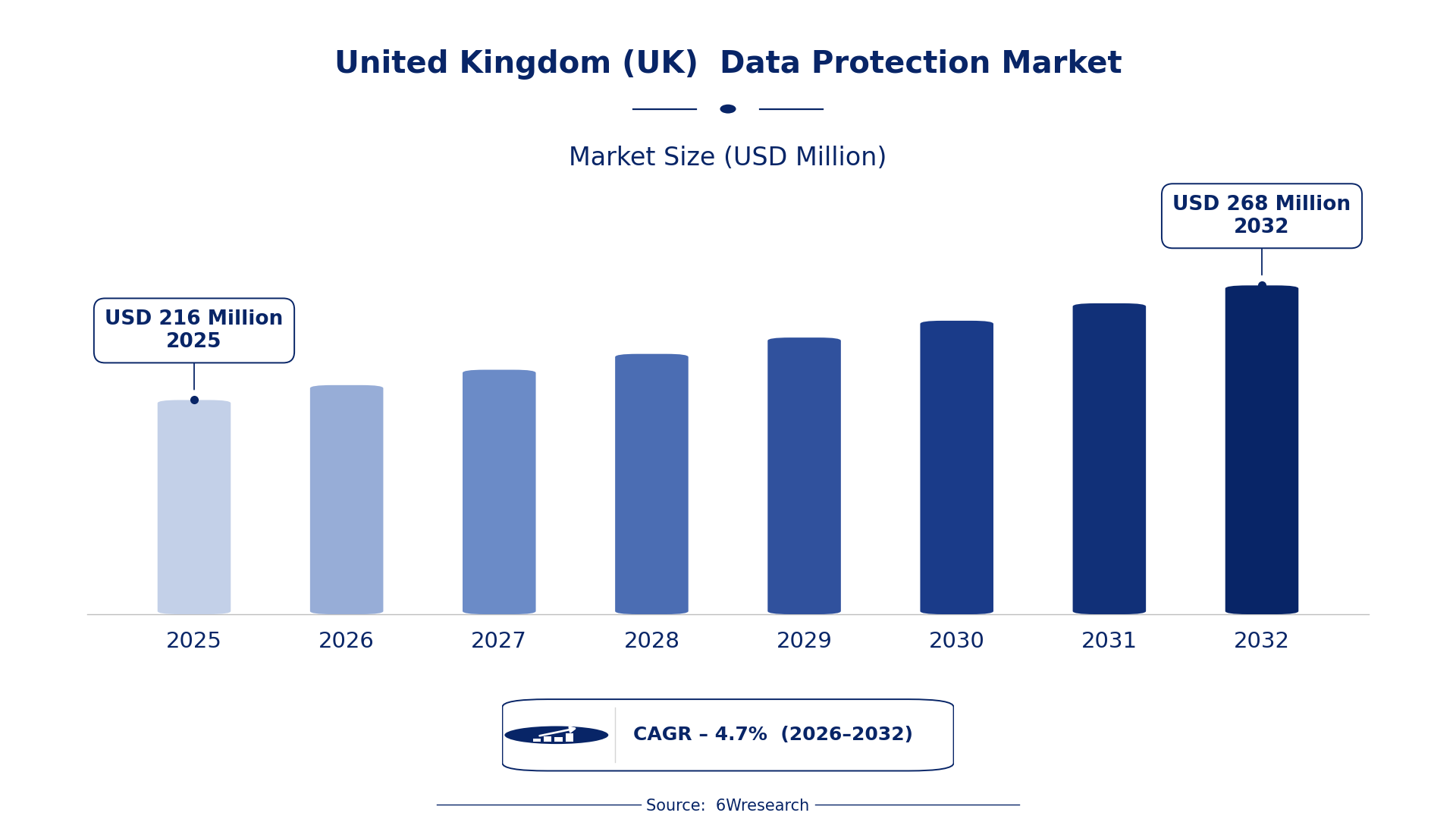
The United Kingdom (UK) Data Protection Market was estimated at USD 216 Million in 2025 and is projected to reach USD 268 Million by 2032, growing at a CAGR of 4.7% from 2026 to 2032.
United Kingdom (UK) Data Protection Market Synopsis
As cyber threats intensify, the need for reliable data protection solutions in the UK is undeniable. Organizations, ranging from SMEs to large enterprises, are prioritizing investments in comprehensive systems that not only secure data but also ensure compliance with stringent regulations.
The convergence of increasing cloud adoption and regulatory compliance requirements drives the growth of this market. Companies are now expected to have advanced data protection strategies in place, thus shaping a landscape where proactive measures take precedence over reactive solutions.
United Kingdom (UK) Data Protection Market Year-wise Growth Rate and Key Drivers
This graph illustrates the annual growth rates of the United Kingdom (UK) Data Protection Market from 2021 to 2032, highlighting a steady upward trajectory and projected expansion over the forecast period.
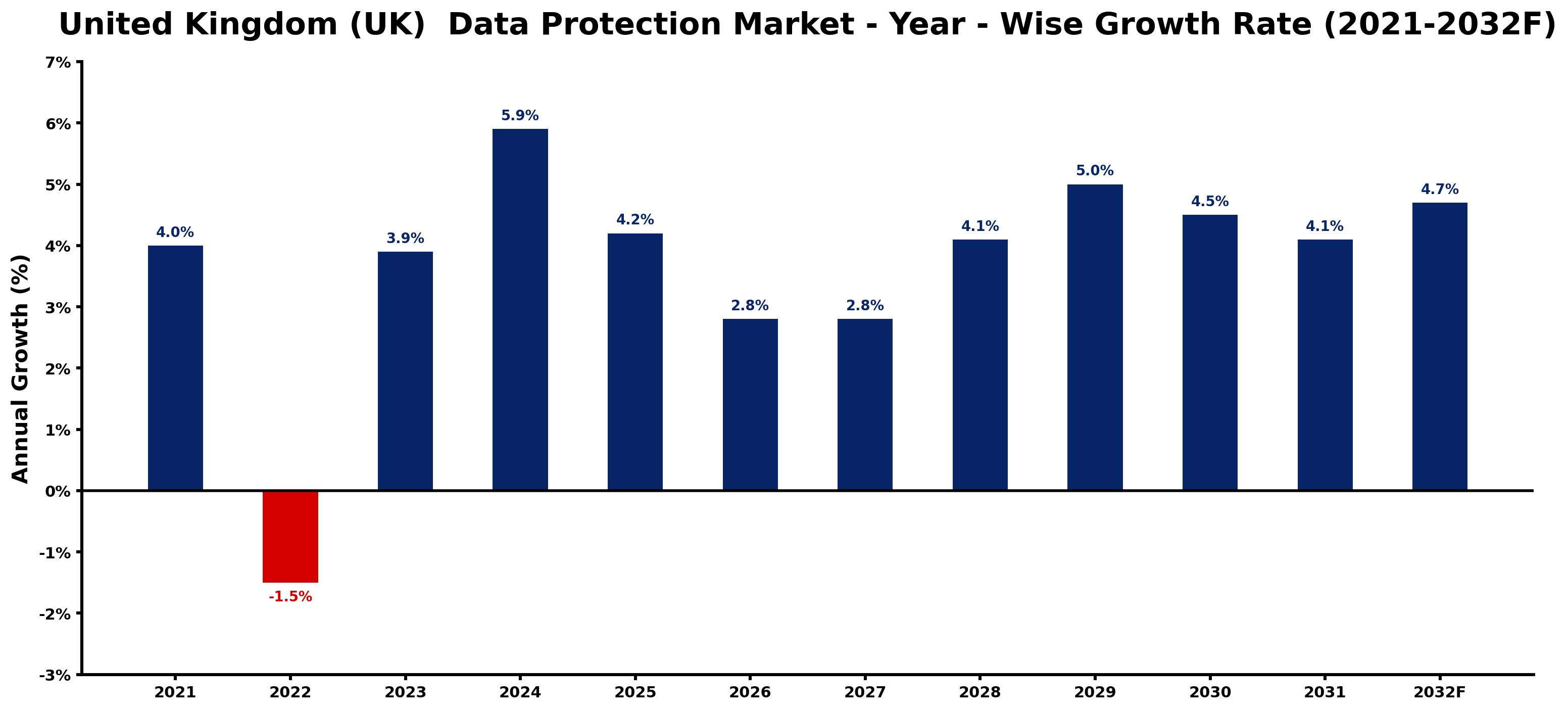
The table below presents the year‑wise growth rates along with the key drivers influencing the market
| Year | Growth Rate | Major Drivers |
| 2021 | 4.0% | GDPR enforcement increases demand for compliance solutions. |
| 2022 | -1.5% | ICO fines increased, discouraging data handling practices. |
| 2023 | 3.9% | UK Data Protection Act amendments boost regulatory requirements. |
| 2024 | 5.9% | National Cyber Security Strategy prioritizes data privacy measures. |
| 2025 | 4.2% | Rise in remote work drives need for secure data management. |
| 2026 | 2.8% | Increased cyber threats heighten focus on data protection. |
| 2027 | 2.8% | Small businesses adopt robust data protection systems following breaches. |
| 2028 | 4.1% | Consumer awareness of data privacy elevates demand for services. |
| 2029 | 5.0% | Regulatory fines for non-compliance impact industry investment. |
| 2030 | 4.5% | Digital transformation initiatives necessitate enhanced data security protocols. |
| 2031 | 4.1% | Government initiatives promote cybersecurity education and awareness. |
| 2032 | 4.7% | Evolving privacy regulations demand continuous adaptation of data practices. |
Note: Market size estimations and growth projections presented in this report are based on 6Wresearch's proprietary forecasting methodology, utilizing the latest available industry data, government publications, and primary research inputs.
United Kingdom (UK) Data Protection Market Key Takeaways
Below are some of the specific key takeaways from the market, including:
- Stringent data privacy regulations, especially GDPR, are compelling organizations to invest heavily in data protection solutions.
- The surge in cyberattacks is pushing businesses to adopt comprehensive security frameworks to safeguard their data.
- Cloud service adoption is significantly driving the need for advanced data protection strategies and solutions.
- Compliance with regulations adds complexity to data protection efforts, making effective strategy essential.
- Ongoing advancements in technology are continuously shaping the capabilities and efficiencies of data protection measures.
Evaluation of Restraints in United Kingdom (UK) Data Protection Market
The market faces significant hurdles in adapting to the rapidly changing cyber threat environment. Companies must constantly evolve their protection strategies, which can be both resource-intensive and complex. The dual challenge of maintaining stringent data protection while ensuring business efficiency often leads to friction. on top of that, the intricacies of compliance, particularly with GDPR and other regulatory frameworks, complicate the implementation of effective solutions.
United Kingdom (UK) Data Protection Market Trends
One of the most notable trends is the increasing integration of AI and machine learning in data protection solutions. These technologies enhance threat detection and response capabilities, allowing organizations to preemptively address vulnerabilities. The shift towards a more decentralized data architecture, driven by cloud adoption, also influences how companies implement data security strategies.
In addition, businesses are prioritizing user education and training as part of their data protection initiatives, recognizing that human error remains a significant risk factor. Increased collaboration between IT and legal teams is becoming common, as organizations seek to bridge the gap between compliance and technical execution.
United Kingdom (UK) Data Protection Market Opportunities
As the UK market continues to expand, notable growth opportunities exist in managed services. Organizations are increasingly turning to third-party providers for data protection expertise, enabling them to focus on their core operations while ensuring robust data security. Additionally, sectors such as healthcare and finance, with their sensitive data needs, present lucrative opportunities for innovative data protection solutions.
The growing emphasis on privacy-enhancing technologies will also shape the future of the market. Solutions that offer secure data sharing while maintaining compliance are expected to see heightened demand, particularly in a data-driven economy.
Government Initiatives in the United Kingdom (UK) Data Protection Market
The regulatory framework in the UK is stringent, with a clear focus on protecting personal data. The presence of laws like the GDPR and the Data Protection Act 2018 reflects a government commitment to safeguarding data privacy. This regulatory environment drives organizations to adopt data protection measures to stay compliant and avoid hefty penalties.
- A recently completed review of the Data Protection Act 2018 aimed at enhancing compliance mechanisms and updating guidance for businesses.
- Currently ongoing public consultations regarding the potential updates to data protection regulations to adapt to new technological challenges.
- A planned government initiative focused on funding cybersecurity training programs aimed at improving the skill set of the workforce in data protection.
- The establishment of a new regulatory body expected to enhance oversight and compliance monitoring, scheduled for rollout in 2026.
- A national awareness campaign promoting the importance of data privacy and compliance, set to launch in early 2025.
Future Insights of the United Kingdom (UK) Data Protection Market
Looking ahead to 2026-2032, the UK data protection market will likely see continued evolution driven by emerging technologies. Organizations will prioritize integrating data privacy into their overall business strategies, viewing compliance not just as a regulatory requirement but as a competitive advantage. on top of that, collaboration between public and private sectors will grow, fostering innovation in data protection technologies and frameworks. This proactive approach will position businesses to not only meet regulatory demands but also build trust with consumers in an increasingly data-sensitive environment.
United Kingdom (UK) Data Protection Market Latest Developments
In recent months, the UK data protection market has seen significant activity as businesses strive to enhance their data security protocols amidst rising cyber threats. The emphasis on compliance continues to dominate discussions, influencing new product developments and service offerings.
- A major technology vendor announced the launch of a new data encryption solution designed for cloud environments, with the rollout expected to begin in Q3 2025.
- An initiative focused on developing a national data protection certification program is currently underway, aiming to standardize best practices across sectors.
- A leading regional operator expanded its data protection services, enhancing backup and recovery offerings, initiated in early 2025.
- A partnership between private cybersecurity firms and public agencies aimed at fostering information sharing on threats has been ongoing since late 2024.
- A new data privacy tool targeting small and medium enterprises is set to launch in mid-2026, responding to market demand for affordable compliance solutions.
United Kingdom (UK) Data Protection Market - Key Attractiveness of the Report
- 10 Years of Market Numbers
- Historical Data Starting from 2022 to 2025
- Base Year: 2025
- Forecast Data until 2032
- Key Performance Indicators Impacting the Market
- Major Upcoming Developments and Projects
Key Highlights of the Report:
- United Kingdom (UK) Data Protection Market Outlook
- Market Size of United Kingdom (UK) Data Protection Market, 2025
- Forecast of United Kingdom (UK) Data Protection Market, 2032
- Historical Data and Forecast of United Kingdom (UK) Data Protection Revenues & Volume for the Period 2022-2032F
- United Kingdom (UK) Data Protection Market Trend Evolution
- United Kingdom (UK) Data Protection Market Drivers and Challenges
- United Kingdom (UK) Data Protection Price Trends
- United Kingdom (UK) Data Protection Porter's Five Forces
- United Kingdom (UK) Data Protection Industry Life Cycle
- Historical Data and Forecast of United Kingdom (UK) Data Protection Market Revenues & Volume By Component for the Period 2022-2032F
- Historical Data and Forecast of United Kingdom (UK) Data Protection Market Revenues & Volume By Solutions for the Period 2022-2032F
- Historical Data and Forecast of United Kingdom (UK) Data Protection Market Revenues & Volume By Services (Professional Services and Managed Services) for the Period 2022-2032F
- Historical Data and Forecast of United Kingdom (UK) Data Protection Market Revenues & Volume By Deployment Mode for the Period 2022-2032F
- Historical Data and Forecast of United Kingdom (UK) Data Protection Market Revenues & Volume By On-premises for the Period 2022-2032F
- Historical Data and Forecast of United Kingdom (UK) Data Protection Market Revenues & Volume By Cloud for the Period 2022-2032F
- Historical Data and Forecast of United Kingdom (UK) Data Protection Market Revenues & Volume By Industry Vertical for the Period 2022-2032F
- Historical Data and Forecast of United Kingdom (UK) Data Protection Market Revenues & Volume By Government and defense for the Period 2022-2032F
- Historical Data and Forecast of United Kingdom (UK) Data Protection Market Revenues & Volume By Banking, Financial Services, and Insurance (BFSI) for the Period 2022-2032F
- Historical Data and Forecast of United Kingdom (UK) Data Protection Market Revenues & Volume By Healthcare for the Period 2022-2032F
- Historical Data and Forecast of United Kingdom (UK) Data Protection Market Revenues & Volume By IT and telecom for the Period 2022-2032F
- Historical Data and Forecast of United Kingdom (UK) Data Protection Market Revenues & Volume By Consumer goods and retail for the Period 2022-2032F
- Historical Data and Forecast of United Kingdom (UK) Data Protection Market Revenues & Volume By Education for the Period 2022-2032F
- Historical Data and Forecast of United Kingdom (UK) Data Protection Market Revenues & Volume By Media and entertainment for the Period 2022-2032F
- Historical Data and Forecast of United Kingdom (UK) Data Protection Market Revenues & Volume By Organization Size Large Enterprises for the Period 2022-2032F
- Historical Data and Forecast of United Kingdom (UK) Data Protection Market Revenues & Volume By SMEs for the Period 2022-2032F
- Historical Data and Forecast of United Kingdom (UK) Data Protection Market Revenues & Volume By Large Enterprises for the Period 2022-2032F
- United Kingdom (UK) Data Protection Import Export Trade Statistics
- Market Opportunity Assessment By Component
- Market Opportunity Assessment By Deployment Mode
- Market Opportunity Assessment By Industry Vertical
- Market Opportunity Assessment By Organization Size Large Enterprises
- United Kingdom (UK) Data Protection Top Companies Market Share
- United Kingdom (UK) Data Protection Competitive Benchmarking By Technical and Operational Parameters
- United Kingdom (UK) Data Protection Company Profiles
- United Kingdom (UK) Data Protection Key Strategic Recommendations






































