United Kingdom (UK) Energy Security Market Size & Growth Rate (2026-2032)
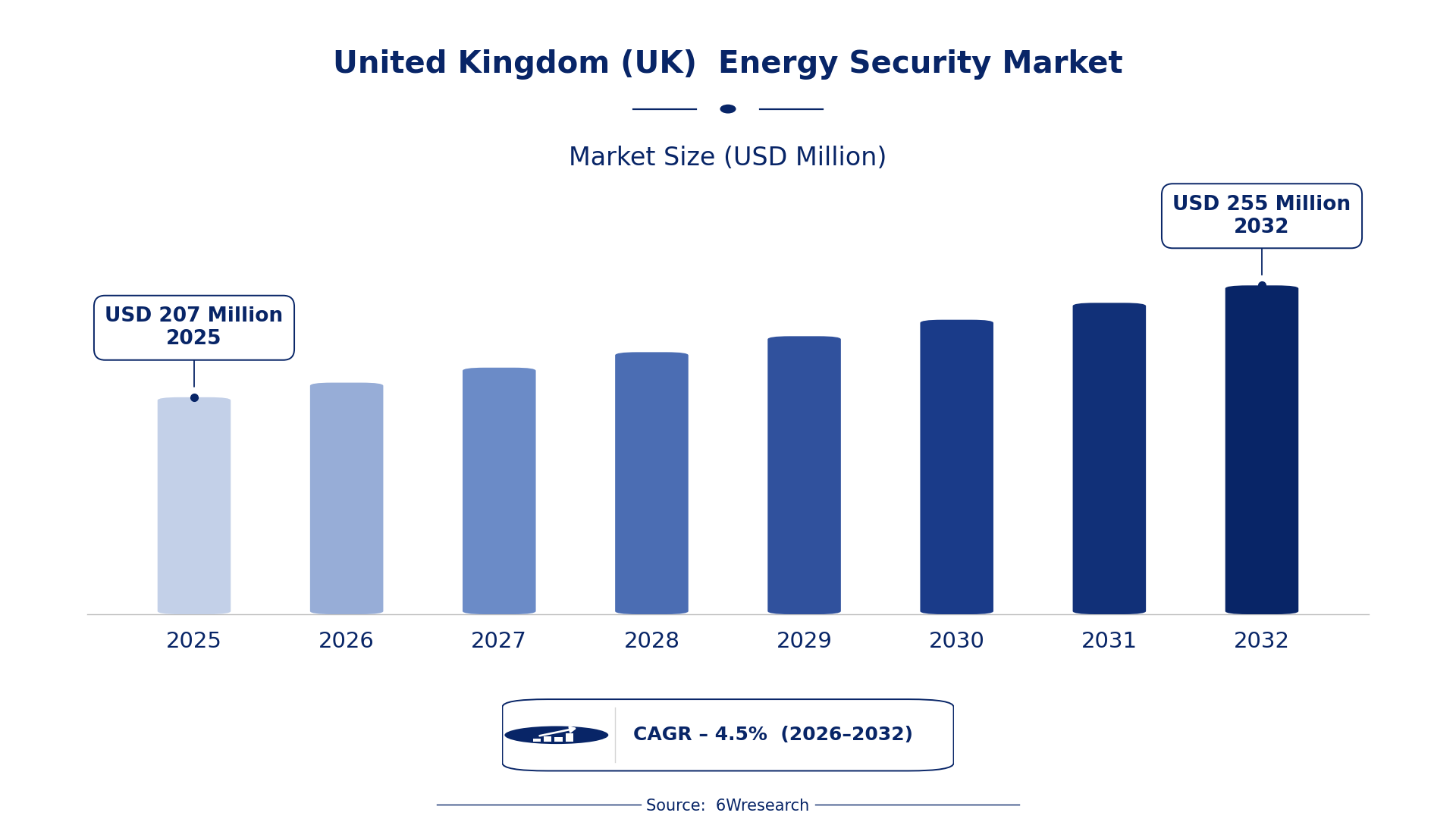
The United Kingdom (UK) Energy Security Market was estimated at USD 207 Million in 2025 and is projected to reach USD 255 Million by 2032, growing at a CAGR of 4.5% from 2026 to 2032.
United Kingdom (UK) Energy Security Market Synopsis
The United Kingdom is firmly positioned at the crossroads of energy security and sustainability. A combination of shifting consumer demand, geopolitical factors, and climate commitments is driving a robust transformation in how energy is supplied and consumed. With the government’s ambitious target of net-zero emissions by 2050, the urgency to strengthen energy infrastructure while simultaneously promoting renewable sources is palpable.
This dynamic market is characterized by an increasing reliance on renewable energy, particularly offshore wind and solar power. As energy security becomes intertwined with cyber resilience and technological advancements, stakeholders are navigating new regulatory frameworks and innovative solutions aimed at safeguarding the energy supply chain against disruptions.
United Kingdom (UK) Energy Security Market Year-wise Growth Rate and Key Drivers
This graph illustrates the annual growth rates of the United Kingdom (UK) Energy Security Market from 2021 to 2032, highlighting a steady upward trajectory and projected expansion over the forecast period.
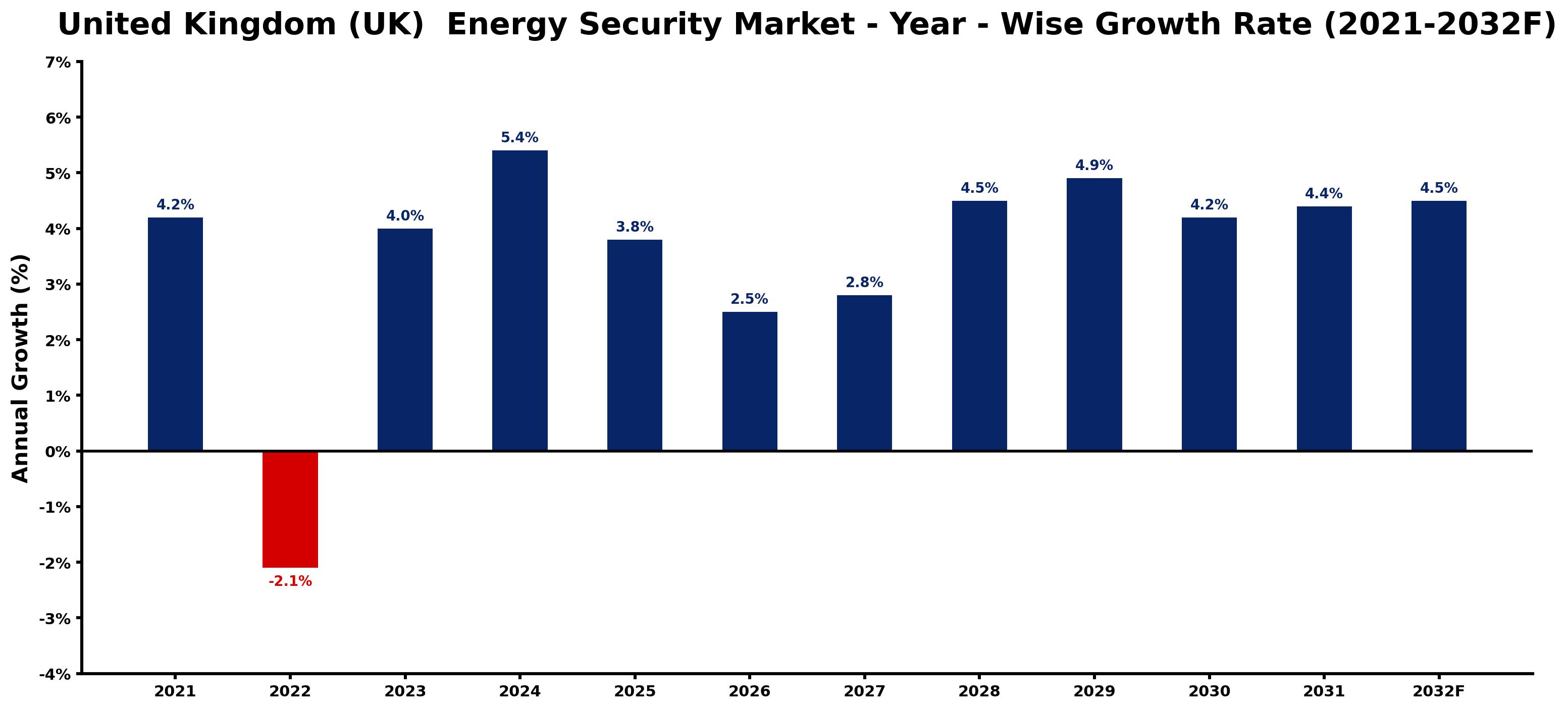
The table below presents the year‑wise growth rates along with the key drivers influencing the market
| Year | Growth Rate | Major Drivers |
| 2021 | 4.2% | UK government’s Net Zero Strategy boost for renewables. |
| 2022 | -2.1% | Government's failure to meet energy independence targets. |
| 2023 | 4.0% | Increased investment in energy storage technologies and solutions. |
| 2024 | 5.4% | Growing public-private partnerships in energy resilience projects. |
| 2025 | 3.8% | Rise in local wind energy capacity and innovations. |
| 2026 | 2.5% | Implementation of new energy efficiency regulations by Ofgem. |
| 2027 | 2.8% | Enhanced cybersecurity measures for critical energy infrastructure. |
| 2028 | 4.5% | Surge in electric vehicle adoption driving energy demand. |
| 2029 | 4.9% | Government incentives for developing offshore renewable energy projects. |
| 2030 | 4.2% | Investment in domestic hydrogen production for energy security. |
| 2031 | 4.4% | Increased consumer awareness on energy conservation initiatives. |
| 2032 | 4.5% | Reinforcement of grid infrastructure post-Brexit energy strategy. |
Note: Market size estimations and growth projections presented in this report are based on 6Wresearch's proprietary forecasting methodology, utilizing the latest available industry data, government publications, and primary research inputs.
United Kingdom (UK) Energy Security Market Key Takeaways
Below are some of the specific key takeaways from the market, including:
- Transition towards renewable energy sources is accelerating, driven by both government policies and market demand.
- Cybersecurity measures are increasingly integrated into energy infrastructure planning to protect against potential threats.
- Investment opportunities are rising in smart grid technologies and energy storage solutions.
- The government aims to enhance domestic energy production while reducing dependency on imports.
- Policy frameworks are evolving to support a diversified and resilient energy ecosystem.
Evaluation of Restraints in United Kingdom (UK) Energy Security Market
Several constraints are evident in the UK Energy Security Market that stakeholders must address. Aging infrastructure remains a significant challenge, complicating the transition to newer, cleaner technologies. There's also the pressing need to diversify energy sources to mitigate risks associated with imports, especially in light of geopolitical tensions. Balancing affordability for consumers while ensuring energy reliability and sustainability is a tightrope that policymakers must walk, with the aim of achieving net-zero emissions by 2050.
United Kingdom (UK) Energy Security Market Trends
The UK is witnessing a pronounced shift towards renewable energy, with wind and solar technologies at the forefront. Government incentives are fostering advancements in energy efficiency and smart grid initiatives. This transformation is also marked by increased investment in energy storage solutions as a means of balancing supply and demand fluctuations. Alongside this, there's a heightened focus on integrating cybersecurity measures to protect critical energy infrastructure from evolving threats.
United Kingdom (UK) Energy Security Market Opportunities
The energy transition presents a wealth of opportunities for investment within the UK Energy Security Market. The growing emphasis on renewable technologies opens avenues for companies specializing in wind, solar, and hydroelectric power. on top of that, as the country strives to enhance energy efficiency, investments in smart grid technologies and energy management systems are likely to yield substantial returns. Innovators that can provide solutions addressing both energy security and sustainability will find the landscape increasingly favorable.
Government Initiatives in the United Kingdom (UK) Energy Security Market
Government policy is critically shaping the UK Energy Security Market, emphasizing the need for a secure, resilient, and sustainable energy future. This commitment is reflected in initiatives designed to bolster domestic production while transitioning to cleaner energy sources. Regulatory measures aim to enhance energy efficiency and integrate advanced technologies, ensuring that the market adapts to both local and global energy demands.
- A recently completed initiative involved the implementation of the Capacity Market, which aims to guarantee energy supply during peak demand periods.
- A current effort is focused on expanding offshore wind capabilities, with several projects now in the deployment phase to enhance renewable energy capacity.
- Plans are underway for a national energy efficiency program expected to launch in 2026, aimed at promoting sustainable consumption practices across the public and private sectors.
- Ongoing reviews of energy regulations are looking to streamline approval processes for new renewable projects, encouraging faster deployment of clean energy technologies.
- The government is developing a cybersecurity framework specifically for critical energy infrastructure, projected to roll out in early 2027.
Future Insights of the United Kingdom (UK) Energy Security Market
Looking towards 2026-2032, the UK Energy Security Market is set to evolve significantly. With a continued push towards renewable energy sources, the market will likely see advancements in energy storage and smart grid technologies. Strengthening infrastructure to handle increasing renewable generation will be paramount. on top of that, integrating cybersecurity measures will not only bolster resilience but also enhance consumer confidence in energy systems as they transition away from fossil fuels.
United Kingdom (UK) Energy Security Market Latest Developments
In the past year, activity within the UK Energy Security Market has gained momentum, reflecting a stronger commitment to both sustainability and security. Major advancements in renewable technologies and strategic partnerships are shaping the market's trajectory. This year has seen concerted efforts from both the public and private sectors to innovate and enhance energy supply reliability while integrating new technologies.
- A partnership launched in Q2 2023 focuses on advancing smart grid technologies, aimed at improving energy distribution efficiency.
- An initiative that began in early 2023 focuses on retrofitting aging infrastructure to better integrate renewable energy sources.
- A technology vendor is currently rolling out an energy storage system capable of stabilizing grid performance during peak usage times, with completion expected by late 2024.
- A public consultation is underway for a national clean energy strategy, aiming to finalize recommendations by late 2025.
- An upcoming investment round in 2024 is planned to support offshore wind projects set to significantly increase capacity by 2028.
United Kingdom (UK) Energy Security Market - Key Attractiveness of the Report
- 10 Years of Market Numbers
- Historical Data Starting from 2022 to 2025
- Base Year: 2025
- Forecast Data until 2032
- Key Performance Indicators Impacting the Market
- Major Upcoming Developments and Projects
Key Highlights of the Report:
- United Kingdom (UK) Energy Security Market Outlook
- Market Size of United Kingdom (UK) Energy Security Market, 2025
- Forecast of United Kingdom (UK) Energy Security Market, 2032
- Historical Data and Forecast of United Kingdom (UK) Energy Security Revenues & Volume for the Period 2022-2032F
- United Kingdom (UK) Energy Security Market Trend Evolution
- United Kingdom (UK) Energy Security Market Drivers and Challenges
- United Kingdom (UK) Energy Security Price Trends
- United Kingdom (UK) Energy Security Porter's Five Forces
- United Kingdom (UK) Energy Security Industry Life Cycle
- Historical Data and Forecast of United Kingdom (UK) Energy Security Market Revenues & Volume By Power Plants for the Period 2022-2032F
- Historical Data and Forecast of United Kingdom (UK) Energy Security Market Revenues & Volume By Nuclear for the Period 2022-2032F
- Historical Data and Forecast of United Kingdom (UK) Energy Security Market Revenues & Volume By Thermal for the Period 2022-2032F
- Historical Data and Forecast of United Kingdom (UK) Energy Security Market Revenues & Volume By Hydro for the Period 2022-2032F
- Historical Data and Forecast of United Kingdom (UK) Energy Security Market Revenues & Volume By Oil for the Period 2022-2032F
- Historical Data and Forecast of United Kingdom (UK) Energy Security Market Revenues & Volume By Gas for the Period 2022-2032F
- Historical Data and Forecast of United Kingdom (UK) Energy Security Market Revenues & Volume By Renewable Energy for the Period 2022-2032F
- Historical Data and Forecast of United Kingdom (UK) Energy Security Market Revenues & Volume By Technologies for the Period 2022-2032F
- Historical Data and Forecast of United Kingdom (UK) Energy Security Market Revenues & Volume By Physical for the Period 2022-2032F
- Historical Data and Forecast of United Kingdom (UK) Energy Security Market Revenues & Volume By Network Security for the Period 2022-2032F
- United Kingdom (UK) Energy Security Import Export Trade Statistics
- Market Opportunity Assessment By Power Plants
- Market Opportunity Assessment By Technologies
- United Kingdom (UK) Energy Security Top Companies Market Share
- United Kingdom (UK) Energy Security Competitive Benchmarking By Technical and Operational Parameters
- United Kingdom (UK) Energy Security Company Profiles
- United Kingdom (UK) Energy Security Key Strategic Recommendations






































