United Kingdom (UK) General Merchandise Market Summary
The united kingdom (uk) general merchandise market was estimated at USD 280 Million in 2025 and is projected to reach USD 346 Million by 2032, growing at a CAGR of 2.5% from 2026 to 2032.
United Kingdom (UK) General Merchandise Market Year-wise Growth Rate and Key Drivers
This graph highlights how the United Kingdom (UK) General Merchandise Market has steadily grown over the past five years, supported by major growth factors.
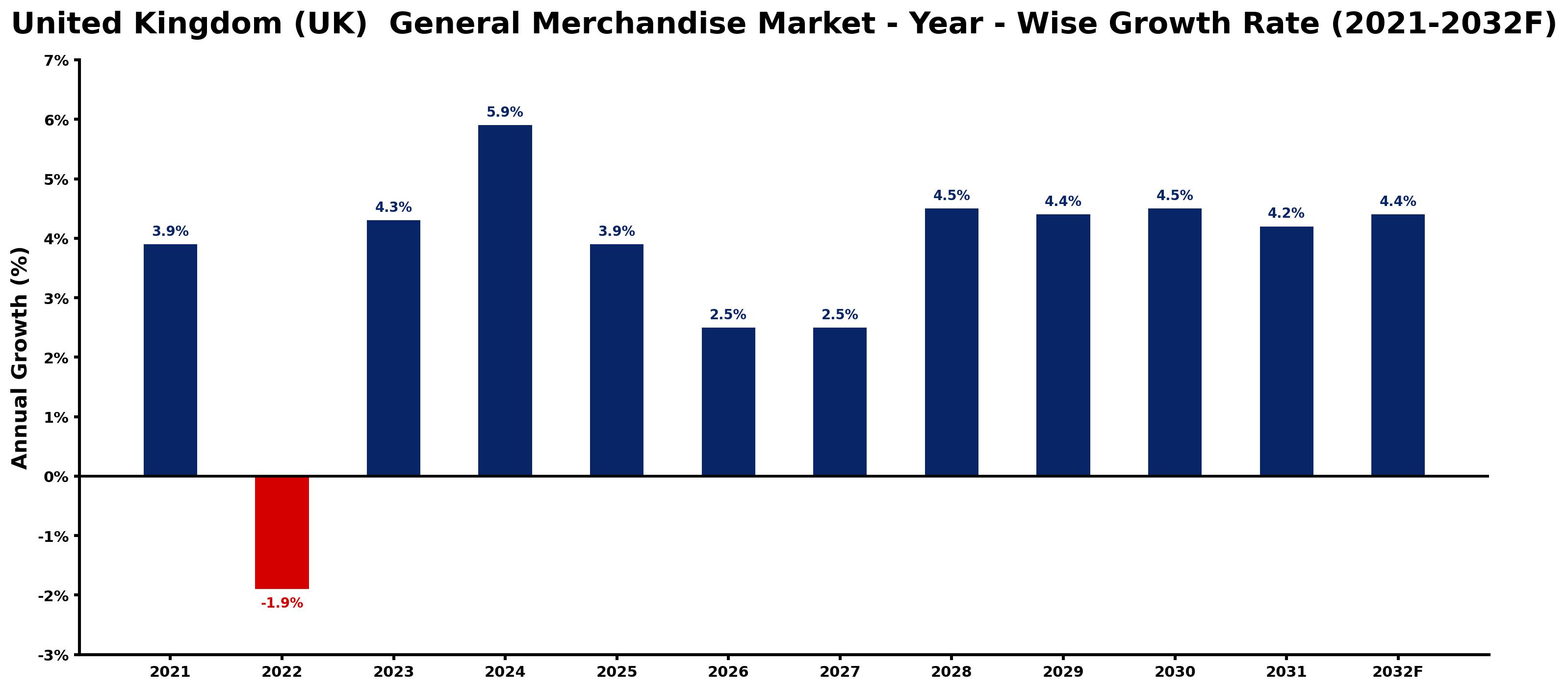
The table below presents the year wise growth rates along with the key drivers influencing the market
| Year | Growth Rate | Major Drivers |
| 2021 | 3.9% | Post-lockdown retail projects shifted consumer behavior toward online shopping channels. |
| 2022 | -1.9% | Economic uncertainty and rising living costs led to decreased discretionary spending on general merchandise items. |
| 2023 | 4.3% | Sustainability trends influenced purchasing decisions, driving eco-friendly product offerings. |
| 2024 | 5.9% | Technology integration in retail enhanced customer engagement through personalized experiences. |
| 2025 | 3.9% | Economic recovery post-COVID-19 spurred discretionary spending across various merchandise categories. |
| 2026 | 2.5% | Expansion of omnichannel strategies became critical for brands to compete effectively. |
| 2027 | 2.5% | Demographic shifts indicated younger consumers prioritizing unique, niche product offerings. |
| 2028 | 4.5% | Supply chain optimization emerged as a necessity to reduce operational inefficiencies. |
| 2029 | 4.4% | Retailers increasingly focused on leveraging data analytics for inventory management improvements. |
| 2030 | 4.5% | Social media platforms transformed into vital sales channels for general merchandise brands. |
| 2031 | 4.2% | Cross-border e-commerce regulations adapted, facilitating smoother international transactions for retailers. |
| 2032 | 4.4% | Consumer education on product origins influenced purchasing patterns towards local brands. |
Note - Market size estimations and growth projections presented in this report are based on 6Wresearch's advanced forecasting approach, validated with industry datasets as of June 2026.
United Kingdom (UK) General Merchandise Market Synopsis
The United Kingdom (UK) General Merchandise Market is projected to reach 2.5% and witness significant growth during the forecast period (2026-2032). The market encompasses a diverse array of products, including clothing, electronics, homeware, and non-food items, all of which reflect the dynamic and competitive nature of the retail landscape in the UK. Driven by evolving consumer preferences, technological advancements, and the prominence of e-commerce, the market is poised for substantial transformation.
United Kingdom (UK) General Merchandise Market Trends and Opportunities
The UK general merchandise market is currently characterized by several prominent trends that are reshaping purchasing behaviors. A significant trend is the increasing consumer demand for sustainable and eco-friendly products. As environmental consciousness continues to rise, brands that incorporate sustainability into their offerings are finding favor with consumers.
Alongside sustainability, the shift towards online shopping has been revolutionary, with consumers gravitating towards the convenience of e-commerce platforms. This trend is further enhanced by mobile shopping applications that simplify the purchasing process. Personalization is another emerging trend, as buyers seek unique items tailored to their individual tastes and preferences.
Moreover, there is a noticeable increase in consumer interest in health and wellness products, reflecting a broader focus on well-being. Retailers are responding by expanding their portfolios to include health-conscious merchandise, which aligns with consumers' more holistic approach to shopping. Overall, the anticipated growth within the UK general merchandise market presents a variety of opportunities for brands willing to innovate and cater to changing consumer demands.
United Kingdom (UK) General Merchandise Market Challenges and Restraints
The UK general merchandise market faces a series of challenges that could impact growth trajectories. One of the most pressing issues is the heightened competition from online retailers, which continue to disrupt traditional brick-and-mortar businesses. This shift has resulted in store closures and job losses, as physical retailers struggle to adapt to changing consumer behaviors.
Furthermore, changing consumer preferences are significantly leaning towards sustainable and ethically sourced products. This evolving landscape requires traditional retailers to revise their inventory and supply chain practices, demanding significant adjustments in operations. Economic uncertainties, particularly those related to Brexit and fluctuating currency values, add another layer of complexity, affecting trade relations and overall market stability.
To remain competitive, businesses must address these challenges strategically, ensuring they remain relevant in a fluctuating retail environment. This might involve leveraging technology, enhancing customer engagement, and aligning product offerings with evolving consumer values.
United Kingdom (UK) General Merchandise Market Government Investment and Initiatives
Government policy plays a crucial role in shaping the UK general merchandise market, with various initiatives aimed at promoting fair competition, consumer protection, and sustainable growth. The Competition and Markets Authority (CMA) is responsible for regulating competition, ensuring that businesses operate within a framework that supports innovation and protects consumer rights.
In addition, policies promoted by the Department for Business, Energy & Industrial Strategy (BEIS) focus on fostering growth within the retail sector through support for innovation and digital transformation. Consumer protection laws enforced by the government ensure that product safety and fair pricing remain a priority, creating a trustworthy environment for shoppers.
The implications of Brexit also necessitate careful consideration, as shifts in trade relations have the potential to disrupt supply chains and market dynamics. Government efforts to navigate these changes are vital to maintaining stability and promoting resilience within the industry. Overall, ongoing investments and initiatives are essential in fostering a competitive and sustainable general merchandise market in the UK.
United Kingdom (UK) General Merchandise Market Latest Developments (May 2025 - June 2026)
Recent developments within the UK general merchandise market between May 2025 and June 2026 reflect a continued focus on enhancing consumer engagement and adapting to market shifts. The growing trend towards e-commerce has prompted many retailers to invest in advanced digital platforms, optimizing user experiences and streamlining supply chain operations. Additionally, the emphasis on sustainability has seen increased product offerings that align with environmentally conscious consumer preferences.
Collaborations between brands and sustainability-focused organizations have also become more prevalent, as retailers strive to enhance their environmental credentials. Furthermore, an increasing number of companies are actively seeking to implement personalized marketing strategies, enhancing customer connections through tailored approaches to advertising and product recommendations.
In response to economic fluctuations and uncertainties, various stakeholders are pivoting their strategies to ensure resilience. This includes diversifying product lines, optimizing pricing strategies, and reinforcing supply chain networks to mitigate potential disruptions. Overall, these developments underscore the market's adaptability and readiness to embrace ongoing changes.
United Kingdom (UK) General Merchandise Market - Key Attractiveness of the Report
- 10 Years of Market Numbers
- Historical Data Starting from 2022 to 2025
- Base Year: 2025
- Forecast Data until 2032
- Key Performance Indicators Impacting the Market
- Major Upcoming Developments and Projects
Key Highlights of the Report:
- United Kingdom (UK) General Merchandise Market Outlook
- Market Size of United Kingdom (UK) General Merchandise Market, 2025
- Forecast of United Kingdom (UK) General Merchandise Market, 2032F
- Historical Data and Forecast of United Kingdom (UK) General Merchandise Revenues & Volume for the Period 2022-2032F
- United Kingdom (UK) General Merchandise Market Trend Evolution
- United Kingdom (UK) General Merchandise Market Drivers and Challenges
- United Kingdom (UK) General Merchandise Price Trends
- United Kingdom (UK) General Merchandise Porter's Five Forces
- United Kingdom (UK) General Merchandise Industry Life Cycle
- Historical Data and Forecast of United Kingdom (UK) General Merchandise Market Revenues & Volume By Types for the Period 2022-2032F
- Historical Data and Forecast of United Kingdom (UK) General Merchandise Market Revenues & Volume By Home and Furniture for the Period 2022-2032F
- Historical Data and Forecast of United Kingdom (UK) General Merchandise Market Revenues & Volume By Garden for the Period 2022-2032F
- Historical Data and Forecast of United Kingdom (UK) General Merchandise Market Revenues & Volume By Electrical for the Period 2022-2032F
- Historical Data and Forecast of United Kingdom (UK) General Merchandise Market Revenues & Volume By Food and Drink for the Period 2022-2032F
- Historical Data and Forecast of United Kingdom (UK) General Merchandise Market Revenues & Volume By Others for the Period 2022-2032F
- Historical Data and Forecast of United Kingdom (UK) General Merchandise Market Revenues & Volume By Applications for the Period 2022-2032F
- Historical Data and Forecast of United Kingdom (UK) General Merchandise Market Revenues & Volume By Supermarket for the Period 2022-2032F
- Historical Data and Forecast of United Kingdom (UK) General Merchandise Market Revenues & Volume By Retail market for the Period 2022-2032F
- Historical Data and Forecast of United Kingdom (UK) General Merchandise Market Revenues & Volume By Specialty store for the Period 2022-2032F
- Historical Data and Forecast of United Kingdom (UK) General Merchandise Market Revenues & Volume By E-tailer for the Period 2022-2032F
- Historical Data and Forecast of United Kingdom (UK) General Merchandise Market Revenues & Volume By Others for the Period 2022-2032F
- United Kingdom (UK) General Merchandise Import Export Trade Statistics
- Market Opportunity Assessment By Types
- Market Opportunity Assessment By Applications
- United Kingdom (UK) General Merchandise Top Companies Market Share
- United Kingdom (UK) General Merchandise Competitive Benchmarking By Technical and Operational Parameters
- United Kingdom (UK) General Merchandise Company Profiles
- United Kingdom (UK) General Merchandise Key Strategic Recommendations






































