United Kingdom (UK) Insulated Glass Market Size, Share & Growth Rate
The United Kingdom (UK) Insulated Glass Market was estimated at USD 367 Million in 2025 and is projected to reach USD 455 Million by 2032, growing at a CAGR of 3.1% from 2026 to 2032. This trajectory is primarily fueled by the surging construction activities across residential and commercial sectors, as well as a heightened awareness of energy efficiency among property developers and homeowners. Additionally, the increasing stringency of building regulations is propelling the adoption of insulated glass solutions, making them a vital component in the construction of modern, energy-efficient structures.
United Kingdom (UK) Insulated Glass Market Year-wise Growth Rate and Key Drivers
This graph highlights how the United Kingdom (UK) Insulated Glass Market has steadily grown over the years, supported by major growth factors.
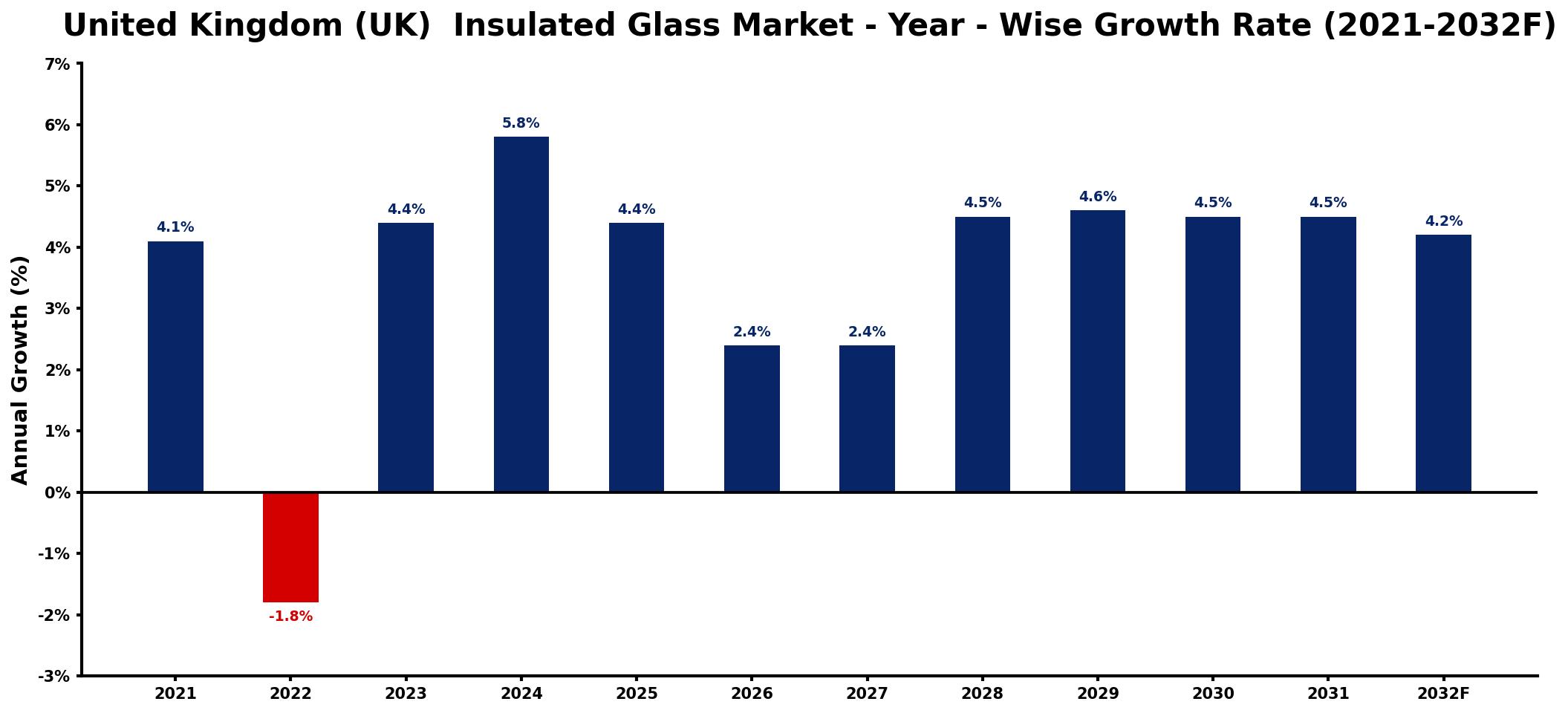
The table below presents the year‑wise growth rates along with the key drivers influencing the market
| Year | Growth Rate | Major Drivers |
| 2021 | 4.1% | Rising construction sector investments |
| 2022 | -1.8% | Slowdown in housing market activity |
| 2023 | 4.4% | Increase in energy efficiency regulations |
| 2024 | 5.8% | Surge in eco-friendly building projects |
| 2025 | 4.4% | Growing demand for residential renovations |
| 2026 | 2.4% | Expansion of commercial real estate |
| 2027 | 2.4% | Emergence of smart building technologies |
| 2028 | 4.5% | Increased focus on sustainability initiatives |
| 2029 | 4.6% | Growth in international trade agreements |
| 2030 | 4.5% | Advancements in manufacturing technologies |
| 2031 | 4.5% | Heightened awareness of climate change |
| 2032 | 4.2% | Ongoing urban development projects |
Note: Market size estimations and growth projections presented in this report are based on 6Wresearch's proprietary forecasting methodology, utilizing the latest available industry data, government publications, and primary research inputs.
United Kingdom (UK) Insulated Glass Market Synopsis
The UK Insulated Glass Market is currently riding a wave of growth, thanks to the strong momentum generated by sustainability initiatives and energy efficiency mandates. However, as the market matures, it is set to evolve with innovations such as smart glass technology and improved manufacturing processes, positioning itself to meet future demands. This evolution will also reflect the changing preferences in architecture, where larger glass facades and aesthetic appeal are becoming increasingly crucial.
As the market heads towards this promising future, players must navigate a landscape characterized by competition from alternative materials and the imperative for continuous innovation. Thus, while the current growth trajectory is encouraging, stakeholders will need to remain vigilant and adaptive to sustain their position in an ever-evolving marketplace.
United Kingdom (UK) Insulated Glass Market Key Takeaways
- The market is projected to grow from USD 367 Million in 2025 to USD 455 Million by 2032.
- Key growth drivers include rising demand for energy-efficient buildings and stringent building regulations.
- Technological advancements are paving the way for innovative solutions like low-emissivity coatings.
- The residential sector remains the largest consumer, but commercial demand is on the rise.
- Government initiatives are actively promoting the adoption of insulated glass in construction.
Evaluation of Restraints in United Kingdom (UK) Insulated Glass Market
Despite its growth potential, the UK Insulated Glass Market faces several constraints that could hinder its progress. Intense competition from alternative building materials and glazing solutions is one significant hurdle, as consumers may opt for cheaper or more innovative options that challenge traditional insulated glass products. Moreover, the rising costs of raw materials and the unpredictability of exchange rates can directly impact manufacturing profitability, which could stifle investment in R&D and new technologies. Lastly, the political and economic uncertainties, particularly those stemming from Brexit, present further risks that could affect market stability and growth.
United Kingdom (UK) Insulated Glass Market Trends
Current trends in the UK Insulated Glass Market are strongly influenced by a focus on sustainability and enhanced energy efficiency. There is a growing shift towards the use of smart glass technologies, which not only provide thermal insulation but also contribute to building automation and energy savings. Additionally, the architecture of contemporary buildings is leaning toward larger glass facades, which necessitate advanced insulated glass solutions that can effectively manage heat and sound. As awareness of climate change issues heightens, these trends are expected to gain traction, further driving demand for insulated glass products.
United Kingdom (UK) Insulated Glass Market Opportunities
The market presents significant investment opportunities, especially for those aligned with the push towards energy efficiency in building construction. Companies that innovate with insulated glass products—focusing on thermal performance, safety, and aesthetic design—are likely to find a receptive market. Strategic partnerships with architects, developers, and construction firms can also facilitate market entry and help establish a robust presence. With sustainability at the forefront of regulatory policies, opportunities for growth are abundant for those committed to developing energy-efficient building solutions.
Government Initiatives in the United Kingdom (UK) Insulated Glass Market
The UK government has launched several initiatives aimed at promoting energy efficiency and sustainability in the building sector, which directly impact the insulated glass market. Programs like the Energy Company Obligation (ECO) and the Green Deal incentivize the installation of energy-efficient insulated glass windows in both residential and commercial properties. Moreover, stringent building regulations set forth by the government stipulate necessary thermal performance standards, effectively driving up the demand for quality insulated glass products. Such policies are crucial in fostering an environment conducive to market growth.
Future Insights of the United Kingdom (UK) Insulated Glass Market
Looking ahead to 2026-2032, the UK Insulated Glass Market is expected to see a steady upward trajectory, powered by ongoing construction activities and a commitment to energy-efficient building practices. Innovations in glass technology will play a vital role in driving demand, as manufacturers strive to meet the evolving needs of the market. The governments continued focus on sustainability and the introduction of more stringent energy efficiency regulations will further reinforce the market's growth prospects. Overall, the landscape appears promising, with numerous opportunities for stakeholders willing to adapt and innovate.
United Kingdom (UK) Insulated Glass Market Latest Developments (2025 - 2026)
Recent developments in the UK Insulated Glass Market indicate a significant shift towards incorporating smart glass technologies and enhancing energy efficiency features in products. Manufacturers are focusing on innovative coatings and advanced gas-filling techniques to improve thermal insulation. Furthermore, partnerships among construction firms and glass manufacturers are becoming increasingly common as stakeholders seek to align their projects with sustainability standards. These trends are expected to drive future growth and shape the overall direction of the market.
United Kingdom (UK) Insulated Glass Market - Key Attractiveness of the Report
- 10 Years of Market Numbers
- Historical Data Starting from 2022 to 2025
- Base Year: 2025
- Forecast Data until 2032
- Key Performance Indicators Impacting the Market
- Major Upcoming Developments and Projects
Key Highlights of the Report:
- United Kingdom (UK) Insulated Glass Market Outlook
- Market Size of United Kingdom (UK) Insulated Glass Market, 2025
- Forecast of United Kingdom (UK) Insulated Glass Market, 2032
- Historical Data and Forecast of United Kingdom (UK) Insulated Glass Revenues & Volume for the Period 2022-2032F
- United Kingdom (UK) Insulated Glass Market Trend Evolution
- United Kingdom (UK) Insulated Glass Market Drivers and Challenges
- United Kingdom (UK) Insulated Glass Price Trends
- United Kingdom (UK) Insulated Glass Porter's Five Forces
- United Kingdom (UK) Insulated Glass Industry Life Cycle
- Historical Data and Forecast of United Kingdom (UK) Insulated Glass Market Revenues & Volume By Type for the Period 2022-2032F
- Historical Data and Forecast of United Kingdom (UK) Insulated Glass Market Revenues & Volume By Heated Insulating Glass for the Period 2022-2032F
- Historical Data and Forecast of United Kingdom (UK) Insulated Glass Market Revenues & Volume By Tempering Insulating Glass for the Period 2022-2032F
- Historical Data and Forecast of United Kingdom (UK) Insulated Glass Market Revenues & Volume By Custom Insulated Glass for the Period 2022-2032F
- Historical Data and Forecast of United Kingdom (UK) Insulated Glass Market Revenues & Volume By Other Glasses for the Period 2022-2032F
- Historical Data and Forecast of United Kingdom (UK) Insulated Glass Market Revenues & Volume By Application for the Period 2022-2032F
- Historical Data and Forecast of United Kingdom (UK) Insulated Glass Market Revenues & Volume By Doors & Partitions for the Period 2022-2032F
- Historical Data and Forecast of United Kingdom (UK) Insulated Glass Market Revenues & Volume By Kitchen Appliances & Cabinets for the Period 2022-2032F
- Historical Data and Forecast of United Kingdom (UK) Insulated Glass Market Revenues & Volume By Floors & Ceilings for the Period 2022-2032F
- Historical Data and Forecast of United Kingdom (UK) Insulated Glass Market Revenues & Volume By Furniture & Curtain Walls for the Period 2022-2032F
- Historical Data and Forecast of United Kingdom (UK) Insulated Glass Market Revenues & Volume By Railings & Bolted Structures for the Period 2022-2032F
- Historical Data and Forecast of United Kingdom (UK) Insulated Glass Market Revenues & Volume By Automotive Glasses for the Period 2022-2032F
- Historical Data and Forecast of United Kingdom (UK) Insulated Glass Market Revenues & Volume By End User for the Period 2022-2032F
- Historical Data and Forecast of United Kingdom (UK) Insulated Glass Market Revenues & Volume By Residential Buildings for the Period 2022-2032F
- Historical Data and Forecast of United Kingdom (UK) Insulated Glass Market Revenues & Volume By Commercial & Institutional Buildings for the Period 2022-2032F
- Historical Data and Forecast of United Kingdom (UK) Insulated Glass Market Revenues & Volume By Industrial Users for the Period 2022-2032F
- United Kingdom (UK) Insulated Glass Import Export Trade Statistics
- Market Opportunity Assessment By Type
- Market Opportunity Assessment By Application
- Market Opportunity Assessment By End User
- United Kingdom (UK) Insulated Glass Top Companies Market Share
- United Kingdom (UK) Insulated Glass Competitive Benchmarking By Technical and Operational Parameters
- United Kingdom (UK) Insulated Glass Company Profiles
- United Kingdom (UK) Insulated Glass Key Strategic Recommendations






































