United Kingdom (UK) Letterpress Printing Machinery Market Size, Share & Growth Rate
The United Kingdom (UK) Letterpress Printing Machinery Market was estimated at USD 241 Million in 2025 and is projected to reach USD 298 Million by 2032, growing at a CAGR of 3.1% from 2026 to 2032. This growth trajectory is primarily fueled by the escalating demand for bespoke and high-quality printing solutions in niche sectors, including luxury packaging and artisanal stationery. Additionally, the rising awareness of sustainable practices is prompting businesses to invest in letterpress machinery, which is perceived as a more eco-friendly alternative to conventional printing methods.
United Kingdom (UK) Letterpress Printing Machinery Market Year-wise Growth Rate and Key Drivers
This graph highlights how the United Kingdom (UK) Letterpress Printing Machinery Market has steadily grown over the years, supported by major growth factors.
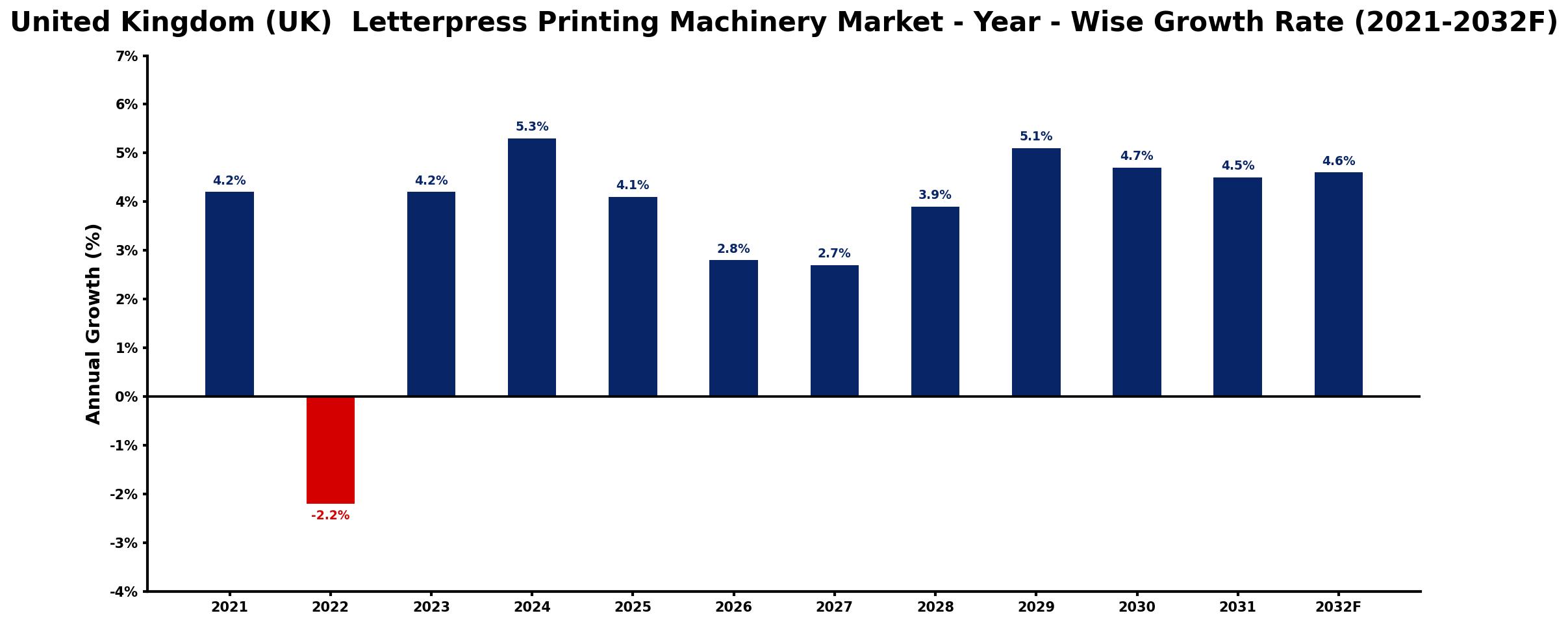
The table below presents the year‑wise growth rates along with the key drivers influencing the market
| Year | Growth Rate | Major Drivers |
| 2021 | 4.2% | Rise in consumer packaging demand |
| 2022 | -2.2% | Decrease in new project investments |
| 2023 | 4.2% | Growth in luxury goods market |
| 2024 | 5.3% | Increase in sustainable practices adoption |
| 2025 | 4.1% | Expansion of small business sector |
| 2026 | 2.8% | Surge in custom design requests |
| 2027 | 2.7% | expanding manufacturing base activity |
| 2028 | 3.9% | growing emerging market penetration |
| 2029 | 5.1% | increased pharmaceutical industry usage |
| 2030 | 4.7% | increased production capacity utilization |
| 2031 | 4.5% | growing regional consumption patterns |
| 2032 | 4.6% | rising procurement volume requirements |
Note: Market size estimations and growth projections presented in this report are based on 6Wresearch's proprietary forecasting methodology, utilizing the latest available industry data, government publications, and primary research inputs.
United Kingdom (UK) Letterpress Printing Machinery Market Synopsis
The UK Letterpress Printing Machinery Market is witnessing a notable revival, driven by an increasing appreciation for traditional printing techniques among consumers and businesses alike. This resurgence is largely attributed to the desire for unique, tactile printed materials that stand apart from the mass-produced offerings of digital printing.
Furthermore, the market is characterized by a growing trend towards vintage and refurbished machinery, reflecting a nostalgia for the craftsmanship inherent in letterpress printing. As the packaging and publishing industries seek innovative ways to stand out, the demand for letterpress technology continues to gain momentum, bolstered by contemporary adaptations that integrate digital elements.
United Kingdom (UK) Letterpress Printing Machinery Market Key Takeaways
- The market is projected to grow from USD 241 Million in 2025 to USD 298 Million by 2032.
- There is a strong interest in eco-friendly printing practices driving investment in sustainable letterpress technologies.
- Technological advancements are facilitating the integration of digital features into traditional letterpress machinery.
- Niche markets such as luxury packaging and personalized products are key growth areas for letterpress printing.
- The appreciation for artisanal techniques is reviving demand for vintage and refurbished letterpress equipment.
Evaluation of Restraints in United Kingdom (UK) Letterpress Printing Machinery Market
Despite the growth opportunities, the UK Letterpress Printing Machinery Market faces significant challenges. The competition from digital printing technologies remains a formidable barrier, given their capacity for faster production times and cost-effective solutions. Additionally, the specialized skills required to operate and maintain letterpress machinery can impose higher operational costs, making it difficult for traditional printers to compete on price and efficiency. Furthermore, a shift in consumer preferences towards digital and offset printing methods is contributing to an overall contraction in demand for letterpress machinery.
United Kingdom (UK) Letterpress Printing Machinery Market Trends
Currently, the UK Letterpress Printing Machinery Market is evolving with several noteworthy trends. The increasing desire for unique and customizable printing solutions has led to a surge in demand for specialty printing services. This is particularly pronounced in the packaging industry, where companies are looking to differentiate their products through high-quality, tactile prints. Furthermore, the integration of digital technologies within traditional letterpress machinery is enabling printers to offer a wider range of services, making it easier to meet diverse customer needs. Sustainability is also a driving force, as businesses seek out printing methods that reduce their environmental footprint.
United Kingdom (UK) Letterpress Printing Machinery Market Opportunities
Investment opportunities in the UK Letterpress Printing Machinery Market are promising, particularly in the realm of personalized printing services. As businesses strive to create unique packaging solutions, the demand for high-quality letterpress machinery is poised to increase. Additionally, the growing focus on sustainability opens doors for innovative printing solutions that utilize eco-friendly materials and processes. Manufacturers that prioritize modernizing their equipment to include these aspects can capitalize on the changing landscape and cater to an environmentally conscious clientele.
Government Initiatives in the United Kingdom (UK) Letterpress Printing Machinery Market
The UK government is actively influencing the Letterpress Printing Machinery Market through various policies aimed at enhancing sustainability and innovation within the manufacturing sector. Initiatives focused on reducing carbon emissions are encouraging businesses to adopt eco-friendly practices. Additionally, government programs that promote research and development in the printing industry are fostering technological advancements. This supportive regulatory environment is expected to play a crucial role in shaping the market's growth dynamics.
Future Insights of the United Kingdom (UK) Letterpress Printing Machinery Market
Looking ahead to 2026-2032, the United Kingdom Letterpress Printing Machinery Market is anticipated to confront ongoing challenges from the prevalence of digital printing solutions. While the demand for traditional letterpress may decline overall, niche opportunities in specialized sectors such as luxury goods and artisanal prints are likely to sustain interest in this craft. As printers adapt by innovating their offerings and targeting discerning customer segments, the market may stabilize, allowing for sustainable growth despite the competition from more efficient printing technologies.
United Kingdom (UK) Letterpress Printing Machinery Market Latest Developments (2025 - 2026)
In recent months, the letterpress printing sector in the UK has been observing a wave of modernization initiatives. Companies are investing in hybrid printing technologies that combine traditional methods with digital capabilities to enhance efficiency and expand their service offerings. Furthermore, there has been an uptick in partnerships between artisans and technology firms aimed at reviving classic printing techniques while incorporating contemporary innovations, reflecting a broader trend towards bespoke and high-quality printed materials.
United Kingdom (UK) Letterpress Printing Machinery Market - Key Attractiveness of the Report
- 10 Years of Market Numbers
- Historical Data Starting from 2022 to 2025
- Base Year: 2025
- Forecast Data until 2032
- Key Performance Indicators Impacting the Market
- Major Upcoming Developments and Projects
Key Highlights of the Report:
- United Kingdom (UK) Letterpress Printing Machinery Market Outlook
- Market Size of United Kingdom (UK) Letterpress Printing Machinery Market, 2025
- Forecast of United Kingdom (UK) Letterpress Printing Machinery Market, 2032
- Historical Data and Forecast of United Kingdom (UK) Letterpress Printing Machinery Revenues & Volume for the Period 2022-2032F
- United Kingdom (UK) Letterpress Printing Machinery Market Trend Evolution
- United Kingdom (UK) Letterpress Printing Machinery Market Drivers and Challenges
- United Kingdom (UK) Letterpress Printing Machinery Price Trends
- United Kingdom (UK) Letterpress Printing Machinery Porter's Five Forces
- United Kingdom (UK) Letterpress Printing Machinery Industry Life Cycle
- Historical Data and Forecast of United Kingdom (UK) Letterpress Printing Machinery Market Revenues & Volume By Type for the Period 2022-2032F
- Historical Data and Forecast of United Kingdom (UK) Letterpress Printing Machinery Market Revenues & Volume By Rotary Letterpress Machine for the Period 2022-2032F
- Historical Data and Forecast of United Kingdom (UK) Letterpress Printing Machinery Market Revenues & Volume By Other for the Period 2022-2032F
- Historical Data and Forecast of United Kingdom (UK) Letterpress Printing Machinery Market Revenues & Volume By Application for the Period 2022-2032F
- Historical Data and Forecast of United Kingdom (UK) Letterpress Printing Machinery Market Revenues & Volume By Securities for the Period 2022-2032F
- Historical Data and Forecast of United Kingdom (UK) Letterpress Printing Machinery Market Revenues & Volume By Invitation Card for the Period 2022-2032F
- Historical Data and Forecast of United Kingdom (UK) Letterpress Printing Machinery Market Revenues & Volume By Other for the Period 2022-2032F
- United Kingdom (UK) Letterpress Printing Machinery Import Export Trade Statistics
- Market Opportunity Assessment By Type
- Market Opportunity Assessment By Application
- United Kingdom (UK) Letterpress Printing Machinery Top Companies Market Share
- United Kingdom (UK) Letterpress Printing Machinery Competitive Benchmarking By Technical and Operational Parameters
- United Kingdom (UK) Letterpress Printing Machinery Company Profiles
- United Kingdom (UK) Letterpress Printing Machinery Key Strategic Recommendations






































