United Kingdom (UK) Medical Imaging Equipment Market Summary
The united kingdom (uk) medical imaging equipment market was estimated at USD 263 Million in 2025 and is projected to reach USD 325 Million by 2032, growing at a CAGR of 2.4% from 2026 to 2032.
United Kingdom (UK) Medical Imaging Equipment Market Year-wise Growth Rate and Key Drivers
This graph highlights how the United Kingdom (UK) Medical Imaging Equipment Market has steadily grown over the past five years, supported by major growth factors.
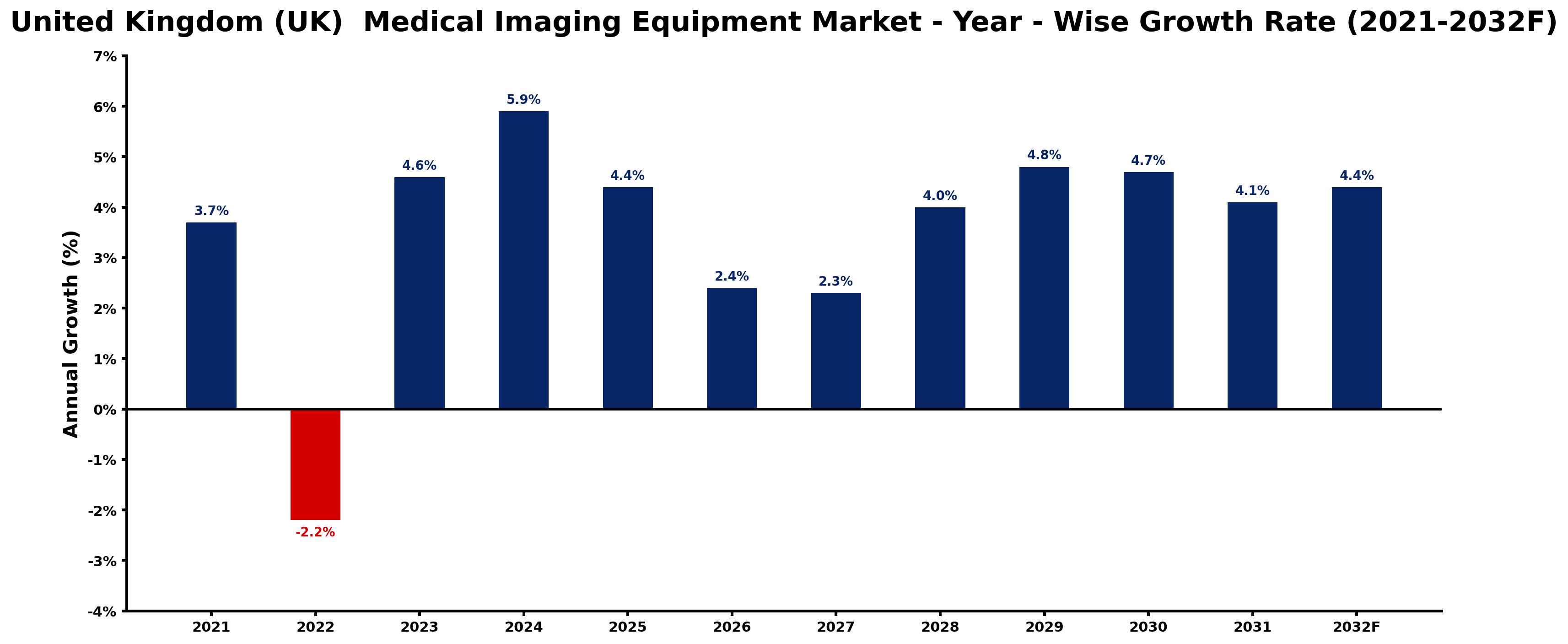
The table below presents the year wise growth rates along with the key drivers influencing the market
| Year | Growth Rate | Major Drivers |
| 2021 | 3.7% | Healthcare facilities invest in modern imaging technologies for enhanced diagnostic capabilities. |
| 2022 | -2.2% | Increased budget constraints within the National Health Service led to reduced investment in medical imaging technologies. |
| 2023 | 4.6% | Increased prevalence of chronic diseases boosts demand for advanced imaging solutions. |
| 2024 | 5.9% | Healthcare budgets expand to accommodate necessary upgrades in diagnostic imaging equipment. |
| 2025 | 4.4% | Collaboration between technology firms and hospitals drives innovative imaging solutions forward. |
| 2026 | 2.4% | Shift towards outpatient care models increases requirement for portable imaging devices. |
| 2027 | 2.3% | Integration of telemedicine encourages remote imaging consultations and analyses effectively. |
| 2028 | 4.0% | Medical research centers focus on advanced imaging techniques for better treatment outcomes. |
| 2029 | 4.8% | Emerging health tech startups introduce disruptive imaging technologies and products continually. |
| 2030 | 4.7% | Population aging spurs demand for imaging solutions tailored for geriatric care facilities. |
| 2031 | 4.1% | Increased public awareness of preventive healthcare elevates imaging service utilization rates. |
| 2032 | 4.4% | Sustainability trends lead to eco-friendly imaging equipment adoption across healthcare systems. |
Note - Market size estimations and growth projections presented in this report are based on 6Wresearch's advanced forecasting approach, validated with industry datasets as of June 2026.
United Kingdom (UK) Medical Imaging Equipment Market Synopsis
The United Kingdom (UK) Medical Imaging Equipment Market is projected to reach 2.4% and witness significant growth during the forecast period (2026-2032). This market encompasses a diverse array of imaging modalities, including X-ray, MRI, CT, ultrasound, and nuclear medicine, which collectively contribute to precise diagnostics and effective patient care. With increasing technological advancements and a mounting prevalence of chronic diseases, the demand for innovative imaging solutions is set to rise, supported by investments from both public and private healthcare sectors.
United Kingdom (UK) Medical Imaging Equipment Market Growth Drivers
Several factors are driving the growth of the United Kingdom (UK) Medical Imaging Equipment Market. Firstly, the rising incidence of chronic diseases, such as cardiovascular conditions and cancer, necessitates advanced diagnostic imaging technologies for early detection and effective treatment planning. Secondly, continuous advancements in imaging modalities, including enhanced resolution and decreased scan times, contribute to the adoption of sophisticated equipment in clinical settings. Thirdly, an expanding elderly population demands more frequent imaging services, further escalating market requirements. Moreover, the integration of artificial intelligence (AI) and machine learning into imaging systems enhances diagnostic accuracy and workflow efficiency. Lastly, the increasing preference for non-invasive diagnostic procedures promotes the use of advanced imaging technologies, driving market expansion.
United Kingdom (UK) Medical Imaging Equipment Market Trends and Opportunities
The United Kingdom (UK) Medical Imaging Equipment Market is experiencing transformative trends that delineate its future trajectory. Key trends include:
- Growing demand for portable imaging equipment is reshaping the market landscape, making diagnostic technologies accessible in various healthcare settings, including rural areas and emergency situations.
- Increased integration of telemedicine solutions enables remote consultations and diagnostics, especially vital during the COVID-19 pandemic recovery, allowing healthcare professionals to reach patients in diverse locations.
- The ongoing trend towards cost-effective imaging solutions is prompting innovation in imaging technologies designed to cater to budget-constrained healthcare facilities.
- The rise of personalized medicine is leading to a burgeoning demand for advanced imaging modalities that can offer tailored diagnostics, enhancing treatment outcomes.
- Sustainable imaging practices are increasingly prioritized, with a focus on reducing the environmental impact of medical imaging technologies through energy-efficient designs.
United Kingdom (UK) Medical Imaging Equipment Market Challenges and Restraints
The United Kingdom (UK) Medical Imaging Equipment Market faces various challenges that stakeholders must navigate. Chief among these are:
- Technological advancements necessitate continuous capital investment from healthcare providers to upgrade obsolete systems, creating pressure on limited budgets.
- Regulatory compliance presents additional complexities for manufacturers and healthcare facilities, requiring adherence to stringent safety and quality standards.
- The shortage of skilled professionals to operate and maintain sophisticated imaging systems compounds the difficulty of integrating new technologies into clinical practice.
- Competition among healthcare facilities for funding and resources can impede the timely adoption of state-of-the-art imaging technologies.
- Economic fluctuations and funding cuts in the healthcare sector can challenge providers' ability to invest in new equipment and technologies.
United Kingdom (UK) Medical Imaging Equipment Market Investment Opportunities
The United Kingdom (UK) Medical Imaging Equipment Market presents various investment opportunities driven by market dynamics and healthcare trends. Potential areas for investment include:
- Development of advanced diagnostic imaging equipment that caters to the clinical need for early disease detection and effective treatment planning.
- Innovative imaging solutions such as AI-driven imaging tools that enhance accuracy and streamline clinical workflows are gaining traction, making them attractive for investors.
- Investments in companies specializing in the fabrication and distribution of portable imaging devices signify a strategic avenue given the demand for increased accessibility.
- Public-private partnerships are essential for driving market penetration and expansion, particularly in underserved regions.
- Research and development initiatives for the next generation of imaging technologies can leverage government funding and incentives, providing a solid basis for investment.
United Kingdom (UK) Medical Imaging Equipment Market Government Investment and Initiatives
The United Kingdom's government actively implements policies and initiatives that fundamentally affect the Medical Imaging Equipment Market. The National Health Service (NHS) Long Term Plan seeks to enhance access to diagnostic services, particularly medical imaging, thereby improving healthcare outcomes for patients. This plan aligns with increasing public investment in healthcare infrastructure, including the procurement and upgrade of imaging equipment.
In conjunction with forward-looking policies, the Medicines and Healthcare products Regulatory Agency (MHRA) plays a critical role in overseeing the safety and quality of medical devices, ensuring compliance with stringent regulations. Such regulatory frameworks not only promote patient safety but also facilitate the collaboration between manufacturers and healthcare providers.
Additionally, through organizations like Innovate UK, funding is allocated to advance research and innovation in medical imaging technology, bolstering the sector's development. However, uncertainty stemming from Brexit poses challenges in the regulatory landscape for medical devices, compelling stakeholders to adapt to new guidelines swiftly.
United Kingdom (UK) Medical Imaging Equipment Market Latest Developments (May 2025 - June 2026)
In the recent industry landscape from May 2025 to June 2026, the United Kingdom (UK) Medical Imaging Equipment Market has demonstrated significant shifts in focus towards innovative technologies. Advancements in AI and machine learning are leading to the development of intelligent imaging systems, which enhance diagnostic capability and operational efficiency in healthcare settings. Moreover, the demand for point-of-care imaging solutions is rising, driven by the need for efficiency and rapid diagnostics in various medical situations.
The adoption of telemedicine has continued to grow, reflecting the ongoing need for remote healthcare solutions. In tandem, partnerships between technology developers and healthcare providers have become more common, aiming to integrate new imaging technologies into existing healthcare systems seamlessly. This collaboration is critical for enhancing accessibility and ensuring that advanced imaging capabilities meet the needs of healthcare professionals and patients alike.
United Kingdom (UK) Medical Imaging Equipment Market - Key Attractiveness of the Report
- 10 Years of Market Numbers
- Historical Data Starting from 2022 to 2025
- Base Year: 2025
- Forecast Data until 2032
- Key Performance Indicators Impacting the Market
- Major Upcoming Developments and Projects
Key Highlights of the Report:
- United Kingdom (UK) Medical Imaging Equipment Market Outlook
- Market Size of United Kingdom (UK) Medical Imaging Equipment Market, 2025
- Forecast of United Kingdom (UK) Medical Imaging Equipment Market, 2032F
- Historical Data and Forecast of United Kingdom (UK) Medical Imaging Equipment Revenues & Volume for the Period 2022-2032F
- United Kingdom (UK) Medical Imaging Equipment Market Trend Evolution
- United Kingdom (UK) Medical Imaging Equipment Market Drivers and Challenges
- United Kingdom (UK) Medical Imaging Equipment Price Trends
- United Kingdom (UK) Medical Imaging Equipment Porter's Five Forces
- United Kingdom (UK) Medical Imaging Equipment Industry Life Cycle
- Historical Data and Forecast of United Kingdom (UK) Medical Imaging Equipment Market Revenues & Volume By Product Type for the Period 2022-2032F
- Historical Data and Forecast of United Kingdom (UK) Medical Imaging Equipment Market Revenues & Volume By Magnetic resonance imaging equipment for the Period 2022-2032F
- Historical Data and Forecast of United Kingdom (UK) Medical Imaging Equipment Market Revenues & Volume By Compound tomography equipment for the Period 2022-2032F
- Historical Data and Forecast of United Kingdom (UK) Medical Imaging Equipment Market Revenues & Volume By X-ray equipment for the Period 2022-2032F
- Historical Data and Forecast of United Kingdom (UK) Medical Imaging Equipment Market Revenues & Volume By Ultrasound equipment for the Period 2022-2032F
- Historical Data and Forecast of United Kingdom (UK) Medical Imaging Equipment Market Revenues & Volume By Molecular equipment for the Period 2022-2032F
- Historical Data and Forecast of United Kingdom (UK) Medical Imaging Equipment Market Revenues & Volume By Application for the Period 2022-2032F
- Historical Data and Forecast of United Kingdom (UK) Medical Imaging Equipment Market Revenues & Volume By Cardiology for the Period 2022-2032F
- Historical Data and Forecast of United Kingdom (UK) Medical Imaging Equipment Market Revenues & Volume By Neurology for the Period 2022-2032F
- Historical Data and Forecast of United Kingdom (UK) Medical Imaging Equipment Market Revenues & Volume By Orthopedics for the Period 2022-2032F
- Historical Data and Forecast of United Kingdom (UK) Medical Imaging Equipment Market Revenues & Volume By Gynecology for the Period 2022-2032F
- Historical Data and Forecast of United Kingdom (UK) Medical Imaging Equipment Market Revenues & Volume By Oncology for the Period 2022-2032F
- Historical Data and Forecast of United Kingdom (UK) Medical Imaging Equipment Market Revenues & Volume By Others for the Period 2022-2032F
- Historical Data and Forecast of United Kingdom (UK) Medical Imaging Equipment Market Revenues & Volume By End user for the Period 2022-2032F
- Historical Data and Forecast of United Kingdom (UK) Medical Imaging Equipment Market Revenues & Volume By Hospitals for the Period 2022-2032F
- Historical Data and Forecast of United Kingdom (UK) Medical Imaging Equipment Market Revenues & Volume By Specialty clinics for the Period 2022-2032F
- Historical Data and Forecast of United Kingdom (UK) Medical Imaging Equipment Market Revenues & Volume By Diagnostic imaging centers for the Period 2022-2032F
- Historical Data and Forecast of United Kingdom (UK) Medical Imaging Equipment Market Revenues & Volume By Others for the Period 2022-2032F
- United Kingdom (UK) Medical Imaging Equipment Import Export Trade Statistics
- Market Opportunity Assessment By Product Type
- Market Opportunity Assessment By Application
- Market Opportunity Assessment By End user
- United Kingdom (UK) Medical Imaging Equipment Top Companies Market Share
- United Kingdom (UK) Medical Imaging Equipment Competitive Benchmarking By Technical and Operational Parameters
- United Kingdom (UK) Medical Imaging Equipment Company Profiles
- United Kingdom (UK) Medical Imaging Equipment Key Strategic Recommendations






































