United Kingdom (UK) Medical Tubing Market Size, Share & Growth Rate
The United Kingdom (UK) Medical Tubing Market was estimated at USD 488 Million in 2025 and is projected to reach USD 605 Million by 2032, growing at a CAGR of 3.1% from 2026 to 2032. This growth trajectory is significantly driven by an aging population that necessitates increased healthcare interventions and the rising prevalence of chronic diseases. Furthermore, advancements in medical technologies, particularly those facilitating minimally invasive procedures, are further amplifying the demand for innovative medical tubing solutions.
United Kingdom (UK) Medical Tubing Market Year-wise Growth Rate and Key Drivers
This graph highlights how the United Kingdom (UK) Medical Tubing Market has steadily grown over the years, supported by major growth factors.
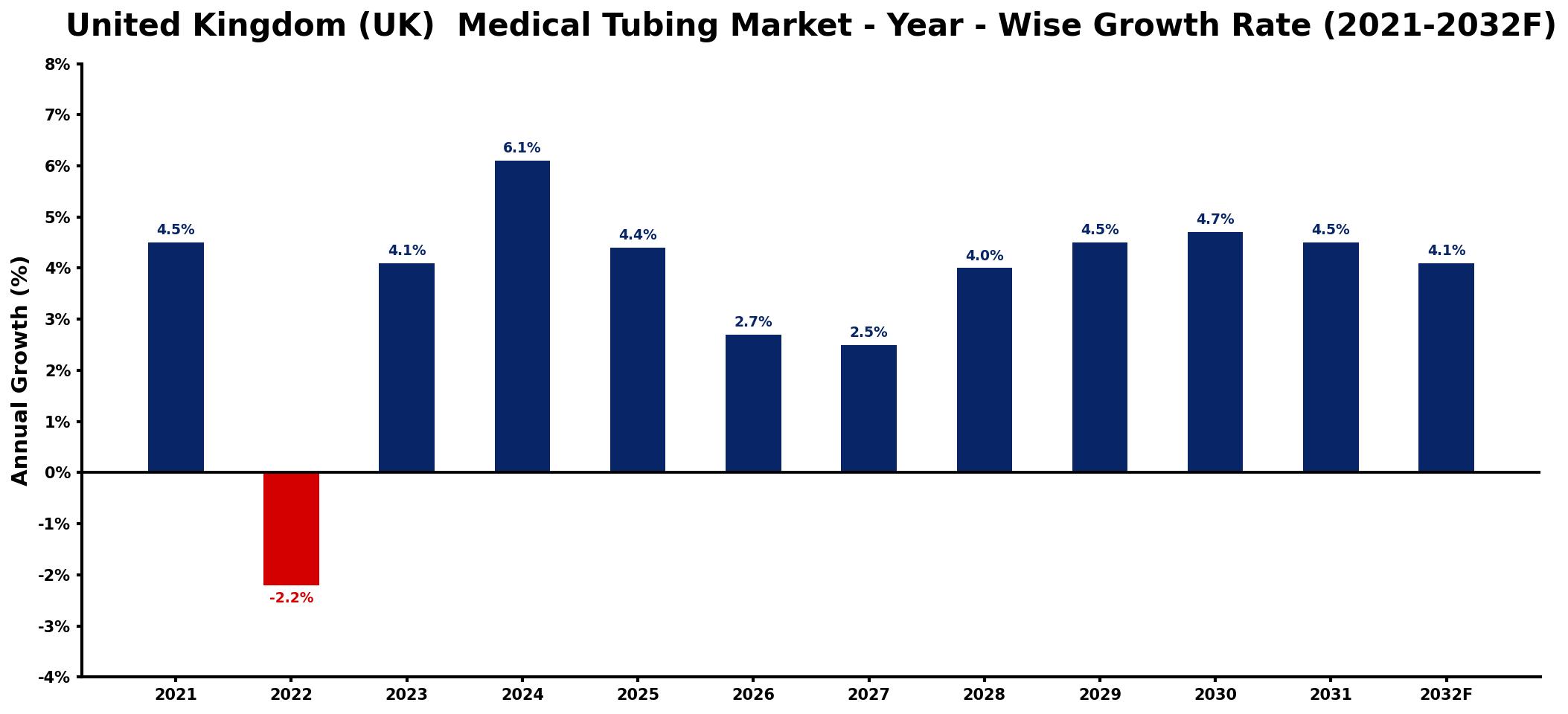
The table below presents the year‑wise growth rates along with the key drivers influencing the market
| Year | Growth Rate | Major Drivers |
| 2021 | 4.5% | Rising healthcare infrastructure investments |
| 2022 | -2.2% | Decreased demand from hospitals |
| 2023 | 4.1% | Expansion of health tech startups |
| 2024 | 6.1% | Increased patient population growth |
| 2025 | 4.4% | Surge in outpatient procedures |
| 2026 | 2.7% | Innovations in healthcare delivery |
| 2027 | 2.5% | Growing preference for disposables |
| 2028 | 4.0% | Rising demand for home care |
| 2029 | 4.5% | Enhanced regulatory compliance standards |
| 2030 | 4.7% | Technological advancements in devices |
| 2031 | 4.5% | Increased focus on sustainability |
| 2032 | 4.1% | Growth in personalized medicine applications |
Note: Market size estimations and growth projections presented in this report are based on 6Wresearch's proprietary forecasting methodology, utilizing the latest available industry data, government publications, and primary research inputs.
United Kingdom (UK) Medical Tubing Market Synopsis
The UK medical tubing market has recently gained momentum thanks to rapid advancements in healthcare technologies and an increasing number of chronic health conditions requiring ongoing medical treatment. As the healthcare landscape evolves, the market is expected to embrace greater innovation and customization, aligning closely with patient needs and regulatory standards.
Looking ahead, the market is poised for robust growth, supported by a rise in minimally invasive procedures and the introduction of new materials that enhance biocompatibility and performance. As manufacturers adapt to changing regulations and strive for sustainability, the UK medical tubing market is set to advance toward a future that prioritizes patient safety and product efficacy.
United Kingdom (UK) Medical Tubing Market Key Takeaways
- The UK medical tubing market is projected to grow at a CAGR of 3.1%, reaching USD 605 million by 2032.
- Key drivers include an aging population and a surge in chronic diseases requiring extensive medical interventions.
- Innovation in tubing materials focusing on biocompatibility and flexibility is vital for market growth.
- Minimally invasive procedures are significantly influencing market demand, leading to more intricate designs.
- Sustainability is emerging as a crucial focus, with eco-friendly materials gaining traction in product development.
Evaluation of Restraints in United Kingdom (UK) Medical Tubing Market
The growth of the UK medical tubing market is hindered by several restraints, notably stringent regulatory requirements that manufacturers must navigate to ensure compliance and patient safety. The competitive landscape is increasingly crowded, with many players offering similar products, intensifying price wars and squeezing margins. Furthermore, the volatility of raw material prices poses a continual challenge, impacting production costs and, consequently, the profitability of manufacturers. Adapting to evolving healthcare demands through continuous innovation is essential, yet represents a significant operational burden for companies striving to stay ahead in the market.
United Kingdom (UK) Medical Tubing Market Trends
Several trends are shaping the UK medical tubing market, including a clear shift towards the use of specialized materials that enhance performance, such as improved flexibility and chemical resistance. The increasing adoption of minimally invasive surgical techniques necessitates smaller and more intricate tubing designs, pushing manufacturers to innovate rapidly. Moreover, technological advancements, including 3D printing and automation in production processes, are allowing for greater customization in medical tubing. Sustainability also plays a pivotal role as manufacturers explore eco-friendly materials to meet growing environmental concerns.
United Kingdom (UK) Medical Tubing Market Opportunities
Investment opportunities in the UK medical tubing market abound, particularly in the development of advanced materials tailored for various applications, such as drug delivery systems and diagnostic equipment. There is a strong need for innovative solutions that meet not just regulatory compliance but also the evolving preferences of healthcare providers and patients. Expanding production capabilities to accommodate the increasing demand driven by personalized medicine and wearable devices represents another lucrative avenue for growth. By harnessing research and development efforts, companies can create next-generation tubing solutions that enhance overall patient outcomes.
Government Initiatives in the United Kingdom (UK) Medical Tubing Market
The UK government plays an influential role in the medical tubing market through policies that prioritize safety, quality, and compliance in medical device manufacturing. Regulatory bodies such as the Medicines and Healthcare products Regulatory Agency (MHRA) ensure that strict standards are met, reinforcing the importance of patient safety. Furthermore, the government encourages innovation in the sector, supporting research and development initiatives aimed at improving patient care and reducing environmental impacts through sustainable practices. Recent shifts in regulatory frameworks due to Brexit also necessitate that businesses adapt to new compliance landscapes.
Future Insights of the United Kingdom (UK) Medical Tubing Market
The outlook for the UK medical tubing market through 2026-2032 remains optimistic, driven by technological advancements and an increasing demand for sophisticated medical devices. As healthcare providers continue to embrace minimally invasive surgical techniques, the need for innovative and high-performance medical tubing will likely rise. The integration of personalized medicine into treatment protocols will further propel the demand for customized solutions that cater to specific patient requirements. While regulatory challenges may persist, the overall growth trajectory suggests a robust evolution of the market, emphasizing innovation, quality, and sustainability.
United Kingdom (UK) Medical Tubing Market Latest Developments (2025 - 2026)
In recent months, the UK medical tubing market has seen a shift towards integrating digital technologies in manufacturing processes. Companies are increasingly leveraging automation and data analytics to streamline production and improve quality control. There has been a notable increase in collaborative efforts among manufacturers and research institutions aimed at developing eco-friendly materials. Additionally, industry players are responding to market demands by enhancing their product lines with customized tubing solutions for specialized medical applications.
United Kingdom (UK) Medical Tubing Market - Key Attractiveness of the Report
- 10 Years of Market Numbers
- Historical Data Starting from 2022 to 2025
- Base Year: 2025
- Forecast Data until 2032
- Key Performance Indicators Impacting the Market
- Major Upcoming Developments and Projects
Key Highlights of the Report:
- United Kingdom (UK) Medical Tubing Market Outlook
- Market Size of United Kingdom (UK) Medical Tubing Market, 2025
- Forecast of United Kingdom (UK) Medical Tubing Market, 2032
- Historical Data and Forecast of United Kingdom (UK) Medical Tubing Revenues & Volume for the Period 2022-2032F
- United Kingdom (UK) Medical Tubing Market Trend Evolution
- United Kingdom (UK) Medical Tubing Market Drivers and Challenges
- United Kingdom (UK) Medical Tubing Price Trends
- United Kingdom (UK) Medical Tubing Porter's Five Forces
- United Kingdom (UK) Medical Tubing Industry Life Cycle
- Historical Data and Forecast of United Kingdom (UK) Medical Tubing Market Revenues & Volume By Material for the Period 2022-2032F
- Historical Data and Forecast of United Kingdom (UK) Medical Tubing Market Revenues & Volume By Plastics for the Period 2022-2032F
- Historical Data and Forecast of United Kingdom (UK) Medical Tubing Market Revenues & Volume By Rubbers for the Period 2022-2032F
- Historical Data and Forecast of United Kingdom (UK) Medical Tubing Market Revenues & Volume By Specialty Polymers for the Period 2022-2032F
- Historical Data and Forecast of United Kingdom (UK) Medical Tubing Market Revenues & Volume By Structure for the Period 2022-2032F
- Historical Data and Forecast of United Kingdom (UK) Medical Tubing Market Revenues & Volume By Single-lumen for the Period 2022-2032F
- Historical Data and Forecast of United Kingdom (UK) Medical Tubing Market Revenues & Volume By Co-extruded for the Period 2022-2032F
- Historical Data and Forecast of United Kingdom (UK) Medical Tubing Market Revenues & Volume By Multi-lumen for the Period 2022-2032F
- Historical Data and Forecast of United Kingdom (UK) Medical Tubing Market Revenues & Volume By Tapered Or Bump Tubing for the Period 2022-2032F
- Historical Data and Forecast of United Kingdom (UK) Medical Tubing Market Revenues & Volume By Braided Tubing for the Period 2022-2032F
- Historical Data and Forecast of United Kingdom (UK) Medical Tubing Market Revenues & Volume By Application for the Period 2022-2032F
- Historical Data and Forecast of United Kingdom (UK) Medical Tubing Market Revenues & Volume By Bulk Disposable Tubing for the Period 2022-2032F
- Historical Data and Forecast of United Kingdom (UK) Medical Tubing Market Revenues & Volume By Catheters & Cannulas for the Period 2022-2032F
- Historical Data and Forecast of United Kingdom (UK) Medical Tubing Market Revenues & Volume By Drug Delivery System for the Period 2022-2032F
- Historical Data and Forecast of United Kingdom (UK) Medical Tubing Market Revenues & Volume By Special Applications for the Period 2022-2032F
- United Kingdom (UK) Medical Tubing Import Export Trade Statistics
- Market Opportunity Assessment By Material
- Market Opportunity Assessment By Structure
- Market Opportunity Assessment By Application
- United Kingdom (UK) Medical Tubing Top Companies Market Share
- United Kingdom (UK) Medical Tubing Competitive Benchmarking By Technical and Operational Parameters
- United Kingdom (UK) Medical Tubing Company Profiles
- United Kingdom (UK) Medical Tubing Key Strategic Recommendations






































