United Kingdom (UK) Military Radar Market Size, Share & Growth Rate
The United Kingdom (UK) Military Radar Market was estimated at USD 172 Million in 2025 and is projected to reach USD 212 Million by 2032, growing at a CAGR of 3.0% from 2026 to 2032. This anticipated growth is largely fueled by the UK's commitment to modernizing its air defense systems, reflecting the increasing demand for advanced radar technologies such as AESA and phased array radar. Additionally, the rising applications in surveillance and missile guidance further underscore the market's upward trajectory.
United Kingdom (UK) Military Radar Market Year-wise Growth Rate and Key Drivers
This graph highlights how the United Kingdom (UK) Military Radar Market has steadily grown over the years, supported by major growth factors.
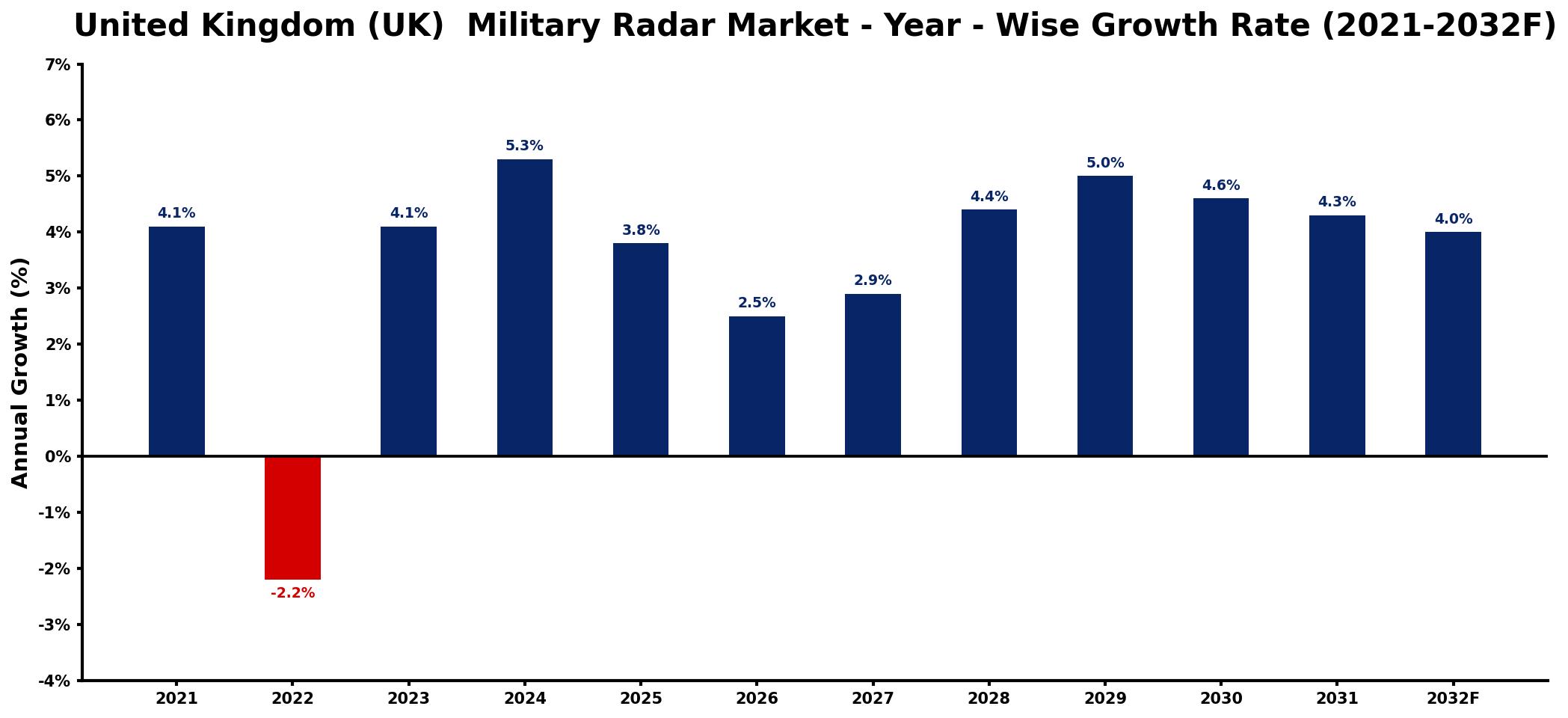
The table below presents the year‑wise growth rates along with the key drivers influencing the market
| Year | Growth Rate | Major Drivers |
| 2021 | 4.1% | expanding manufacturing base activity |
| 2022 | -2.2% | Decreased procurement of systems |
| 2023 | 4.1% | Heightened international security concerns |
| 2024 | 5.3% | Expansion of defense partnerships |
| 2025 | 3.8% | Growth in technology investments |
| 2026 | 2.5% | Rising demand for advanced applications |
| 2027 | 2.9% | Strengthened national defense strategies |
| 2028 | 4.4% | Surge in modernization efforts |
| 2029 | 5.0% | Increased focus on cybersecurity integration |
| 2030 | 4.6% | Wider adoption of innovative technologies |
| 2031 | 4.3% | Enhanced collaboration with allies |
| 2032 | 4.0% | Growing emphasis on defense readiness |
Note: Market size estimations and growth projections presented in this report are based on 6Wresearch's proprietary forecasting methodology, utilizing the latest available industry data, government publications, and primary research inputs.
United Kingdom (UK) Military Radar Market Synopsis
The UK military radar market is witnessing a significant shift towards multi-function radar systems that enhance situational awareness. This transition is driven by the need to address evolving threat environments and the integration of radar networks within modern defense strategies.
Moreover, investments in radar technology are reflecting the UK governments focus on strengthening defense capabilities. Advanced signal processing algorithms and radar cross-section reduction techniques are becoming essential components in enhancing the performance and resilience of military radar systems.
United Kingdom (UK) Military Radar Market Key Takeaways
- Modernization efforts are a primary driver, emphasizing the integration of advanced radar technologies.
- The market is influenced by the necessity for enhanced surveillance and target tracking capabilities.
- Government regulations are shaping the development and deployment of radar systems.
- Investments in network-centric warfare concepts are pushing the demand for multifunctional radar solutions.
- Emerging technologies are critical in overcoming challenges posed by electronic countermeasures.
Evaluation of Restraints in United Kingdom (UK) Military Radar Market
Despite the positive growth trajectory, the UK military radar market faces significant challenges, particularly in advancing sensor capabilities and signal processing techniques. The pace of technological advancements must keep up with the rapidly evolving threat landscapes, necessitating continuous upgrades. Moreover, the complexity of implementing radar systems that can effectively counter electronic warfare tactics adds layers of difficulty. Companies must navigate these constraints to maintain competitiveness while meeting stringent government standards.
United Kingdom (UK) Military Radar Market Trends
A key trend is the shift towards integrated sensor networks, which enhance operational capabilities through real-time data sharing and analysis. Moreover, the development of phased array radar systems is becoming increasingly prominent, providing agility in target tracking and improved detection ranges. Additionally, there is a growing emphasis on the use of artificial intelligence and machine learning to enhance radar functionalities and improve decision-making processes in dynamic environments.
United Kingdom (UK) Military Radar Market Opportunities
The convergence of emerging technologies presents numerous opportunities for growth in the UK military radar market. Investments aimed at developing next-generation radar systems that can operate seamlessly within integrated defense networks are likely to yield significant returns. Furthermore, as international defense collaborations expand, opportunities for technology sharing and joint development initiatives can further strengthen the UKs position within the global radar market.
Government Initiatives in the United Kingdom (UK) Military Radar Market
The UK government is actively pursuing initiatives to bolster defense capabilities, which include regulations focusing on performance standards for radar systems. Public spending is increasingly directed towards advanced radar technologies to ensure that the military can maintain a strategic edge. The governments commitment to electromagnetic spectrum management plays a critical role in shaping the market dynamics and ensuring effective deployment of radar systems.
Future Insights of the United Kingdom (UK) Military Radar Market
Looking ahead to 2026-2032, the UK military radar market is poised for considerable advancements fueled by technological innovation and strategic defense initiatives. The ongoing emphasis on multi-functional systems will likely drive new developments in radar technology. Furthermore, the focus on network-centric warfare will continue to shape market dynamics as the UK adapts to emerging threats and strives for operational superiority in varied environments.
United Kingdom (UK) Military Radar Market Latest Developments (2025 - 2026)
In recent months, the UK military radar sector has seen significant momentum with advancements in phased array technology, which enhance detection capabilities and responsiveness. Additionally, there is a marked increase in collaborative projects aimed at integrating radar systems with other defense platforms, reflecting a broader trend towards joint military operations. This alignment with evolving defense strategies underscores the importance of adaptability in the face of changing security demands.
United Kingdom (UK) Military Radar Market - Key Attractiveness of the Report
- 10 Years of Market Numbers
- Historical Data Starting from 2022 to 2025
- Base Year: 2025
- Forecast Data until 2032
- Key Performance Indicators Impacting the Market
- Major Upcoming Developments and Projects
Key Highlights of the Report:
- United Kingdom (UK) Military Radar Market Outlook
- Market Size of United Kingdom (UK) Military Radar Market, 2025
- Forecast of United Kingdom (UK) Military Radar Market, 2032
- Historical Data and Forecast of United Kingdom (UK) Military Radar Revenues & Volume for the Period 2022-2032F
- United Kingdom (UK) Military Radar Market Trend Evolution
- United Kingdom (UK) Military Radar Market Drivers and Challenges
- United Kingdom (UK) Military Radar Price Trends
- United Kingdom (UK) Military Radar Porter's Five Forces
- United Kingdom (UK) Military Radar Industry Life Cycle
- Historical Data and Forecast of United Kingdom (UK) Military Radar Market Revenues & Volume By Platform for the Period 2022-2032F
- Historical Data and Forecast of United Kingdom (UK) Military Radar Market Revenues & Volume By Airborne Radar for the Period 2022-2032F
- Historical Data and Forecast of United Kingdom (UK) Military Radar Market Revenues & Volume By Land Radar for the Period 2022-2032F
- Historical Data and Forecast of United Kingdom (UK) Military Radar Market Revenues & Volume By Naval Radar for the Period 2022-2032F
- Historical Data and Forecast of United Kingdom (UK) Military Radar Market Revenues & Volume By Range for the Period 2022-2032F
- Historical Data and Forecast of United Kingdom (UK) Military Radar Market Revenues & Volume By Long for the Period 2022-2032F
- Historical Data and Forecast of United Kingdom (UK) Military Radar Market Revenues & Volume By Medium for the Period 2022-2032F
- Historical Data and Forecast of United Kingdom (UK) Military Radar Market Revenues & Volume By Short for the Period 2022-2032F
- Historical Data and Forecast of United Kingdom (UK) Military Radar Market Revenues & Volume By Very Short for the Period 2022-2032F
- Historical Data and Forecast of United Kingdom (UK) Military Radar Market Revenues & Volume By Application for the Period 2022-2032F
- Historical Data and Forecast of United Kingdom (UK) Military Radar Market Revenues & Volume By Weapon Guidance for the Period 2022-2032F
- Historical Data and Forecast of United Kingdom (UK) Military Radar Market Revenues & Volume By Airspace Monitoring & Traffic Management for the Period 2022-2032F
- Historical Data and Forecast of United Kingdom (UK) Military Radar Market Revenues & Volume By Airborne Mapping for the Period 2022-2032F
- Historical Data and Forecast of United Kingdom (UK) Military Radar Market Revenues & Volume By Ground Surveillance & Intruder Detection for the Period 2022-2032F
- Historical Data and Forecast of United Kingdom (UK) Military Radar Market Revenues & Volume By Navigation for the Period 2022-2032F
- Historical Data and Forecast of United Kingdom (UK) Military Radar Market Revenues & Volume By Others for the Period 2022-2032F
- Historical Data and Forecast of United Kingdom (UK) Military Radar Market Revenues & Volume By Frequency for the Period 2022-2032F
- Historical Data and Forecast of United Kingdom (UK) Military Radar Market Revenues & Volume By C-Band for the Period 2022-2032F
- Historical Data and Forecast of United Kingdom (UK) Military Radar Market Revenues & Volume By S-Band for the Period 2022-2032F
- Historical Data and Forecast of United Kingdom (UK) Military Radar Market Revenues & Volume By X-Band for the Period 2022-2032F
- Historical Data and Forecast of United Kingdom (UK) Military Radar Market Revenues & Volume By L-Band for the Period 2022-2032F
- Historical Data and Forecast of United Kingdom (UK) Military Radar Market Revenues & Volume By UHF/VHF for the Period 2022-2032F
- Historical Data and Forecast of United Kingdom (UK) Military Radar Market Revenues & Volume By Ku/K/Ka-Band for the Period 2022-2032F
- Historical Data and Forecast of United Kingdom (UK) Military Radar Market Revenues & Volume By Component for the Period 2022-2032F
- Historical Data and Forecast of United Kingdom (UK) Military Radar Market Revenues & Volume By Transmitter for the Period 2022-2032F
- Historical Data and Forecast of United Kingdom (UK) Military Radar Market Revenues & Volume By Antenna for the Period 2022-2032F
- Historical Data and Forecast of United Kingdom (UK) Military Radar Market Revenues & Volume By Receiver for the Period 2022-2032F
- Historical Data and Forecast of United Kingdom (UK) Military Radar Market Revenues & Volume By Duplexer for the Period 2022-2032F
- Historical Data and Forecast of United Kingdom (UK) Military Radar Market Revenues & Volume By Others for the Period 2022-2032F
- United Kingdom (UK) Military Radar Import Export Trade Statistics
- Market Opportunity Assessment By Platform
- Market Opportunity Assessment By Range
- Market Opportunity Assessment By Application
- Market Opportunity Assessment By Frequency
- Market Opportunity Assessment By Component
- United Kingdom (UK) Military Radar Top Companies Market Share
- United Kingdom (UK) Military Radar Competitive Benchmarking By Technical and Operational Parameters
- United Kingdom (UK) Military Radar Company Profiles
- United Kingdom (UK) Military Radar Key Strategic Recommendations






































