United Kingdom (UK) Pneumatic Equipment Market Size, Share & Growth Rate
The United Kingdom (UK) Pneumatic Equipment Market was estimated at USD 258 Million in 2025 and is projected to reach USD 320 Million by 2032, growing at a CAGR of 3.1% from 2026 to 2032. This growth trajectory is primarily driven by the increasing automation trends across critical sectors such as manufacturing and automotive. As industries continue to prioritize operational efficiency and precision, the adoption of pneumatic systems is expected to accelerate, positioning them as a favorable alternative to traditional mechanical solutions.
United Kingdom (UK) Pneumatic Equipment Market Year-wise Growth Rate and Key Drivers
This graph highlights how the United Kingdom (UK) Pneumatic Equipment Market has steadily grown over the years, supported by major growth factors.
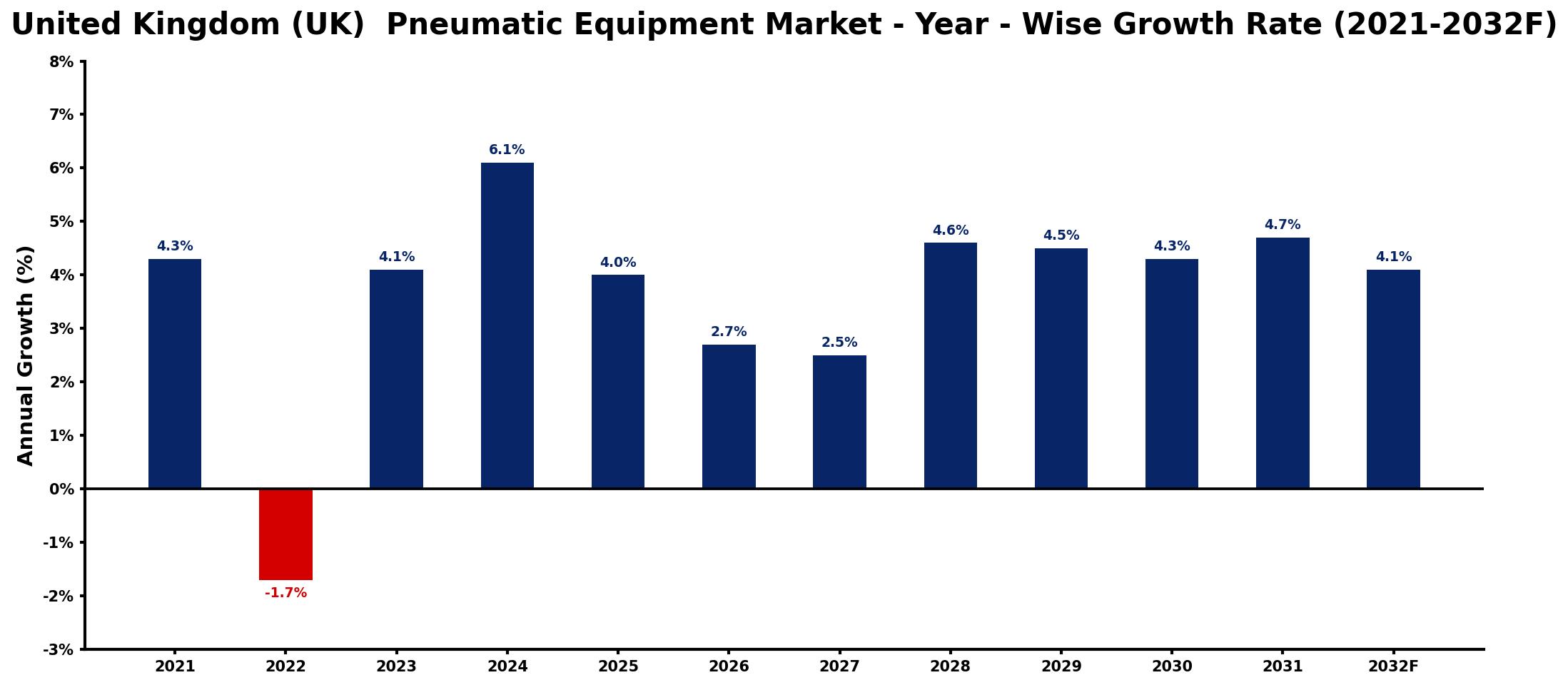
The table below presents the year‑wise growth rates along with the key drivers influencing the market
| Year | Growth Rate | Major Drivers |
| 2021 | 4.3% | Increased manufacturing sector investments |
| 2022 | -1.7% | Lower demand from construction industry |
| 2023 | 4.1% | Rising automation in industries |
| 2024 | 6.1% | Expansion in renewable energy projects |
| 2025 | 4.0% | Growth in automotive production levels |
| 2026 | 2.7% | Elevated logistics and transportation needs |
| 2027 | 2.5% | Enhanced industrial safety regulations |
| 2028 | 4.6% | Surge in aerospace sector projects |
| 2029 | 4.5% | Boost in food processing demand |
| 2030 | 4.3% | Increased focus on energy efficiency |
| 2031 | 4.7% | increased pharmaceutical industry usage |
| 2032 | 4.1% | Rising investments in smart technologies |
Note: Market size estimations and growth projections presented in this report are based on 6Wresearch's proprietary forecasting methodology, utilizing the latest available industry data, government publications, and primary research inputs.
United Kingdom (UK) Pneumatic Equipment Market Synopsis
The pneumatic equipment market in the UK is currently experiencing a paradigm shift, where traditional machinery is increasingly being replaced by advanced pneumatic tools that enhance productivity and reliability. Companies in the manufacturing and construction sectors are particularly drawn to the advantages that pneumatic systems offer, including improved energy efficiency and better performance in challenging environments.
Furthermore, as the push for sustainable and energy-efficient solutions grows stronger, pneumatic equipment is becoming a critical component in modern industrial practices. This evolving landscape presents a unique opportunity for stakeholders to innovate and deliver high-performance solutions that meet the dynamic needs of the market.
United Kingdom (UK) Pneumatic Equipment Market Key Takeaways
- The market is set to expand significantly, driven by increasing automation and demand for energy-efficient solutions.
- Technological advancements are enhancing the efficiency and reliability of pneumatic systems.
- Regulatory compliance remains a key factor influencing market dynamics and product development.
- End-user industries are seeking lightweight, compact systems that offer high performance under demanding conditions.
- Government initiatives support the adoption of energy-efficient pneumatic technologies, providing an additional growth impetus.
Evaluation of Restraints in United Kingdom (UK) Pneumatic Equipment Market
The UK pneumatic equipment market faces several constraints that could impede its growth trajectory. A significant challenge is the rapid pace of technological advancements, which necessitates constant innovation and adaptation by manufacturers. Companies must continually invest in research and development to keep up with evolving consumer demands and regulatory requirements. Additionally, optimizing energy consumption while delivering high-performance pneumatic components complicates product development, requiring manufacturers to balance efficiency with cost-effectiveness.
United Kingdom (UK) Pneumatic Equipment Market Trends
Current trends in the UK pneumatic equipment market highlight a shift towards smart technologies and automation integration. Companies are exploring solutions that leverage IoT capabilities, enabling real-time monitoring and predictive maintenance to reduce downtime and enhance system performance. Additionally, the demand for lightweight and compact pneumatic systems is on the rise, as industries seek to maximize space and improve energy efficiency. This trend is coupled with an increasing focus on sustainability, further steering investments towards innovative and environmentally friendly pneumatic technologies.
United Kingdom (UK) Pneumatic Equipment Market Opportunities
The UK pneumatic equipment market is ripe with opportunities for growth and investment. As industries undergo digital transformation, there is a growing need for advanced pneumatic systems that can seamlessly integrate with automated processes. Manufacturers who focus on developing energy-efficient solutions tailored to specific industry needs can capture significant market share. Furthermore, the increasing emphasis on safety and regulatory compliance creates avenues for companies to differentiate themselves through high-quality and reliable products.
Government Initiatives in the United Kingdom (UK) Pneumatic Equipment Market
The UK government has implemented a range of policies aimed at ensuring the safety and reliability of pneumatic systems across various sectors. Compliance with the Pressure Systems Safety Regulations 2000 is mandatory, which mandates regular inspection and maintenance of pneumatic equipment. Additionally, the government actively promotes energy-efficient pneumatic solutions through various incentives and support programs designed to foster technological advancements in this sector.
Future Insights of the United Kingdom (UK) Pneumatic Equipment Market
Looking ahead to the period from 2026 to 2032, the UK pneumatic equipment market is expected to thrive, driven by sustained investment in automation and advanced technologies. As industries place increasing importance on operational efficiency, the demand for innovative pneumatic systems is projected to surge. Moreover, evolving regulatory landscapes and heightened consumer expectations will push manufacturers to prioritize quality and performance, shaping the future of the market in a positive direction.
United Kingdom (UK) Pneumatic Equipment Market Latest Developments (2025 - 2026)
Recent developments in the UK pneumatic equipment market indicate a significant focus on the integration of smart technologies. As companies strive to enhance their operational efficiencies, many are investing in IoT-enabled pneumatic systems that allow for advanced monitoring and data analytics. Moreover, industry stakeholders are actively collaborating to explore sustainable practices, ensuring that new developments align with the rising demand for energy-efficient solutions.
United Kingdom (UK) Pneumatic Equipment Market - Key Attractiveness of the Report
- 10 Years of Market Numbers
- Historical Data Starting from 2022 to 2025
- Base Year: 2025
- Forecast Data until 2032
- Key Performance Indicators Impacting the Market
- Major Upcoming Developments and Projects
Key Highlights of the Report:
- United Kingdom (UK) Pneumatic Equipment Market Outlook
- Market Size of United Kingdom (UK) Pneumatic Equipment Market, 2025
- Forecast of United Kingdom (UK) Pneumatic Equipment Market, 2032
- Historical Data and Forecast of United Kingdom (UK) Pneumatic Equipment Revenues & Volume for the Period 2022-2032F
- United Kingdom (UK) Pneumatic Equipment Market Trend Evolution
- United Kingdom (UK) Pneumatic Equipment Market Drivers and Challenges
- United Kingdom (UK) Pneumatic Equipment Price Trends
- United Kingdom (UK) Pneumatic Equipment Porter's Five Forces
- United Kingdom (UK) Pneumatic Equipment Industry Life Cycle
- Historical Data and Forecast of United Kingdom (UK) Pneumatic Equipment Market Revenues & Volume By Product Type for the Period 2022-2032F
- Historical Data and Forecast of United Kingdom (UK) Pneumatic Equipment Market Revenues & Volume By Camera for the Period 2022-2032F
- Historical Data and Forecast of United Kingdom (UK) Pneumatic Equipment Market Revenues & Volume By Lens for the Period 2022-2032F
- Historical Data and Forecast of United Kingdom (UK) Pneumatic Equipment Market Revenues & Volume By Others for the Period 2022-2032F
- Historical Data and Forecast of United Kingdom (UK) Pneumatic Equipment Market Revenues & Volume By Distribution Channel for the Period 2022-2032F
- Historical Data and Forecast of United Kingdom (UK) Pneumatic Equipment Market Revenues & Volume By Online Retail for the Period 2022-2032F
- Historical Data and Forecast of United Kingdom (UK) Pneumatic Equipment Market Revenues & Volume By Offline Retail for the Period 2022-2032F
- United Kingdom (UK) Pneumatic Equipment Import Export Trade Statistics
- Market Opportunity Assessment By Product Type
- Market Opportunity Assessment By Distribution Channel
- United Kingdom (UK) Pneumatic Equipment Top Companies Market Share
- United Kingdom (UK) Pneumatic Equipment Competitive Benchmarking By Technical and Operational Parameters
- United Kingdom (UK) Pneumatic Equipment Company Profiles
- United Kingdom (UK) Pneumatic Equipment Key Strategic Recommendations






































