United Kingdom Precious Metal Market Size Growth Rate
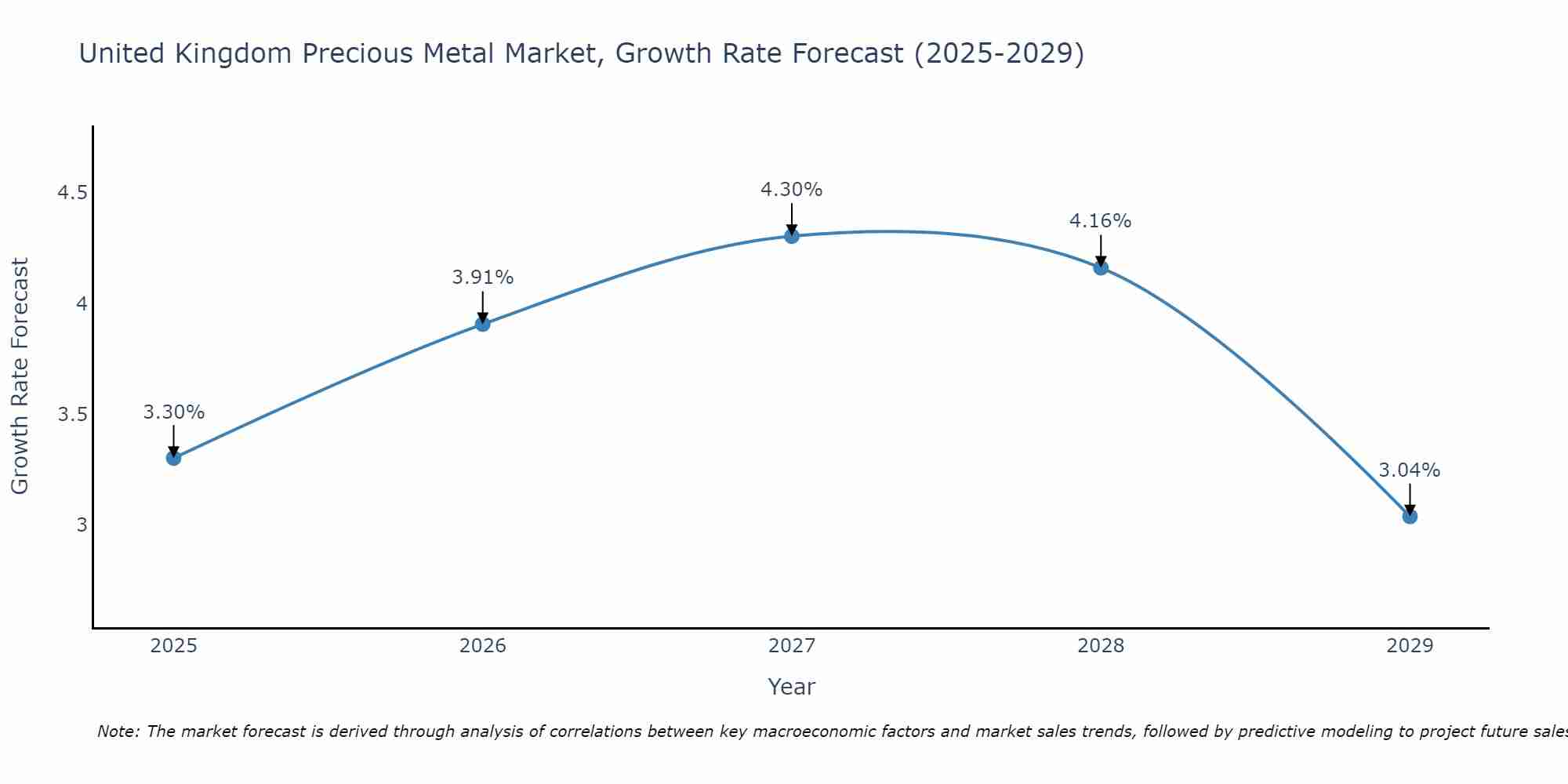
The United Kingdom Precious Metal Market is projected to witness mixed growth rate patterns during 2025 to 2029. Growth accelerates to 4.30% in 2027, following an initial rate of 3.30%, before easing to 3.04% at the end of the period.
United Kingdom (UK) Precious Metal Market Overview
The precious metal market in the UK encompasses gold, silver, platinum, and palladium. The market is driven by the demand for precious metals in jewelry, investment, and industrial applications. Innovations in mining and refining techniques, along with the development of new applications in electronics and renewable energy, are enhancing market growth. The market also benefits from the increasing focus on sustainable and ethical sourcing practices.
Drivers of the market
Growth in the UK precious metal market is driven by increasing investment demand, jewelry manufacturing, and industrial applications requiring gold, silver, platinum, and palladium metals. Precious metals serve as stores of value, financial assets, and industrial commodities in bullion coins, jewelry, electronics, and catalytic converters. Rising demand for safe-haven investments, luxury goods production, and high-tech applications drives market expansion. Technological innovations in metal recycling technologies, refining processes, and sustainable sourcing practices support market growth. Regulatory compliance with precious metal purity standards, trade tariffs, and import-export regulations further stimulate market growth in the precious metal segment.
Challenges of the market
The UK precious metal market faces challenges related to global economic uncertainties affecting metal prices, supply chain disruptions, and geopolitical factors influencing trade and investment in precious metals.
Government Policy of the market
Government policies in the UK precious metal market focus on ensuring fair trade practices and sustainable resource management. Regulations govern the extraction, refining, and trading of precious metals such as gold, silver, and platinum to prevent illegal mining activities and promote ethical sourcing. The UK government supports initiatives that enforce transparency in precious metal supply chains, combat smuggling and money laundering, and support responsible mining practices to benefit local economies and environmental conservation efforts.
Key Highlights of the Report:
- United Kingdom (UK) Precious Metal Market Outlook
- Market Size of United Kingdom (UK) Precious Metal Market, 2024
- Forecast of United Kingdom (UK) Precious Metal Market, 2031
- Historical Data and Forecast of United Kingdom (UK) Precious Metal Revenues & Volume for the Period 2021-2031
- United Kingdom (UK) Precious Metal Market Trend Evolution
- United Kingdom (UK) Precious Metal Market Drivers and Challenges
- United Kingdom (UK) Precious Metal Price Trends
- United Kingdom (UK) Precious Metal Porter's Five Forces
- United Kingdom (UK) Precious Metal Industry Life Cycle
- Historical Data and Forecast of United Kingdom (UK) Precious Metal Market Revenues & Volume By Product for the Period 2021-2031
- Historical Data and Forecast of United Kingdom (UK) Precious Metal Market Revenues & Volume By Gold for the Period 2021-2031
- Historical Data and Forecast of United Kingdom (UK) Precious Metal Market Revenues & Volume By Silver for the Period 2021-2031
- Historical Data and Forecast of United Kingdom (UK) Precious Metal Market Revenues & Volume By Platinum Group Metals (PGM) for the Period 2021-2031
- Historical Data and Forecast of United Kingdom (UK) Precious Metal Market Revenues & Volume By Applications for the Period 2021-2031
- Historical Data and Forecast of United Kingdom (UK) Precious Metal Market Revenues & Volume By Jewelry for the Period 2021-2031
- Historical Data and Forecast of United Kingdom (UK) Precious Metal Market Revenues & Volume By Industrial for the Period 2021-2031
- Historical Data and Forecast of United Kingdom (UK) Precious Metal Market Revenues & Volume By Investment for the Period 2021-2031
- United Kingdom (UK) Precious Metal Import Export Trade Statistics
- Market Opportunity Assessment By Product
- Market Opportunity Assessment By Applications
- United Kingdom (UK) Precious Metal Top Companies Market Share
- United Kingdom (UK) Precious Metal Competitive Benchmarking By Technical and Operational Parameters
- United Kingdom (UK) Precious Metal Company Profiles
- United Kingdom (UK) Precious Metal Key Strategic Recommendations






































