United Kingdom (UK) Radioactive Waste Management Market Size, Share & Growth Rate
The United Kingdom (UK) Radioactive Waste Management Market was estimated at USD 306 Million in 2025 and is projected to reach USD 380 Million by 2032, growing at a CAGR of 3.1% from 2026 to 2032. This steady growth is fueled by ongoing nuclear decommissioning projects, increased regulatory compliance, and advancements in waste containment technologies. As the UK's energy landscape evolves, there is a corresponding rise in demand for sustainable and efficient waste management solutions that meet stringent safety and environmental standards.
United Kingdom (UK) Radioactive Waste Management Market Year-wise Growth Rate and Key Drivers
This graph highlights how the United Kingdom (UK) Radioactive Waste Management Market has steadily grown over the years, supported by major growth factors.
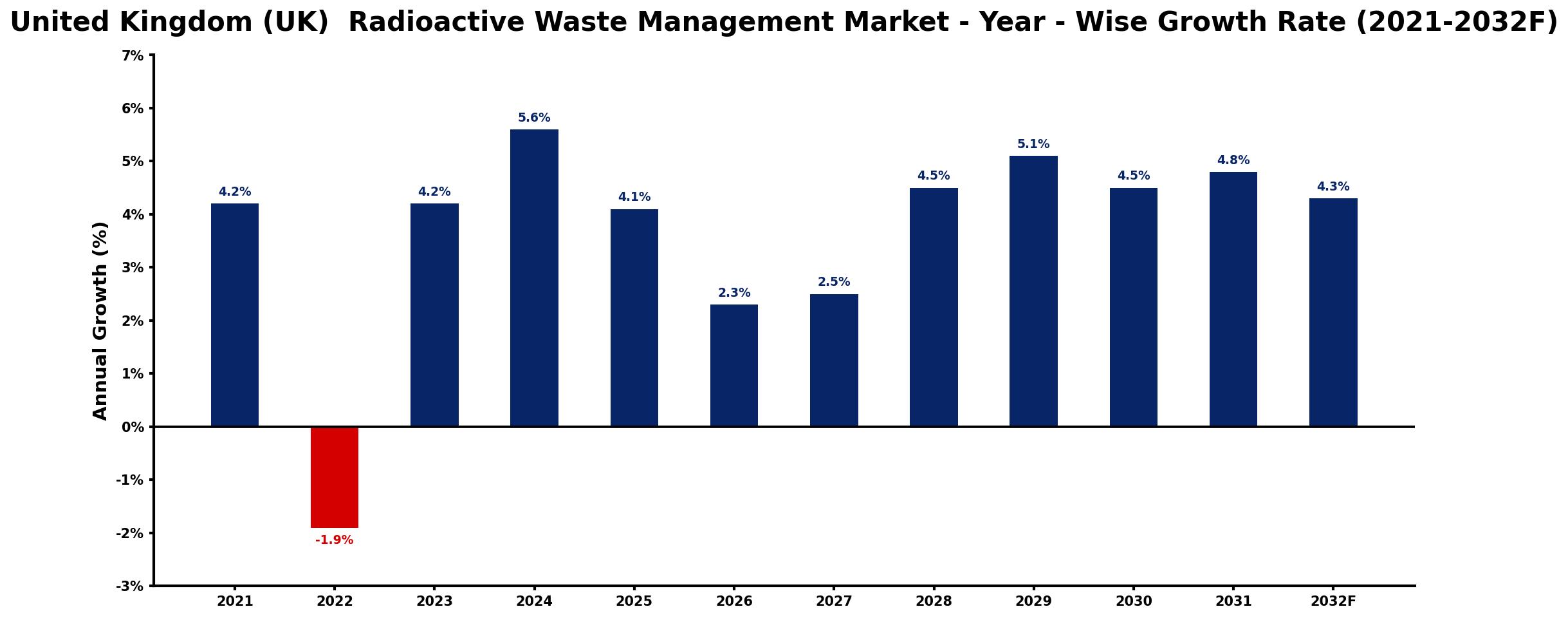
The table below presents the year‑wise growth rates along with the key drivers influencing the market
| Year | Growth Rate | Major Drivers |
| 2021 | 4.2% | Increased investments in infrastructure |
| 2022 | -1.9% | Decreased project funding availability |
| 2023 | 4.2% | Rising demand for disposal solutions |
| 2024 | 5.6% | Growth in nuclear energy sector |
| 2025 | 4.1% | Expansion of recycling initiatives |
| 2026 | 2.3% | Emerging technologies driving efficiency |
| 2027 | 2.5% | Higher regulatory compliance requirements |
| 2028 | 4.5% | Increased public awareness campaigns |
| 2029 | 5.1% | Strengthened international cooperation efforts |
| 2030 | 4.5% | Advancements in safety protocols |
| 2031 | 4.8% | Growing private sector participation |
| 2032 | 4.3% | Enhanced research and development focus |
Note: Market size estimations and growth projections presented in this report are based on 6Wresearch's proprietary forecasting methodology, utilizing the latest available industry data, government publications, and primary research inputs.
United Kingdom (UK) Radioactive Waste Management Market Synopsis
The UK radioactive waste management market has experienced robust momentum in recent years, driven by heightened public awareness of nuclear safety and environmental protection. However, as the market matures, it faces the pressing need for innovative solutions that address both regulatory compliance and community concerns about waste transportation and disposal.
Looking forward, the market is poised for growth, bolstered by investments in new disposal facilities and technological innovations. The ongoing transition towards a cleaner energy future also aligns with the growing emphasis on sustainable waste management practices, further paving the way for market expansion in the coming years.
United Kingdom (UK) Radioactive Waste Management Market Key Takeaways
- The market is projected to grow from USD 306 Million in 2025 to USD 380 Million by 2032, indicating a healthy CAGR of 3.1%.
- Nuclear decommissioning projects are pivotal in driving demand for waste management solutions.
- Technological advancements in waste treatment and containment are crucial for regulatory compliance.
- Public concerns regarding waste management practices necessitate transparency and community engagement.
- Government policies are increasingly supporting sustainable waste disposal initiatives and research into innovative treatment technologies.
Evaluation of Restraints in United Kingdom (UK) Radioactive Waste Management Market
Despite the promising growth trajectory, several factors could hinder market development. The complexity of developing safe, long-term storage and disposal solutions poses significant challenges, as does the necessity to continuously align with stringent regulatory frameworks. Public apprehensions regarding the safety of nuclear waste transportation and management further complicate market dynamics. Addressing these concerns requires persistent efforts in communication and stakeholder engagement, as well as advancements in technology that can assure public safety and environmental protection.
United Kingdom (UK) Radioactive Waste Management Market Trends
The market is witnessing several key trends that are shaping its future. The integration of advanced technologies, such as remote handling systems and enhanced environmental monitoring tools, is becoming increasingly vital for safe waste management operations. Additionally, there is a growing focus on developing sustainable packaging solutions that minimize environmental impact. Furthermore, the emphasis on community involvement in decision-making processes is transforming public perception and acceptance of nuclear waste management initiatives.
United Kingdom (UK) Radioactive Waste Management Market Opportunities
Genuine growth opportunities lie in the realm of technological innovation and regulatory compliance. The ongoing push for nuclear decommissioning presents avenues for expanding waste management services, particularly in the area of waste treatment and disposal facility development. Moreover, as the UK government continues to foster research into novel waste management techniques, companies that can provide innovative solutions are well-positioned to capitalize on this evolving landscape. Enhanced partnerships between public and private sectors will also play a vital role in driving investment in the sector.
Government Initiatives in the United Kingdom (UK) Radioactive Waste Management Market
The UK government is actively promoting initiatives that underscore nuclear safety, environmental protection, and adherence to regulatory frameworks governing radioactive waste management. Policies are increasingly focused on ensuring that waste management practices not only comply with safety standards but also address public concerns. Investment in research programs aimed at improving waste treatment technologies, along with community outreach initiatives, are key components of government efforts to build trust and transparency in radioactive waste management operations.
Future Insights of the United Kingdom (UK) Radioactive Waste Management Market
Looking ahead to 2026-2032, the UK radioactive waste management market is set to evolve significantly. The anticipated growth in nuclear energy generation, coupled with the need for effective decommissioning strategies, will drive demand for comprehensive waste management solutions. Increased regulatory scrutiny will further propel technological advancements aimed at ensuring safety and sustainability in waste handling practices. As the market landscape changes, stakeholders must remain agile to harness emerging opportunities and mitigate potential risks associated with public perception and compliance challenges.
United Kingdom (UK) Radioactive Waste Management Market Latest Developments (2025 - 2026)
Recent developments in the UK radioactive waste management market indicate a concerted effort towards enhancing waste treatment technologies and expanding disposal facilities. Regulatory bodies are focusing on stringent safety protocols while fostering innovation within the sector. Additionally, there are emerging partnerships between government agencies and private entities aimed at improving transparency and public engagement in waste management processes. The commitment to sustainable practices and community involvement remains a central theme in shaping the future direction of the market.
United Kingdom (UK) Radioactive Waste Management Market - Key Attractiveness of the Report
- 10 Years of Market Numbers
- Historical Data Starting from 2022 to 2025
- Base Year: 2025
- Forecast Data until 2032
- Key Performance Indicators Impacting the Market
- Major Upcoming Developments and Projects
Key Highlights of the Report:
- United Kingdom (UK) Radioactive Waste Management Market Outlook
- Market Size of United Kingdom (UK) Radioactive Waste Management Market, 2025
- Forecast of United Kingdom (UK) Radioactive Waste Management Market, 2032
- Historical Data and Forecast of United Kingdom (UK) Radioactive Waste Management Revenues & Volume for the Period 2022-2032F
- United Kingdom (UK) Radioactive Waste Management Market Trend Evolution
- United Kingdom (UK) Radioactive Waste Management Market Drivers and Challenges
- United Kingdom (UK) Radioactive Waste Management Price Trends
- United Kingdom (UK) Radioactive Waste Management Porter's Five Forces
- United Kingdom (UK) Radioactive Waste Management Industry Life Cycle
- Historical Data and Forecast of United Kingdom (UK) Radioactive Waste Management Market Revenues & Volume By Type for the Period 2022-2032F
- Historical Data and Forecast of United Kingdom (UK) Radioactive Waste Management Market Revenues & Volume By Exempt Waste and Very Low-Level Waste(VLLW) for the Period 2022-2032F
- Historical Data and Forecast of United Kingdom (UK) Radioactive Waste Management Market Revenues & Volume By Low-Level Waste(LLW) for the Period 2022-2032F
- Historical Data and Forecast of United Kingdom (UK) Radioactive Waste Management Market Revenues & Volume By Intermediate-Level Waste(ILW) for the Period 2022-2032F
- Historical Data and Forecast of United Kingdom (UK) Radioactive Waste Management Market Revenues & Volume By High-Level Waste(HLW) for the Period 2022-2032F
- Historical Data and Forecast of United Kingdom (UK) Radioactive Waste Management Market Revenues & Volume By Application for the Period 2022-2032F
- Historical Data and Forecast of United Kingdom (UK) Radioactive Waste Management Market Revenues & Volume By Industrial for the Period 2022-2032F
- Historical Data and Forecast of United Kingdom (UK) Radioactive Waste Management Market Revenues & Volume By Utility for the Period 2022-2032F
- United Kingdom (UK) Radioactive Waste Management Import Export Trade Statistics
- Market Opportunity Assessment By Type
- Market Opportunity Assessment By Application
- United Kingdom (UK) Radioactive Waste Management Top Companies Market Share
- United Kingdom (UK) Radioactive Waste Management Competitive Benchmarking By Technical and Operational Parameters
- United Kingdom (UK) Radioactive Waste Management Company Profiles
- United Kingdom (UK) Radioactive Waste Management Key Strategic Recommendations






































