United Kingdom (UK) Small Mammal and Reptile Food Market Size, Share & Growth Rate
The United Kingdom (UK) Small Mammal and Reptile Food Market was estimated at USD 396 Million in 2025 and is projected to reach USD 490 Million by 2032, growing at a CAGR of 3.1% from 2026 to 2032. This positive trajectory is being propelled by a heightened awareness among pet owners regarding the nutritional needs of small mammals and reptiles. Moreover, the increasing trend of pet humanization is pushing consumers to seek premium, specialized diets that support the health and longevity of their companions.
United Kingdom (UK) Small Mammal and Reptile Food Market Year-wise Growth Rate and Key Drivers
This graph highlights how the United Kingdom (UK) Small Mammal and Reptile Food Market has steadily grown over the years, supported by major growth factors.
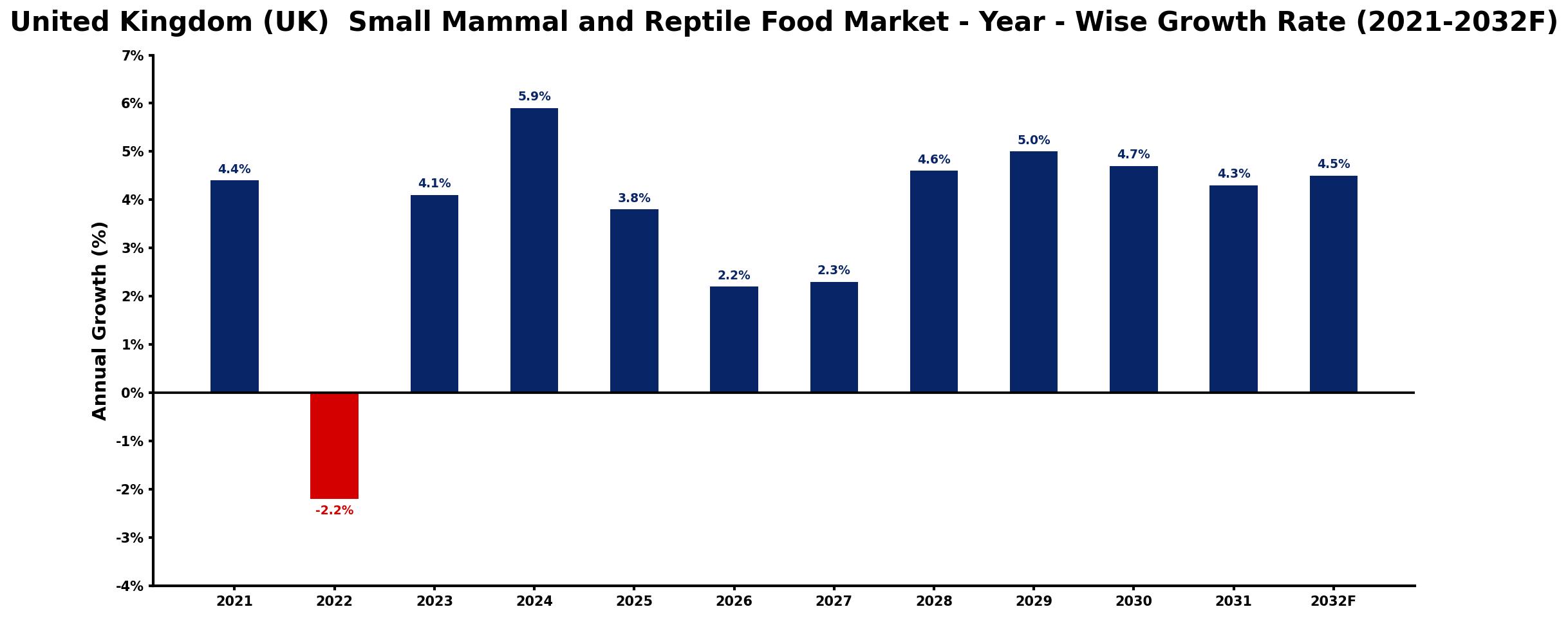
The table below presents the year‑wise growth rates along with the key drivers influencing the market
| Year | Growth Rate | Major Drivers |
| 2021 | 4.4% | Increased consumer pet ownership |
| 2022 | -2.2% | Supply chain disruptions affecting sourcing |
| 2023 | 4.1% | Growing interest in exotic pets |
| 2024 | 5.9% | Rising disposable income levels |
| 2025 | 3.8% | Expansion of specialty retailers |
| 2026 | 2.2% | Innovations in product formulations |
| 2027 | 2.3% | Increased focus on sustainability |
| 2028 | 4.6% | Growing online shopping trends |
| 2029 | 5.0% | Enhanced marketing strategies employed |
| 2030 | 4.7% | Emerging trends in pet nutrition |
| 2031 | 4.3% | Rising awareness of pet health |
| 2032 | 4.5% | Expansion into new markets |
Note: Market size estimations and growth projections presented in this report are based on 6Wresearch's proprietary forecasting methodology, utilizing the latest available industry data, government publications, and primary research inputs.
United Kingdom (UK) Small Mammal and Reptile Food Market Synopsis
The UK Small Mammal and Reptile Food Market is evolving rapidly as pet ownership trends shift towards smaller, exotic animals. This burgeoning interest is complemented by a demand for tailored nutrition that addresses the unique dietary requirements of these pets, ranging from high-quality pellets to innovative snacks.
In recent years, there has been a marked increase in consumer preference for natural and organic ingredients. Pet owners are not only looking for products that nourish their pets but also those that align with their own values regarding sustainability and ethical sourcing.
United Kingdom (UK) Small Mammal and Reptile Food Market Key Takeaways
- The market is driven by increasing pet ownership, particularly among small mammals and reptiles.
- There is a growing emphasis on natural and organic ingredients in pet food formulations.
- Sustainability and ethical sourcing practices are key considerations for consumers.
- Innovation in product offerings is vital for brands to differentiate themselves in a crowded marketplace.
- The pet humanization trend is shaping consumer expectations around pet nutrition.
Evaluation of Restraints in United Kingdom (UK) Small Mammal and Reptile Food Market
A significant restraint in the UK Small Mammal and Reptile Food Market lies in the intensifying competition. With the growing popularity of small pets, many new brands have entered the arena, leading to an oversaturated market. This scenario makes it increasingly difficult for niche players to carve out a distinct identity and capture market share. Additionally, companies face challenges such as fluctuating raw material costs, the need to meet strict regulations, and the dynamic nature of consumer preferences, which are shifting toward healthier and more sustainable options. These factors necessitate innovative marketing and product differentiation strategies to maintain relevance and achieve growth in this competitive environment.
United Kingdom (UK) Small Mammal and Reptile Food Market Trends
Several key trends are currently shaping the landscape of the UK Small Mammal and Reptile Food Market. A notable shift towards natural, organic ingredients is evident, as pet owners increasingly prioritize nutrition. This demand is coupled with an interest in specialized diets for different species, ages, and health conditions. Innovative packaging solutions are also gaining traction, catering to the convenience-seeking behaviors of modern consumers. Moreover, e-commerce is becoming a crucial sales channel, providing pet owners with easy access to a wider variety of products.
United Kingdom (UK) Small Mammal and Reptile Food Market Opportunities
The market presents numerous growth opportunities, primarily driven by the trend of increased pet ownership. This environment encourages investment in research and development aimed at creating new, premium product formulations that align with evolving consumer expectations. Expanding distribution channels, particularly through online platforms, will be vital for brands looking to capture a broader audience. Collaborations with pet retail outlets and veterinary clinics can further enhance reach and credibility, catering to the burgeoning interest in small mammals and reptiles.
Government Initiatives in the United Kingdom (UK) Small Mammal and Reptile Food Market
The UK government enforces various regulations aimed at ensuring the safety and quality of pet food products, including those designed for small mammals and reptiles. The Animal Welfare Act mandates proper care and nutrition for animals, influencing market practices and product formulations. Additionally, the Food Standards Agency provides oversight on ingredient sourcing and labeling, ensuring transparency and protection for consumers. Initiatives promoting responsible pet ownership are also being implemented, encouraging the use of sustainable practices within the industry.
Future Insights of the United Kingdom (UK) Small Mammal and Reptile Food Market
Looking ahead to 2026-2032, the UK Small Mammal and Reptile Food Market is poised for continued growth as awareness of specialized pet nutrition expands. The trend of pet humanization will drive demand for higher-quality, ethically sourced products. Additionally, the integration of e-commerce as a key distribution channel will facilitate market penetration. Innovations in product formulations that cater to specific dietary needs will likely become a focal point, helping brands differentiate themselves in a competitive landscape.
United Kingdom (UK) Small Mammal and Reptile Food Market Latest Developments (2025 - 2026)
Recent developments in the UK Small Mammal and Reptile Food Market showcase a shift towards innovative product offerings focused on natural ingredients and enhanced nutritional profiles. Brands are increasingly adopting eco-friendly packaging solutions to appeal to environmentally conscious consumers. Moreover, collaborations with veterinarians to develop specialized diets are gaining traction, aligning with the heightened consumer interest in pet health. The adoption of digital marketing strategies is also on the rise, enabling brands to connect more effectively with pet owners.
United Kingdom (UK) Small Mammal and Reptile Food Market - Key Attractiveness of the Report
- 10 Years of Market Numbers
- Historical Data Starting from 2022 to 2025
- Base Year: 2025
- Forecast Data until 2032
- Key Performance Indicators Impacting the Market
- Major Upcoming Developments and Projects
Key Highlights of the Report:
- United Kingdom (UK) Small Mammal and Reptile Food Market Outlook
- Market Size of United Kingdom (UK) Small Mammal and Reptile Food Market, 2025
- Forecast of United Kingdom (UK) Small Mammal and Reptile Food Market, 2032
- Historical Data and Forecast of United Kingdom (UK) Small Mammal and Reptile Food Revenues & Volume for the Period 2022-2032F
- United Kingdom (UK) Small Mammal and Reptile Food Market Trend Evolution
- United Kingdom (UK) Small Mammal and Reptile Food Market Drivers and Challenges
- United Kingdom (UK) Small Mammal and Reptile Food Price Trends
- United Kingdom (UK) Small Mammal and Reptile Food Porter's Five Forces
- United Kingdom (UK) Small Mammal and Reptile Food Industry Life Cycle
- Historical Data and Forecast of United Kingdom (UK) Small Mammal and Reptile Food Market Revenues & Volume By Type for the Period 2022-2032F
- Historical Data and Forecast of United Kingdom (UK) Small Mammal and Reptile Food Market Revenues & Volume By Rabbits Food for the Period 2022-2032F
- Historical Data and Forecast of United Kingdom (UK) Small Mammal and Reptile Food Market Revenues & Volume By Rodents Food for the Period 2022-2032F
- Historical Data and Forecast of United Kingdom (UK) Small Mammal and Reptile Food Market Revenues & Volume By Small Reptiles Food for the Period 2022-2032F
- Historical Data and Forecast of United Kingdom (UK) Small Mammal and Reptile Food Market Revenues & Volume By Other for the Period 2022-2032F
- Historical Data and Forecast of United Kingdom (UK) Small Mammal and Reptile Food Market Revenues & Volume By Application for the Period 2022-2032F
- Historical Data and Forecast of United Kingdom (UK) Small Mammal and Reptile Food Market Revenues & Volume By Pet-Speciality Stores for the Period 2022-2032F
- Historical Data and Forecast of United Kingdom (UK) Small Mammal and Reptile Food Market Revenues & Volume By Supermarkets and Hypermarkets for the Period 2022-2032F
- Historical Data and Forecast of United Kingdom (UK) Small Mammal and Reptile Food Market Revenues & Volume By Convenience Stores for the Period 2022-2032F
- Historical Data and Forecast of United Kingdom (UK) Small Mammal and Reptile Food Market Revenues & Volume By Other for the Period 2022-2032F
- United Kingdom (UK) Small Mammal and Reptile Food Import Export Trade Statistics
- Market Opportunity Assessment By Type
- Market Opportunity Assessment By Application
- United Kingdom (UK) Small Mammal and Reptile Food Top Companies Market Share
- United Kingdom (UK) Small Mammal and Reptile Food Competitive Benchmarking By Technical and Operational Parameters
- United Kingdom (UK) Small Mammal and Reptile Food Company Profiles
- United Kingdom (UK) Small Mammal and Reptile Food Key Strategic Recommendations






































