United Kingdom (UK) Smart Retail Market Size, Share & Growth Rate
The United Kingdom (UK) Smart Retail Market was estimated at USD 836 Million in 2025 and is projected to reach USD 1201 Million by 2032, growing at a CAGR of 5.3% from 2026 to 2032. This growth trajectory is fueled by the increasing integration of technologies such as IoT and AI, enabling retailers to provide personalized experiences and streamline operations. The demand for efficient inventory management and seamless omnichannel strategies is also propelling market expansion, as businesses adapt to evolving consumer preferences.
United Kingdom (UK) Smart Retail Market Year-wise Growth Rate and Key Drivers
This graph highlights how the United Kingdom (UK) Smart Retail Market has steadily grown over the years, supported by major growth factors.
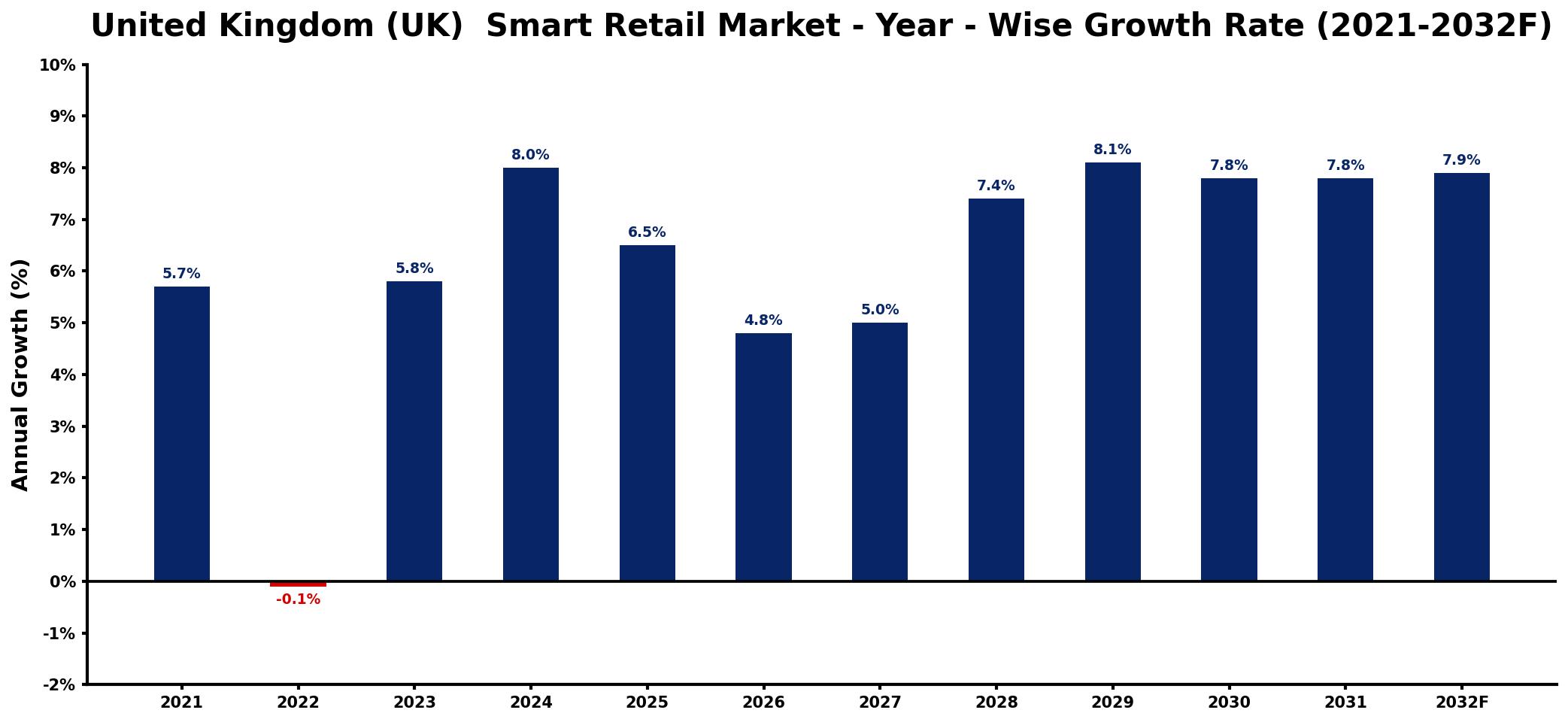
The table below presents the year‑wise growth rates along with the key drivers influencing the market
| Year | Growth Rate | Major Drivers |
| 2021 | 5.7% | increased consumer spending on technology |
| 2022 | -0.1% | reduced investments in new technologies |
| 2023 | 5.8% | growing adoption of digital solutions |
| 2024 | 8.0% | expansion of online shopping platforms |
| 2025 | 6.5% | rising demand for personalized experiences |
| 2026 | 4.8% | enhanced focus on sustainability practices |
| 2027 | 5.0% | growing integration of AI tools |
| 2028 | 7.4% | increased collaboration with tech partners |
| 2029 | 8.1% | expanding use of automation systems |
| 2030 | 7.8% | evolving consumer preferences for convenience |
| 2031 | 7.8% | strengthened emphasis on data analytics |
| 2032 | 7.9% | broader applications of IoT technologies |
Note: Market size estimations and growth projections presented in this report are based on 6Wresearch's proprietary forecasting methodology, utilizing the latest available industry data, government publications, and primary research inputs.
United Kingdom (UK) Smart Retail Market Synopsis
The UK Smart Retail Market has experienced dynamic growth recently, yet it is on the cusp of further transformation. As retailers increasingly adopt advanced technologies, they are positioning themselves to meet consumer expectations in innovative ways.
Looking ahead, the market is expected to capitalize on trends such as mobile shopping and cashierless solutions. This evolution not only enhances the customer shopping journey but also provides retailers with tools to manage operations more effectively and engage more personally with consumers.
United Kingdom (UK) Smart Retail Market Key Takeaways
- The market is set for significant growth, reflecting a shift towards technology-driven retail solutions.
- Consumer demand for personalized shopping experiences is driving the adoption of smart technologies.
- Innovations such as cashierless stores are reshaping traditional retail operations.
- Data privacy concerns are a key consideration for retailers adopting new technologies.
- Investment in smart retail solutions offers growth potential and competitive advantages for businesses.
Evaluation of Restraints in United Kingdom (UK) Smart Retail Market
As the UK Smart Retail Market evolves, it faces significant constraints that could impede growth. Chief among these are concerns surrounding data privacy and security, which are increasingly pivotal as retailers utilize data analytics to enhance consumer experiences. The integration of diverse technologies can also pose logistical challenges, particularly for smaller retailers lacking the necessary resources. Additionally, the demand for skilled professionals to manage and analyze the resulting data remains unfulfilled, adding another layer of complexity to the landscape.
United Kingdom (UK) Smart Retail Market Trends
Several key trends are shaping the landscape of the UK Smart Retail Market. The shift towards omnichannel retailing is gaining momentum, as consumers increasingly expect seamless experiences across both online and offline platforms. Additionally, the rise of mobile shopping continues to influence retail strategies, encouraging businesses to enhance their digital presence. Sustainability is another critical factor, with retailers embracing eco-friendly practices to resonate with environmentally conscious consumers. These trends collectively indicate a market that is adapting rapidly to consumer needs while leveraging technology to drive operational efficiency.
United Kingdom (UK) Smart Retail Market Opportunities
The UK Smart Retail Market is ripe with investment opportunities as technology adoption accelerates. Retailers are increasingly looking for innovative solutions to optimize operations and enhance customer engagement, making areas such as smart payment systems and automated checkout technologies particularly attractive. Furthermore, investments in personalized marketing strategies and inventory management systems are anticipated to yield substantial returns, as businesses strive to differentiate themselves in a competitive environment. Overall, the potential for growth within this sector is substantial, offering avenues for innovation and improved customer experiences.
Government Initiatives in the United Kingdom (UK) Smart Retail Market
The UK government is actively supporting the Smart Retail Market through various initiatives aimed at fostering innovation and technological advancement. Programs such as the Future High Streets Fund and the Digital High Street Skills Programme underscore the commitment to enhancing consumer experiences and encouraging retailers to embrace digital transformation. Furthermore, regulatory frameworks like the General Data Protection Regulation (GDPR) aim to protect consumer rights and data in an increasingly digital marketplace, demonstrating a proactive approach to ensuring a sustainable and competitive retail environment.
Future Insights of the United Kingdom (UK) Smart Retail Market
The outlook for the UK Smart Retail Market from 2026 to 2032 is robust, driven by technological advancements and shifting consumer demands. Retailers are expected to increasingly implement AI, IoT, and big data analytics solutions to refine customer interactions and enhance operational efficiencies. The focus on omnichannel retailing and convenience will likely remain central to retail strategies, leading to further innovations in how consumers engage with brands. As the market continues to evolve, it will present ample opportunities for businesses to differentiate themselves while meeting the heightened expectations of tech-savvy shoppers.
United Kingdom (UK) Smart Retail Market Latest Developments (2025 - 2026)
In recent months, the UK Smart Retail Market has witnessed a surge in the development of cashierless store technologies, streamlining the shopping experience. Retailers are also increasingly investing in personalized marketing strategies to enhance customer engagement. Furthermore, sustainability initiatives are gaining traction as businesses look to integrate eco-friendly practices within their operations. The overall direction of the market indicates a strong commitment to innovation and responsiveness to evolving consumer preferences.
United Kingdom (UK) Smart Retail Market - Key Attractiveness of the Report
- 10 Years of Market Numbers
- Historical Data Starting from 2022 to 2025
- Base Year: 2025
- Forecast Data until 2032
- Key Performance Indicators Impacting the Market
- Major Upcoming Developments and Projects
Key Highlights of the Report:
- United Kingdom (UK) Smart Retail Market Outlook
- Market Size of United Kingdom (UK) Smart Retail Market, 2025
- Forecast of United Kingdom (UK) Smart Retail Market, 2032
- Historical Data and Forecast of United Kingdom (UK) Smart Retail Revenues & Volume for the Period 2022-2032F
- United Kingdom (UK) Smart Retail Market Trend Evolution
- United Kingdom (UK) Smart Retail Market Drivers and Challenges
- United Kingdom (UK) Smart Retail Price Trends
- United Kingdom (UK) Smart Retail Porter's Five Forces
- United Kingdom (UK) Smart Retail Industry Life Cycle
- Historical Data and Forecast of United Kingdom (UK) Smart Retail Market Revenues & Volume By System for the Period 2022-2032F
- Historical Data and Forecast of United Kingdom (UK) Smart Retail Market Revenues & Volume By Digital Signage Solutions for the Period 2022-2032F
- Historical Data and Forecast of United Kingdom (UK) Smart Retail Market Revenues & Volume By Smart Labels for the Period 2022-2032F
- Historical Data and Forecast of United Kingdom (UK) Smart Retail Market Revenues & Volume By Smart Payment Systems for the Period 2022-2032F
- Historical Data and Forecast of United Kingdom (UK) Smart Retail Market Revenues & Volume By Intelligent Vending Machines for the Period 2022-2032F
- Historical Data and Forecast of United Kingdom (UK) Smart Retail Market Revenues & Volume By Augmented Reality Solutions for the Period 2022-2032F
- Historical Data and Forecast of United Kingdom (UK) Smart Retail Market Revenues & Volume By Virtual Reality Solutions for the Period 2022-2032F
- Historical Data and Forecast of United Kingdom (UK) Smart Retail Market Revenues & Volume By POS Solutions for the Period 2022-2032F
- Historical Data and Forecast of United Kingdom (UK) Digital Signage Solutions Smart Retail Market Revenues & Volume By Smart Carts for the Period 2022-2032F
- Historical Data and Forecast of United Kingdom (UK) Smart Retail Market Revenues & Volume By Application for the Period 2022-2032F
- Historical Data and Forecast of United Kingdom (UK) Smart Retail Market Revenues & Volume By Foot-traffic Monitoring for the Period 2022-2032F
- Historical Data and Forecast of United Kingdom (UK) Smart Retail Market Revenues & Volume By Inventory Management for the Period 2022-2032F
- Historical Data and Forecast of United Kingdom (UK) Smart Retail Market Revenues & Volume By Loyalty Management and Payment for the Period 2022-2032F
- Historical Data and Forecast of United Kingdom (UK) Smart Retail Market Revenues & Volume By Predictive Equipment Maintenance for the Period 2022-2032F
- Historical Data and Forecast of United Kingdom (UK) Smart Retail Market Revenues & Volume By Brand Protection for the Period 2022-2032F
- Historical Data and Forecast of United Kingdom (UK) Smart Retail Market Revenues & Volume By Smart Fitting Rooms for the Period 2022-2032F
- Historical Data and Forecast of United Kingdom (UK) Smart Retail Market Revenues & Volume By Retail Offering for the Period 2022-2032F
- Historical Data and Forecast of United Kingdom (UK) Smart Retail Market Revenues & Volume By Apparel and Accessories for the Period 2022-2032F
- Historical Data and Forecast of United Kingdom (UK) Smart Retail Market Revenues & Volume By Fast-moving Consumer Goods for the Period 2022-2032F
- Historical Data and Forecast of United Kingdom (UK) Smart Retail Market Revenues & Volume By Hardlines and Leisure Goods for the Period 2022-2032F
- Historical Data and Forecast of United Kingdom (UK) Smart Retail Market Revenues & Volume By Others for the Period 2022-2032F
- United Kingdom (UK) Smart Retail Import Export Trade Statistics
- Market Opportunity Assessment By System
- Market Opportunity Assessment By Application
- Market Opportunity Assessment By Retail Offering
- United Kingdom (UK) Smart Retail Top Companies Market Share
- United Kingdom (UK) Smart Retail Competitive Benchmarking By Technical and Operational Parameters
- United Kingdom (UK) Smart Retail Company Profiles
- United Kingdom (UK) Smart Retail Key Strategic Recommendations






































