United Kingdom (UK) Yacht Market Size, Share & Growth Rate
The United Kingdom (UK) Yacht Market was estimated at USD 194 Million in 2025 and is projected to reach USD 239 Million by 2032, growing at a CAGR of 3.0% from 2026 to 2032. This trajectory is propelled by increasing disposable incomes among high-net-worth individuals, a growing preference for luxury leisure activities, and the rising popularity of yacht rental services. As sustainability becomes a central focus in luxury markets, the demand for eco-friendly yacht designs also plays a significant role in shaping market dynamics.
United Kingdom (UK) Yacht Market Year-wise Growth Rate and Key Drivers
This graph highlights how the United Kingdom (UK) Yacht Market has steadily grown over the years, supported by major growth factors.
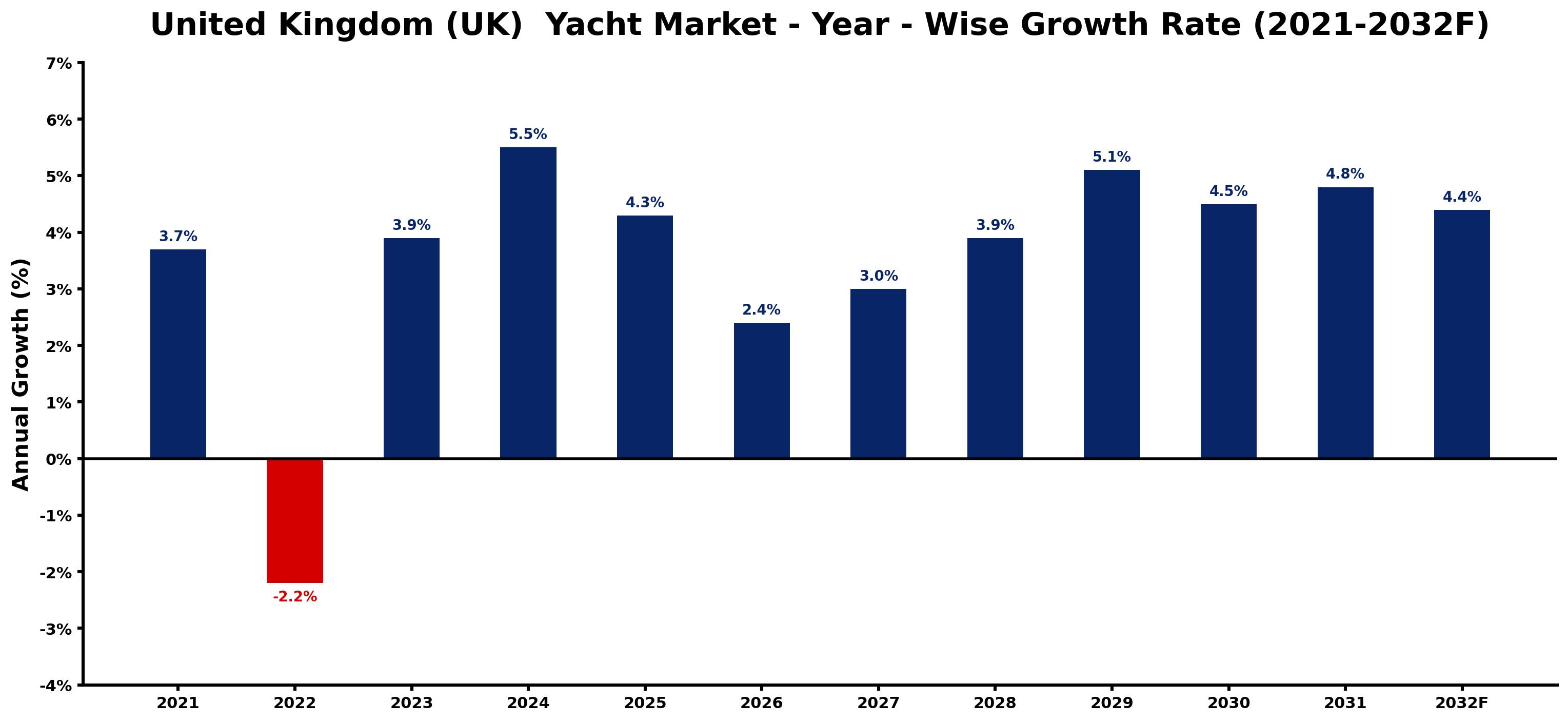
The table below presents the year‑wise growth rates along with the key drivers influencing the market
| Year | Growth Rate | Major Drivers |
| 2021 | 3.7% | Growing urbanization and commercial development |
| 2022 | -2.2% | Expansion of manufacturing activities |
| 2023 | 3.9% | Expansion of commercial construction activities |
| 2024 | 5.5% | Increasing adoption of advanced technologies |
| 2025 | 4.3% | Expansion of manufacturing activities |
| 2026 | 2.4% | Expansion of transportation and logistics networks |
| 2027 | 3.0% | Increasing industrial infrastructure investments |
| 2028 | 3.9% | Expansion of commercial construction activities |
| 2029 | 5.1% | Government infrastructure modernization initiatives |
| 2030 | 4.5% | Increasing smart city development projects |
| 2031 | 4.8% | Increasing industrial automation investments |
| 2032 | 4.4% | Growing urbanization and commercial development |
Note - Market size estimations and growth projections presented in this report are based on 6Wresearch’s advanced forecasting approach, validated with industry datasets as of June 2026.
United Kingdom (UK) Yacht Market Synopsis
In recent years, the UK yacht market has experienced a resurgence, driven by a renewed interest in leisure boating and sailing. The segment has benefitted from a strong tradition of maritime activities and a robust economy. However, as the market heads towards 2032, the emphasis on innovation and sustainability will increasingly dictate competitive advantages, pushing manufacturers to adopt cutting-edge technology.
Looking forward, the market is expected to evolve with heightened consumer expectations and regulatory requirements. Innovations in hybrid propulsion systems and lightweight materials are not just trends; they are essential for staying competitive. The shift towards eco-friendly designs will also attract a new demographic of environmentally conscious consumers, adding layers to market complexity.
United Kingdom (UK) Yacht Market Key Takeaways
- The UK yacht market is projected to grow steadily, with an increasing emphasis on luxury and customization.
- Technological advancements are crucial, especially in sustainable yacht design and hybrid propulsion systems.
- The market is supported by the country's strong maritime tradition and favorable geographic conditions.
- Yacht shows and marinas are pivotal in promoting sales and enhancing brand visibility.
- Government policies are geared towards fostering innovation and maintaining high safety and environmental standards.
Evaluation of Restraints in United Kingdom (UK) Yacht Market
Despite its robust growth potential, the UK yacht market faces real restraints that could impact its performance. High production and maintenance costs present a significant barrier, limiting accessibility for a broader consumer base. Manufacturers must continuously innovate, not only to enhance yacht performance but also to comply with stringent safety and environmental regulations. Moreover, the competitive landscape, with alternative luxury recreational activities, necessitates effective marketing strategies to attract discerning clients.
United Kingdom (UK) Yacht Market Trends
Current trends in the UK yacht market reflect a shifting focus towards sustainability and advanced technology. The integration of hybrid propulsion systems is making waves, leading to quieter and more fuel-efficient operations. Lightweight materials are not just about performance; they significantly enhance maneuverability and speed. Additionally, digital navigation technologies are improving user experience, making it easier for both seasoned sailors and newcomers to navigate the waters.
Furthermore, there is a noticeable shift in consumer preferences towards bespoke experiences, with customization becoming a hallmark of modern yacht ownership. Increasingly, clients are looking for yachts that not only provide luxury but also align with their personal values, particularly concerning environmental impact. As these trends continue to gain traction, they will shape the future of the market.
United Kingdom (UK) Yacht Market Opportunities
The UK yacht market presents substantial growth and investment opportunities, particularly in the realm of eco-friendly yacht designs. Manufacturers who embrace sustainable materials and energy-efficient technologies will likely capture a significant share of the emerging market. Additionally, the burgeoning demand for yacht rental services opens avenues for investment in charter fleets, especially in regions with high tourist traffic. As maritime tourism continues to expand, developing luxury leisure experiences tailored to affluent clients can yield lucrative returns.
Government Initiatives in the United Kingdom (UK) Yacht Market
Government policies in the UK yacht market are aimed at promoting maritime safety, enhancing recreational boating standards, and supporting the marine tourism sector. Regulatory frameworks are in place to ensure yacht safety, including vessel registration and compliance with maritime laws. Initiatives also emphasize the importance of technological advancements, pushing for innovations in yacht design that enhance performance, fuel efficiency, and passenger comfort, while prioritizing marine pollution prevention and navigational safety.
Future Insights of the United Kingdom (UK) Yacht Market
From 2026 to 2032, the UK yacht market is poised for transformation driven by consumer expectations and environmental considerations. The anticipated growth will likely hinge on advancements in yacht technology and sustainable practices, propelling the market towards a greener future. With a focus on customization and eco-friendly innovations, manufacturers will need to adapt to the evolving desires of affluent consumers, ensuring that luxury and sustainability coexist harmoniously in the coming years.
United Kingdom (UK) Yacht Market Latest Developments (May 2025 - June 2026)
Recent developments within the UK yacht market indicate a shift towards increased collaboration among manufacturers and technology firms to enhance yacht performance. Efforts to streamline production processes and reduce costs while maintaining quality are gaining traction. Furthermore, the rise in consumer demand for bespoke yacht experiences is prompting manufacturers to offer more customization options. These directions are expected to significantly influence market dynamics in the near term.
United Kingdom (UK) Yacht Market - Key Attractiveness of the Report
- 10 Years of Market Numbers
- Historical Data Starting from 2022 to 2025
- Base Year: 2025
- Forecast Data until 2032
- Key Performance Indicators Impacting the Market
- Major Upcoming Developments and Projects
Key Highlights of the Report:
- United Kingdom (UK) Yacht Market Outlook
- Market Size of United Kingdom (UK) Yacht Market, 2025
- Forecast of United Kingdom (UK) Yacht Market, 2032
- Historical Data and Forecast of United Kingdom (UK) Yacht Revenues & Volume for the Period 2022-2032F
- United Kingdom (UK) Yacht Market Trend Evolution
- United Kingdom (UK) Yacht Market Drivers and Challenges
- United Kingdom (UK) Yacht Price Trends
- United Kingdom (UK) Yacht Porter's Five Forces
- United Kingdom (UK) Yacht Industry Life Cycle
- Historical Data and Forecast of United Kingdom (UK) Yacht Market Revenues & Volume By Types for the Period 2022-2032F
- Historical Data and Forecast of United Kingdom (UK) Yacht Market Revenues & Volume By Super yacht for the Period 2022-2032F
- Historical Data and Forecast of United Kingdom (UK) Yacht Market Revenues & Volume By Flybridge yacht for the Period 2022-2032F
- Historical Data and Forecast of United Kingdom (UK) Yacht Market Revenues & Volume By Sport yacht for the Period 2022-2032F
- Historical Data and Forecast of United Kingdom (UK) Yacht Market Revenues & Volume By Long range yacht for the Period 2022-2032F
- Historical Data and Forecast of United Kingdom (UK) Yacht Market Revenues & Volume By Others for the Period 2022-2032F
- Historical Data and Forecast of United Kingdom (UK) Yacht Market Revenues & Volume By Length for the Period 2022-2032F
- Historical Data and Forecast of United Kingdom (UK) Yacht Market Revenues & Volume By Up to 20 ft for the Period 2022-2032F
- Historical Data and Forecast of United Kingdom (UK) Yacht Market Revenues & Volume By 20 to 50 ft for the Period 2022-2032F
- Historical Data and Forecast of United Kingdom (UK) Yacht Market Revenues & Volume By Above 50 ft for the Period 2022-2032F
- United Kingdom (UK) Yacht Import Export Trade Statistics
- Market Opportunity Assessment By Types
- Market Opportunity Assessment By Length
- United Kingdom (UK) Yacht Top Companies Market Share
- United Kingdom (UK) Yacht Competitive Benchmarking By Technical and Operational Parameters
- United Kingdom (UK) Yacht Company Profiles
- United Kingdom (UK) Yacht Key Strategic Recommendations






































