United States (US) Alcohol Testing Market Summary
The united states (us) alcohol testing market was estimated at USD 88 Million in 2025 and is projected to reach USD 104 Million by 2032, growing at a CAGR of 2.7% from 2026 to 2032.
United States (US) Alcohol Testing Market Year-wise Growth Rate and Key Drivers
This graph highlights how the United States (US) Alcohol Testing Market has steadily grown over the past five years, supported by major growth factors.
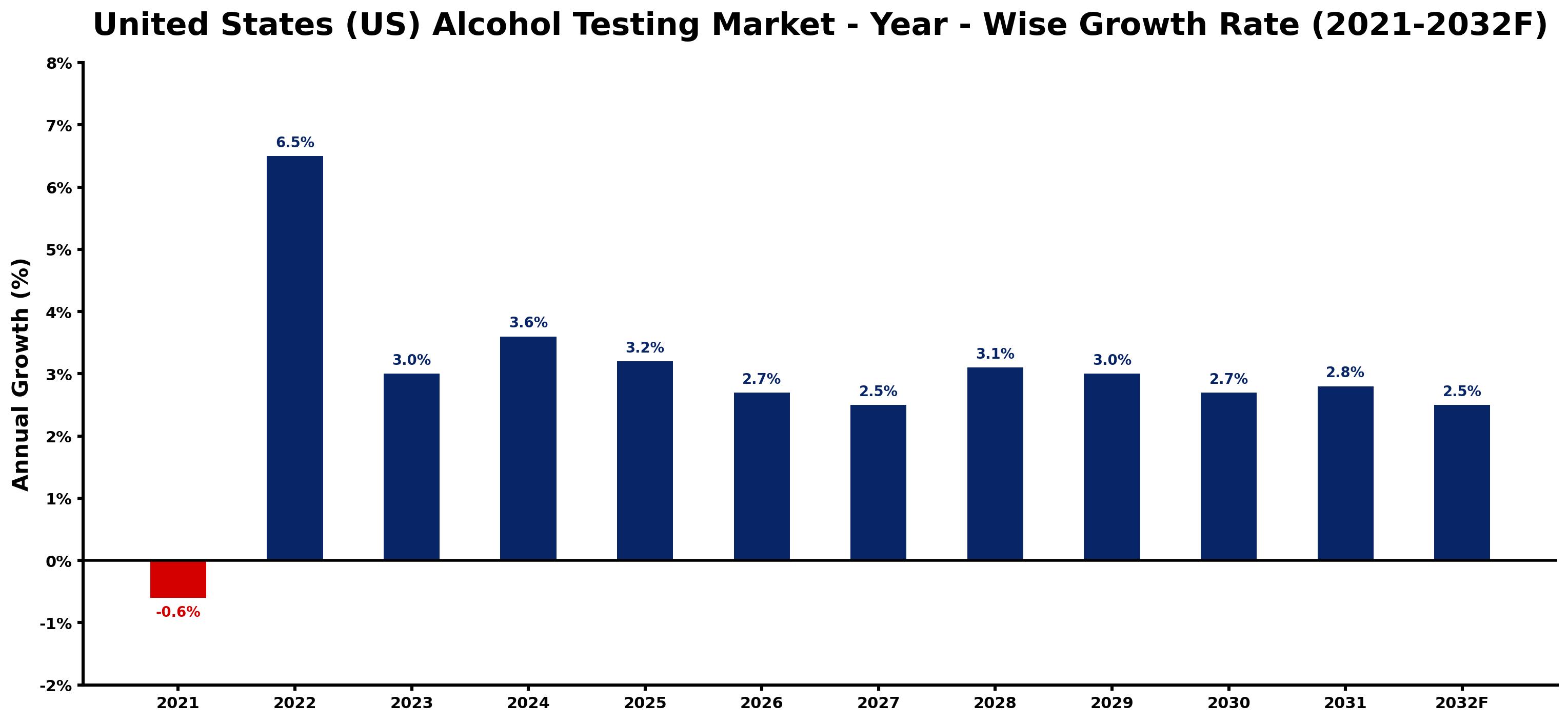
The table below presents the year wise growth rates along with the key drivers influencing the market
| Year | Growth Rate | Major Drivers |
| 2021 | -0.6% | Increased public awareness of health risks associated with alcohol consumption led to reduced testing demands. |
| 2022 | 6.5% | Increased focus on workplace safety measures fueled demand for reliable testing devices. |
| 2023 | 3.0% | Consumer awareness of impaired driving risks prompted heightened alcohol testing initiatives. |
| 2024 | 3.6% | Technological improvements in portable testing devices captured consumer interest and confidence. |
| 2025 | 3.2% | Insurance companies began incentivizing businesses to implement alcohol testing protocols. |
| 2026 | 2.7% | Market players diversified offerings to include advanced data analytics in testing solutions. |
| 2027 | 2.5% | Public awareness campaigns targeted at youth reduced alcohol consumption rates significantly. |
| 2028 | 3.1% | A collaborative approach between law enforcement and technology firms enhanced product development. |
| 2029 | 3.0% | Health and wellness trends encouraged personal use of alcohol testing devices. |
| 2030 | 2.7% | Corporate responsibility initiatives pushed companies to adopt comprehensive testing policies. |
| 2031 | 2.8% | Integration of mobile applications with testing devices provided real-time monitoring solutions. |
| 2032 | 2.5% | Emerging regulatory frameworks mandated stricter compliance measures across various industries. |
Note - Market size estimations and growth projections presented in this report are based on 6Wresearch's advanced forecasting approach, validated with industry datasets as of June 2026.
United States (US) Alcohol Testing Market Synopsis
The United States (US) Alcohol Testing Market is projected to reach 2.7% and witness significant growth during the forecast period (2026-2032). The market is primarily driven by increasing demand for alcohol testing solutions, attributable to the rising concerns surrounding drug abuse and alcoholism nationwide. Furthermore, advancements in technology and the introduction of new products by various manufacturers aim to enhance testing accuracy and provide quicker results than existing alternatives. Regulatory compliance regulations, particularly those set forth by the Department of Transportation (DOT), necessitate alcohol testing for employees in crucial sectors such as transportation and aviation, further fueling market growth in the coming years.
United States (US) Alcohol Testing Market Growth Drivers
Several factors are propelling the expansion of the United States (US) Alcohol Testing Market. Firstly, the increasing incidence of alcohol-related incidents and accidents has heightened the demand for rigorous testing protocols in various industries. Secondly, the evolution of innovative testing technologies, including breath analyzers and efficient lab-based testing systems, has improved the reliability and efficiency of results.
- The growing awareness of the health implications of alcohol consumption among the general public encourages proactive testing, particularly in workplace environments.
- Frequent media coverage of alcohol abuse cases has contributed to societal pressure on industries to implement stringent alcohol testing measures.
- Corporate responsibility initiatives are prompting companies to invest in alcohol testing technologies to ensure a safe and productive workforce.
- Legislative measures mandating regular testing for employees in certain high-risk occupations reinforce the need for reliable alcohol testing solutions.
- The adaptability of testing products to integrate with modern workplace technologies enhances their appeal and adoption rates.
United States (US) Alcohol Testing Market Challenges and Restraints
Despite the positive outlook for the United States (US) Alcohol Testing Market, certain challenges may hinder its growth trajectory. One significant restraint includes the high costs associated with advanced testing equipment, which can deter smaller companies from adopting necessary protocols. Additionally, resistance from employees regarding mandatory testing procedures due to privacy concerns may impede implementation efforts. Furthermore, the rapid evolution of technology necessitates continuous investment in updates and training, placing a strain on resources.
- Regulatory compliance costs can be substantial, posing a barrier for businesses seeking to maintain alignments with legal requirements.
- The availability of alternative methods for substance detection may pose competition to traditional alcohol testing solutions.
- Public perception regarding the efficacy and privacy of alcohol testing methods can impact wide-scale acceptance.
- Geographical disparities in regulatory frameworks can create inconsistencies in testing protocols across states.
- The market's reliance on labor-intensive processes can hinder efficiency and scalability.
United States (US) Alcohol Testing Market Trends and Opportunities
The United States (US) Alcohol Testing Market is witnessing notable trends that present abundant opportunities for growth. Increasing investments in research and development are expected to lead to the introduction of more compact, efficient, and accurate testing devices. There is also a discernible shift towards integrating digital solutions and mobile applications to facilitate on-site testing, which caters to the demand for convenience. Moreover, partnerships between technology firms and traditional testing manufacturers can result in innovative solutions that enhance user experience.
- Growing emphasis on workplace safety and employee well-being drives interest in regular and reliable alcohol testing solutions.
- The rise in entrepreneurship and start-ups in the health technology sector fuels innovation and agility in product development.
- Increased consumer demand for rapid testing results promotes the need for portable and user-friendly testing devices.
- The expansion of telehealth services paves the way for remote testing solutions, improving accessibility.
- Government funding for community health initiatives offers financial backing for advancements in testing technologies.
United States (US) Alcohol Testing Market Government Investment and Initiatives
The United States government has recognized the importance of addressing alcohol-related issues within various sectors, leading to substantial investments and initiatives aimed at enhancing alcohol testing measures. Public spending is increasingly being directed towards the development of comprehensive substance abuse programs, which often include alcohol testing components. Federal and state governments have initiated campaigns focusing on the promotion of responsible drinking behaviors and the implementation of robust testing protocols in workplaces.
- Legislation aimed at improving workplace safety often includes provisions for regular alcohol testing in high-risk industries.
- Government grants are available to support businesses in adopting advanced alcohol testing technologies and training employees.
- Investment in research studies on the effects of alcohol consumption fosters better understanding and leads to refined testing methodologies.
- Public health initiatives are increasingly emphasizing the role of alcohol testing in preventing accidents and promoting health education.
- Collaborations between governmental agencies and health organizations enhance community outreach efforts regarding alcohol misuse.
United States (US) Alcohol Testing Market Latest Developments (May 2025 - June 2026)
Recent developments within the United States (US) Alcohol Testing Market reflect a dynamic landscape characterized by innovation and regulatory evolution. Over the past year, industry players have been focusing on enhancing the accuracy and speed of testing devices, resulting in the launch of several new products designed to meet the increasing demands of corporate and regulatory environments. Regulatory bodies have also been revising guidelines to adapt to emerging technologies, ensuring that new methods comply with established safety standards.
- Innovation in breath analysis technology has led to the creation of devices that provide immediate results, enhancing workplace efficiency.
- Increased collaboration across sectors has resulted in comprehensive alcohol education programs paired with testing initiatives.
- Corporate partnerships aimed at improving employee wellness have risen, integrating alcohol testing into broader health monitoring solutions.
- Regulatory updates are encouraging the adoption of digital alcohol testing solutions, paving the way for future market growth.
- Expansion of telehealth services has facilitated the increase of remote testing options, improving accessibility for consumers.
United States (US) Alcohol Testing Market - Key Attractiveness of the Report
- 10 Years of Market Numbers
- Historical Data Starting from 2022 to 2025
- Base Year: 2025
- Forecast Data until 2032
- Key Performance Indicators Impacting the Market
- Major Upcoming Developments and Projects
Key Highlights of the Report:
- United States (US) Alcohol Testing Market Outlook
- Market Size of United States (US) Alcohol Testing Market, 2025
- Forecast of United States (US) Alcohol Testing Market, 2032
- Historical Data and Forecast of United States (US) Alcohol Testing Revenues & Volume for the Period 2022-2032
- United States (US) Alcohol Testing Market Trend Evolution
- United States (US) Alcohol Testing Market Drivers and Challenges
- United States (US) Alcohol Testing Price Trends
- United States (US) Alcohol Testing Porter's Five Forces
- United States (US) Alcohol Testing Industry Life Cycle
- Historical Data and Forecast of United States (US) Alcohol Testing Market Revenues & Volume By Testing Equipment Types for the Period 2022-2032
- Historical Data and Forecast of United States (US) Alcohol Testing Market Revenues & Volume By Infrared Based Breathalyzer for the Period 2022-2032
- Historical Data and Forecast of United States (US) Alcohol Testing Market Revenues & Volume By Semi-conductor Based Breathalyzer for the Period 2022-2032
- Historical Data and Forecast of United States (US) Alcohol Testing Market Revenues & Volume By Immunoassay Analyzers for the Period 2022-2032
- Historical Data and Forecast of United States (US) Alcohol Testing Market Revenues & Volume By Fuel Cell Based Breathalyzer for the Period 2022-2032
- Historical Data and Forecast of United States (US) Alcohol Testing Market Revenues & Volume By Oral Fluid Testing Devices for the Period 2022-2032
- Historical Data and Forecast of United States (US) Alcohol Testing Market Revenues & Volume By Hair Testing Devices for the Period 2022-2032
- Historical Data and Forecast of United States (US) Alcohol Testing Market Revenues & Volume By Urine Testing Devices for the Period 2022-2032
- Historical Data and Forecast of United States (US) Infrared Based Breathalyzer Alcohol Testing Market Revenues & Volume By Others for the Period 2022-2032
- Historical Data and Forecast of United States (US) Alcohol Testing Market Revenues & Volume By Applications for the Period 2022-2032
- Historical Data and Forecast of United States (US) Alcohol Testing Market Revenues & Volume By Alcohol Detection for the Period 2022-2032
- Historical Data and Forecast of United States (US) Alcohol Testing Market Revenues & Volume By Drug Detection for the Period 2022-2032
- United States (US) Alcohol Testing Import Export Trade Statistics
- Market Opportunity Assessment By Testing Equipment Types
- Market Opportunity Assessment By Applications
- United States (US) Alcohol Testing Top Companies Market Share
- United States (US) Alcohol Testing Competitive Benchmarking By Technical and Operational Parameters
- United States (US) Alcohol Testing Company Profiles
- United States (US) Alcohol Testing Key Strategic Recommendations






































