United States (US) Borosilicate Glass Market Size, Share & Growth Rate
The United States (US) Borosilicate Glass Market was estimated at USD 179 Million in 2025 and is projected to reach USD 211 Million by 2032, growing at a CAGR of 2.4% from 2026 to 2032. This positive trajectory can be attributed to the robust demand in sectors like pharmaceuticals and kitchenware, where the unique properties of borosilicate glass—such as thermal resistance and chemical stability—are highly valued. Additionally, the increasing preference for eco-friendly packaging solutions further propels growth in this market.
United States (US) Borosilicate Glass Market Year-wise Growth Rate and Key Drivers
This graph highlights how the United States (US) Borosilicate Glass Market has steadily grown over the years, supported by major growth factors.
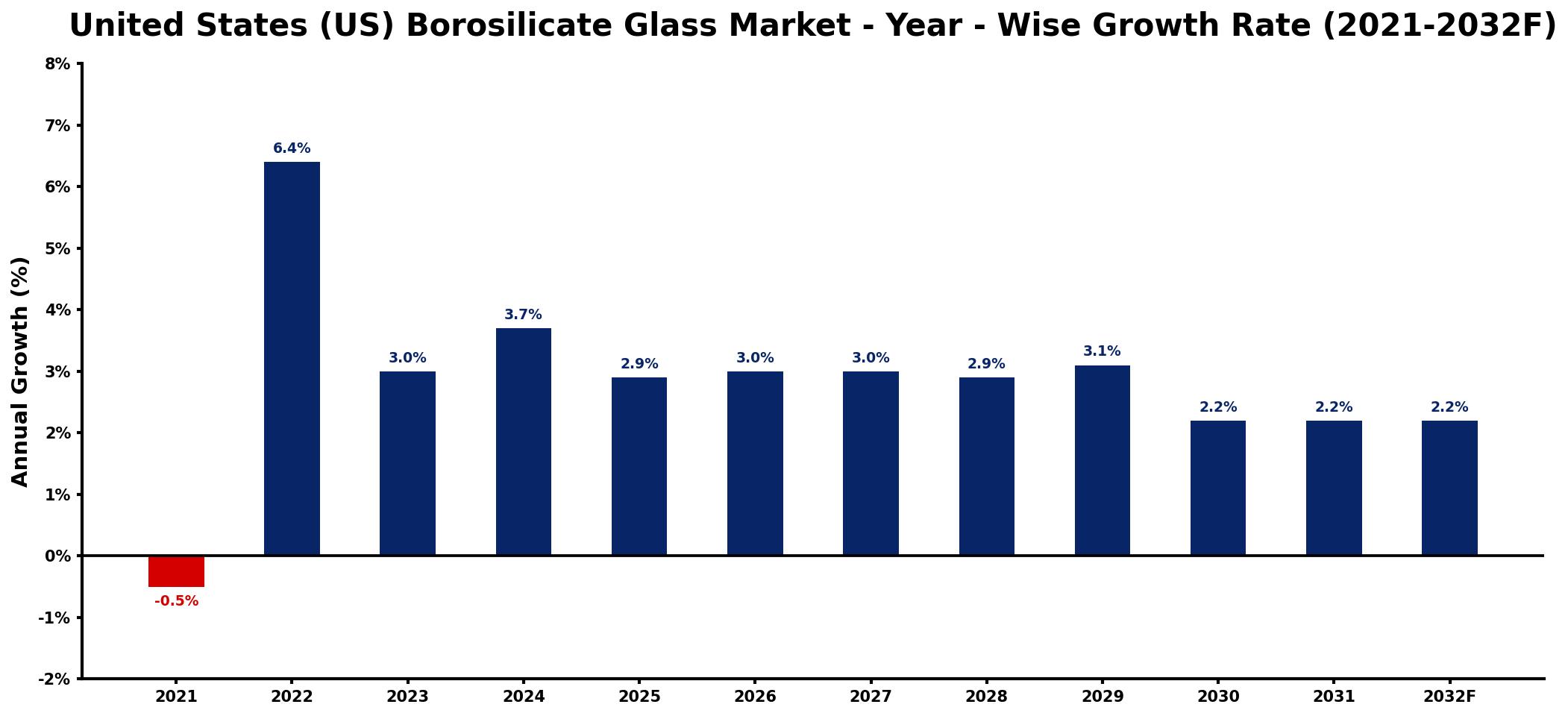
The table below presents the year‑wise growth rates along with the key drivers influencing the market
| Year | Growth Rate | Major Drivers |
| 2021 | -0.5% | decreased investment in manufacturing facilities |
| 2022 | 6.4% | increased demand from pharmaceutical sector |
| 2023 | 3.0% | growing popularity of laboratory equipment |
| 2024 | 3.7% | rising interest in sustainable packaging |
| 2025 | 2.9% | expansion of food service applications |
| 2026 | 3.0% | development of innovative cooking products |
| 2027 | 3.0% | surge in home brewing activities |
| 2028 | 2.9% | increased adoption in electronics industry |
| 2029 | 3.1% | growth in educational laboratory setups |
| 2030 | 2.2% | rising awareness of safety standards |
| 2031 | 2.2% | expansion into emerging markets |
| 2032 | 2.2% | increased focus on research initiatives |
Note: Market size estimations and growth projections presented in this report are based on 6Wresearch's proprietary forecasting methodology, utilizing the latest available industry data, government publications, and primary research inputs.
United States (US) Borosilicate Glass Market Synopsis
The primary force shaping the US Borosilicate Glass Market is the escalating demand from the pharmaceutical and healthcare sectors. Borosilicate glass, known for its ability to withstand high temperatures and resist chemical corrosion, is an ideal material for pharmaceutical packaging, laboratory equipment, and medical devices.
Simultaneously, consumer interest in sustainable products is rising, steering demand towards borosilicate glass as it is recyclable and offers a longer life cycle compared to conventional glass options. This combination of factors not only sustains but also stimulates market growth across diverse applications.
United States (US) Borosilicate Glass Market Key Takeaways
- The market benefits from strong demand in pharmaceuticals, laboratory, and kitchenware applications.
- Consumers are increasingly leaning towards sustainable and eco-friendly glass packaging solutions.
- Innovations in product design are influencing purchasing decisions, particularly in consumer glassware.
- Investment in manufacturing technology is critical for maintaining competitiveness in this growing market.
- Regulatory compliance and environmental considerations will shape market dynamics moving forward.
Evaluation of Restraints in United States (US) Borosilicate Glass Market
Despite the promising growth trajectory, the US Borosilicate Glass Market faces several restraints. Competition from alternative materials like plastic and tempered glass poses a significant challenge due to their lower cost and rising perception as environmentally friendly. Additionally, fluctuations in raw material prices can disrupt production costs for manufacturers. The need for continuous innovation to cater to evolving consumer preferences adds pressure on companies to invest significantly in research and development. Moreover, adhering to strict environmental regulations complicates operational capabilities and can hinder growth if not managed effectively.
United States (US) Borosilicate Glass Market Trends
Current trends in the US Borosilicate Glass Market reflect a shift towards enhanced functionality and aesthetic appeal. There's a marked rise in the use of colored borosilicate glass and customized designs that resonate with consumer preferences. The growing awareness about the importance of sustainable practices is leading manufacturers to prioritize eco-friendly materials in their product lines. Additionally, the upsurge in laboratory automation and sophisticated analysis techniques is driving demand for durable glassware, thus boosting the market.
United States (US) Borosilicate Glass Market Opportunities
Investment opportunities abound in the US Borosilicate Glass Market, particularly in the segments of laboratory glassware, consumer kitchenware, and industrial applications. With a consistent increase in demand for high-performance glass products, companies are well-positioned to capitalize on this trend. The shift towards sustainable production methods opens avenues for innovative technologies that enhance manufacturing efficiency while appealing to eco-conscious consumers. As the demand for premium glassware expands, strategic investments in product development can yield significant competitive advantages.
Government Initiatives in the United States (US) Borosilicate Glass Market
The US government plays a crucial role in shaping the Borosilicate Glass Market through a framework of regulations and initiatives. Environmental policies aimed at reducing the ecological footprint of manufacturing processes are influencing production practices. Trade policies and tariffs on imported glass products also affect market dynamics, encouraging domestic manufacturing. Furthermore, governmental support for research and development in glass technology is fostering innovation, positioning the industry for future advancements.
Future Insights of the United States (US) Borosilicate Glass Market
Looking ahead to 2026-2032, the US Borosilicate Glass Market is expected to maintain its growth momentum, driven by consistent demand across various sectors including pharmaceuticals, chemicals, and household products. The emphasis on eco-friendly packaging solutions will continue to fuel interest in borosilicate glass, thanks to its recyclability and durable properties. Advances in glass manufacturing technologies, alongside a growing focus on quality and safety in consumer products, will further bolster market expansion, paving the way for promising opportunities in the years to come.
United States (US) Borosilicate Glass Market Latest Developments (2025 - 2026)
Recent developments in the US Borosilicate Glass Market indicate a trend towards increased collaboration between manufacturers and research institutions to drive innovation in glass technologies. New product launches focusing on eco-friendly glass solutions have gained traction, responding to consumer demand for sustainable options. Moreover, advancements in manufacturing processes aimed at reducing energy consumption and enhancing material quality are shaping competitive strategies within the market.
United States (US) Borosilicate Glass Market - Key Attractiveness of the Report
- 10 Years of Market Numbers
- Historical Data Starting from 2022 to 2025
- Base Year: 2025
- Forecast Data until 2032
- Key Performance Indicators Impacting the Market
- Major Upcoming Developments and Projects
Key Highlights of the Report:
- United States (US) Borosilicate Glass Market Outlook
- Market Size of United States (US) Borosilicate Glass Market, 2025
- Forecast of United States (US) Borosilicate Glass Market, 2032
- Historical Data and Forecast of United States (US) Borosilicate Glass Revenues & Volume for the Period 2022-2032F
- United States (US) Borosilicate Glass Market Trend Evolution
- United States (US) Borosilicate Glass Market Drivers and Challenges
- United States (US) Borosilicate Glass Price Trends
- United States (US) Borosilicate Glass Porter's Five Forces
- United States (US) Borosilicate Glass Industry Life Cycle
- Historical Data and Forecast of United States (US) Borosilicate Glass Market Revenues & Volume By Type for the Period 2022-2032F
- Historical Data and Forecast of United States (US) Borosilicate Glass Market Revenues & Volume By High Borosilicate Glass for the Period 2022-2032F
- Historical Data and Forecast of United States (US) Borosilicate Glass Market Revenues & Volume By Medium Borosilicate Glass for the Period 2022-2032F
- Historical Data and Forecast of United States (US) Borosilicate Glass Market Revenues & Volume By Application for the Period 2022-2032F
- Historical Data and Forecast of United States (US) Borosilicate Glass Market Revenues & Volume By Solar Energy Tubes for the Period 2022-2032F
- Historical Data and Forecast of United States (US) Borosilicate Glass Market Revenues & Volume By Heat Glassware for the Period 2022-2032F
- Historical Data and Forecast of United States (US) Borosilicate Glass Market Revenues & Volume By Laboratory Glassware for the Period 2022-2032F
- Historical Data and Forecast of United States (US) Borosilicate Glass Market Revenues & Volume By Pharmaceutical Packaging for the Period 2022-2032F
- Historical Data and Forecast of United States (US) Borosilicate Glass Market Revenues & Volume By Chemical Tubes for the Period 2022-2032F
- Historical Data and Forecast of United States (US) Borosilicate Glass Market Revenues & Volume By Others for the Period 2022-2032F
- United States (US) Borosilicate Glass Import Export Trade Statistics
- Market Opportunity Assessment By Type
- Market Opportunity Assessment By Application
- United States (US) Borosilicate Glass Top Companies Market Share
- United States (US) Borosilicate Glass Competitive Benchmarking By Technical and Operational Parameters
- United States (US) Borosilicate Glass Company Profiles
- United States (US) Borosilicate Glass Key Strategic Recommendations






































