United States Copper Alloy Market Year-wise Growth Rate (2021-2031F)
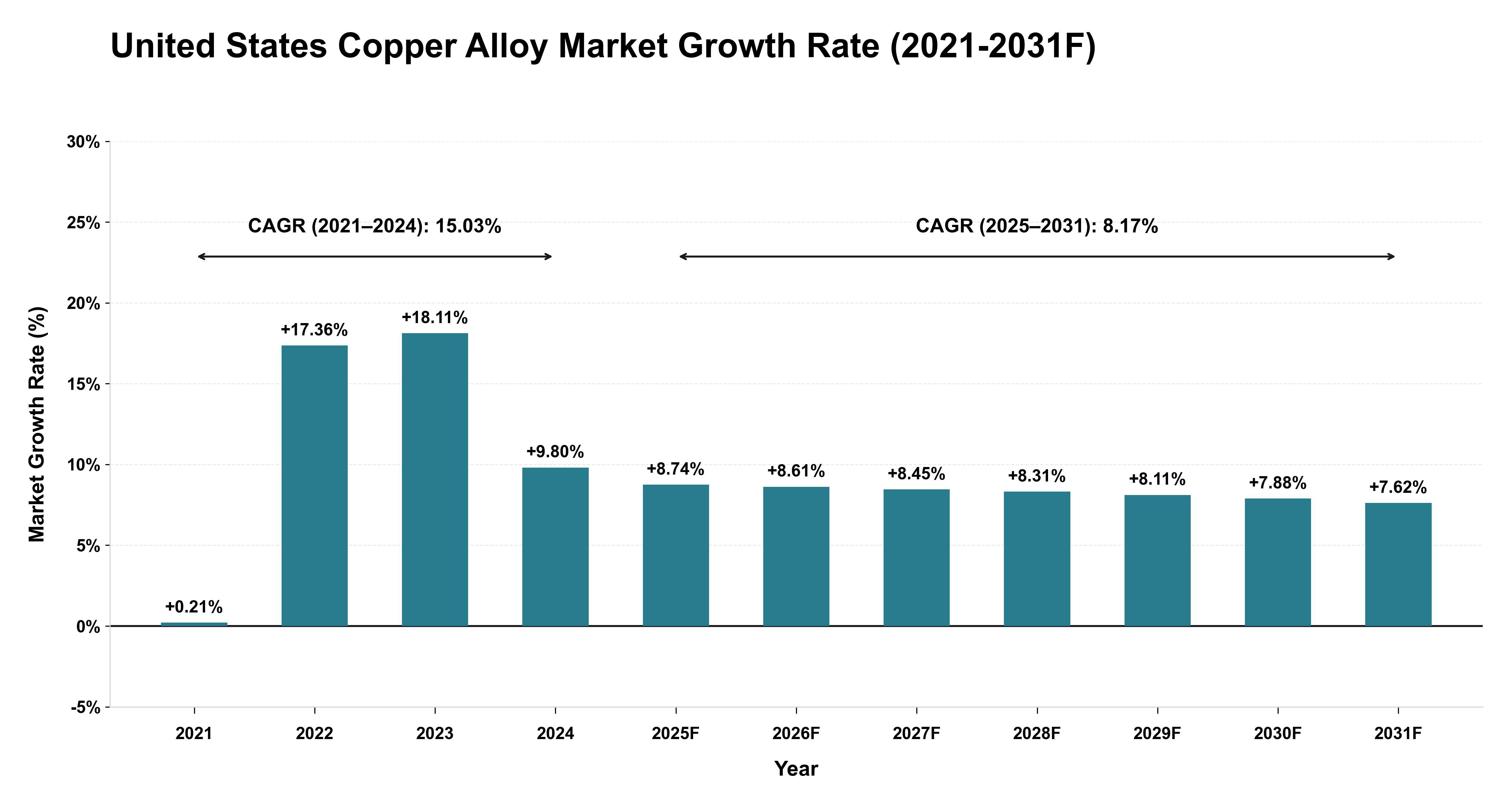
The United States Copper Alloy Market experienced robust growth from 2021 to 2024, with a significant CAGR of 15.03%. This was driven by increasing demand from industries like electronics, construction, and automotive due to their unique properties such as high conductivity and corrosion resistance. The years 2022 and 2023 saw accelerated growth rates of 17.36% and 18.11%, respectively, indicating rising adoption and investment. However, in 2024, the growth rate slightly decelerated to 9.80%, hinting at potential supply chain constraints or market adjustments. Looking ahead to 2025-2031, the market is expected to maintain a positive trajectory with a forecasted CAGR of 8.17%. This slower but steady growth reflects a more mature market phase with stable demand patterns and established applications, suggesting sustained but moderate expansion in the coming years amidst evolving technological advancements and regulatory influences.
United States (US) Copper Alloy Market Overview
The United States Copper Alloy Market is a thriving sector within the metal industry, driven by the increasing demand for copper alloys in various applications such as electrical components, construction materials, and industrial machinery. The market is influenced by factors such as infrastructure development, technological advancements, and the growth of end-user industries like automotive and aerospace. Key players in the US Copper Alloy Market include Mueller Industries Inc., Wieland Copper Products, LLC, and Copper & Brass Sales. The market is characterized by a high level of competition, with companies focusing on product innovation, strategic partnerships, and expanding their distribution networks to gain a competitive edge. With the ongoing emphasis on sustainability and the increasing adoption of copper alloys for their durability and recyclability, the US Copper Alloy Market is poised for steady growth in the coming years.
United States (US) Copper Alloy Market Trends
The current trend in the US Copper Alloy Market is a growing demand for sustainable and high-performance materials in various industries such as construction, electronics, and automotive. As companies and consumers alike place a greater emphasis on environmental consciousness and energy efficiency, copper alloys are gaining popularity due to their durability, corrosion resistance, and recyclability. Additionally, the increasing focus on infrastructure development and technological advancements is driving the demand for copper alloys, particularly in the construction sector for applications like plumbing, electrical wiring, and HVAC systems. With the ongoing shift towards green technologies and sustainable practices, the US Copper Alloy Market is expected to continue experiencing steady growth in the coming years.
United States (US) Copper Alloy Market Challenges
In the US Copper Alloy Market, one of the key challenges faced is the fluctuating prices of copper, which directly impact the overall cost of copper alloy products. This volatility makes it difficult for manufacturers and suppliers to predict and manage their production costs, leading to potential margin pressures. Additionally, competition from alternative materials and substitutes poses a threat to the market share of copper alloys. The need for continuous innovation and development of new copper alloy products to meet changing industry requirements also presents a challenge. Furthermore, environmental regulations and sustainability concerns around the mining and production of copper alloys are increasingly important factors that companies operating in this market need to address to remain competitive.
United States (US) Copper Alloy Market Investment Opportunities
The United States Copper Alloy Market presents several investment opportunities due to increasing demand across various industries such as automotive, construction, electronics, and manufacturing. One opportunity lies in investing in copper alloy producers or manufacturers to capitalize on the growing demand for these materials. Additionally, investing in companies that specialize in recycling copper alloys can be profitable as sustainability and environmental concerns drive the shift towards circular economy practices. Another potential investment avenue is in companies that provide innovative copper alloy products for emerging applications such as renewable energy technologies and electric vehicles. Overall, the US Copper Alloy Market offers diverse investment opportunities that cater to the increasing demand for these materials across a wide range of industries.
United States (US) Copper Alloy Market Government Policy
The United States government has enacted various policies related to the Copper Alloy Market, including regulations on mining, production, and trade. The US Department of the Interior oversees mining activities to ensure environmental protection and resource conservation. Additionally, the Department of Commerce implements trade policies to safeguard domestic producers from unfair competition and promote exports. The government also supports research and development initiatives to enhance the competitiveness of the US copper alloy industry. Overall, policy measures aim to maintain a balance between promoting economic growth in the sector and ensuring sustainable practices for the environment and stakeholders.
United States (US) Copper Alloy Market Future Outlook
The future outlook for the United States Copper Alloy Market appears promising, driven by several factors such as increasing infrastructure development, growth in the automotive and electronics industries, and the expanding renewable energy sector. The demand for copper alloys is expected to rise as they are widely used in various applications due to their superior properties such as conductivity, corrosion resistance, and strength. Additionally, the emphasis on sustainable practices and the shift towards electric vehicles are likely to further boost the demand for copper alloys. However, challenges such as fluctuations in raw material prices and global economic uncertainties could impact the market dynamics. Overall, the US Copper Alloy Market is poised for growth in the coming years, with opportunities for innovation and technological advancements driving market expansion.
Key Highlights of the Report:
- United States (US) Copper Alloy Market Outlook
- Market Size of United States (US) Copper Alloy Market, 2021
- Forecast of United States (US) Copper Alloy Market, 2031
- Historical Data and Forecast of United States (US) Copper Alloy Revenues & Volume for the Period 2018 - 2031
- United States (US) Copper Alloy Market Trend Evolution
- United States (US) Copper Alloy Market Drivers and Challenges
- United States (US) Copper Alloy Price Trends
- United States (US) Copper Alloy Porter's Five Forces
- United States (US) Copper Alloy Industry Life Cycle
- Historical Data and Forecast of United States (US) Copper Alloy Market Revenues & Volume By Type for the Period 2018 - 2031
- Historical Data and Forecast of United States (US) Copper Alloy Market Revenues & Volume By Rods & Wires for the Period 2018 - 2031
- Historical Data and Forecast of United States (US) Copper Alloy Market Revenues & Volume By Plates & Strips for the Period 2018 - 2031
- Historical Data and Forecast of United States (US) Copper Alloy Market Revenues & Volume By Tubes for the Period 2018 - 2031
- Historical Data and Forecast of United States (US) Copper Alloy Market Revenues & Volume By Other for the Period 2018 - 2031
- Historical Data and Forecast of United States (US) Copper Alloy Market Revenues & Volume By Application for the Period 2018 - 2031
- Historical Data and Forecast of United States (US) Copper Alloy Market Revenues & Volume By Electrical Industry for the Period 2018 - 2031
- Historical Data and Forecast of United States (US) Copper Alloy Market Revenues & Volume By Transportation Industry for the Period 2018 - 2031
- Historical Data and Forecast of United States (US) Copper Alloy Market Revenues & Volume By Machinery and Metallurgy Industry for the Period 2018 - 2031
- Historical Data and Forecast of United States (US) Copper Alloy Market Revenues & Volume By Architecture and Art for the Period 2018 - 2031
- Historical Data and Forecast of United States (US) Copper Alloy Market Revenues & Volume By Other for the Period 2018 - 2031
- United States (US) Copper Alloy Import Export Trade Statistics
- Market Opportunity Assessment By Type
- Market Opportunity Assessment By Application
- United States (US) Copper Alloy Top Companies Market Share
- United States (US) Copper Alloy Competitive Benchmarking By Technical and Operational Parameters
- United States (US) Copper Alloy Company Profiles
- United States (US) Copper Alloy Key Strategic Recommendations






































