United States (US) Data Center Market Growth Rate
According to 6Wresearch internal databases and industry insights, the United States (US) Data Center Market is projected to grow at a compound annual growth rate (CAGR) of 7.84% during the forecast period (2026–2032).
United States (US) Data Center Market Year-wise Growth Rate and Key Drivers (2022–2032)
This graph illustrates the annual growth rates of the United States (US) Data Center Market from 2022 to 2032, highlighting a steady upward trajectory and projected market expansion over the forecast period.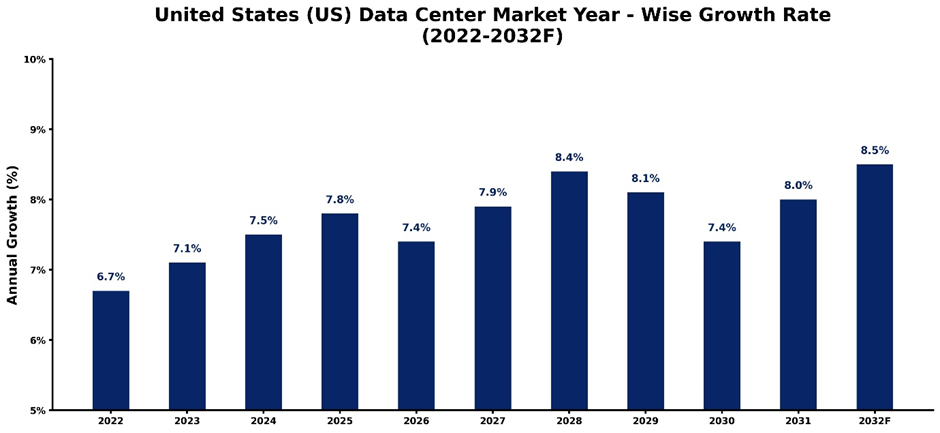
The following table summarizes the historical and forecasted growth rates of the United States (US) Data Center Market, along with the rationale behind each year’s performance.
| Year | Estimated Growth (%) | Market Rationale |
| 2022 | 6.7% | Growth driven by post-pandemic cloud adoption and rising colocation demand. |
| 2023 | 7.1% | Expansion fueled by hyperscale investments, data traffic, and AI infrastructure. |
| 2024 | 7.5% | Growth supported by GPU computing, cloud platforms, and hybrid IT adoption. |
| 2025 | 7.8% | Market boosted by data center projects, AI processing, and renewable integration. |
| 2026 | 7.4% | Growth driven by AI workloads, edge deployment, and cloud facility expansion. |
| 2027 | 7.9% | Expansion supported by hybrid cloud migration and advanced networking demand. |
| 2028 | 8.4% | Rising AI, ML, and high-density computing adoption drives investment. |
| 2029 | 8.1% | Stable growth supported by energy-efficient facilities and optimized operations. |
| 2030 | 7.4% | Expansion driven by digital services, automation, and connectivity needs. |
| 2031 | 8% | Mature market growth supported by infrastructure upgrades and modernization. |
| 2032 | 8.5% | Long-term demand sustained by AI, cloud, and data-intensive industries. |
Topics Covered in the United States (US) Data Center Market Report
The USA Data Center Industry report covers the market by component and by vertical. The report provides a detailed analysis of ongoing market trends, opportunities/high-growth areas, and market drivers that will help stakeholders align strategies based on current and future market dynamics.
United States (US) Data Center Market Highlights
| Report Name | United States (US) Data Center Market |
| Forecast period | 2026-2032 |
| CAGR | 7.84% |
| Growing Sector | Artificial Intelligence-Optimized Data Center Infrastructure |
United States (US) Data Center Market Synopsis
The United States (US) Data Center Market is experiencing significant growth, as a result of high cloud adoption rates, increased data creation by enterprises, AI adoption rates, and the demand for low latency computing. Additionally, the growth of sectors such as e-commerce, financial services, healthcare, telecommunications, and media streaming is generating substantial volumes of data, increasing the requirement for secure and scalable storage and processing facilities. The shift toward hybrid cloud environments and enterprise digital transformation initiatives is encouraging organizations to modernize their IT infrastructure and utilize colocation services.
Evaluation of Growth Drivers in United States (US) Data Center Market (2026–2032)
Below are some major drivers and their influence on market dynamics:
| Drivers | Primary Segment Affected | Why It Matters (Evidence) |
| AI and High-Performance Computing Growth | Data Center Infrastructure Providers | AI applications require high-density computing environments, increasing demand for advanced cooling solutions. |
| Expansion of Cloud Computing Services | Hyperscale Data Centres | Rising adoption of cloud platforms surges demand for large-scale facilities and server capacity expansion. |
| Digital Enterprise Transformation | Enterprise Data Centres | Firms are innovating their IT environments, and investing in hybrid cloud and private infrastructure. |
| Increasing Data Traffic and Connected Devices | Networking Equipment Providers | Increasing IoT, streaming and digital services fuel demand for fast networking infrastructure. |
| Renewable Energy and Sustainability Initiatives | Data Center Operators | Operators are adopting renewable power and energy-efficient technologies to reduce carbon emissions. |
The United States (US) Data Center Market is estimated to grow at a CAGR of 7.84% during the forecast period of 2026-2032, due to rising AI computing needs, expansion of cloud services, and the digital transformation of enterprises. The increased amount of data being generated around the world each year by over 20% is a key driver of this process. Currently, data centres use up to 4-5% of the total electricity production in the United States, which stimulates green energy usage. Organizations cloud usage has surpassed 80%, ensuring further growth in the future.
Evaluation of Restraints in United States (US) Data Center Market
Below are some major restraints and their influence on market dynamics:
| Restraints | Primary Segment Affected | What This Means (Evidence) |
| High Energy Consumption and Power Constraints | Data Center Operators | Surging electricity demands create challenges related to operational costs and power availability. |
| Rising Construction and Equipment Costs | Infrastructure Developers | Advanced cooling requirements and equipment expenses increase project investment requirements. |
| Environmental Regulations | Large Data Center Operators | Sustainability compliance requirements is driving the pressure to adopt renewable energy. |
| Skilled Workforce Shortage | Data Center Operations | Limited availability of trained professionals affects facility management and maintenance capabilities. |
| Supply Chain Challenges | Hardware and Equipment Providers | Semiconductor shortages and equipment delays impacts infrastructure deployment timelines. |
United States (US) Data Center Market Challenges
Challenges restricting the United States (US) data center market growth include rising power consumption, limited availability of suitable infrastructure, stringent environmental regulations, and increasing operational costs.AI workloads are pushing rack power density significantly higher, with advanced AI facilities requiring 30–100+ kW per rack, compared to traditional racks with lower densities. Data centres consume about 4-5% of the US electricity consumption, which creates a high demand for improved energy efficiency, and the use of renewable energy sources. Furthermore, cooling systems are accounted for almost 30-40% of total data center energy consumption, leading to the requirement for innovative thermal management solutions.
United States (US) Data Center Market Trends
Emerging trends shaping the United States (US) Data Center Market include the following:
- Rising Demand for AI-Optimized Data Centres: The growth of AI and ML applications is creating a demand for data centres with GPUs, high-capacity networking, and cooling mechanisms.
- Growing Use of Liquid Cooling Technology: Rising computing needs are compelling operators to deploy liquid cooling systems, owing to their superior heat transfer characteristics.
- Edge Data centres Expansion: Companies are investing in smaller and local data centres to improve speed and performance.
- Increasing Use of Renewable Energy: Firms are shifting to renewable sources of energy, to enhance sustainability and meet corporate environmental targets.
Investment Opportunities in United States (US) Data Center Market
Key areas of investment potential in the United States (US) Data Center Market are mentioned below:
- Development of AI Data Center Infrastructure: Innovation of AI infrastructure facilities is a vast opportunity, due to the growing demand for high performance computing and GPU operations.
- Energy Efficient Cooling Solutions: Demand for energy efficient liquid cooling and immersion cooling solutions will be high for enterprise customers.
- Sustainable Energy: Operators are choosing to invest in sustainable energy solutions for data centres, which will reduce operational costs over the long term.
- Edge Computing Infrastructures: The surging demand for low latency applications is an opportunity for the businesses to deploy distributed data centres.
- Data Center Infrastructure Automation: Opportunity for operational efficiency with AI-enabled monitoring and automation systems.
Top 5 Leading Players in United States (US) Data Center Market
Below is an overview of key companies operating in the United States (US) Data Center Industry:
1. Equinix
| Company Name | Equinix |
|---|---|
| Established Year | 1998 |
| Headquarters | Redwood City, California, USA |
| Official Website | Click Here |
Equinix is one of the largest global data center and colocation service providers, operating an extensive network of interconnected facilities across major U.S. markets.
2. Digital Realty
| Company Name | Digital Realty |
|---|---|
| Established Year | 2001 |
| Headquarters | Austin, Texas, USA |
| Official Website | Click Here |
Digital Realty is a leading data center infrastructure provider specializing in carrier-neutral facilities, hyperscale deployments, and enterprise digital infrastructure solutions.
3. Microsoft
| Company Name | Microsoft |
|---|---|
| Established Year | 1975 |
| Headquarters | Redmond, Washington, USA |
| Official Website | Click Here |
Microsoft operates a large network of hyperscale data centres across the US to support its cloud computing platform, artificial intelligence services, enterprise applications, and digital solutions.
4. Amazon Web Services
| Company Name | Amazon Web Services |
|---|---|
| Established Year | 2006 |
| Headquarters | Seattle, Washington, USA |
| Official Website | Click Here |
Amazon Web Services (AWS) is one of the largest cloud infrastructure providers globally and operates multiple data center regions across the United States.
5. Google
| Company Name | |
|---|---|
| Established Year | 1998 |
| Headquarters | Mountain View, California, USA |
| Official Website | Click Here |
Google operates advanced data center facilities supporting Google Cloud services, artificial intelligence applications, search infrastructure, and enterprise workloads.
Government Initiatives Being Implemented in the United States (US) Data Center Market
The US government is currently promoting the development of digital infrastructure by means of various programs addressing cybersecurity, artificial intelligence, energy efficiency, and growth in domestic technological capabilities. The programs of the government, like the CHIPS and Science Act, promote manufacturing of semiconductors and the technology ecosystems, indirectly assisting in data center hardware supply chain management. Also, government agencies are promoting adoption of cloud infrastructure by means of programs like FedRAMP (Federal Risk and Authorization Management Program), that set security standards for cloud service providers for federal organizations.
Future Insights of the United States (US) Data Center Market
The United States (US) Data Center Market is projected to experience steady growth, owing to AI, cloud computing, and digitalization of enterprises. The AI-related workloads have been accumulating to the infrastructure needs for data centres, with supercomputing centres having racks with power density levels surpassing 50 kW per rack. Sustainability will continue to be an important consideration, since the current power consumption by the data centres is about 4–5% of U.S. energy demand. Furthermore, the rise in edge computing will drive local infrastructure build-up, especially considering the global connectivity of IoT devices, which will cross 30 billion by 2030.
Market Segmentation Analysis
This report presents a detailed analysis of the market segments along with their leading categories:
By Component – Electrical Systems Dominate Market
According to Ravi Bhandari, Research Head, 6Wresearch, the Electrical Systems segment held the largest share in the United States (US) Data Center Market in 2025, occupying around 34.6% of the market share in terms of total revenue. The segment is projected to expand at a CAGR of 8.12% during 2026–2032, driven by increasing data center capacity additions and rising power requirements from AI workloads.
By Vertical – IT & Telecom Sector Leads
The IT & Telecom sector held the largest share in the United States (US) Data Center Market in 2025, accounting for around 38.7% of the total market revenue. The segment leadership is supported by the constant growth of cloud platforms, telecom networks, internet services and digital applications that require large scale computing infrastructure. This segment is expected to register a CAGR of 7.65% during 2026–2032, supported by rising cloud adoption, increasing data traffic, and growing demand for high-performance computing capabilities.
Note: Market size estimations and growth projections presented in this report are based on 6Wresearch's proprietary forecasting methodology, utilizing the latest available industry data, government publications, and primary research inputs.
Key Attractiveness of the Report
- 10 Years of Market Numbers
- Historical Data Starting from 2022 to 2025
- Base Year: 2025
- Forecast Data until 2032
- Key Performance Indicators Impacting the Market
- Major Upcoming Developments and Projects
Key Highlights of the Report:
- United States (US) Data Center Market Outlook
- Market Size of United States (US) Data Center Market, 2025
- Forecast of United States (US) Data Center Market, 2032
- Historical Data and Forecast of United States (US) Data Center Revenues & Volume for the Period 2022-2032F
- United States (US) Data Center Market Trend Evolution
- United States (US) Data Center Market Drivers and Challenges
- United States (US) Data Center Price Trends
- United States (US) Data Center Porter's Five Forces
- United States (US) Data Center Industry Life Cycle
- Historical Data and Forecast of United States (US) Data Center Market Revenues & Volume By Component for the Period 2022-2032F
- Historical Data and Forecast of United States (US) Data Center Market Revenues & Volume By Electrical for the Period 2022-2032F
- Historical Data and Forecast of United States (US) Data Center Market Revenues & Volume By Mechanical for the Period 2022-2032F
- Historical Data and Forecast of United States (US) Data Center Market Revenues & Volume By Networking for the Period 2022-2032F
- Historical Data and Forecast of United States (US) Data Center Market Revenues & Volume By Racks for the Period 2022-2032F
- Historical Data and Forecast of United States (US) Data Center Market Revenues & Volume By Security Systems for the Period 2022-2032F
- Historical Data and Forecast of United States (US) Data Center Market Revenues & Volume By Fire Systems for the Period 2022-2032F
- Historical Data and Forecast of United States (US) Data Center Market Revenues & Volume By Vertical for the Period 2022-2032F
- Historical Data and Forecast of United States (US) Data Center Market Revenues & Volume By Banking Financial Services & Insurance (BFSI) for the Period 2022-2032F
- Historical Data and Forecast of United States (US) Data Center Market Revenues & Volume By Government for the Period 2022-2032F
- Historical Data and Forecast of United States (US) Data Center Market Revenues & Volume By IT & Telecom for the Period 2022-2032F
- Historical Data and Forecast of United States (US) Data Center Market Revenues & Volume By Media for the Period 2022-2032F
- Historical Data and Forecast of United States (US) Data Center Market Revenues & Volume By Retail for the Period 2022-2032F
- Historical Data and Forecast of United States (US) Data Center Market Revenues & Volume By Manufacturing for the Period 2022-2032F
- Historical Data and Forecast of United States (US) Data Center Market Revenues & Volume By Others for the Period 2022-2032F
- United States (US) Data Center Import Export Trade Statistics
- Market Opportunity Assessment By Component
- Market Opportunity Assessment By Vertical
- United States (US) Data Center Top Companies Market Share
- United States (US) Data Center Competitive Benchmarking By Technical and Operational Parameters
- United States (US) Data Center Company Profiles
- United States (US) Data Center Key Strategic Recommendations
Market Covered
The report offers an extensive study of the following market segments:
By Component
- Electrical Systems
- Mechanical Systems
- Networking Equipment
- Racks
- Security Systems
- Fire Systems
By Vertical
- Banking Financial Services & Insurance (BFSI)
- Government
- IT & Telecom
- Media
- Retail
- Manufacturing
- Others






































