United States (US) Drill Pipe Market Top 5 Importing Countries and Market Competition (HHI) Analysis
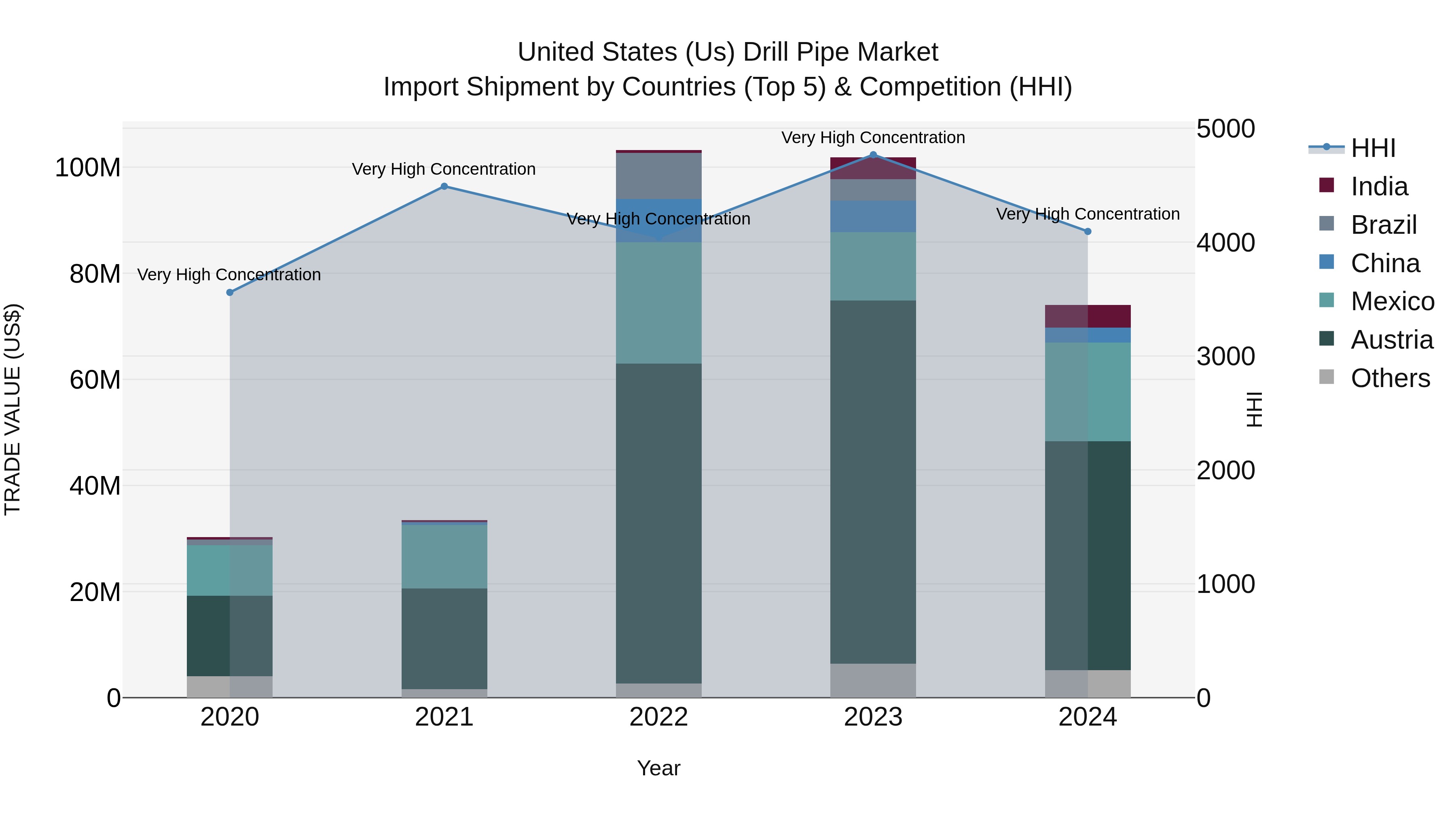
In 2024, the United States saw significant drill pipe import shipments from top exporting countries including Austria, Mexico, India, China, and Thailand. The market remained highly concentrated with a high Herfindahl-Hirschman Index (HHI). Despite a notable compound annual growth rate (CAGR) of 25.06% from 2020 to 2024, there was a sharp decline in growth rate from 2023 to 2024 at -27.36%. This dynamic landscape suggests evolving trends in the drill pipe import market, signaling potential shifts in trade dynamics and market conditions.
USA Export Potential Assessment For Drill Pipe Market (Values in USD Thousand)
United States (US) Drill Pipe Market Synopsis
The United States Drill Pipe Market is a significant segment within the oil and gas industry, driven by the country`s extensive drilling activities for petroleum exploration and production. The market is characterized by a high demand for durable and high-quality drill pipes that can withstand harsh drilling conditions. Key players in the US drill pipe market include manufacturers such as National Oilwell Varco, Tenaris, and Vallourec. The market is influenced by factors such as fluctuating oil prices, technological advancements in drilling equipment, and regulations governing the oil and gas sector. With the increasing focus on shale gas exploration and production, the US drill pipe market is expected to witness steady growth in the coming years, supported by ongoing investments in drilling operations and infrastructure development.
United States (US) Drill Pipe Market Trends
The current trends in the US Drill Pipe Market include a growing demand for advanced drill pipe technologies to enhance drilling efficiency and performance. This includes the adoption of high-strength and corrosion-resistant materials in drill pipe manufacturing to withstand harsh drilling conditions. Companies are also focusing on developing lightweight drill pipe designs to reduce overall drilling costs and increase operational efficiency. Additionally, there is an increasing emphasis on the integration of digital technologies such as IoT and automation to monitor and optimize drilling operations in real-time. The market is also witnessing a rise in the adoption of environmentally-friendly practices and sustainable drilling solutions to align with regulatory requirements and industry standards. Overall, the US Drill Pipe Market is evolving towards more innovative and sustainable practices to meet the growing demands of the oil and gas industry.
United States (US) Drill Pipe Market Challenges
In the US drill pipe market, challenges include fluctuations in oil prices impacting drilling activity levels, which directly influence the demand for drill pipes. Additionally, the market faces competition from alternative drilling technologies like horizontal drilling and hydraulic fracturing, which can reduce the need for traditional drill pipe equipment. Environmental regulations and concerns also pose challenges, as stricter regulations can increase operational costs for drill pipe manufacturers and operators. Moreover, the market is influenced by geopolitical factors and trade policies, which can impact the supply chain and pricing dynamics. Overall, the US drill pipe market must navigate these challenges by focusing on innovation, cost-efficiency, and sustainability to remain competitive and adapt to changing market conditions.
United States (US) Drill Pipe Market Investment Opportunities
The United States drill pipe market presents several investment opportunities, driven by the growth in the oil and gas industry. With increasing exploration and production activities, there is a rising demand for drill pipe to support drilling operations. Investing in companies that manufacture or supply drill pipe can be lucrative, especially those focusing on technological advancements to enhance drilling efficiency and durability. Additionally, with the emphasis on cost-effective and environmentally sustainable practices in the industry, there is potential for investment in companies developing eco-friendly drill pipe materials or recycling solutions. Overall, the US drill pipe market offers opportunities for investors to capitalize on the growth of the oil and gas sector and innovations in drilling technologies.
Jordan Agar Market Government Policies
Government policies related to the US Drill Pipe Market are primarily governed by regulations from agencies such as the Occupational Safety and Health Administration (OSHA) and the Department of Energy (DOE). These regulations focus on ensuring workplace safety, environmental protection, and adherence to industry standards for drilling operations. Additionally, trade policies and tariffs imposed by the US government can also impact the import and export of drill pipe products, influencing market dynamics and pricing. The government`s energy policies and initiatives, such as promoting domestic energy production and reducing reliance on foreign imports, can also play a significant role in shaping the demand for drill pipe in the US market. Overall, government policies in the US Drill Pipe Market aim to balance industry growth while maintaining safety and environmental standards.
United States (US) Drill Pipe Market Future Outlook
The future outlook for the United States Drill Pipe Market appears promising, driven by ongoing investments in oil and gas exploration and production activities. With the increasing demand for energy and the development of unconventional resources, such as shale gas and tight oil, the market is expected to witness steady growth. Technological advancements in drilling techniques, coupled with the adoption of high-performance drill pipes, are likely to enhance efficiency and productivity in the sector. However, factors such as fluctuating oil prices, environmental concerns, and regulatory challenges could pose risks to market expansion. Overall, the US Drill Pipe Market is anticipated to experience moderate growth in the coming years, supported by the country`s robust energy industry and favorable market conditions.
Key Highlights of the Report:
- United States (US) Drill Pipe Market Outlook
- Market Size of United States (US) Drill Pipe Market, 2021
- Forecast of United States (US) Drill Pipe Market, 2031
- Historical Data and Forecast of United States (US) Drill Pipe Revenues & Volume for the Period 2018 - 2031
- United States (US) Drill Pipe Market Trend Evolution
- United States (US) Drill Pipe Market Drivers and Challenges
- United States (US) Drill Pipe Price Trends
- United States (US) Drill Pipe Porter's Five Forces
- United States (US) Drill Pipe Industry Life Cycle
- Historical Data and Forecast of United States (US) Drill Pipe Market Revenues & Volume By Type for the Period 2018 - 2031
- Historical Data and Forecast of United States (US) Drill Pipe Market Revenues & Volume By Standard Drill Pipe for the Period 2018 - 2031
- Historical Data and Forecast of United States (US) Drill Pipe Market Revenues & Volume By Heavy Weight Drill Pipe for the Period 2018 - 2031
- Historical Data and Forecast of United States (US) Drill Pipe Market Revenues & Volume By Drill Collar for the Period 2018 - 2031
- Historical Data and Forecast of United States (US) Drill Pipe Market Revenues & Volume By Deployment for the Period 2018 - 2031
- Historical Data and Forecast of United States (US) Drill Pipe Market Revenues & Volume By Onshore for the Period 2018 - 2031
- Historical Data and Forecast of United States (US) Drill Pipe Market Revenues & Volume By Offshore for the Period 2018 - 2031
- United States (US) Drill Pipe Import Export Trade Statistics
- Market Opportunity Assessment By Type
- Market Opportunity Assessment By Deployment
- United States (US) Drill Pipe Top Companies Market Share
- United States (US) Drill Pipe Competitive Benchmarking By Technical and Operational Parameters
- United States (US) Drill Pipe Company Profiles
- United States (US) Drill Pipe Key Strategic Recommendations






































